
Best Kitchen Organizer Ideas to Keep Your Kitchen Clutter-Free
Radhika couldn't find her measuring cups. They were behind a forgotten rajma container in the wrong cabinet. So we spent a Saturday reorganizing her entire kitchen. Here's the play-by-play.
Best Kitchen Organizer Ideas to Keep Your Kitchen Clutter-Free
Radhika called me on a Friday night sounding defeated. "I can't find the measuring cups. They're somewhere in the kitchen. I've opened every cabinet. I've looked behind the mixer. I moved the atta dabba. They're GONE."
They weren't gone. They were behind the backup bottle of cooking oil on the second shelf of her upper cabinet, wedged next to a container of rajma she'd forgotten she'd bought.
Radhika has a 7-by-8-foot kitchen. I helped her plan it - tall units, wall storage, magnetic strips, the whole thing. It was beautifully organized on Day 1. But kitchens don't stay organized by default. They have this natural gravitational pull toward chaos. Things get shoved in "for now." New items arrive without old items leaving. Surfaces that were cleared in January are covered by March. The entropy of daily Indian cooking is relentless.
So I went over on Saturday morning. Two cups of chai first - priorities - and then we did a full kitchen reorganization that took about four hours. What I'm going to share isn't a list of organizer products. It's what we actually DID, step by step, and what Radhika's kitchen taught me about why kitchens get cluttered in the first place.
Hour One: The Counter Audit (Where We Found the Real Problem)
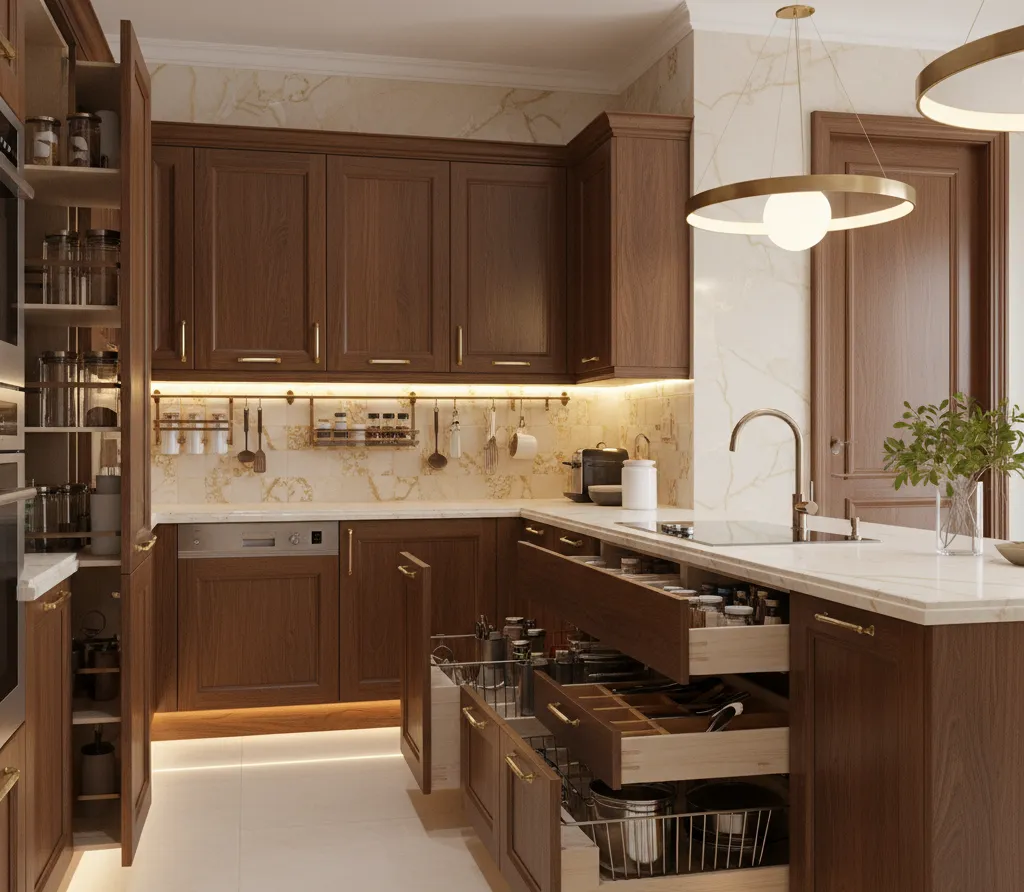
I asked Radhika to stand at her kitchen entrance and tell me everything she could see on the counter. She listed: mixer grinder, toaster, microwave (on the wall shelf, not counter - good), the chai pot, a spoon rest, the masala dabba, three jars of different sizes, a cutting board, a steel tumbler with cooking spoons, a phone charger cable, two bananas, a half-empty pack of bread, and a box of biscuits her daughter had left there three days ago.
Thirteen items. On a counter that's about 6 feet of usable length. Roughly two items per linear foot. No wonder she felt cramped.
We played a game. I asked her to touch each item and tell me: "Do I use this EVERY DAY or not?" Not every week. Not sometimes. Every single day.
The mixer? "Maybe three times a week." Off the counter. Into the base cabinet pull-out shelf that we'd specifically installed for it. She'd been leaving it on the counter because pulling it out felt like "extra work." But the extra work is three seconds. The counter space it was stealing was permanent.
The toaster? "Weekend mornings only." Into the cabinet. She resisted. "But I'll forget I have it." She won't. It's been in the cabinet for two months since our session. She hasn't forgotten once.
The bread and bananas? "They don't have a place." We designated a small wooden tray - ₹180 from the local market - as the "counter food zone." Bread and fruit go ON the tray. Nothing else. The tray creates a boundary. Without it, food items spread across the counter like an invasive species. With it, they stay contained in their 10-inch-by-8-inch territory.
The three jars? One had sugar she uses in chai. Stays. One had some random trail mix her husband bought two months ago and nobody ate. Goes into the upper cabinet. The third was empty. EMPTY. Just sitting there because nobody had picked it up and put it away. Into the sink for washing.
The phone charger cable? "My husband charges his phone from the kitchen outlet." This is apparently a universal phenomenon in Indian households. I've encountered it in my brother's kitchen too. We installed a small adhesive hook on the wall below the outlet. Cable hangs from the hook when not in use instead of lying across the counter like a snake.
After the counter audit, Radhika had five items remaining: masala dabba, cutting board, chai pot, spoon tumbler, and the sugar jar. Plus the fruit tray. Her 6-foot counter went from thirteen items to six. The empty space was physically startling. She stared at it like she'd discovered extra square footage in her apartment.
Hour Two: The Cabinet Purge (Where Guilt Lives)
This was the hard part. Not physically - emotionally.
We opened every cabinet. Every drawer. And we asked one question about each item: "Have you used this in the last six months?"
The answer was "no" for more things than Radhika was comfortable admitting. A sandwich maker she got as a wedding gift in 2022. Used twice. Taking up half a shelf. A set of six ceramic serving bowls - pretty, expensive, never used because "they're for special occasions" that never come. An idli maker her mother gave her that she's used exactly once because she prefers buying idlis from the shop down the road.
Here's the thing about Indian kitchens and guilt. We can't throw things away. Especially gifts. The sandwich maker was from her cousin. The bowls were from her college friend. Getting rid of them feels like rejecting the person. So they stay in the cabinet, taking up space, making it harder to find the things you actually use.
We didn't throw anything away. I'm not a monster. We packed the rarely-used items into a cardboard box labelled "KITCHEN - RARELY USED" and moved them to the top shelf of her bedroom cupboard. If she needs the sandwich maker for some reason, it's accessible. But it's no longer occupying prime kitchen real estate that her daily-use pressure cookers need.
The ceramic bowls she actually decided to start using. "If they're too nice for daily use, when will I use them?" she said. She replaced her stainless steel serving bowls with the ceramic ones. Now they come out at every dinner. The steel bowls went into the box. Net space savings: zero. But emotional satisfaction: significant.
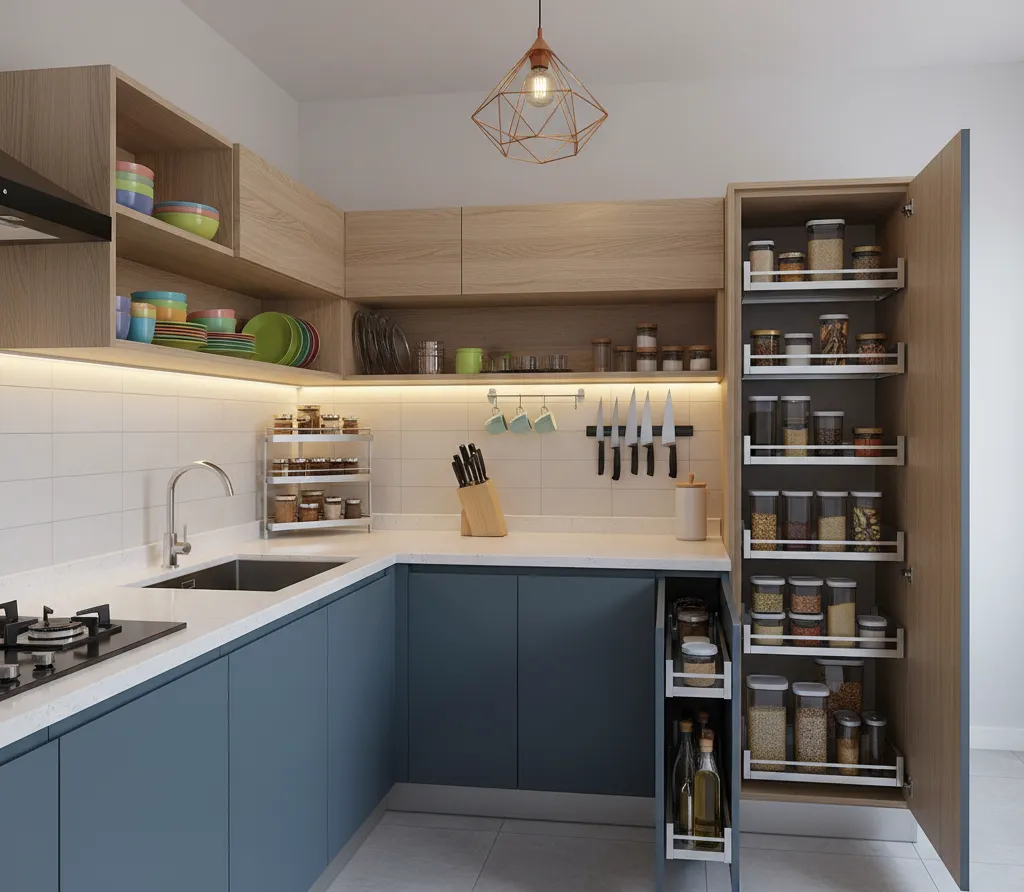
Hour Three: The Grouping Exercise (Where Order Comes From)
After clearing out the rarely-used items, we reorganized what remained. And this is where most "organization tips" blogs miss the point entirely. They tell you to buy organizer products. Buy a tray. Buy a rack. Buy a lazy Susan.
Products help. But the principle that makes a kitchen stay organized isn't a product - it's GROUPING. Keeping items together by when and how you use them. Not by what they are.
Traditional organization: all plates together, all bowls together, all spices together, all vessels together. Logical by category.
Better organization: everything for CHAI together. Chai pot, cups, sugar jar, tea leaves, strainer, the small saucepan she heats milk in. All in one cabinet. One door opens, everything she needs for chai is right there. She doesn't walk to three different cabinets to make one cup of tea.
We did this for three cooking "workflows" in Radhika's kitchen.
Chai station: one upper cabinet near the stove. Cups, tea, sugar, strainer, the small milk pan. Everything for chai in one spot.
Roti station: one section of the counter near the tall unit. Chakla and belan hanging from wall hooks. Atta in the tall unit pull-out directly below. Ghee in the adjacent masala drawer. She stands in one spot and makes rotis without walking anywhere.
Daily cooking zone: the masala dabba on the counter. The oil bottle in the bottle pull-out next to the stove. The most-used kadai in the nearest base cabinet drawer. The pressure cooker in the tall unit's bottom pull-out - two steps from the stove. Frequently used spoon and karchi in the steel tumbler right next to the hob.
Each workflow has its items within arm's reach of where the task happens. No crossing the kitchen for the oil. No opening three cabinets for chai ingredients. No bending to the far corner for the pressure cooker.
This grouping took about forty minutes. We moved maybe fifteen items from their old "category" homes to their new "workflow" homes. Radhika's initial reaction: "This feels wrong. The cups should be with the cups." After cooking two meals with the new layout, she texted me: "I'm not going back."
Hour Four: The Maintenance System (Where Most People Fail)
Organization isn't a Saturday project. It's a daily habit. Every kitchen I've organized - my own, Radhika's, my brother's, my chachi's - starts reverting to chaos within two weeks if there's no system to maintain it.
The system Radhika and I agreed on has three rules. That's it. Three rules.
One: after cooking, everything goes back to its workflow zone before leaving the kitchen. Not "later." Not "after the show." Before you walk out. The masala dabba goes back to its spot. The oil goes back in the pull-out. The pressure cooker goes back in the tall unit. Takes ninety seconds. She times it now because I told her it takes ninety seconds and she didn't believe me.
Two: one item in, one item out. If a new gadget or container enters the kitchen, something existing has to leave. When her husband bought a new insulated water bottle last month, an old scratched one went into the donate bag. The kitchen's total item count stays roughly constant instead of growing indefinitely.
Three: ten-minute reset every Sunday. Open each cabinet, scan for items that migrated from their workflow zone during the week, move them back. Check the counter for creeping clutter. Relocate anything that doesn't belong. Ten minutes. She does it while her chai is brewing on Sunday morning. It prevents the slow accumulation that eventually leads to "I can't find the measuring cups" panic calls on Friday nights.
What Radhika's Kitchen Looks Like Now
Two months after our Saturday session. I visited last week.
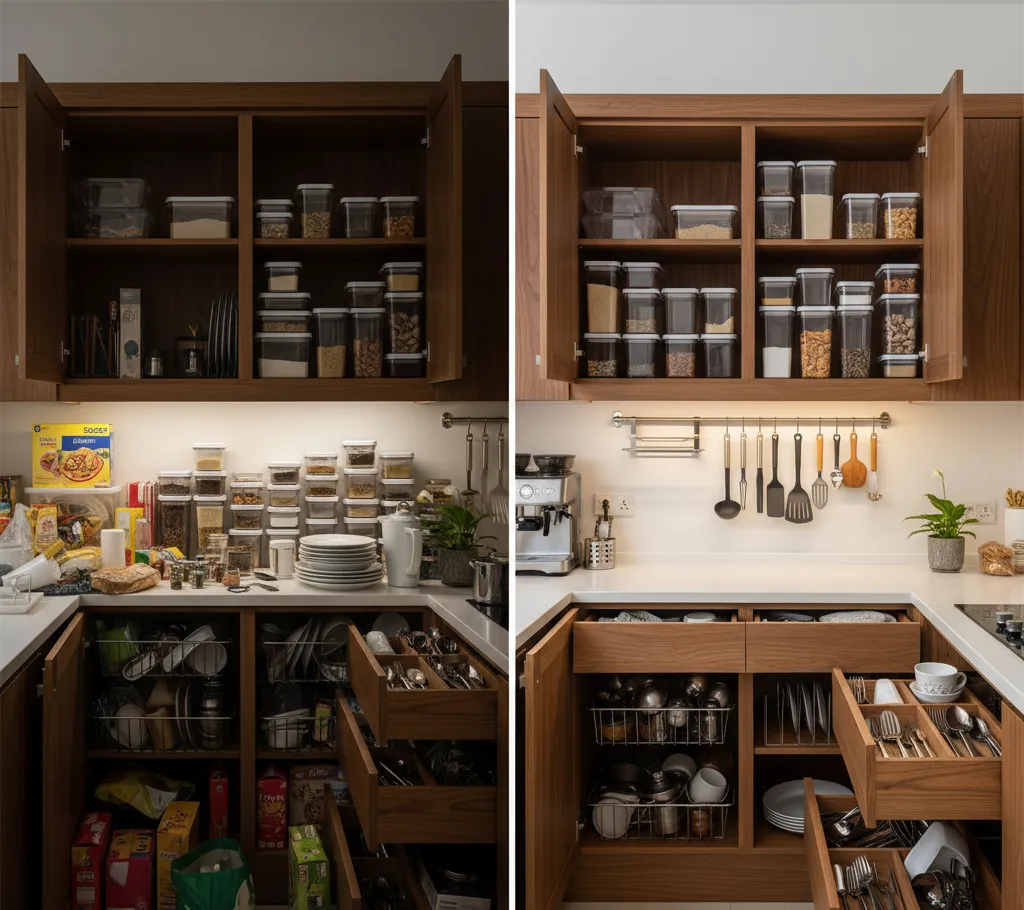
Counter: six items. Same six as the day we organized. The fruit tray had a mango and two apples. The chai pot was in its spot. The counter surface was visible. Actually visible. Not buried under appliances and mystery items.
Cabinets: workflow-organized. She opened the chai cabinet and made tea without moving from one spot. She opened the daily cooking drawer and the kadai was right there. The measuring cups - the ones that started this whole thing - live in the masala drawer now, next to the measuring spoons. She hasn't lost them since.
The "RARELY USED" box in the bedroom? Still sealed. She hasn't needed a single item from it in two months. She's starting to consider donating the contents. "If I haven't opened the box in three months, do I really need what's inside?" Probably not.
Her kitchen isn't bigger. It's 7 by 8 feet. Same walls. Same cabinets. Same countertop. But it feels bigger because you can SEE the surfaces. You can FIND the things. You can COOK without moving six items to make room for a cutting board.
Organization isn't about buying products. It's about removing what you don't use, grouping what you keep by how you cook, and spending ninety seconds after every meal putting things back.
That's it. No fancy organizers. No ₹5,000 cabinet inserts. Just decisions and discipline.
Although the ₹180 fruit tray didn't hurt.
Want more kitchen organization that's based on how Indian families actually cook? KitchenKaki - we don't sell organizers. We rearrange what you already have.
