
Best Material for Modular Kitchen Cabinets in India (2026)
I didn't know what BWR plywood meant until my uncle's kitchen got eaten by termites. I didn't know what HDHMR was until my bhabhi's designer said it and I made him repeat it twice. Here's everything I've learned from watching four kitchens age.
Best Material for Modular Kitchen Cabinets in India
I didn't know what BWR plywood meant until my uncle's kitchen got eaten by termites in 2023. I didn't know what HDHMR stood for until my bhabhi's designer said it out loud and I made him repeat it twice because I thought he was inventing acronyms. I definitely didn't know what particle board was until I saw what was left of my cousin's kitchen cabinets after three years of Jaipur's monsoon humidity turned them into something that resembled wet cardboard with laminate still clinging to the surface like a bad relationship.
Most people shopping for a modular kitchen don't know what their cabinets are made of. They pick a colour. They pick a layout. They haggle on the total price. And somewhere in that process, the kitchen company decides what goes INSIDE the pretty laminate face - the actual board that holds your pressure cookers, your masala jars, and your mother-in-law's 25 steel dabbas. You don't ask. They don't volunteer. And two or three years later, when something swells or sags or crumbles, you finally learn the word "carcass material" and wish you'd learned it sooner.
Let me tell you what I know now, after watching four family kitchens age in real time and one of them die.
The Cousin's Kitchen That Turned to Mush
My cousin Rohit got a modular kitchen installed in his Mansarovar flat in 2020. Small operation did it. Quoted ₹1.4 lakh for an L-shape. Good price. Rohit was happy. His wife Megha picked a nice walnut-finish laminate. Everything looked great for about a year.
Second monsoon, Megha noticed the base cabinet near the sink was swelling at the bottom. Just a slight puffiness. She ignored it. By the third monsoon, the swelling was visible - the cabinet base had expanded maybe half an inch. The laminate was starting to bubble at the edges. There was a faint smell when you opened the cabinet. Not mould exactly. More like wet wood that's been trapped in a closed space.
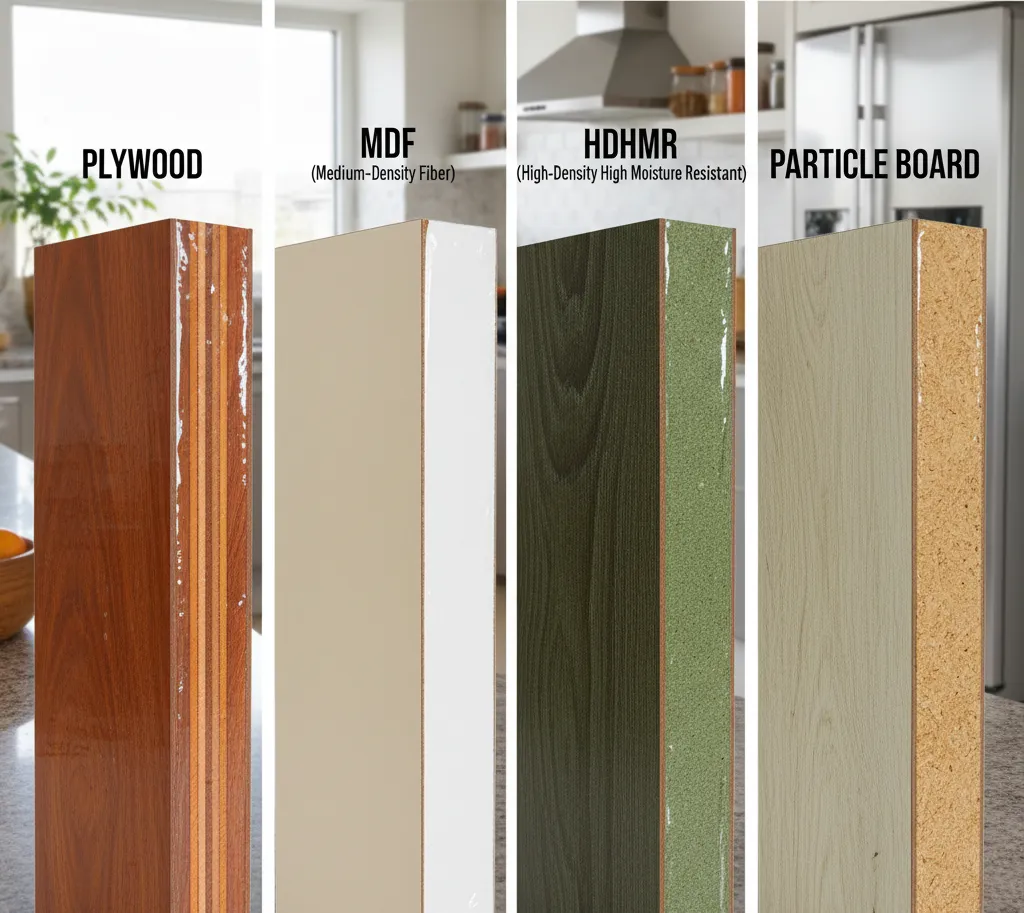
I came over and pulled off the kick plate. The bottom panel of the base cabinet - the part sitting closest to the floor - was particle board. I could tell because the edge was visible where the laminate had peeled away, and instead of wood layers (like plywood) or dense compressed fibre (like HDHMR), it was a crumbly mixture of wood chips and sawdust held together with resin that had clearly given up.
Particle board. The cheapest cabinet material on the market. About ₹25-35 per square foot. Kitchen companies use it when they're quoting aggressive prices and need to cut costs somewhere invisible. And it IS invisible - until water finds it. Once moisture gets into particle board, the wood chips swell, the resin bond weakens, and the whole thing turns soft. In a Jaipur kitchen where the sink area gets splashed daily and monsoon humidity hangs around for two months - particle board under the sink is basically a countdown timer.
Rohit's quotation - I asked to see it - said "pre-laminated board" under materials. Not "particle board." Not "MDF." Just "pre-laminated board." Which technically isn't a lie but is deliberately vague enough to hide what's actually inside. Pre-laminated board COULD be particle board, MDF, or HDHMR - the laminate is just the pretty face. What matters is the core. And Rohit's core was the cheapest option available.
The cabinet company replaced the swollen panels for ₹4,500. Used the same particle board. Rohit didn't know to ask for something better. Megha called me six months ago - the new panels are starting to swell too. Same spot. Same problem. She's furious. He's embarrassed. I'm frustrated because ₹4,500 would've covered an upgrade to BWR plywood for just the base cabinets during the original installation and this cycle would never have started.
What My Mummy's 16-Year-Old Kitchen Is Made Of
My parents' original kitchen - the carpenter one from 1998 - was solid wood and regular commercial plywood. It lasted 22 years, though by the end it was held together mostly by stubbornness and newspaper wedged into cockroach gaps.
Their new modular kitchen, installed in 2020, uses BWR plywood. Full BWR for every cabinet - base units, wall units, the tall pantry column. My dad insisted on it because - and this is the one decision I give him credit for approximately once a month - he'd read somewhere that BWR stands for Boiling Water Resistant and that it's treated with phenol formaldehyde resin which makes it resistant to both moisture AND termites.
He didn't understand the chemistry. He just liked the idea of boiling water resistance because, in his mind, if it can survive boiling water it can survive anything a kitchen throws at it. This is not technically accurate - BWR plywood isn't invincible - but the spirit of his reasoning was correct.
Six years later. Same kitchen. Every cabinet is structurally sound. The base cabinet near the sink - the exact location that killed Rohit's particle board in two monsoons - is perfectly fine. No swelling. No bubbling. No smell. The plywood edges are sealed with proper edge banding, which my mummy's kitchen company did correctly (unlike Rohit's, where the edge banding on the base cabinets was sloppy - I could see gaps where moisture was creeping in).
BWR plywood runs about ₹75-90 per square foot at the factory level. For my parents' U-shaped kitchen, the total plywood cost was significantly higher than what Rohit paid - but the kitchen also hasn't needed a single repair in six years. Not one. The under-sink area that I obsessively check every few months - because I'm now permanently traumatised by cabinet base failures - is dry, solid, and exactly as it was the day it was installed.
The termite thing matters too. We live in Malviya Nagar. Same house where termites ate the bookshelf, the shoe rack, and the window frames over the years. The kitchen? Untouched. Because BWR plywood's chemical treatment makes it unappetising to termites. Not impossible for them to attack - but dramatically less likely. Mummy also sprays anti-termite solution behind the cabinets every June, which helps. But the base protection starts with the material itself.
The HDHMR Plot Twist in Bhabhi's Kitchen
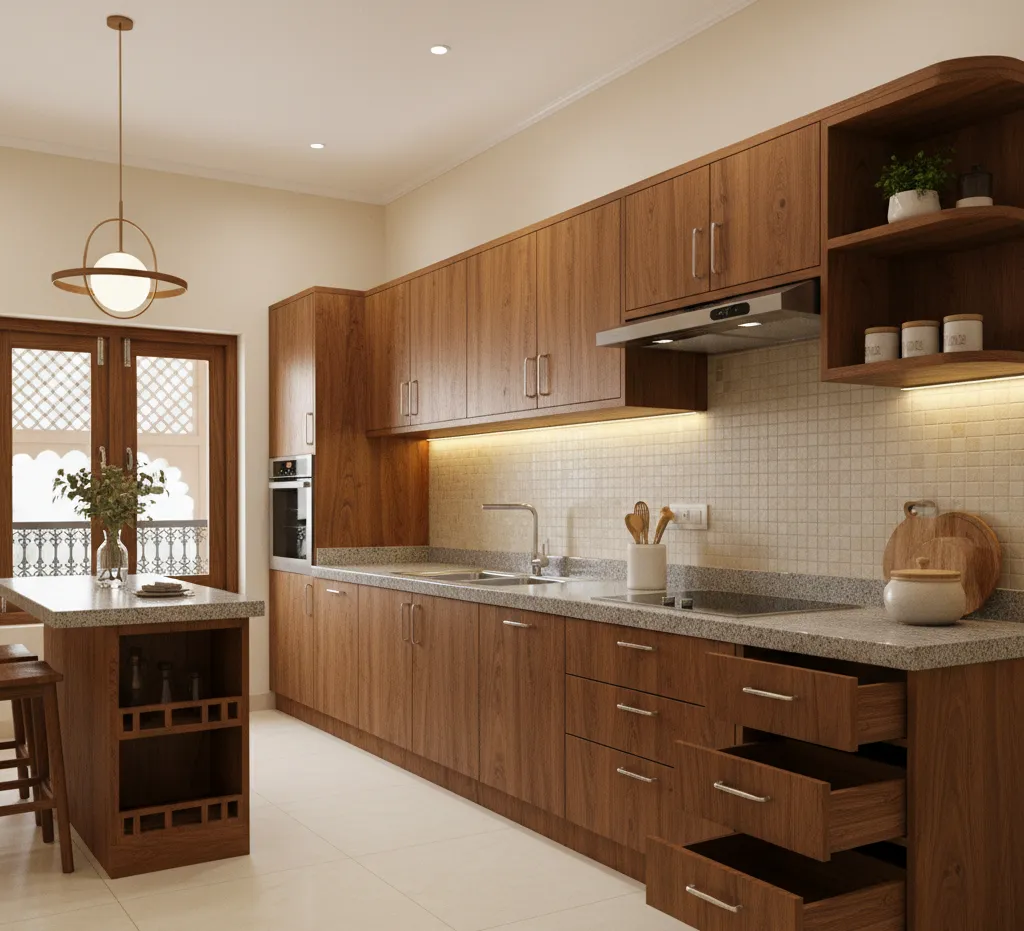
When bhabhi was planning her Jagatpura kitchen last year, her designer suggested something I hadn't encountered before. HDHMR. High Density High Moisture Resistance board. I made him spell it. Then I Googled it in the car on the way home because I didn't want to admit I'd never heard of it.
HDHMR isn't plywood. It's not wood layers glued together. It's wood FIBRES compressed under insane pressure with moisture-resistant resin until they form a super-dense board. Think of it like... if you took sawdust, mixed it with industrial glue, and squeezed it so hard it became something that barely resembles wood anymore. The result is denser than plywood, smoother on the surface, and - here's the interesting part - naturally harder for termites to chew through because there are no layers for them to work between.
Bhabhi's designer used HDHMR for the wall cabinets and the upper sections. For the base cabinets - especially under and near the sink - he used BWR plywood. His logic: the base cabinets face the worst moisture exposure. Splashing, dripping, potential leaks. BWR plywood handles standing water better than HDHMR because plywood's cross-layered construction gives it better structural integrity when wet. But for wall cabinets that mostly just sit there holding masala jars and steel containers? HDHMR is lighter (easier on wall anchors), smoother (takes laminate beautifully), and cheaper than BWR by about ₹15-25 per square foot.
This split approach - BWR at the bottom, HDHMR on top - is apparently what a lot of smart kitchen companies are doing now. You spend more where risk is highest and save where risk is lowest. Bhabhi's kitchen cost about ₹2.8 lakh total. If she'd used full BWR everywhere, it would've been maybe ₹3.1-3.2 lakh. If she'd used full HDHMR everywhere, it would've been cheaper but I'd have been nervous about the sink area.
It's been a year. Everything is fine. But one year isn't long enough to declare victory. I have a phone reminder set for 2028 to do a full inspection. Bhabhi thinks I'm joking. I am not.
MDF - the Material That Confuses Everyone
MDF comes up in every kitchen showroom conversation and every time I have to explain the same thing: MDF is fine for SOME parts of the kitchen and terrible for others.
Medium Density Fibreboard. Wood fibres pressed together with resin. Smooth surface. Takes paint and laminate beautifully. Cheaper than both HDHMR and plywood. About ₹30-45 per square foot depending on thickness and grade.
My brother's kitchen uses MDF for exactly one thing - the shutter faces on his wall cabinets. Not the carcass. Not the base cabinets. Just the visible door fronts. Why? Because MDF gives you a smooth, consistent surface that laminate adheres to perfectly. You can even CNC-route it for decorative patterns - those shaker-style kitchen doors you see in European kitchen photos? That's routed MDF.
But MDF near water is a disaster waiting to happen. Standard MDF swells like a sponge when it gets wet. In a Jaipur kitchen with hard water splashing, steam rising, and monsoon humidity - MDF as a base cabinet carcass is asking for trouble. Even MDF shutters near the sink area can develop edge swelling if the edge banding isn't perfectly sealed.
There's a moisture-resistant version - HMR MDF - that's better. But even HMR MDF isn't as structurally water-resistant as BWR plywood. I wouldn't use it for any load-bearing cabinet near a wet zone. It's fine for wall cabinet shutters, dry-area carcasses, and decorative panels. Just keep it away from the sink.
The confusion happens because kitchen companies sometimes say "MDF" without specifying whether it's standard MDF, HMR MDF, or HDHMR (which is technically a type of MDF but behaves very differently). These are NOT the same product. The price difference between standard MDF at ₹30 per square foot and HDHMR at ₹65-85 per square foot tells you they're not the same product. But the names are similar enough that a vague quotation can hide the difference.
Marine Plywood - For the Paranoid (Like Me)
After my uncle's termite disaster and Rohit's particle board nightmare, I became the family's unofficial cabinet material inspector. A role nobody asked for and everyone tolerates.
When my uncle rebuilt his kitchen after the termites, I told him - BWP. Marine grade. IS-710 certified. The stuff that theoretically survives 72 hours of continuous boiling. It's the highest grade of plywood you can get for residential use.
BWP runs about ₹100-150 per square foot. Expensive compared to BWR at ₹75-90. For a full kitchen, the difference is maybe ₹8,000-12,000. My uncle, having just spent ₹38,000 on termite damage repairs, didn't argue about the price for even one second.
Two years since the rebuild. His wife still knocks on the cabinet doors with her knuckles periodically, checking for hollow sounds. Trauma does that to you. Everything is solid.
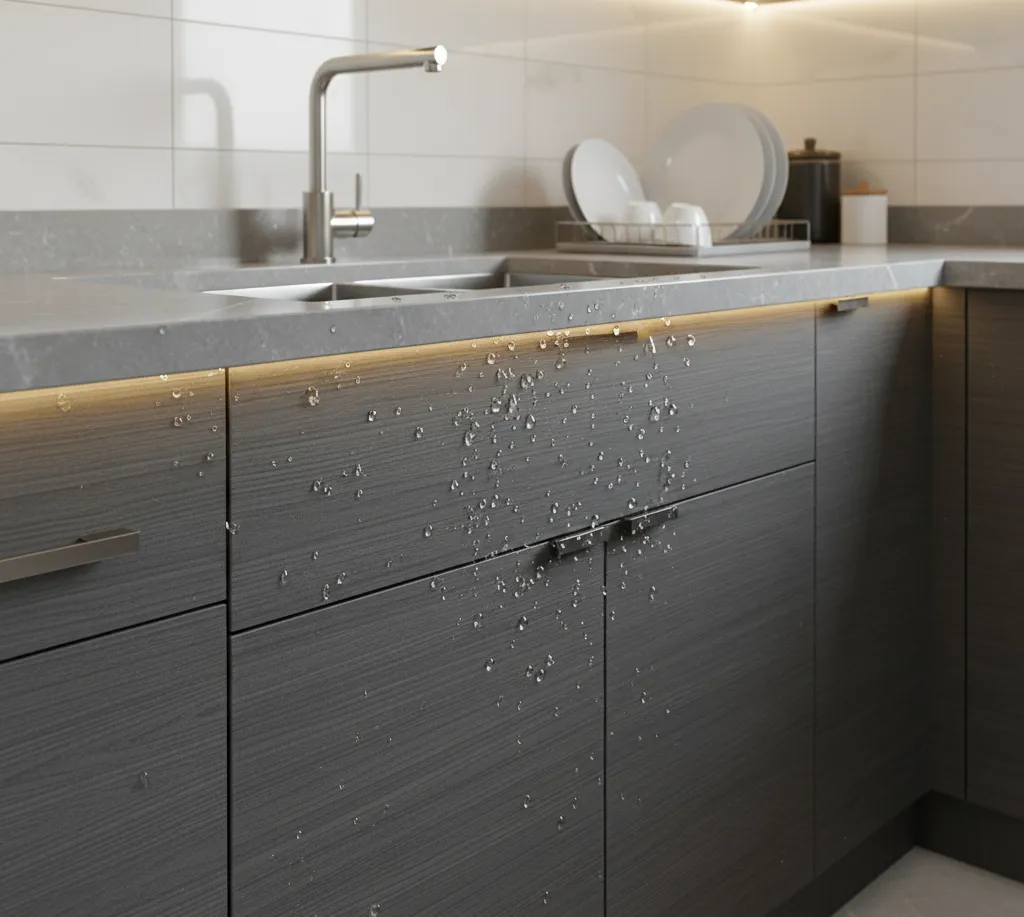
Do you NEED marine plywood for your entire kitchen? Honestly, no. BWR is sufficient for most cabinets. Where marine plywood genuinely earns its premium is the base cabinet under the sink - the single wettest spot in any kitchen. That one cabinet. Spend the extra ₹1,500-2,000 on marine plywood for just that section. The rest can be BWR.
My mummy's plumber - a recurring character in this family's kitchen saga - once told me something that stuck: "Madam, the cabinet dies from the bottom. Always the bottom. Fix the bottom and the rest takes care of itself." He was talking about water damage but it applies to material selection too. Spend your money where the risk is. The bottom. The wet zone. The sink area.
The Quotation Trick You Need to Catch
One more thing. The thing that could've saved Rohit's kitchen if he'd known to ask.
When you get a quotation from a modular kitchen company, look at the materials section. If it says "pre-laminated board" - ask WHICH board. Is it particle board? MDF? HDHMR? BWR plywood? Get the specific material name in writing. On the quotation. In ink.
If it says "imported hardware" - ask which brand. If it says "best quality plywood" - ask which grade. BWR? BWP? Commercial? These words exist for a reason. Vague quotations exist for a different reason - to give the company flexibility to use the cheapest option while charging you for something better.
Rohit's quotation said "pre-laminated board." He got particle board. If it had said "BWR plywood" he would've gotten BWR plywood and his kitchen would still be standing properly instead of swelling through its second set of replacement panels.
Write it down. Make them commit. The material inside your cabinets matters more than the colour on the outside. I learned this from watching my family's kitchens age. Some gracefully. Some not.
Kitchen material advice from someone who's inspected too many cabinets? KitchenKaki - we check behind the laminate so you know what you're buying.
