
Built-In Oven vs Countertop Oven: Which to Choose for Modular Kitchen
I bought a countertop OTG in 2019 to make my grandmother's nan khatai. Made it once. Then the OTG sat on my counter for eight months being used approximately twice. When the kitchen renovation came around, I had no idea how to make this decision properly — built-in or countertop, and why. Here's the guide I wish had existed, written for Indian homes and the way we actually use ovens.
Built-In Oven vs Countertop Oven: Which to Choose for Modular Kitchen
I bought a countertop OTG in 2019 for one specific reason - I wanted to make my grandmother's nan khatai at home.
Made it once. It turned out reasonably well. The kitchen smelled incredible for about four hours and my grandmother, who was visiting, gave it a seven out of ten which from her is essentially a standing ovation.
Then the OTG sat on my counter for the next eight months being useful approximately twice - once for reheating pizza that was too thick for the microwave, once for making garlic bread when we had guests. A 28-litre appliance occupying a permanent 2.5 square feet of my most valuable counter space, being used about as often as the iron.
When we renovated the kitchen two years later the question came up - keep the countertop OTG, upgrade it, or build in a proper oven? And I realised I had no framework for making this decision. Nobody had ever explained it properly. Every article I found either assumed I baked regularly (I don't) or was written for a Western kitchen context where ovens are a given rather than a considered purchase.
So here is the article I wish existed when I was making that decision - written specifically for Indian homes and the way Indian households actually use ovens, or don't.
First, What Are We Actually Comparing?
Just to be clear about what sits on each side of this comparison, because the terminology gets confused.
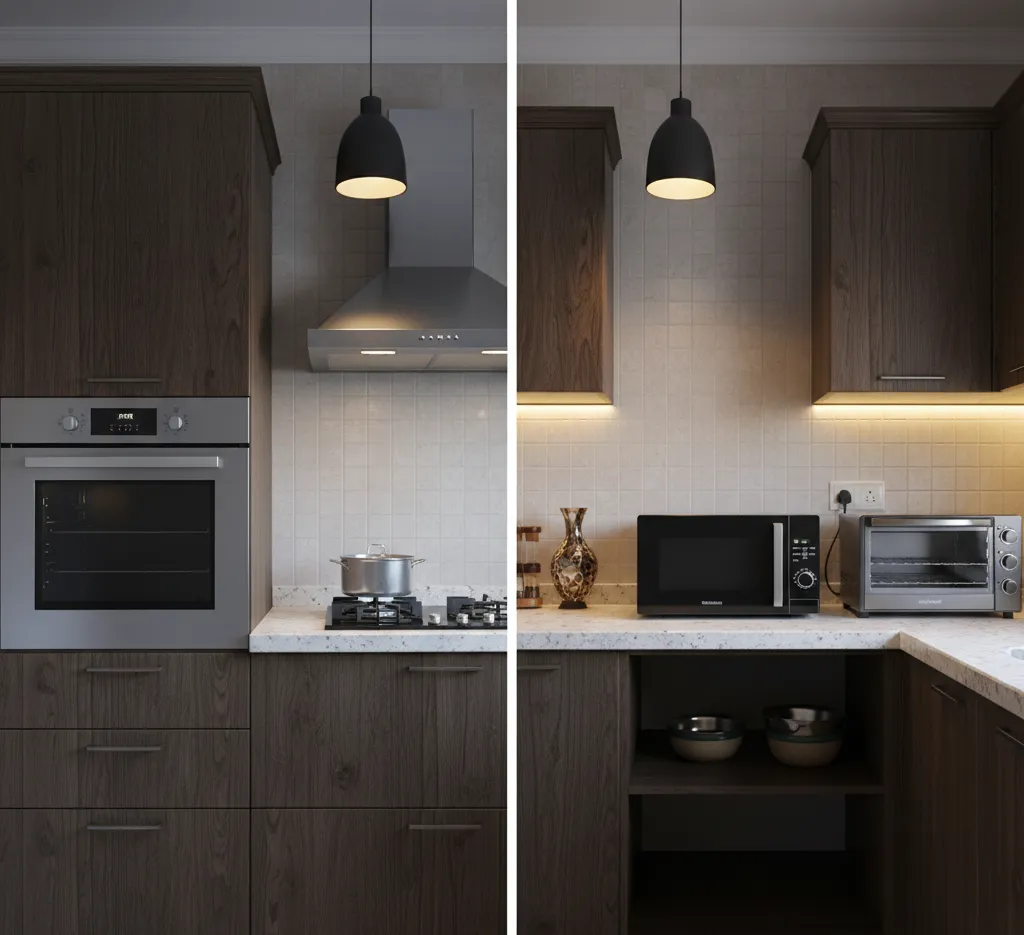
Countertop oven - in Indian homes this usually means an OTG (Oven Toaster Griller). A standalone appliance that sits on the counter, plugs into a standard socket, and does oven functions - baking, grilling, toasting - without being built into the kitchen structure. Usha, Bajaj, Morphy Richards, Philips - the brands most Indian households know. Capacities from 9 litres to 60 litres. You can move it, take it to a new house, sell it if you stop using it.
Built-in oven - a full-size oven (typically 60cm wide, various heights) designed to be installed inside a kitchen cabinet at eye level or below counter level. It connects to the kitchen's electrical system, looks like part of the kitchen, and cannot be removed without disturbing the cabinetry. Brands like Bosch, Siemens, Faber, Electrolux, IFB. These are what you see in modular kitchen showrooms in the tall appliance column.
There's also a middle category - countertop convection microwave ovens - which do some oven functions but aren't really in the same conversation as a proper built-in or a dedicated OTG. I'll mention them where relevant but they're a separate decision.
The Question Before the Question
Before comparing the two options, there's a more honest question to answer first.
How much do you actually bake or roast?
Not how much you plan to. Not how much you'd like to. How much do you actually, currently, in your real life, use an oven?
If the answer is "we make cake on birthdays, bake cookies occasionally during winter, maybe make a grilled dish once a month" - that's a light oven user. Light oven users have different needs than people who bake bread every weekend, roast a full chicken regularly, or use the oven as a primary cooking method for certain dishes.
I ask this because the built-in oven decision gets made emotionally more often than practically. The modular kitchen showroom has a beautiful tall appliance column with a built-in oven at eye level and it looks considered and complete and very much like the kitchen you imagined for your home. The designer includes it in the quote almost automatically. And two years later the oven has been used twelve times and the cabinet space it occupies has become aspirational storage.
Answer the usage question honestly. Everything else follows from it.
The Case for a Built-In Oven
For the right household, a built-in oven is genuinely the better choice and worth the significantly higher cost. Here's when that's true.
You bake or roast regularly. Weekly or close to it. Bread, cakes, cookies, roasted vegetables, grilled meats, casseroles - if these are part of your actual cooking rotation and not just occasional aspirations, a built-in oven gives you capacity, precision, and functionality that an OTG can't fully match. Built-in ovens have better heat distribution, more precise temperature control, larger capacity, and more cooking modes than even the best OTG.
The ergonomics matter to you. A built-in oven at eye level means you can see inside without bending, slide trays in and out at a comfortable height, and check on things without crouching. If you bake regularly, this stops being a comfort detail and starts being a practical one. Taking a heavy baking tray out of a counter-level or floor-level oven is a genuine awkward moment every single time.
The kitchen is permanent. Built-in ovens make sense in a home you're staying in long-term. The cabinet is built around it, the electrical point is planned for it, the kitchen's visual design includes it. If you move houses every few years, a built-in oven is a complication - it stays with the flat or requires someone to reinstall it.
The kitchen design matters to you. This is a legitimate reason and doesn't need to be justified. A modular kitchen with a properly integrated built-in oven in a tall appliance column looks complete in a way that the same kitchen with a countertop OTG perched somewhere doesn't. If the visual coherence of the kitchen is a priority - and for many people who invest in a modular kitchen it is - the built-in oven earns its place on those grounds alone.
The Real Costs of a Built-In Oven
This is the section that usually changes the conversation.
A decent built-in oven in India - Bosch, Siemens, Faber, IFB - costs between ₹25,000 and ₹80,000 depending on the brand, capacity, and features. The appliance itself.
Then the cabinet. A tall appliance column designed to house a built-in oven costs ₹15,000 to ₹35,000 as part of a modular kitchen, depending on the material and the brand. This is a dedicated cabinet that exists solely to house the oven - it's not multipurpose storage.
Then the electrical point. A built-in oven needs a dedicated 15-amp or 20-amp circuit in most cases. If this isn't already in the kitchen's electrical plan, adding it after the fact means opening walls, which means cost and disruption.
Total realistic cost of the built-in oven decision - the oven, the cabinet, the electrical point - is somewhere between ₹50,000 and ₹1,20,000 depending on choices made.
A good countertop OTG - a 28 to 40-litre Morphy Richards or Usha with convection - costs ₹5,000 to ₹12,000. Plugs into a standard socket. No special cabinet required.
The cost difference is significant. For a household that uses the oven regularly, the built-in option earns its cost through performance, ergonomics, and kitchen aesthetics. For a household that uses it occasionally, that's a large amount of money for something that mostly decorates the kitchen.
The Case for Keeping a Countertop OTG
The countertop OTG gets dismissed too easily in modular kitchen conversations because it doesn't look as impressive and designers don't make margin on it. But it's the right choice for more Indian households than the showroom experience suggests.
It's honest about usage. If your household bakes occasionally, an OTG is exactly the right tool. It does the job when needed, costs a fraction of a built-in, and doesn't require dedicated cabinet space that would otherwise be used for storage.
It's flexible. When you move house, it comes with you. When it stops working, you replace it for ₹6,000 rather than ₹40,000. When you decide you want a different capacity - you went from occasional baking to more serious baking, or the children grew up and you bake less now - you change it without touching the kitchen.
Modern OTGs are genuinely capable. A 40-litre OTG with convection from a decent brand handles most baking tasks a home baker needs. The temperature accuracy is not as precise as a built-in, the heat distribution is not as even, and the capacity ceiling is lower. But for nan khatai, for a birthday cake, for grilled chicken, for most things an Indian home actually asks an oven to do - a good OTG works.
Counter space is the real cost. The honest downside of a countertop OTG is not performance - it's the counter space it occupies. In a small Indian kitchen where every square foot is precious, a permanently placed OTG is a real sacrifice. This is the argument for building it in - not that a built-in oven performs better for your actual usage, but that it moves the appliance off the counter and into a cabinet.
This specific problem - wanting the oven off the counter without the full cost of a built-in - has a solution worth knowing about.
The Middle Option Nobody Talks About Enough
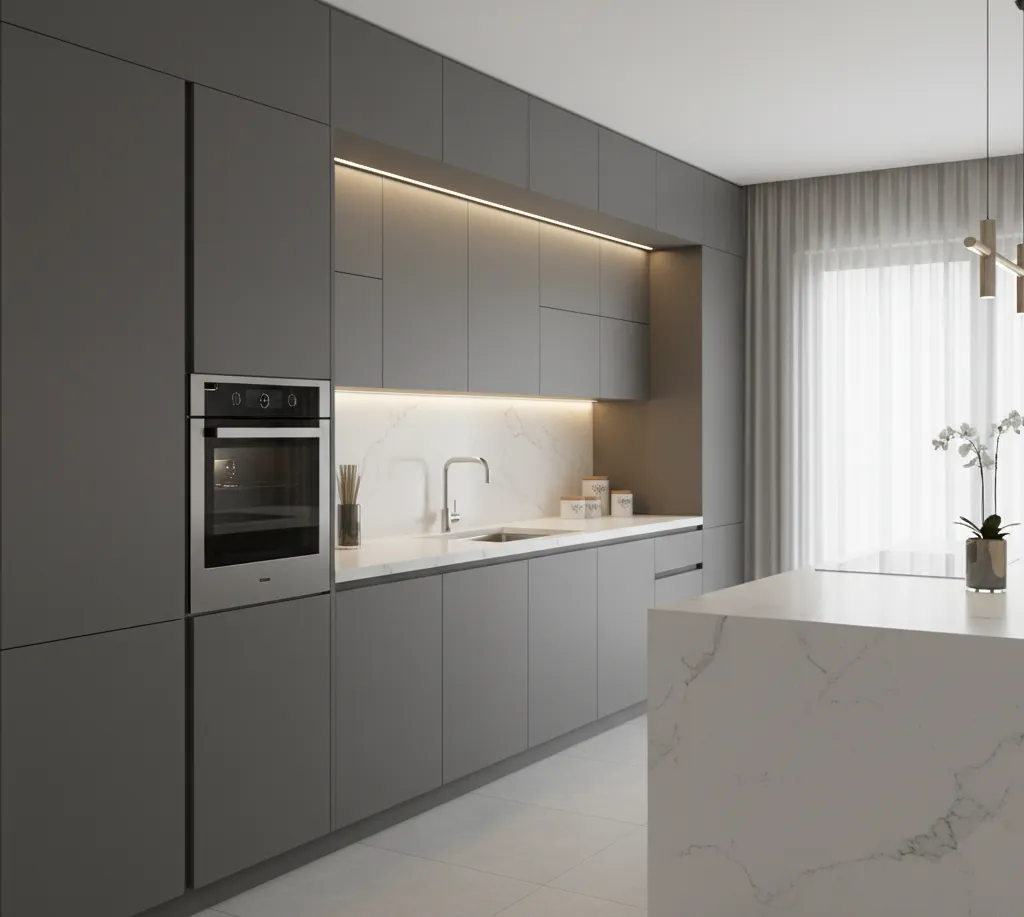
A dedicated OTG shelf or OTG housing built into the kitchen.
Not a full built-in oven cabinet. Just a designed shelf - at eye level or slightly below - with a dedicated electrical point, that the countertop OTG sits on permanently. The OTG is still the same countertop appliance. It's just housed in the kitchen structure rather than sitting on the counter.
This costs a fraction of a built-in oven column - a shelf with electrical point adds maybe ₹3,000 to ₹8,000 to the kitchen cost. The OTG itself is ₹6,000 to ₹12,000. Total: under ₹20,000 in almost every case.
The result: the OTG is off the counter, at a comfortable working height, with its own power point, looking reasonably integrated into the kitchen. Not as seamless as a true built-in - the OTG is still visibly a standalone appliance - but significantly better than a countertop OTG eating into your prep space.
For households that bake occasionally and want the counter back without the full built-in investment, this is the option worth having the conversation with your kitchen designer about. Most designers don't suggest it because they're selling the full modular solution. But it exists and it works.
Heat Distribution and Performance - The Honest Comparison
For households where performance actually matters - regular bakers, people who roast seriously, home cooks who use the oven as a primary tool - here's the honest technical comparison.
Temperature accuracy: Built-in ovens win clearly. A good built-in oven holds the temperature you set within a few degrees throughout the cooking cycle. OTGs fluctuate more - the thermostat is less precise, the cycling of the element is more noticeable, and actual temperatures inside can vary from set temperatures by 10 to 20 degrees depending on the model and age. For bread baking and macaron-level precision baking, this matters. For birthday cake and nan khatai, it matters less than the recipes make it sound.
Heat distribution: Built-in ovens, especially fan-assisted or convection models, distribute heat more evenly. In an OTG, the position of the tray relative to the top and bottom elements affects the result - things on the bottom rack brown faster on the base, things too close to the top element get coloured too quickly. Experienced OTG users learn to rotate trays and adjust positions. It's manageable. It's a learned skill rather than something the appliance handles for you.
Capacity: Built-in ovens typically start at 60 litres and go up. A large OTG tops out at around 60 litres but the usable space inside - accounting for the position of elements and racks - is effectively less than the stated capacity. For cooking a full chicken, a large baking project, or multiple trays simultaneously, a built-in oven has a genuine capacity advantage.
Recovery time: When you open an oven door mid-cooking, temperature drops. Built-in ovens recover to set temperature faster because they're better insulated and have more powerful elements. OTGs recover more slowly. Again - for most Indian home baking use cases, this is not a significant problem. For serious or frequent baking, it adds up.
What About the Convection Microwave?
The convection microwave - a microwave that also does convection oven functions - deserves a mention because many Indian households already have one and wonder whether it replaces the need for either an OTG or a built-in.
For basic oven tasks - reheating, some baking, grilling - a convection microwave is adequate. It does the job.
For serious baking it falls short. The cavity is small, the convection heating in most combination appliances is less even than a dedicated oven, and using it for both microwave and oven functions means it's never fully available for either. If you're trying to reheat something in the microwave while something else is baking - common in a busy kitchen - a combination appliance creates scheduling conflicts a dedicated oven doesn't.
The convection microwave is a good compromise for kitchens where space is extremely limited and oven use is genuinely occasional. It's not a substitute for either a dedicated OTG or a built-in oven if oven cooking is regular.
Which One Is Right for Your Kitchen - A Straight Answer
After all of this, here's the direct guidance.
Choose a built-in oven if: You bake or roast at least once a week. You're investing in a modular kitchen you'll use for ten or more years. Counter space is genuinely limited and you need the OTG off the surface. The kitchen's visual design matters to you and the integrated look is worth paying for. Budget is not a primary constraint.
Choose a countertop OTG if: You bake occasionally - birthdays, festivals, a few times a month at most. You're in a rental or a home you'll leave within a few years. Budget is a real consideration. You'd rather put the ₹60,000 to ₹80,000 difference into something that gets more daily use - better storage, better lighting, better countertop material.
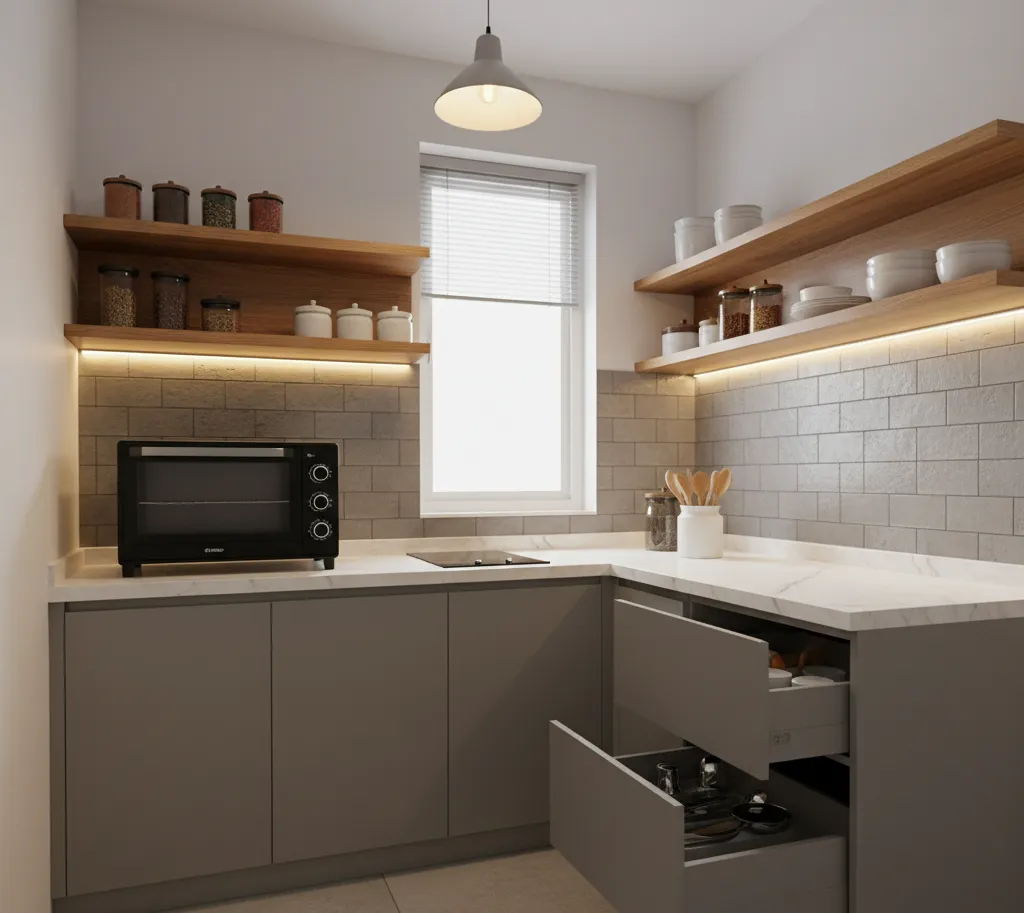
Choose the OTG-on-shelf option if: You bake occasionally and want the counter space back. Budget is a constraint but you still want the OTG off the counter and at a comfortable height. You're not committed enough to oven cooking to invest in a full built-in but you're tired of the appliance taking up prep space.
The Nan Khatai Postscript
I went with the OTG-on-shelf option in my renovated kitchen. A 40-litre Morphy Richards on a purpose-built shelf at eye level, dedicated socket, looks reasonably tidy.
I use it more than I used the old countertop OTG, partly because it's at a comfortable height and partly because having it off the counter somehow made it feel more intentional - like a real oven rather than a appliance that wandered onto my counter and never left.
Made the nan khatai again last Diwali. Eight out of ten from my grandmother. Progress.
More honest appliance and kitchen planning advice for Indian homes at Kitchen Kaki.
