
Dark Kitchen Design: Black & Grey Cabinet Ideas | Kitchen Kaki
My cousin Vikram painted all his kitchen cabinets black. His mother-in-law stopped speaking to him for two weeks. By the end of her visit she admitted — quietly, once, not for the record — that it looked "quite nice actually." That's the entire journey of dark kitchens in India. Here's everything you need to know before you make the same bold call.
Dark Kitchen Design: Bold Ideas With Black & Grey Cabinets
My cousin Vikram did something in his kitchen that made his mother-in-law stop speaking to him for approximately two weeks.
He painted all his kitchen cabinets black.
Not the entire kitchen - the walls are white, the countertop is a light grey quartz, there's a big window on one side that gets good afternoon light. Just the cabinets. Floor-to-ceiling matte black shutters with slim brass handles.
His mother-in-law's objection was immediate and firm. Dark colours in the kitchen bring bad energy. The kitchen should be bright and welcoming. Black is for mourning, not for cooking. She had a whole framework for this and she deployed it thoroughly.
Vikram waited out the two weeks, cooked her favourite dal makhani in the new kitchen, and by the end of the visit she had admitted - quietly, once, not for the record - that it looked "quite nice actually."
That story is basically the entire journey of dark kitchens in India. The resistance is real, the concerns are understandable, and then you see one done properly and something shifts.
Dark kitchens have moved from a foreign design trend to something Indian homeowners are genuinely choosing - not because they saw it on Instagram and wanted to copy it, but because when it's done right, a dark kitchen has a quality that white and beige kitchens simply don't. It feels considered. Deliberate. Like someone made a real decision rather than defaulting to the safest option.
Let's talk about how to actually do it - what works, what doesn't, and the specific things that make a dark kitchen succeed in an Indian home.
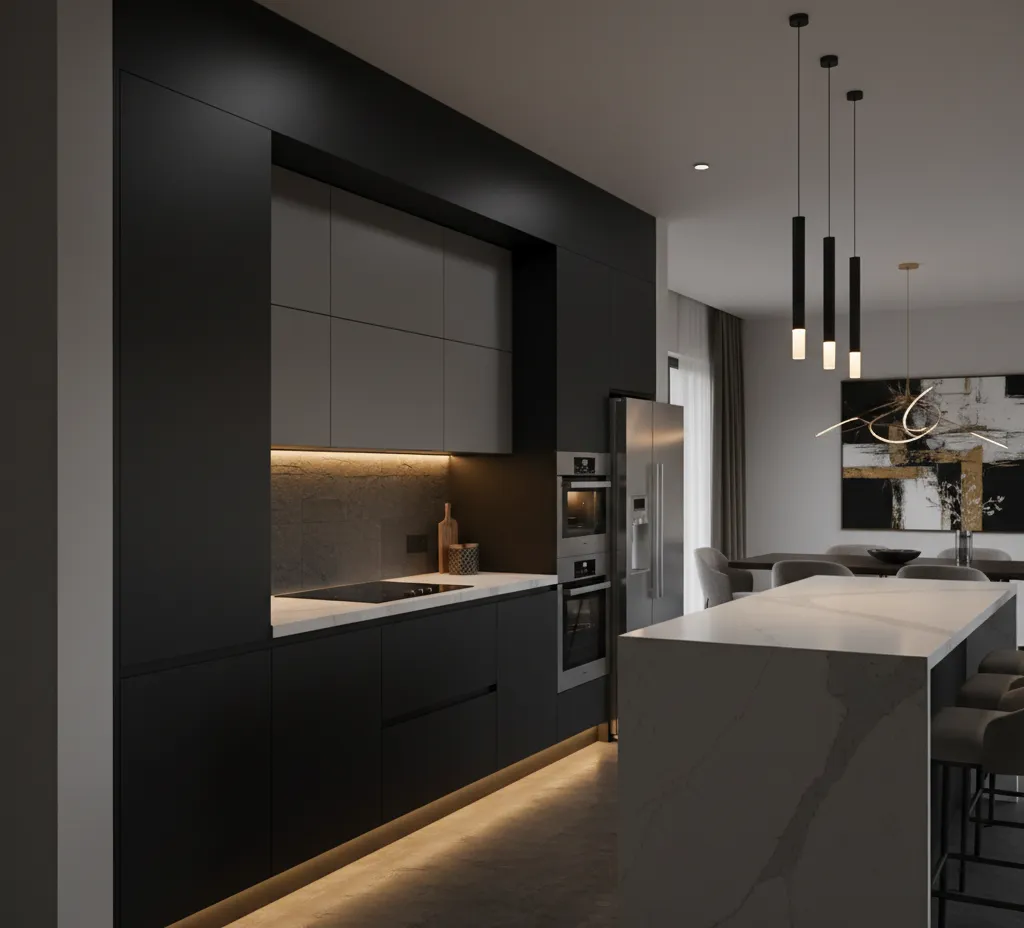
Why Dark Kitchens Work - The Case Beyond Aesthetics
Before the design decisions, let's address the practical question that comes up every time: isn't a dark kitchen impractical?
The honest answer is - less impractical than you'd think, and more practical in some ways than a light kitchen.
Hiding daily cooking mess. Indian cooking produces oil mist, turmeric traces, masala splatter. On white or cream cabinets, every one of these shows. On dark cabinets - charcoal, deep navy, black - most of this disappears. You still need to clean, but the mess is far less visible between cleanings. A dark kitchen on a Tuesday evening looks presentable in a way a white kitchen in the same state does not.
The dust problem. Here's the honest counterpoint - fine dust, which settles on every horizontal surface in Indian homes and especially in drier cities, shows more on dark surfaces than light ones. The top of dark overhead cabinets, the ledges, the flat tops of appliances - in a dusty environment, this requires regular wiping. Knowing this ahead of time means it's a manageable reality rather than a surprise disappointment.
The light question. This is the real concern and it deserves a real answer. Dark cabinets absorb light rather than reflect it. In a kitchen with poor natural light - north-facing, single small window, no glass door - dark cabinets will make the space feel significantly dimmer. This is not fixed by adding a ceiling light. It requires proper under-cabinet lighting, good task lighting, and ideally some reflective surfaces - a light countertop, a glass or light-coloured backsplash - to bounce what light exists back into the space.
In a kitchen with good natural light - a large window, a glass door, south or west-facing - dark cabinets look extraordinary. The natural light prevents the darkness from feeling heavy and the contrast between the bright light and the dark surfaces creates exactly the dramatic quality that makes dark kitchens compelling.
Assess your light situation honestly before committing. If the kitchen is genuinely dark, there are ways to make it work - but they require planning and some additional investment in lighting.
Black Cabinets - The Full Commitment
All-black cabinets are the boldest version of this and the one that causes the most family discussion.
Done right, a black kitchen is one of the most striking interiors you can create in a home. Done wrong - wrong finish, wrong countertop pairing, wrong lighting - it becomes oppressive and you end up repainting in two years.
Finish matters enormously with black. Glossy black cabinets show every fingerprint, every smear, every touch. In a kitchen that gets daily use - children, multiple cooks, frequent cooking - glossy black is a maintenance exercise that never ends. Matte black is dramatically more practical. Fingerprints are far less visible, the surface has a depth and sophistication that glossy black doesn't, and it's easier to clean on a day-to-day basis.
What to pair with black cabinets:
A light countertop is almost essential unless the kitchen has exceptional light. White quartz, light grey granite, pale Kota stone - the contrast between the dark cabinets and the light work surface is what prevents the kitchen from feeling like a cave. The countertop becomes the brightest surface in the kitchen and your eye goes to it, which is exactly where you want attention in a working kitchen.
White or very light backsplash - same logic. A glass backsplash in white or pale grey behind black cabinets reflects light back into the space and creates a clean contrast that photographs beautifully and functions well.
Brass or gold hardware on black cabinets. This is not a subtle combination - it's intentionally striking - and it works because the warmth of the brass cuts the coldness of the black. Matte black hardware on black cabinets looks good too, more minimal and quiet. Chrome or silver on black can feel cold depending on the other tones in the kitchen.
What doesn't work with black cabinets:
Dark countertop with dark cabinets. Unless you're specifically designing a kitchen that's entirely dark - which can work in the right hands - a dark countertop against dark cabinets removes the contrast that makes a black kitchen interesting and just makes everything look heavy.
Dark backsplash. Same issue. Keep at least one major surface light.
A single ceiling light as the only light source. Black cabinets need layered lighting - ceiling light plus under-cabinet strips plus ideally some accent lighting inside glass-door cabinets if you have them. Plan the lighting before the kitchen is built, not after.
Charcoal Grey - The Smarter Starting Point
If full black feels like too much commitment, charcoal grey is where most people who want a dark kitchen actually end up - and often where they're happiest.
Charcoal is almost black but warmer. It has enough depth to read as dark and dramatic but it doesn't carry the visual weight of true black. In a smaller kitchen or one with moderate natural light, charcoal works where black might overwhelm.
The other advantage of charcoal over black - it's more forgiving across different lighting conditions. A kitchen that looks incredible with the afternoon sun coming through the window and looks slightly menacing on an overcast morning is a problem. Charcoal grey handles lighting variation better than black because it has more natural variation in tone.
Charcoal with warm wood accents. This combination is the one that keeps showing up in well-designed Indian kitchens right now. Charcoal lower cabinets or full-height cabinets, with a section of open shelves or upper cabinets in a warm wood tone - teak veneer, walnut laminate, or even a well-chosen wood-finish foil. The wood adds warmth that charcoal alone doesn't have, and the combination reads as both modern and liveable.
Charcoal with white. Classic, always works, never feels like a risk. Charcoal lowers, white uppers. Or charcoal on one wall, white on another. The contrast is strong enough to make the kitchen feel intentional without the full drama of black and white.
Charcoal with terracotta or warm earthy tones. An unexpected combination that works beautifully in Indian homes. Charcoal cabinets with a terracotta tile backsplash, or a warm ochre-painted wall at one end. The earthy tone softens the charcoal, makes the kitchen feel rooted and warm rather than cold and industrial.
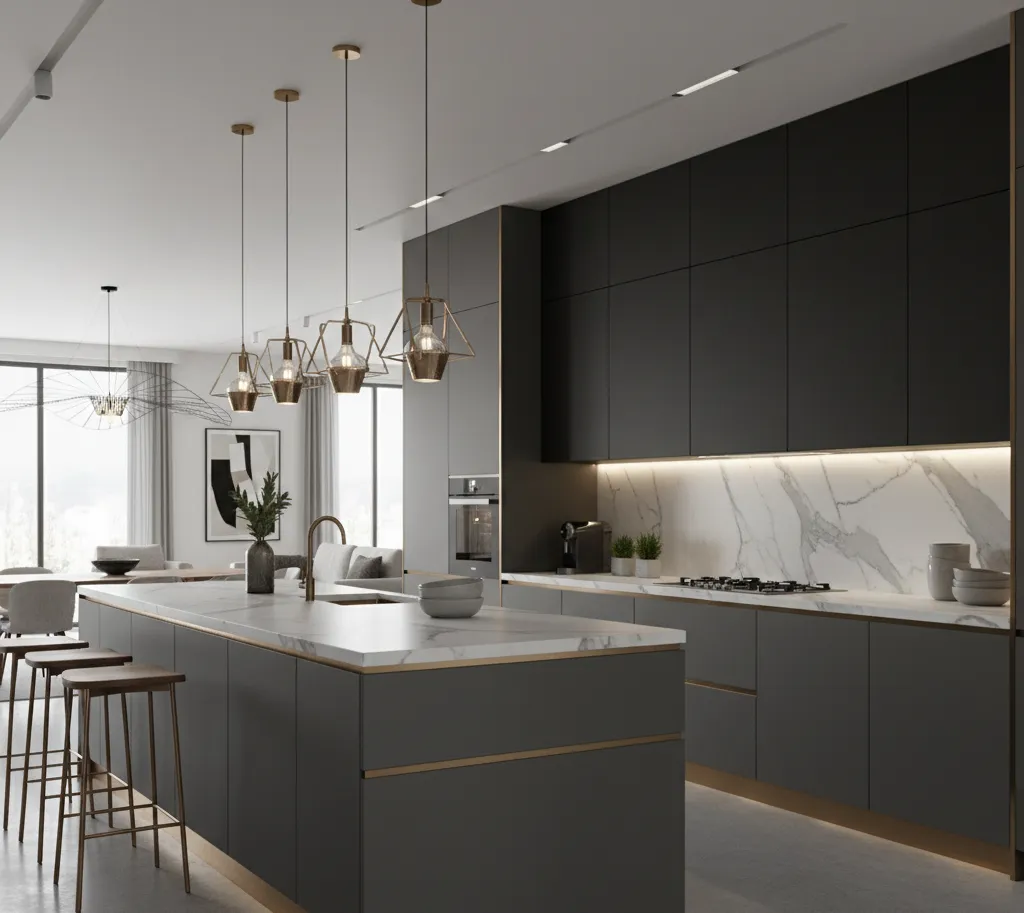
Dark Grey - The Safe Version of Dark
One step lighter than charcoal, dark grey sits in that range where it's clearly not a neutral but not fully committed to being dramatic either.
This is the version most recommended for kitchens with moderate light - not poor, not great, just the average Indian flat window situation. Dark grey cabinets give you the visual interest and the mess-hiding practicality of a dark kitchen without the maintenance concerns of true black or the commitment required by charcoal.
Dark grey also pairs with the widest range of other materials. It works with warm woods, with white, with stone countertops in almost any tone, with brass or chrome or matte black hardware. It's not the most exciting choice but it's the one that will still look right in ten years regardless of what else changes in the kitchen.
If you're choosing a dark kitchen colour for an investment property or a flat you plan to sell within a few years - dark grey is the version that appeals to the most buyers. Not everyone responds to black. Almost everyone responds to a well-executed dark grey kitchen.
Navy Blue - Dark Without Being Dark
Navy blue doesn't always get listed in dark kitchen discussions but it belongs here.
A deep, proper navy - not a bright blue, not a mid-tone - has all the visual qualities of a dark kitchen with the added advantage of being a colour rather than an absence of colour. It feels warmer than black or grey. It's less confronting as an idea - "navy kitchen" gets less family resistance than "black kitchen" even when the actual effect is similar.
Navy with brass hardware and a white or cream countertop is one of the most consistently beautiful kitchen combinations available. The navy reads as rich and considered, the brass adds warmth, and the light countertop keeps the working surface bright. In India specifically, this combination feels both current and somehow timeless - perhaps because deep blue has always been part of Indian material culture in textiles and architecture.
Navy is also one of the more practical dark colours for Indian kitchens because it hides the turmeric-toned oil mist that settles on cabinet surfaces from daily cooking. Turmeric on a dark blue surface essentially disappears. Turmeric on a white surface does not.
The lighter the shade of navy, the more it shifts toward a mid-tone that loses some of the drama. Go dark with it - near-midnight navy, almost-black navy - or it loses the quality that makes it worth choosing over a conventional blue.
Dark Kitchen Designs That Work for Indian Homes
The Half-Dark Kitchen
Dark lower cabinets, white or light upper cabinets. This is the most accessible entry point into dark kitchen design ↗ and the one that works in the widest range of kitchen sizes and light conditions.
The logic is sound: the lower cabinets are where most of the cooking mess lands - the oil splatter, the vegetable prep, the general daily contact. Dark lower cabinets hide this. The upper cabinets, which see less mess and are at eye level where the kitchen's overall tone is most registered, stay light and keep the space from feeling closed in.
This design works in kitchens as small as 6 feet by 8 feet. The dark lowers ground the space, the light uppers open it up, and the countertop in between acts as a natural divider.
The Full-Dark Kitchen With a Light Backsplash
All cabinets dark - charcoal or black - with a deliberately light backsplash in glass or large-format light tile. The backsplash becomes the brightest surface in the kitchen and the eye goes to it, which creates a focal point and prevents the all-dark cabinet scheme from feeling heavy.
This needs good lighting to succeed. Under-cabinet LEDs lighting the backsplash from above, plus a strong ceiling light or track lighting. When lit properly, this design has a dramatic quality that's hard to achieve any other way.
The Dark Island in a Light Kitchen
If the kitchen layout allows for an island or peninsula, making the island dark while keeping the perimeter cabinets light is the lowest-risk way to bring dark colours into a kitchen.
The island is a single unit. It's visually separate from the main kitchen. It can be changed more easily than all the perimeter cabinets if you decide you want something different in a few years. And a dark island in a light kitchen reads as an intentional design decision - not a mistake, not a trend-following exercise, but a choice.
Dark island with a contrasting lighter countertop and brass pendant lights above - this specific combination shows up in well-designed Indian kitchens with good reason. It's not complicated and it works consistently.
The Moody All-Dark Kitchen
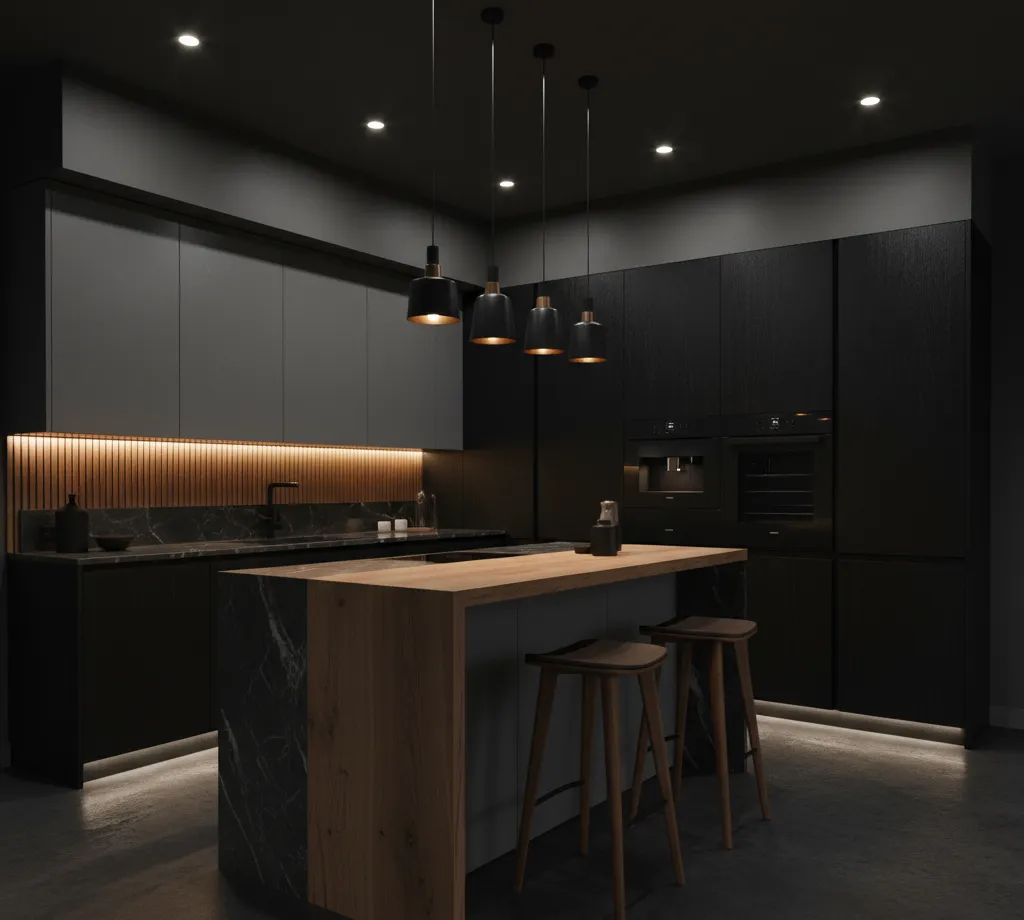
This is the version with the most impact and the most requirements. Charcoal or black on all surfaces - cabinets, potentially the ceiling, possibly the backsplash. Kept from being oppressive by excellent lighting, at least one light countertop surface, and thoughtfully chosen hardware and accessories.
This design is not for every kitchen or every family. It requires a specific kind of confidence in the choice and a genuine commitment to maintaining it. In the right space - a kitchen with good proportions, reasonable light, and an owner who loves cooking and wants the kitchen to feel like a serious, dedicated space rather than a bright cheerful room - the all-dark kitchen is extraordinary.
It is also the version most likely to cause extended family commentary. Worth knowing in advance.
Lighting a Dark Kitchen - Non-Negotiable Planning
Every dark kitchen needs this conversation before a single cabinet is ordered.
Under-cabinet LED strips. In a dark kitchen these go from "nice to have" to essential. They light the counter from directly above, they make the backsplash glow, and in a dark kitchen they do more to make the space feel functional and bright than any other single addition. Plan for them from the start - the wiring should be part of the kitchen electrical plan, not an afterthought.
A strong primary ceiling light. Not one standard batten fitting. A proper ceiling fixture - track lighting that can be directed, a statement pendant above the island if there is one, or multiple recessed lights if the budget and ceiling height allow. Dark cabinets absorb light. The ceiling light has to work harder to compensate.
Inside cabinet lighting. If any cabinets have glass doors or open shelving is part of the design, lights inside those sections add a layer of visual interest and warmth that makes the dark kitchen feel curated rather than just dark. LED strip inside glass-door wall cabinets creates a warm glow that's genuinely beautiful.
Natural light first. All of the above matters less if the kitchen gets good natural light. A dark kitchen in a south-facing room with a large window needs far less artificial lighting intervention than the same kitchen in a north-facing room with one small window. Assess the natural light situation before deciding how much to invest in artificial lighting.
The Practical Questions Before You Commit
How clean are you willing to keep the kitchen? Dark cabinets hide oil and cooking mess but show dust more than light cabinets. If daily wiping of horizontal surfaces is not something you'll actually do, know this before deciding.
Who else uses the kitchen? Children near dark gloss cabinets leave marks constantly. Elderly family members sometimes find dark kitchens harder to navigate when light is low. These aren't reasons not to do it - they're things to factor into the finish choice and the lighting plan.
What does the rest of the home look like? A dark kitchen attached to a bright white living room can feel disconnected. A dark kitchen that flows from a home with rich, warm, layered interiors feels like a natural continuation. Neither is wrong - but the relationship between the kitchen's palette and the rest of the home is worth thinking about.
Is this a long-term home? Dark kitchens are a strong personal choice. If you're planning to sell the flat in the next two or three years, a very bold dark kitchen - full black, all cabinets - may limit buyer appeal. Dark grey or navy is a safer bet if resale value is a consideration. A dark island in an otherwise lighter kitchen is safer still.
The Honest Bottom Line
A dark kitchen done properly is one of the most impressive interiors a home can have. The drama, the sense of deliberateness, the way it makes you feel when you walk into it - none of that is available in a white or beige kitchen, regardless of how well those are executed.
It requires more planning than a light kitchen. The lighting needs to be right. The countertop and backsplash need to provide contrast. The finish needs to be chosen with daily life in mind, not just photographs.
And yes - some family members will have opinions. Strong ones, delivered with conviction and a certain amount of historical and spiritual context.
Cook them something good in it. Works every time.
More bold and practical kitchen design ideas for Indian homes at Kitchen Kaki.
