
Granite vs. Quartz: Which Countertop Survives Heavy Rajasthani Cooking?
Your Rajasthani kitchen throws haldi, smoking tawas, and oil at the counter every day. Granite and quartz handle that abuse very differently. Here's what actually happened when I tested both.
Granite vs. Quartz: Which Countertop Survives Heavy Rajasthani Cooking?
There's a yellow patch on my mummy's kitchen counter that's older than my nephew. It showed up in 2017. She left a haldi-smeared spoon sitting near the stove while she answered a phone call - maybe twenty minutes, maybe less - and that was it. Permanent resident. No amount of lemon or baking soda or that weird infomercial cleaner my dad bought could remove it.
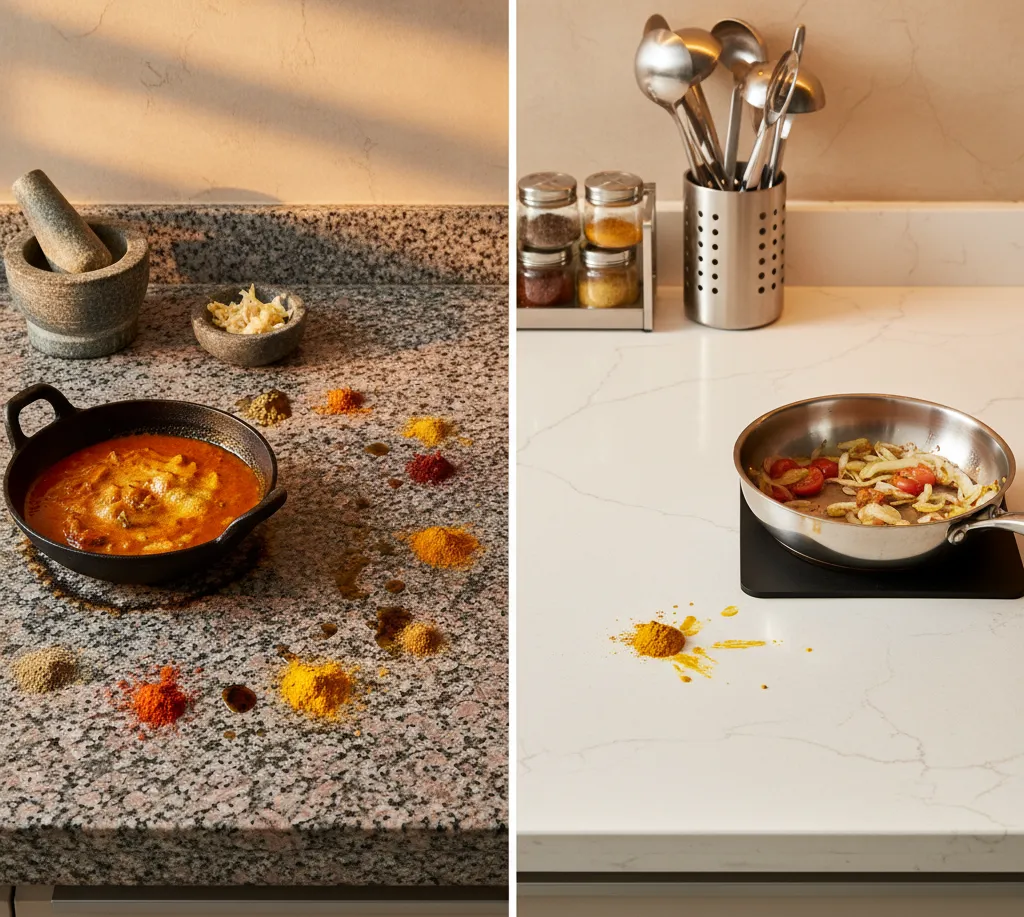
She's not bothered. "It adds character," she says. Typical mummy.
My bhabhi saw that stain when she was choosing a countertop for her new Jagatpura flat. Looked at it, looked at mummy, and said, "I'm getting quartz." Didn't even hesitate.
And you know what? Two years later, bhabhi's quartz counter looks brand new. She cooks the same dal baati churma, gatte ki sabzi, and ker sangri that mummy does. She's MESSIER than mummy. Leaves stuff sitting for hours. Doesn't wipe immediately. And still - not a single stain.
Meanwhile mummy's granite has that haldi patch, a faint oil shadow near the tawa spot, and a tiny chip on the edge where my dad dropped the steel pressure cooker lid last Diwali.
So quartz wins, right? Case closed?
Nah. It's way more complicated than that. Because last month bhabhi put a smoking hot tawa directly on her quartz counter - forgot the trivet - and now there's a faint brown ring that won't fully come out. She hasn't told anyone in the family yet. I only know because I noticed it and she made me promise not to mention it.
Oops.
What Your Counter Deals With in a Rajasthani Kitchen
I want you to actually picture a normal day. Not a special occasion day. Just a regular Tuesday.
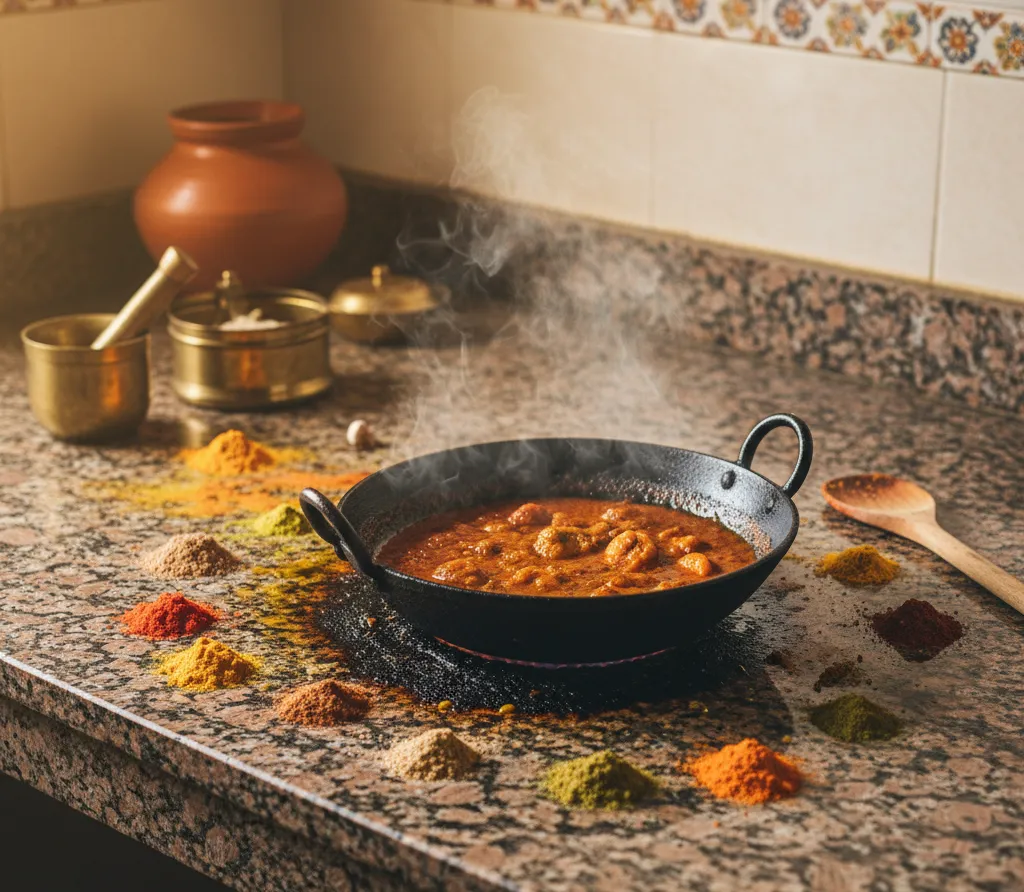
Morning chai. Milk boils over, drips down the edge. Someone makes aloo paratha with ghee - the ghee sits in a katori on the counter and leaves a ring. Mummy starts lunch prep around 11. Out comes the masala dabba. Haldi on her fingers. She touches the counter. Red chilli powder near the chopping board. She's rolling rotis - atta dust EVERYWHERE. The belan goes back and forth across the stone surface. Meanwhile a kadai with oil is heating on the gas. She lifts the tawa off the burner and puts it - where? On the counter. Obviously. Because where else would it go? There's no trivet within reach. She's holding hot metal and she's not going to walk across the kitchen to find a wooden board.
This happens DAILY. Sometimes twice daily.
Evening - more chai (more potential spills), maybe pakoras if someone shows up unannounced. Then dinner, which is basically lunch again with different sabzi.
Your countertop takes this kind of beating 365 days a year. So yeah, the material matters.
The Granite Argument (AKA Mummy's Side)
I'll say this for granite - it's TOUGH in ways quartz simply isn't.
Take the heat thing. My mummy has been dropping scorching tawas and kadais on her granite counter since 2009. Fifteen years. The granite doesn't care. Not even a whisper of a heat mark. Granite formed inside the earth at temperatures that make your gas burner look like a birthday candle. You can't hurt it with heat. It's physically impossible in a home kitchen.
For Rajasthani cooking specifically, where heavy iron tawas and thick-bottom kadais are going on and off the flame constantly - this is not a small deal. It's the whole deal. My mummy doesn't use a trivet. She's never used a trivet. She didn't grow up with trivets. She doesn't believe in trivets. And her granite has never once complained.
Then there's the price thing. We live in Rajasthan. Kishangarh - the country's biggest granite processing hub - is like 90 minutes from Jaipur. Some families literally drive there on a Sunday, pick their slab in person, and get it delivered for half what a Jaipur showroom would charge. Indian granite starts at ₹80 per square foot. Even a really good quality black granite is maybe ₹300-400. For a typical kitchen counter, you're spending ₹8,000 to ₹15,000 including cutting and fitting. That's it. That's the whole bill.
But here's where mummy's beloved granite falls apart.
Granite is porous. It's got millions of tiny holes you can't see. Oil finds those holes. Haldi finds them. Tomato juice finds them. And once something seeps in? It's IN. Hence the 2017 haldi patch that now has its own personality.
You're supposed to apply a sealant every 2-3 years. This closes the pores temporarily. Did mummy ever seal her granite? Of course not. She didn't know she had to. The stone shop never said anything. The contractor didn't mention it. Nobody talks about this in India. I only found out because I Googled it while researching for bhabhi's kitchen. YEARS after mummy's counter was installed.
And it chips. Not constantly, but when it chips, it's ugly. That pressure cooker lid incident left a visible nick on the front edge. My dad tried filling it with some adhesive. It looks worse now than the chip did.
The Quartz Argument (AKA Bhabhi's Side)
My bhabhi doesn't care about what granite can handle. She cares about one thing - "I don't want to see stains on my counter. Period."
Fair enough. And quartz delivers on that promise like nothing else.
Quartz is engineered. About 90% crushed quartz crystals smooshed together with resin under insane pressure. The result is a surface with zero pores. Nothing gets in. Haldi sits on top - wipe it off, gone. Oil splatter - wipe it, gone. Red chilli paste left for three hours because bhabhi went to take a nap after lunch - wipe it, gone. Maybe a faint shadow if something sits overnight, but even that comes out with baking soda and five minutes of patience.
I actually tested this at a showroom on Ajmer Road. Rubbed raw haldi paste on a granite sample and a quartz sample. Left both for one hour. Came back, wiped with a damp cloth. Granite - yellow stain, clearly visible, scrubbing helped a little but it stayed. Quartz - completely clean. Like I'd imagined the whole thing.
Bhabhi's counter after two years of daily Rajasthani cooking confirms this. She doesn't seal it. She doesn't do any special maintenance. Soap and water. That's her entire routine. The counter looks like it did the day it was installed.
Also - quartz comes in consistent patterns. You pick a design in the showroom, that's exactly what shows up at home. No surprises. Granite can betray you - the slab they install might have a vein running in a weird spot or a colour patch that wasn't visible in the sample. Happened to my chachi. She picked a light grey granite and the installed slab had a dark brownish streak running through one corner. She was furious for a week.
Now the part bhabhi doesn't like talking about.
Quartz can't handle heat the way granite does. That resin holding everything together softens at high temperatures. You put a 250°C tawa on it directly? Bad things happen. Discolouration. Sometimes a crack if the thermal shock is sudden enough. Bhabhi's secret brown ring is proof. She used the trivet for six months, got comfortable, forgot it ONCE, and now she's got a permanent reminder.
Price is also noticeably higher. Quartz runs ₹250-375 per square foot. A standard kitchen counter costs ₹20,000 to ₹40,000 depending on brand and thickness. Roughly double what granite costs. Not outrageous, but not nothing - especially when granite is practically free by comparison in Rajasthan.
The Showroom Moment That Changed My Thinking
So I'm at this Ajmer Road showroom with bhabhi, right? After the haldi test, the salesman - nice guy, clearly experienced - put a hot chai cup on the quartz sample. Regular chai, fresh from the flask. Not boiling, just very hot.
Left it for two minutes. Picked it up. Faint ring. He panicked slightly, rubbed it with some solution, and it came out. But the fact that a CUP OF CHAI left a mark? On a ₹350-per-sqft surface?
Then he put the same cup on the granite. Left it longer, maybe five minutes. Picked it up. Nothing. Absolutely nothing. Granite didn't even acknowledge the cup existed.
He looked at me and shrugged. "Both have weaknesses, madam."
Yeah. He wasn't wrong.
What I Tell People Now
I don't give a clean "pick this one" answer anymore. I tried doing that with my chachi's kitchen and got it wrong because I didn't factor in how she cooks.
Instead I ask two questions.
"Will you use a trivet every single time? EVERY time? Even when you're rushing, even when you're tired, even when the kadai is burning your fingers and you just want to put it DOWN?"
If yes, genuinely yes - get quartz. You'll love it forever. Zero stains, zero sealing, zero maintenance drama.
If you hesitated even a little - granite might be your safer bet. At least you can slam hot stuff on it without wincing.
"Do stains bother you or can you live with them?"
My mummy genuinely does not care about that haldi patch. It's been there eight years. She looks at it and sees a kitchen that's been well-used. If you're wired like that - granite is fine. It'll stain eventually. You'll make peace with it.
If a stain would drive you crazy - like bhabhi, who would probably repaint her entire kitchen over a single blemish - quartz is the only option that'll keep you sane.
There's also this sneaky combo option I saw in two Jaipur kitchens. Granite on the 3-4 feet of counter right next to the stove - the hot zone. Quartz on everything else - prep area, breakfast counter, serving zone. Hot stuff lands on granite. Messy prep happens on quartz. Each material handles its strength. The two surfaces weren't an exact colour match but honestly? Nobody noticed unless I pointed it out.
Couple Things Worth Knowing Regardless
Jaipur hard water is brutal on both surfaces. Those white chalky deposits around the sink? That's mineral buildup. Wipe the sink area dry every night. Seriously. Five seconds. Saves you ugly white rings on either material.
If you go granite - get it sealed the WEEK it's installed. Don't wait. And put a recurring reminder in your phone for two years later. Nobody remembers on their own. Also consider buying direct from Kishangarh if you have a car and a free Sunday. The prices there are genuinely 30-40% lower.
If you go quartz - buy two wooden trivets and one big silicone mat. Place them permanently next to the stove. Don't put them in a drawer. Don't store them "neatly." They need to be within arm's reach at all times because the one time they're not is the time you burn a ring into your counter.
And for BOTH - don't cut directly on the surface. Use a cutting board. Granite dulls your knives. Quartz can get fine scratches over time. Neither is built to be a chopping block.
Where I've Landed Personally
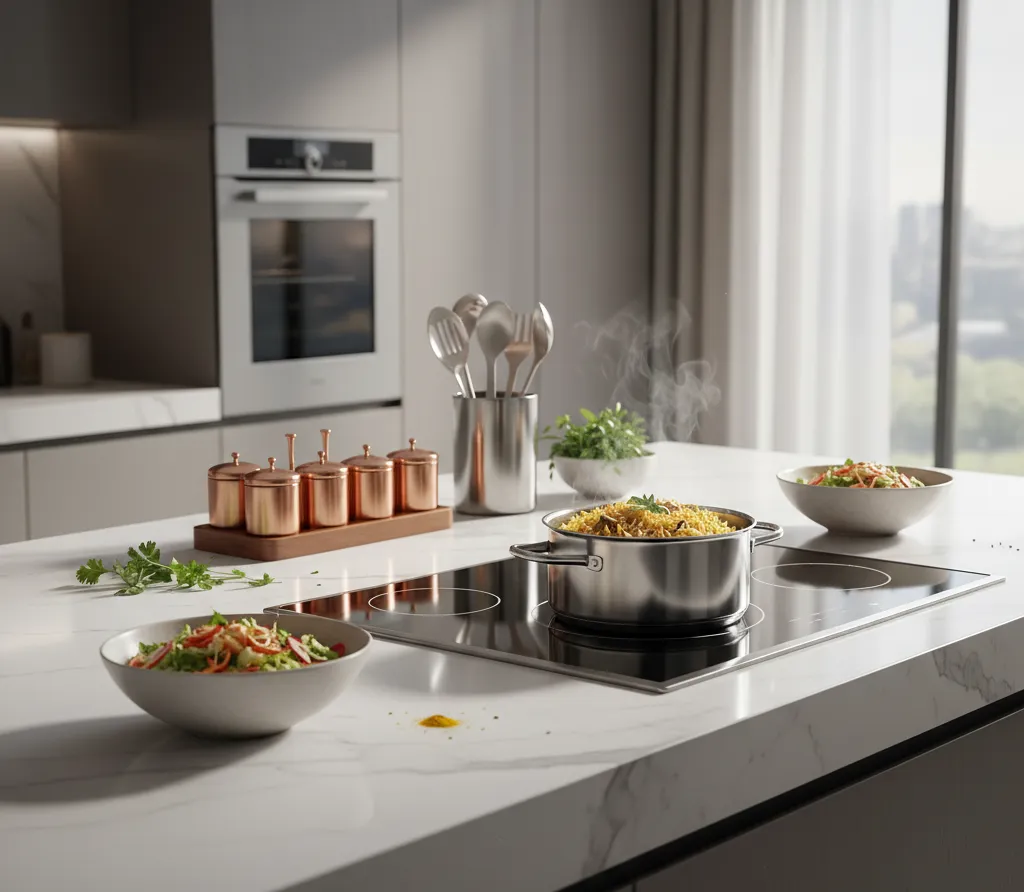
I'd get quartz for my own kitchen. But I'd also superglue a trivet to the counter next to my stove. And I'd put granite on the 2-foot section right beside the gas burner where I KNOW I'll drop hot stuff without thinking.
Mummy thinks I'm overcomplicating it. "Just get granite and stop being fancy," she said last week.
Bhabhi texted me a photo of her spotless counter with a smug emoji.
They're both right. They're both wrong. Welcome to the great Indian countertop debate.
More kitchen advice that doesn't pretend there's one right answer? KitchenKaki - where we argue about this stuff so you don't have to.
