
How Jaipur's Hard Water Ruins Kitchen Cabinets & Sinks (And How to Prevent It)
That white crust on your sink? The rotting plywood under it? That's Jaipur's hard water doing slow damage nobody warns you about. Here's what four families tried and what actually worked.
How Jaipur's Hard Water Ruins Kitchen Cabinets & Sinks (And How to Prevent It)
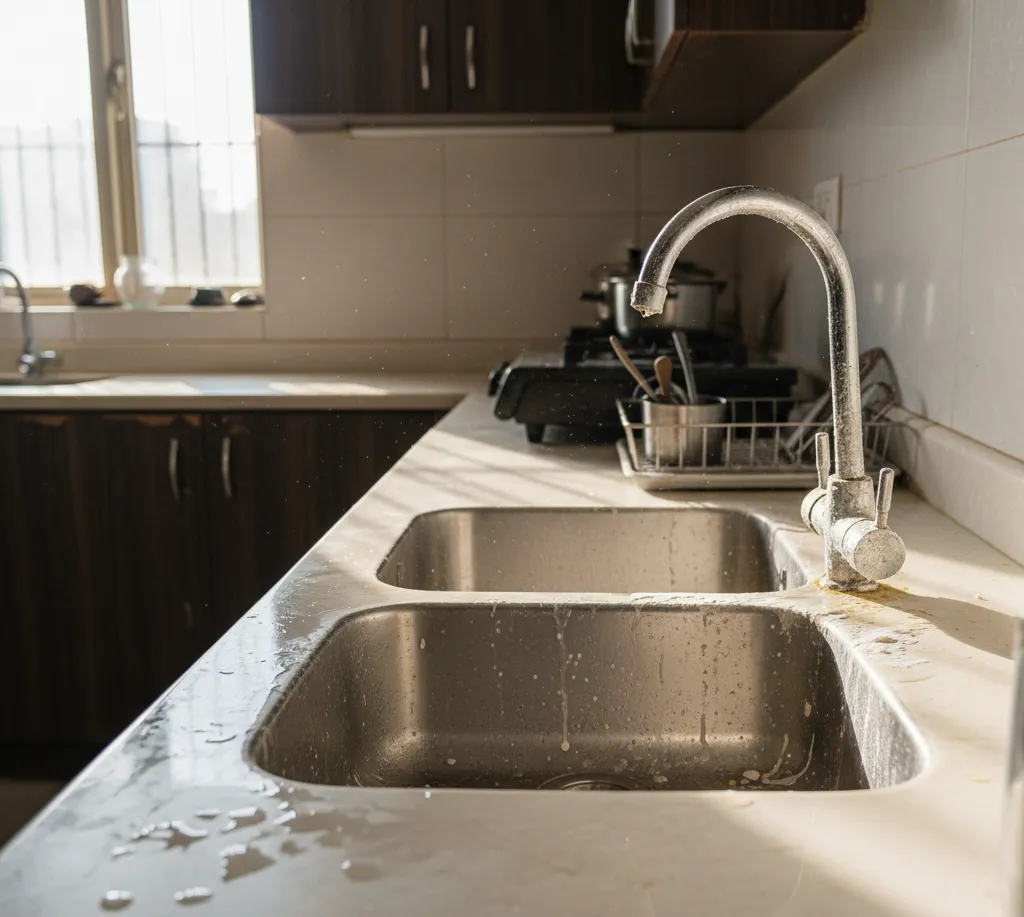
My chachi has been calling me about her kitchen sink since 2021. Same story every time. "The white stuff is back." She means the calcium crust that keeps forming around the drain and tap base. She scrubs it off every morning with Vim. It returns by dinner. She's been stuck in this loop for four years now. Four years, man.
Her sink is 304-grade stainless steel. Cost decent money. It looked like a magazine photo for about four months. Now it permanently looks like someone dusted rangoli powder on it and walked away.
I finally got fed up hearing about it in January this year and drove to her place in Pratap Nagar with a ₹40 bottle of white vinegar and an old dupatta. More on what happened in a minute - but first let me tell you why Jaipur kitchens specifically have this problem, because it's worse than most people realize.
We're Basically Washing Our Dishes With Mineral Soup
Seventy percent of Jaipur's water supply has TDS above 500 mg/L. That number means nothing to most people so let me put it this way - in Bangalore or Pune, kitchen taps run water around 150-300 TDS. In Sanganer? My neighbour got his tested last year. 1,340. In parts of Vaishali Nagar and Mansarovar Extension it regularly crosses 1,000. The calcium and magnesium levels are so high that NEERI - the National Environmental Engineering Research Institute - has published papers specifically about Jaipur's groundwater quality. Or lack thereof.
Every time this water touches a surface and evaporates, it leaves behind a thin layer of mineral deposit. One layer is invisible. A week of layers looks like a faint haze. A month looks chalky. A year? That's when your sink starts feeling rough to the touch even right after you clean it.
But the sink is actually the least of your problems. The real damage is happening somewhere you're probably not looking.
Go Open the Cabinet Under Your Kitchen Sink. Right Now.
I'm serious. Go look. I'll wait.
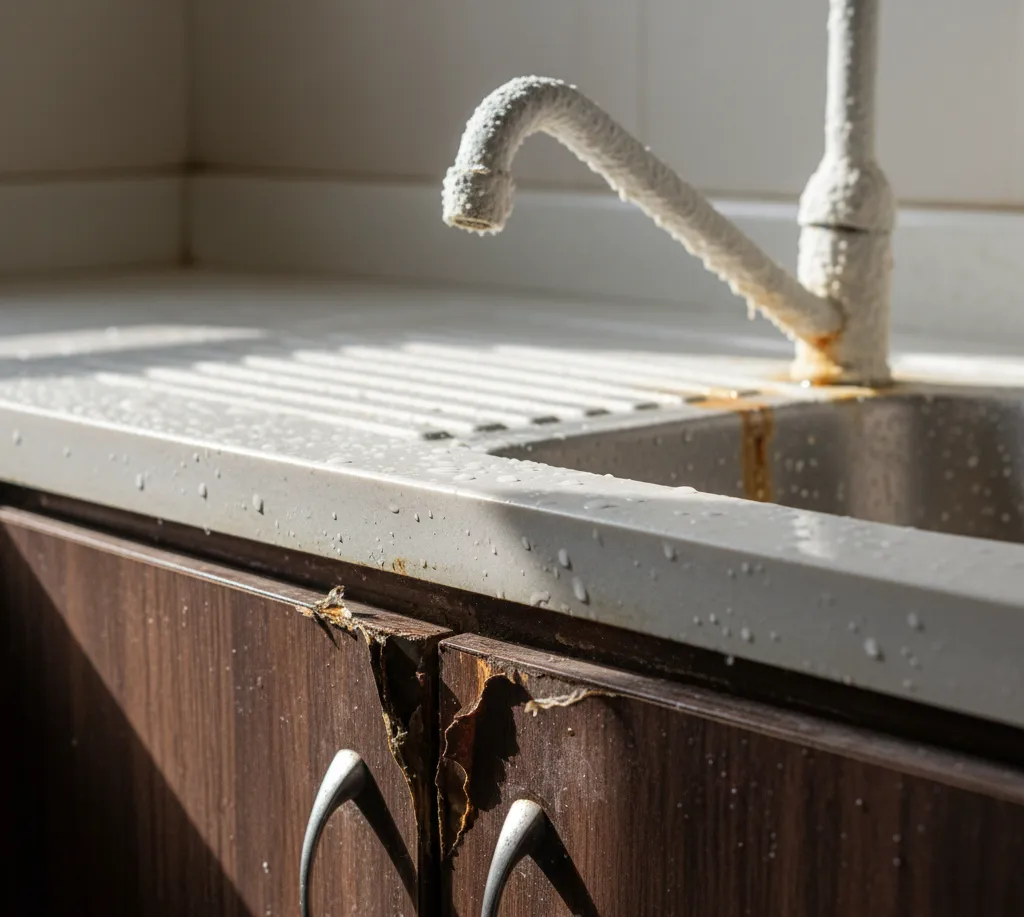
My mummy's kitchen taught me this lesson the hard way last December. Our tap had been dripping - just this slow, annoying drip drip drip. My dad ignored it for three weeks because he's my dad. Finally called the plumber. The plumber opened the under-sink cabinet, pulled out the Harpic bottles and plastic bins my mummy stores there, and pressed his thumb into the plywood base.
It went right through. Like wet cardboard. The whole panel was waterlogged - dark, soft, slightly smelly. Months of invisible drips that nobody caught because those cabinet doors stay shut 99% of the time.
The plumber wasn't even surprised. He gave us this look like yeah, I see this every week. In Jaipur, he probably does.
Now here's the thing - that drip alone wouldn't have destroyed the panel so fast in a city with softer water. Regular water would wet the plywood and then dry. Jaipur water wets the plywood AND leaves mineral deposits in the wood fibres. Those minerals attract MORE moisture. The wood never fully dries. It just gets softer and softer until one day a plumber's thumb goes through it.
Replacement panel plus pipe fix cost ₹3,500. My dad and mummy had a whole argument about who should've noticed the drip first. Nobody won. Everybody was annoyed.
After that I went slightly crazy. Checked under every kitchen sink in my family. Chachi's - swollen plywood edges on the left side. Bhabhi's - faint water stain spreading from the pipe joint. Mama's in Mansarovar - everything looked okay visually but there was a faint musty smell when you put your nose near the base. Pre-mould territory. Every single kitchen had some version of the damage. Every one.
So I started fixing things. Different solutions for different kitchens. Some worked great. Some were just okay. Let me walk you through the whole messy process.
The Dupatta Solution (Chachi's Kitchen)
Back to chachi and the vinegar bottle.
I told her she needed to do ONE thing. Just one. Wipe the sink completely dry with a cloth after the last dish wash at night. That's it. No standing water overnight. No puddles near the drain. Nothing.
She looked at me like I'd asked her to repaint the house. "Who has energy for that after dinner?" she said. Fair point. But I kept nagging. Finally she started doing it in late January - using an old cotton dupatta because she said microfibre "doesn't absorb properly." I have no idea if that's scientifically true but she's committed to the dupatta and I'm not arguing.
One month later she called me. Not to complain. To brag. The heavy overnight buildup that used to greet her every morning? Gone. Her sink still gets splatter spots during the day - that's unavoidable when you're washing dishes with Jaipur water - but the thick crusty layer stopped forming because there's no water sitting there for eight hours while everyone sleeps.
The vinegar is her weekly thing now. Every Sunday she sprays the whole sink and around the tap base, waits ten minutes, scrubs gently, rinses, dries. Six weeks from one bottle. ₹40. Her sink doesn't look brand new but it's SO much better than the chalky disaster it was before. She sent me a photo last month with a sun emoji. I think I accidentally created a cleaning influencer.
The funny thing is - wiping dry costs nothing. Zero rupees. Takes 30 seconds. And it's the single most effective thing anyone in my family has done for their sink. Not the vinegar. Not any special cleaner. Just removing the water before it has time to leave its minerals behind.
The ₹150 Mat That Saved Mummy's Next Cabinet
After the plumber fixed mummy's under-sink panel, I went to the hardware shop on MI Road. Bought a sheet of thick PVC. ₹150. Brought it home, cut it to size with regular scissors - took maybe ten minutes and one argument with mummy about whether I was cutting it straight - and laid it flat at the bottom of the under-sink cabinet.
Simple concept. Any drip now lands on the PVC mat instead of soaking into the plywood. Every Sunday mummy moves the bottles aside and checks the mat. If it's dry, great, no leaks. If there's water on it, we know something's dripping BEFORE it rots the wood. Last month she found a tiny wet patch on the mat. Turned out the pipe joint had loosened slightly. Plumber tightened it in five minutes. ₹200. Without the mat? We'd have found out six months later when the panel collapsed again.
While I was at it, I also scraped out the old silicone seal between her sink and countertop - it came out in hard, crumbly chunks, which tells you how dead it was - and reapplied fresh food-grade silicone. ₹250 for the tube. Did it myself. YouTube tutorial. Twenty minutes. I have a phone reminder to redo this every 12 months because in Jaipur water conditions, silicone breaks down way faster than it should. In softer water cities this seal lasts 4-5 years. Here? My plumber says 12-18 months max.
Why Bhabhi's Neighbour Keeps Replacing Hinges
This one is subtle. Nobody thinks about cabinet hardware in relation to water quality. I didn't, until bhabhi pointed something out at her neighbour's flat.
The standard zinc-alloy hinges that come with most modular kitchens - the default option, the ones nobody thinks to upgrade - they develop this whitish-green crust when they're constantly exposed to hard water splashes. It takes about a year, maybe eighteen months. The crust builds up inside the hinge mechanism. Door starts feeling stiff. Then it makes this awful grinding noise. Then the door stops closing flush. Bhabhi's neighbour has replaced two hinges already. A third one is starting to go.
When bhabhi's kitchen was installed two years ago, I made her swap every hinge and handle near the sink zone to 304-grade stainless steel. ₹1,200 extra for the lot. She thought I was being paranoid. Two years later - zero corrosion. Not a spot. Her neighbour's kitchen was installed the same month by the same company with the same layout. Exact same kitchen. Only difference is the hardware material. ₹1,200 separated "working perfectly" from "replacing hinges every year."
And this extends to the little mesh aerator at the tip of the tap. In Jaipur, that tiny screen clogs with calcium every few months. Water starts spraying sideways. Pressure drops. You either clean it with vinegar soak or replace it. My dad has gone through five aerators since 2020. He buys them in bulk packs on Amazon now and keeps spares in the cutlery drawer. That's the level of resignation hard water pushes you to.
Mama's "Miracle Nahi Hai" Filter
Everybody eventually asks - "Why not just install a water softener and fix everything?"
Real talk? A proper whole-house ion-exchange softener costs ₹15,000 to ₹35,000 in Jaipur. Plus salt refills. Plus annual maintenance. Most families aren't spending that kind of money on water treatment for the kitchen specifically.
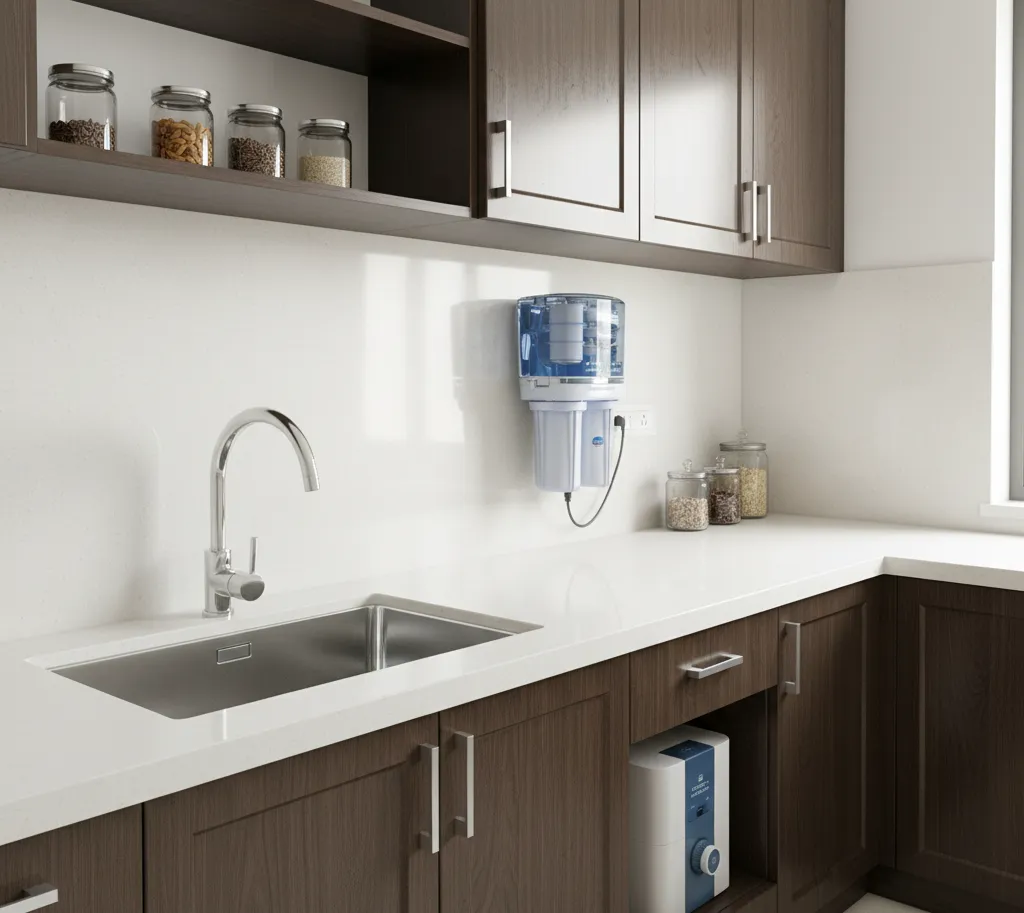
What my mama in Mansarovar did instead is install a small inline sediment-plus-carbon filter on his kitchen tap. Not an RO purifier - just a basic filter that takes the edge off the hardness. Cost about ₹2,500 installed. I asked him after three months how it was going. His exact words, in Hindi first because it's funnier that way: "Difference hai, par miracle nahi hai." Meaning - there's a difference, but it's not a miracle.
His sink still spots. But it takes longer. And the spots come off with less effort. His wife says she went from scrubbing daily to scrubbing every three days. For ₹2,500, he considers that a win. I agree.
The full softener is obviously better if you can swing it. A family in bhabhi's building installed one and their kitchen tap water feels noticeably different - smoother, less residue. But they also paid ₹28,000 plus ongoing costs. It's a budget call.
What Nobody in the Kitchen Industry Will Tell You
This is the part that genuinely makes me angry.
I've been to multiple kitchen showrooms in Jaipur. Talked to contractors. Dealt with modular kitchen companies. NOT ONE of them has ever said: "Hey, Jaipur has very hard water. We should use marine-grade plywood under your sink. Your hinges should be stainless steel. The sealant needs yearly reapplication. Here's a ₹150 mat for the cabinet base."
Not one. Ever.
These upgrades - marine ply, steel hardware, waterproof base, quality sealant - cost MAYBE ₹3,000 to ₹5,000 extra during installation. For the entire kitchen. But nobody suggests them because the standard cheaper materials are what they always use and what they've already quoted.
So you get regular plywood. Regular zinc hinges. One-time silicone. No mat. And two or three years later you're spending ₹10,000 to ₹20,000 on repairs that ₹5,000 of prevention would have avoided.
My family has spent more on kitchen water damage across four homes than those upgrades would have cost. Multiple times over. We're not careless people. We just didn't know what Jaipur water does behind closed cabinet doors.
Now you know. Go check under your sink.
Kitchen advice that actually deals with Jaipur's real problems? That's what we do at KitchenKaki. No showroom fluff.
