
How to Choose the Right Modular Kitchen Dealer: 7 Things to Check
The modular kitchen brand and the modular kitchen dealer are not the same thing — and almost nobody explains this before you sign a contract. The same brand can have a brilliant dealer in one city and a mediocre one across the street. Here are 7 specific things to check before choosing your dealer — including the one question most dealers try to avoid answering and what their response tells you.
How to Choose the Right Modular Kitchen Dealer: 7 Things to Check
The modular kitchen brand and the modular kitchen dealer are not the same thing.
This distinction matters enormously and almost nobody explains it before you sign a contract.
When you walk into a kitchen showroom - Häfele, Sleek, Godrej Interio, Livspace, whoever - you are almost always walking into a franchise dealership. The brand sets the product specifications, the material standards, and the design system. The dealer owns the showroom, employs the designers and installers, manages the installation, and handles after-sales for the kitchens they sell.
The same brand can have a brilliant dealer in one city and a mediocre dealer in another. The Sleek showroom in one part of Bengaluru can produce consistently excellent installations while a Sleek showroom across the city - same brand, same products - produces installations that generate customer complaints. This is not a secret in the industry. Everyone in the kitchen business knows it. Almost nobody tells the customer before the customer signs.
The brand's marketing materials cannot tell you whether your local dealer is good. The showroom display cannot tell you whether the installation team is skilled. The quoted price cannot tell you whether the dealer will be responsive when something needs fixing in year two.
Seven things can tell you. Here they are.

1. Visit a Kitchen They Installed - Not Their Showroom
This is the single most important thing on this list and the one that dealers most consistently try to avoid.
Every modular kitchen showroom looks good. The displays are lit correctly, the cabinets are perfectly aligned, the countertop has no scratches, the hardware operates smoothly because nobody has opened and closed those drawers ten thousand times. A showroom display is a controlled environment designed to present the product at its absolute best.
What you need to see is a kitchen that has been living with a real family - cooking Indian food daily, opening and closing drawers and cabinets hundreds of times a week, dealing with moisture and steam and turmeric and the accumulated life of a household - for at least two to three years.
Ask the dealer: can I visit a kitchen you installed two or three years ago and speak with the homeowner about their experience?
A dealer who has been doing good work for years will have customers willing to receive a visitor. They will give you names and numbers without significant hesitation.
A dealer who deflects this request - who says the customers are not available, or who only offers to show you photos, or who shows you a one-month-old installation - is a dealer who is not confident you will like what you find.
When you do visit - look at the joints between countertop and wall. Look at the drawer bases. Open the cabinets near the sink and check for any swelling or discolouration in the carcass. Check whether all the doors are still aligned. Ask the homeowner what needed fixing after installation and how long it took the dealer to respond.
What you find in that thirty-minute visit will tell you more than any amount of showroom conversation.
2. Ask Specifically What Carcass Material Is Being Used - And Get It in Writing
We have covered carcass material in other articles on this site. It appears here again because it is consistently the place where dealer quality separates from dealer promises.
The carcass is the structural box of the cabinet. It is almost always invisible in a finished kitchen - hidden by shutters, inside pull-outs, under countertops. It is also the component most subject to quality reduction during procurement because the customer can't see it and often can't verify what was used after installation.
BWR (boiling water resistant) plywood or marine ply is what belongs in a kitchen carcass. It resists moisture, handles the steam and humidity of an Indian cooking environment, and does not swell or warp under normal kitchen conditions.
MDF, HDF, and particle board are cheaper. They are used in many kitchens sold as mid-range or standard-range. They are fine in dry environments. In a kitchen - particularly near the sink area and near the hob where steam is regular - they absorb moisture over time, swell, and eventually deform.
Ask the dealer: what carcass board is used in the range you are quoting? Ask for the brand name of the board - Greenply, Centuryply, and National Plywood are reliable brands. Ask for the grade - BWR or marine.
Then ask for this to be specified in the contract with the brand name and grade written in. A dealer confident in the materials they use will agree to this immediately. A dealer who resists specifying it in writing is a dealer who may substitute cheaper material during procurement.
3. Check the Hardware Specification Before Negotiating the Price
Every modular kitchen quote has a hardware line item - hinges, drawer channels, lift-up mechanisms, corner units, pull-outs. This is where dealers have the most room to reduce costs without the customer immediately noticing.
Hettich ↗ and Hafele are the hardware standard benchmarks in India. Their hinges have a specified life of fifty thousand to one hundred thousand opening cycles. Their drawer channels operate smoothly under load. Their soft-close mechanisms work quietly and consistently.
Generic hardware - unbranded, sourced from local suppliers, priced significantly below Hettich/Hafele - can look and feel similar in the showroom. After two years of daily use in an Indian household, the difference becomes very clear.
Before negotiating the price, ask for the hardware brand to be specified in the quote. Not just "quality hardware" - the actual brand name and product line. If the quote says Hettich or Hafele and you later discover that something cheaper was installed - you have a documented dispute. If the quote says "quality hardware" - you have nothing.
A reliable dealer specifies hardware by brand in the quote without being asked. This is the sign of a dealer who is proud of what they use rather than hoping you don't ask.
4. Understand Who Actually Does the Installation
The company whose name is on the showroom is not always the company whose people install the kitchen.
Major modular kitchen brands have their own installation teams in some cities. In others, the dealer subcontracts installation to labour contractors - carpenters and fitters who work for multiple dealers and may have varying levels of training and commitment to quality.
Ask the dealer: who installs the kitchen - the brand's own trained team, the dealer's own employed team, or subcontracted labour?
There is no automatically correct answer to this - good subcontracted teams exist. But the question tells you something about how the dealer approaches quality control. A dealer who uses their own trained team can be held directly accountable for installation quality. A dealer who subcontracts can always create distance between themselves and installation problems.
Follow-up question: who is responsible if there are installation defects - the dealer or the brand? Get a clear answer. The answer reveals where the accountability actually sits and who you will be dealing with when something needs to be fixed.

5. Check Online Reviews - Specifically for Post-Installation Experience
Online reviews for kitchen brands and dealers are widely available and widely misread.
Most positive reviews are written within the first few weeks of installation - when the kitchen looks beautiful, the experience of having a new kitchen is exciting, and no problems have had time to emerge. These reviews tell you about the sales experience and the initial installation impression. They don't tell you about the experience of living with the kitchen.
When reading reviews, specifically look for:
Reviews written six months or more after installation. These are the ones that mention real-world performance - whether drawers are still smooth, whether the dealer responded when something needed fixing, whether the carcass has held up.
Reviews that mention after-sales specifically. A review that says "the installation was great, the team was friendly" is a different data point from "when the drawer mechanism broke eight months later, they replaced it within a week without argument." The second review tells you about the dealer's service commitment.
Negative reviews and how they were responded to. A dealer who responds to negative reviews with a dismissive or defensive reply versus one who acknowledges the problem and describes resolution - the response pattern tells you about how they handle problems in practice.
Google Maps, JustDial, and housing-specific forums like Housing.com and NoBroker discussion sections are where the more honest kitchen dealer reviews tend to accumulate in India.
6. Understand the Warranty - What It Covers and What It Excludes
Every modular kitchen dealer offers a warranty. The range is typically one year to ten years depending on the brand and the specific component. The headline warranty number - "ten-year warranty" - sounds comprehensive. The actual warranty terms are usually significantly more limited.
Common warranty exclusions that matter for Indian kitchens:
Damage from water or moisture - which is interesting, given that the kitchen is a moisture environment. Many warranties exclude warping or delamination caused by "excessive moisture" - a term that can be applied liberally to the very conditions a kitchen regularly experiences.
Damage from "improper use" - defined broadly enough that a dealer can use it to decline almost any claim.
Hardware after the first year - many kitchen warranties cover hardware only for the first year, after which hardware failure is a chargeable service call.
Before signing - read the warranty document. Specifically ask: does the warranty cover carcass swelling near the sink area? Does it cover hinge or drawer mechanism failure in year three? What is the process for a warranty claim - do I call the brand or the dealer, and what is the typical resolution time?
A warranty that covers very little in the circumstances most likely to arise is not really a warranty. It is a document that creates the impression of protection without the substance of it.
7. Get Three Quotes - And Compare Line Items, Not Just Totals
This is practical advice that sounds obvious and gets skipped constantly.
Get three quotes for your kitchen from three different dealers - ideally from different brands to compare cross-brand, but even three dealers from the same brand will produce different quotes.
Do not compare the total numbers. Compare the line items.
Carcass material and board grade. Hardware brand and product line. Shutter material and finish process. Countertop material, thickness, and edge profile. Installation - whether it's included or quoted separately. Post-installation service terms.
A quote that comes in significantly lower than two others is not a bargain find. It is a signal that something in the line items is different - cheaper carcass material, generic hardware, thinner countertop, excluded installation. Find the difference before concluding that one dealer is simply better value than the others.
The quote that clearly specifies every line item - carcass board by brand and grade, hardware by brand and product, shutter material and finish process - is the quote from a dealer who wants you to know what you're getting. The quote that uses vague language - "quality materials," "branded hardware," "standard finish" - is the quote that leaves room for substitution.
Bring your three quotes to a final meeting with the dealer you're leaning toward. Ask them to address any line item where their specification is vague relative to the more specific quote from another dealer. A dealer who responds to this with clarity and confidence - who explains what they use and why - is a dealer worth trusting. A dealer who becomes evasive or dismissive of the comparison exercise is showing you something important about how they will handle questions later.
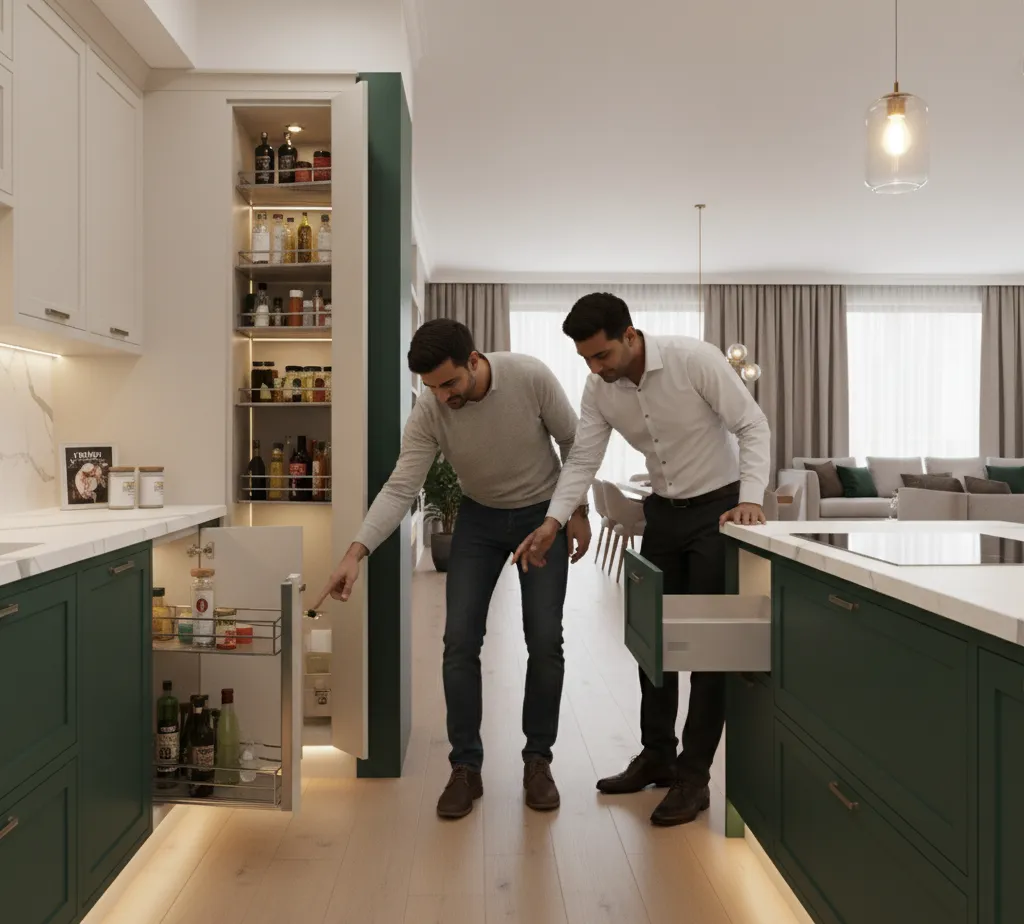
The Visit Sequence Worth Following
Before signing anything - here is a practical sequence that covers all seven points.
First visit: go to the showroom, look at the displays, get a preliminary quote, ask the seven questions and note which ones the dealer answers clearly and which ones they deflect.
Second step: visit an actual customer kitchen installed by this dealer two or more years ago. Take thirty minutes to look around and speak to the homeowner.
Third step: read online reviews specifically for post-installation experience and after-sales responsiveness.
Fourth step: get the competing quotes, compare line items, bring specific comparison questions back to your preferred dealer.
Fifth step: before signing the contract, verify that carcass material and grade, hardware brand, and warranty terms are all specified in writing in the contract document itself - not just promised verbally.
This sequence takes more time than walking into a showroom and saying yes to the first proposal. It also takes significantly less time than managing the consequences of choosing a dealer based on a showroom display and a charming salesperson.
The kitchen will be there for ten to fifteen years. The choice of dealer takes three to four visits and a few hours of review reading. The proportion of effort to outcome is reasonable.
The Dealer Tells You More Than the Brand
This is the point that brings everything together.
The brand sets the ceiling - the maximum quality possible with their materials and design system. The dealer determines where within that range the actual kitchen lands. A good dealer with a mid-range brand produces a better kitchen than a poor dealer with a premium brand. The brand's reputation is a starting point for trust. The dealer's track record is what actually matters for your specific kitchen.
Choose the dealer as carefully as you choose the brand. Ask the questions. Visit the installations. Read the reviews with the right filter. Get the line items in writing.
The showroom will always look good. The kitchen that gets installed is the one that matters.
More honest kitchen planning and buying guidance for Indian homes at Kitchen Kaki.
