
Kitchen Vastu: Best Direction for Stove, Sink & Fridge | Kitchen Kaki
I cooked on my stove every day for three years and could not have told you with confidence which direction it faced. The stove was where it was. It worked. And then a Vastu question came up during the kitchen renovation and suddenly nobody knew where to begin. Here's the specific, compass-direction guide for the three appliances Vastu addresses most — gas stove, sink, and fridge — along with honest remedies for when the layout won't let you place them where Vastu wants them.
Kitchen Vastu Tips: Best Direction for Gas Stove, Sink & Fridge
The first time someone asked me which direction my gas stove faced, I had absolutely no idea.
Not approximately. Actually no idea. I had cooked on that stove every day for three years and could not have told you with confidence whether it faced east, south, or somewhere in between. The stove was where it was. It worked. I had never thought about which wall it was on in terms of compass direction.
This, I have since learned, is extremely common. Most people who cook daily in Indian kitchens - who know exactly how much water the dal needs, who can tell by the sound of a pressure cooker whistle whether something is done, who have opinions about which spatula is for which vessel - have no idea which direction their stove faces.
And yet when a Vastu question comes up - before a renovation, during a kitchen redesign, when a family member raises a concern - the direction of the stove, the sink, and the fridge suddenly becomes very important and nobody quite knows where to begin.
This guide is the beginning. Specific, practical, compass-direction guidance for the three appliances that Vastu addresses most specifically in the kitchen - the gas stove, the sink, and the refrigerator. Along with the reasoning behind each recommendation, because understanding the why makes the guidance far easier to apply to a real kitchen that may not perfectly match the ideal.
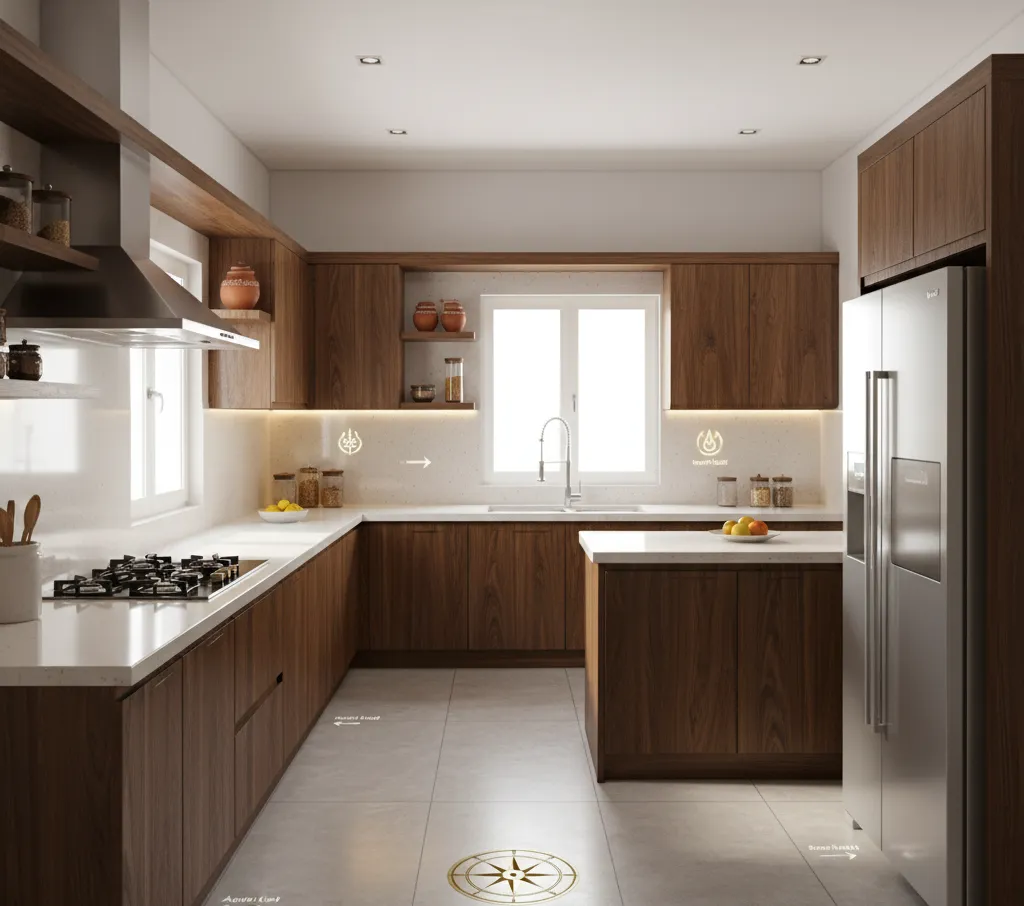
Before the Directions - Get Your Bearings First
This sounds obvious and gets skipped constantly: before applying any Vastu kitchen guidance, establish the actual compass directions of your kitchen.
Not approximately. Actually.
Stand in the centre of your kitchen with a compass - the one on your phone works perfectly - and identify north. Mark it mentally or physically. Now you know where all the other directions are.
The reason this step gets skipped is that people assume they know which direction their kitchen faces based on which way the building faces or where the sun comes in. These assumptions are frequently wrong by 45 degrees or more, which is enough to completely change which wall is east and which is southeast.
Before reading further - check the actual compass direction of each wall in your kitchen. North wall, south wall, east wall, west wall. Know specifically which wall the stove is currently on, which wall the sink is on, and where the refrigerator sits in relation to these directions.
Everything that follows will be more useful with that information in hand.
The Gas Stove - Direction and Placement
The gas stove is the most discussed appliance in kitchen Vastu and for clear reasons. In Vastu Shastra, fire - Agni - is the fundamental element the kitchen represents. The stove is where that fire lives. Its direction carries more Vastu significance than any other placement decision in the kitchen.
The ideal direction for the gas stove
The stove should be placed on the eastern wall of the kitchen. When the stove is on the eastern wall, the cook faces east while cooking - toward the direction of the rising sun, the direction associated with Agni and positive solar energy in Vastu.
The southeast wall is the second best option. The southeast is the Agni corner in Vastu - the direction specifically governed by the fire element. A stove on the southeastern wall is considered very well placed in Vastu terms.
Why east and southeast specifically
The eastern direction receives the morning sun. In a purely practical sense, a kitchen that catches eastern light is brighter and better ventilated in the morning hours when cooking most often begins. Vastu and practical design arrive at the same recommendation from different starting points - the east-facing kitchen has genuine daily functional advantages beyond the directional principle.
The southeast's association with fire is ancient and consistent across Vastu literature. The fire element finds its most natural expression in the southeast direction and placing the stove - the home's primary fire element - in alignment with this direction is the foundational principle of kitchen Vastu.
Acceptable alternatives
South wall - acceptable in Vastu. The cook faces south, which is not ideal but not the problematic directions. If the east and southeast walls are not available for stove placement due to the kitchen's layout or the gas line position, the south wall is a workable alternative.
Directions to avoid for the stove
North wall - problematic. The north is the direction of water element and the zone of Kuber, the deity of wealth. Fire on the northern wall creates an elemental conflict - fire and water in opposition - that Vastu associates with financial instability and health concerns. This is one of the more consistent warnings across Vastu literature and one of the most commonly violated in Indian apartments where the gas line happens to be on the north wall.
West wall - less ideal. West is earth element in Vastu and while fire on the west wall is not as specifically problematic as fire on the north wall, it's not the recommended placement.
Northeast wall - the most problematic placement of all. The northeast is the Ishan corner, the sacred water and spiritual energy zone. Fire in the northeast creates the strongest elemental conflict in Vastu - this is the placement associated with the most significant concerns. If the stove is currently on the northeast wall, this is the placement most worth addressing.
The cook's facing direction - as important as the stove's wall
Vastu is specific about this: the cook should face east or southeast while cooking. Not the stove's wall - the cook's face. When the stove is on the east wall, the cook faces east. When the stove is on the west wall, the cook faces east only if the stove is against the west wall and the cook stands west of it - which doesn't make sense physically. The stove wall and the cook's direction are directly connected.
This is why north-wall stoves are problematic beyond just the elemental direction - the cook faces north, which is both the water direction and the direction considered inauspicious for the active fire element of cooking.
The Kitchen Sink - Direction and Placement
Water is the element of the sink. In Vastu, water has its natural home in the north and northeast directions. The sink placement follows this elemental logic.
The ideal direction for the kitchen sink
Northeast is the ideal placement for the sink. The northeast is the water and spiritual energy zone - a sink in the northeast corner of the kitchen places the water element in its most natural Vastu home.
North wall is also excellent. The north is associated with water, prosperity, and the positive flow of energy - a sink on the north wall is very well placed in Vastu terms and is one of the more easily achievable recommendations since north-wall plumbing is common in Indian building design.
East wall is acceptable for the sink. Less ideal than north or northeast but within the range of workable placements.
Directions to avoid for the sink
South wall - not recommended. The south is associated with fire and earth elements. Water on the south wall creates an elemental tension.
Southeast wall - particularly problematic for the sink. The southeast is the Agni corner - the fire direction. Placing water (the sink) on the fire wall creates the sharpest water-fire conflict in kitchen Vastu. In a kitchen where the stove is correctly placed on the southeast wall and the sink ends up there too due to counter configuration, this is worth specifically trying to avoid.
Southwest wall - also avoid. Southwest is the earth element zone, associated with stability and weight. Water on the southwest is considered to undermine the stabilising quality of that direction.
The stove-sink separation principle
Beyond the individual directions for each appliance, Vastu is specific about the relationship between stove and sink. They should not be directly adjacent - immediately next to each other with no separation. They should not be directly opposite each other across a parallel kitchen corridor.
The fire-water opposition is the concern. When stove and sink are adjacent or directly facing, the fire and water elements are in constant proximity and opposition. Vastu associates this with tension - within the kitchen energy and within the household relationships of those who cook there.
The practical remedy when layout makes separation difficult - a small partition, a different countertop section, a tall vessel or plant placed between them as a visual and energetic separator. Even a few feet of counter space between the stove and sink reduces the directional opposition meaningfully.
In an L-shaped kitchen where both appliances are on the same counter run - position them on different arms of the L rather than on the same wall. In a parallel kitchen where they face each other - offset them so they don't sit directly opposite.
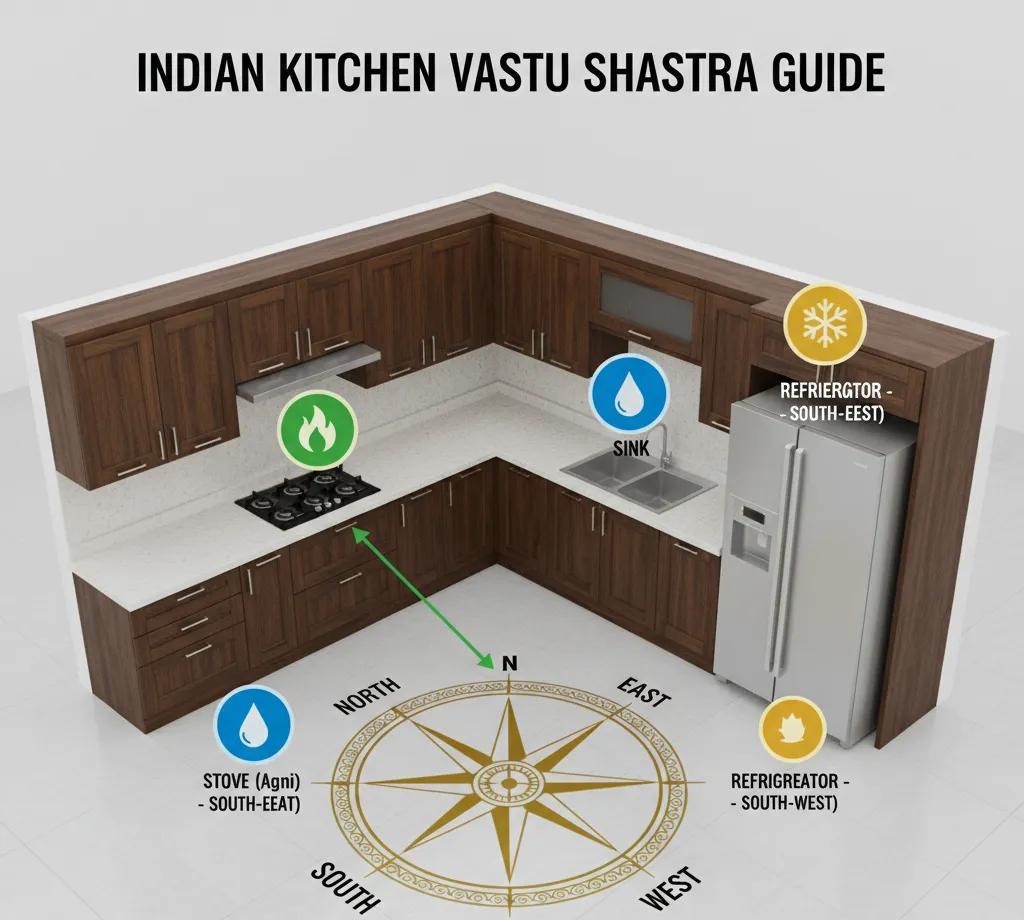
The Refrigerator - Direction and Placement
The refrigerator is the heaviest appliance in most kitchens - and Vastu treats weight and heavy objects as earth element. Heavy earth-element appliances belong in the directions associated with earth and stability.
The ideal direction for the refrigerator
Southwest is the ideal Vastu placement for the refrigerator. The southwest is the earth element direction - the zone associated with stability, grounding, and weight. Heavy appliances here are considered to reinforce rather than conflict with the directional energy.
South wall is very good. The south direction is associated with Yama (the deity governing stability and order) and with the earth element. A refrigerator on the south wall is well-placed in Vastu.
West wall is also acceptable. West is earth element and an appropriate direction for heavy storage and appliances.
Northwest wall - workable with some caveats. The northwest is the air element zone (Vayu corner) - not the ideal direction for a heavy earth-element appliance, but not specifically problematic. Many Indian kitchen configurations place the fridge in the northwest due to layout and it functions adequately from a Vastu perspective.
Directions to avoid for the refrigerator
Northeast corner - this is the most significant refrigerator placement to avoid in Vastu. The northeast is the Ishan corner - the sacred water and spiritual energy zone that Vastu specifically directs should be kept light, open, and free from heavy objects. A refrigerator in the northeast corner places significant earth-element weight exactly where Vastu says weight should not be. This is a specific and consistently stated concern across Vastu literature.
North wall - less ideal than the southwest/south/west options. While not as problematic as the northeast corner specifically, a heavy appliance on the north wall works against the light, open quality Vastu associates with that direction.
The refrigerator door opening direction
This detail is less commonly mentioned and worth knowing. In Vastu, the refrigerator door should ideally open toward the south or west - meaning the hinge is on the north or east side and the door swings south or west when opened. This is a minor consideration compared to the overall placement direction, but in a kitchen being specifically designed with Vastu in mind, it's worth factoring into which wall the fridge is placed against and which side the door hinges are on.
Height and visual weight
In Vastu, the principle of keeping the north and east walls lighter and the south and west walls heavier extends to height as well. A tall refrigerator on the southwest or south wall is appropriate - the height reinforces the solidity associated with that direction. The same tall refrigerator on the north or east wall visually and energetically weighs down the direction that Vastu says should be kept open and light.
When All Three Are in the Wrong Directions
This is the situation in most Indian apartments. The gas line is where the builder put it. The plumbing is on whatever wall suited the building's infrastructure. The kitchen was designed for function and space efficiency, not directional alignment.
Stove facing north. Sink on the south wall. Fridge in the northeast corner. All three in less than ideal positions simultaneously.
The question is always: what do you do?
The honest answer has two parts.
Part one - what can be changed
During a renovation or initial kitchen fit-out, stove placement is the single most important change to make if any change is possible. Rerouting the gas line during a renovation is not as expensive or disruptive as it sounds when done as part of a larger kitchen project. If the gas line can be moved to allow the stove to face east or southeast, this addresses the most significant Vastu kitchen concern and is worth the additional cost.
Plumbing for the sink is more fixed and more expensive to move. If the sink cannot be relocated, the remedies for water-fire proximity become relevant - distance, partition, plant between stove and sink.
Refrigerator placement is often the most flexible - it's not plumbed and not connected to a fixed gas point. If the fridge is currently in the northeast corner, simply moving it to the south or west wall requires no structural work. This is the easiest Vastu correction in many kitchens and one that makes an immediate and visible difference to the Vastu alignment of the space.
Part two - when nothing can be changed
When the kitchen is fully fitted, the gas line is fixed, the plumbing is fixed, and full renovation is not happening - the remedies that don't require structural change:
For a north-facing stove: a copper strip affixed to the wall behind the stove, as close to the southeast corner of that wall as possible. A Vastu yantra placed on the north wall of the kitchen to address the water-fire conflict. The cook consciously facing as close to east as the stove position allows - even a slight body angle toward the east while cooking is considered meaningful in Vastu.
For a south-wall sink: a small bowl of water with a few drops of Ganga jal placed in the northeast corner of the kitchen - reinforcing the water element in its correct direction even though the physical sink is not there.
For a northeast refrigerator: move it if at all possible - this is the one change that requires no plumbing and no gas work. If truly impossible, a Vastu pyramid placed in the northeast corner alongside the refrigerator, and keeping the area scrupulously clean, are the primary remedies.
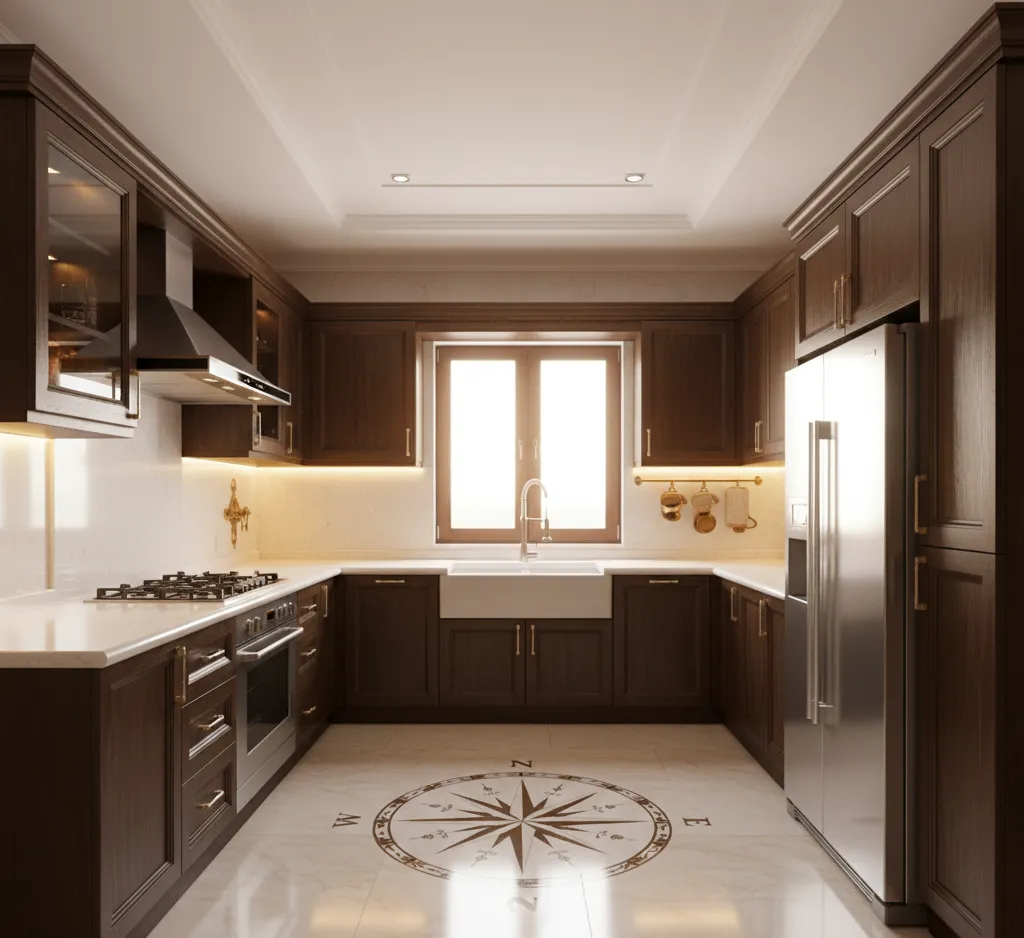
The Direction Summary - Quick Reference
Gas Stove Best: East wall (cook faces east) Also good: Southeast wall Acceptable: South wall Avoid: North wall, northeast wall, southwest wall
Kitchen Sink Best: Northeast corner or north wall Also good: East wall Avoid: Southeast wall, south wall, southwest wall
Refrigerator Best: Southwest corner or south wall Also good: West wall, northwest wall Avoid: Northeast corner, north wall
Cook's Facing Direction While Cooking Best: East Also good: Southeast, south Avoid: North, northwest, northeast
The Relationship Between All Three
Vastu does not look at each appliance in isolation - it looks at the kitchen as a system of elemental relationships. The ideal kitchen has all three appliances placed so that their elemental associations don't conflict with each other or with the directional zones they occupy.
Stove in the east or southeast - fire element in the fire direction. Sink in the north or northeast - water element in the water direction. Fridge in the southwest or south - earth element in the earth direction.
When all three are correctly placed, each occupies its natural elemental zone and the kitchen functions as a balanced elemental system. When one or more are misplaced, the remedies described above address the specific conflict that arises.
The kitchen that achieves this balance - even approximately, even with remedies filling the gaps where the ideal couldn't be achieved - is considered in Vastu to support the health, prosperity, and harmony of the household in a way that a kitchen with unaddressed elemental conflicts does not.
Whether that framework is held fully or partially, the practical outcome of applying these principles - a kitchen where the cooking area is well-placed, the water and fire elements are separated, and the heavy appliances are on the stable walls - is a kitchen that functions well and feels right to work in.
Which, in the end, is what any kitchen should do.
More Vastu and practical kitchen planning guidance for Indian homes at Kitchen Kaki.
