
Kitchen Ventilation in Jaipur: Best Chimneys for Heavy Tadka & Frying
Three dead chimneys. One motor burned from grease. One too weak for two burners. One slowly dying because nobody mentioned the oil cup. Here's everything my family learned about kitchen ventilation the expensive way.
The Ultimate Guide to Kitchen Ventilation in Jaipur: Chimneys for Heavy Tadka & Frying
We've killed three chimneys in this family. THREE. My mummy's kitchen alone has gone through two. My uncle's Mansarovar rental burned through one in fourteen months. And my chachi - bless her - is currently using a chimney that sounds like a diesel autorickshaw and she thinks that's normal because nobody told her it isn't.
I didn't care about kitchen chimneys until the day my mummy made hing tadka with the chimney off - the motor had died the night before - and within ten minutes our living room curtains smelled like a dhaba on NH-48. My dad was sitting on the sofa watching cricket and he genuinely thought something was burning in the building. "Is there a fire?" he asked, alarmed, while mummy stood at the stove looking at the dead chimney like it had personally betrayed her.
That was the moment I became the family's unofficial chimney researcher. A role I never wanted and cannot resign from.
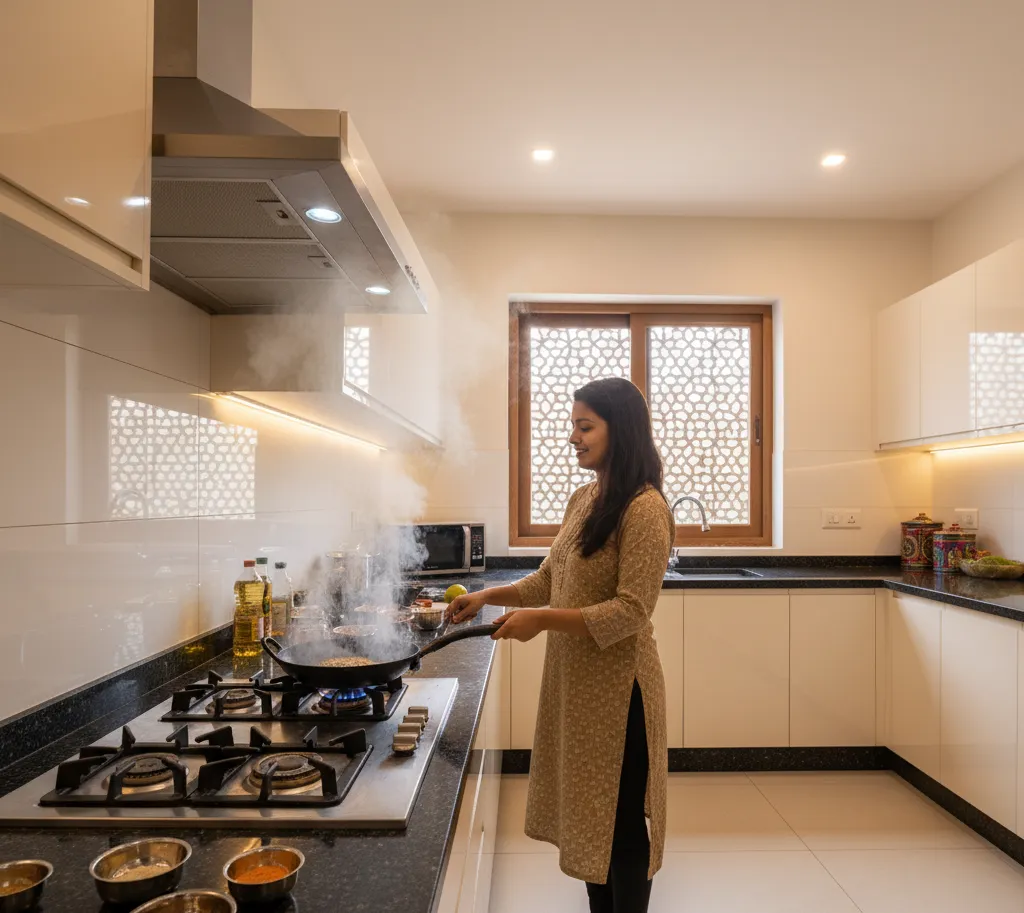
How Mummy's First Chimney Died
When we did the kitchen renovation in 2020 - the one I've talked about in other blogs, Ramu kaka's kitchen to modular, seven days, the whole saga - the kitchen company bundled a chimney in the package. Basic model. Curved glass. 1000 m³/hr suction. Mesh filter. Cost maybe ₹6,000-7,000 as part of the total deal. We didn't question it because, honestly, who knows anything about chimneys when they're busy picking cabinet colours and arguing about quartz?
First six months - fine. Worked great. Sucked up the smoke, kept the kitchen clear. Mummy was happy.
Then the problems started. The mesh filter - this layered aluminium screen that's supposed to catch grease - got clogged. Like, REALLY clogged. Indian cooking produces absurd amounts of oil vapour. Every tadka, every deep-fried batch of pakoras, every tawa paratha oozing ghee - all that oil goes up as microscopic particles and gets trapped in the mesh. Within two months the mesh looked like someone had dipped it in a bucket of old cooking oil.
Mummy didn't know she was supposed to clean it. The kitchen company never mentioned it. There were no instructions. No "clean every two weeks" sticker on the chimney. Nothing. She found out when the suction dropped so badly that smoke just hovered at the ceiling and refused to leave.
I Googled how to clean it. Soaked the mesh in hot water with baking soda and vinegar. Scrubbed with a toothbrush for thirty minutes. Got maybe 60% of the grease out. The mesh was also slightly bent from my enthusiastic scrubbing. Put it back in. Suction improved but not to original levels.
This cleaning drama repeated every 3-4 weeks. Eventually mummy just... stopped doing it because who has 30 minutes every month to scrub a greasy metal sheet with a toothbrush? The suction degraded. The motor worked harder to compensate. And fourteen months after installation, the motor burned out.
₹6,000 chimney. Fourteen months of life. Dead.
The Replacement That Actually Survived
This time I did research. Talked to three different appliance store guys on MI Road. Called my cousin in Bangalore who'd just bought one. Read approximately 400 Amazon reviews at 1am on a Tuesday because I have problems.
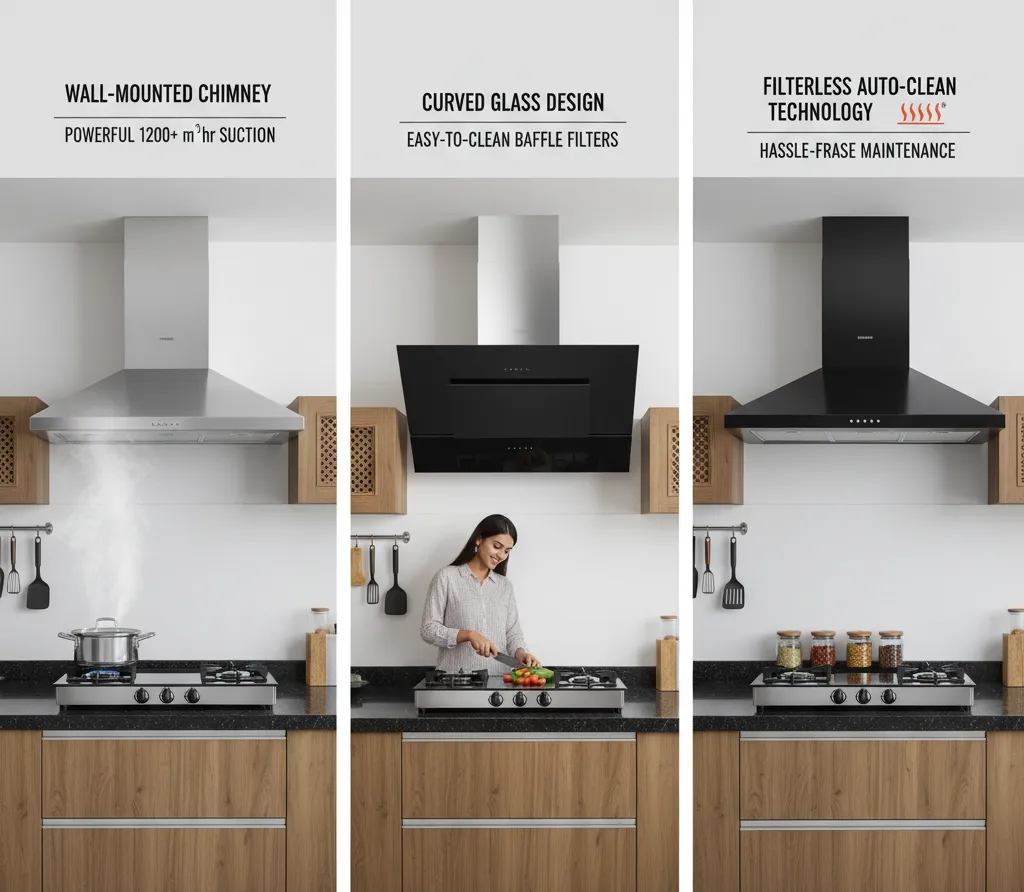
What I learned - and what I wish someone had told us before - is that for Indian cooking, specifically Rajasthani cooking where we're doing tadka in hot ghee, deep frying kachoris, making chhonk with whole red chillies, and running the stove for 3-4 hours daily across multiple meals - there are really only two filter types worth considering.
Baffle filter or auto-clean filterless. That's it. Mesh filters are for kitchens where people make salad and toast. Not for kitchens where mummy is frying 30 pooris for a family gathering while simultaneously doing a jeera-hing tadka on the other burner.
We went with an auto-clean chimney. ₹14,500. The way it works is genuinely clever - when grease builds up, you push the auto-clean button. The chimney heats an internal plate. The grease melts and drips into a small removable oil collector cup at the bottom. You empty that cup every two weeks. Takes 10 seconds. No scrubbing. No soaking filters. No toothbrush. No 30-minute cleaning sessions.
Mummy has had this chimney for four years now. Four years. The motor is fine. The suction is still strong. She empties the oil cup every couple of weeks - it fills up with this thick yellowish grease that honestly looks disgusting but at least it's IN the cup instead of ON the motor. She runs the auto-clean cycle maybe once a month. The inside of the chimney is cleaner than the outside, which is ironic but true.
The ₹14,500 hurt at the time. But divided by four years? That's ₹3,625 per year. The ₹6,000 mesh chimney lasted fourteen months - that's ₹5,143 per year. The expensive chimney is actually CHEAPER per year of use. I did this math for my dad and he got very quiet, which is how I know I won that particular argument.
My Uncle's Chimney Disaster (A Cautionary Tale About Suction Power)
My uncle's Mansarovar rental kitchen - the one with the parallel layout mistake, regular readers will remember my guilt - came with a 60cm chimney at 800 m³/hr suction. The kitchen company said it was "sufficient for a small kitchen."
It was not sufficient. Not even close.
The tenants - the young couple from Jodhpur - cook on two burners simultaneously most evenings. One burner for the main sabzi, one for the tadka or rotis. With 800 m³/hr, the chimney could handle one burner's worth of smoke. The second burner's smoke would drift out from under the chimney's edges and float into the living room because the kitchen is open-plan.
Within six months, the ceiling above the stove had a visible yellowish tint. The wall next to the chimney - the part the chimney didn't cover - had a faint grease film you could feel with your fingers. The living room sofa, which is maybe 12 feet from the stove, started smelling vaguely of cooking oil.
The tenant called my uncle. "The chimney doesn't work properly." My uncle called me. "What's wrong with the chimney?" I went to look. The chimney was working. The motor was fine. The filter was clean. The problem was simple - 800 m³/hr isn't enough for Indian cooking on two burners.
For daily Indian cooking you need minimum 1000-1200 m³/hr. If you fry frequently - pakoras, pooris, samosas, anything involving a kadai of oil - you want 1200-1500. My mummy's auto-clean chimney is 1300 m³/hr and it handles her worst days - the days when she's frying AND doing tadka AND the pressure cooker is venting steam - without breaking a sweat.
My uncle replaced the 800 with a 1200 m³/hr model. ₹11,000 because he went with a baffle filter this time, not auto-clean, because it was a rental and he didn't want to spend ₹14,000+ on a tenant's kitchen. Baffle filters are the middle ground - they're steel plates with slits that separate grease from smoke using a cut-and-chop mechanism. They clog slower than mesh filters and they're easier to clean - you can soak them in hot soapy water and the grease slides off in 15 minutes instead of needing a toothbrush.
The tenants are happy now. The ceiling stopped getting yellower. The sofa stopped absorbing oil. But my uncle is annoyed about paying ₹11,000 for something that should've been right the first time. "You could've told me," he said. I could've. But I was too busy feeling guilty about his parallel layout to think about his chimney. I can only carry so many kitchen regrets at once.
Chachi's Autorickshaw Chimney
I was at chachi's place in Pratap Nagar last month. She was making dal. The chimney was on. And it was making this NOISE - a deep, vibrating, grinding hum that literally shook the glass panel on the chimney's front. It sounded like a motor struggling against something. Because it was. Her oil collector cup - the auto-clean cup - was full. Not just full. Overflowing. Grease had spilled over the cup lip and was dripping onto the motor casing.
"Has it always sounded like this?" I asked.
"For about two months," she said casually.
TWO MONTHS. She'd been cooking with a chimney whose motor was drowning in its own grease for TWO MONTHS because nobody told her that the auto-clean cup needs to be emptied. The kitchen company that installed it - this was a different company from ours, some showroom in Vaishali Nagar - apparently never explained the maintenance. They sold her a ₹16,000 chimney and didn't spend 30 seconds saying "empty this cup every two weeks."
I emptied the cup. It was thick, dark, congealed oil-grease. The kind of stuff that makes you briefly consider vegetarianism. I cleaned the motor casing with a damp cloth. The noise dropped by maybe 70%. Not fully gone - I think some grease had gotten into the motor bearings at that point - but dramatically better.
Chachi looked at me like I'd performed surgery. "You just fixed my chimney," she said. I hadn't fixed anything. I'd emptied a cup. That's it. A ₹16,000 appliance was being slowly destroyed because nobody told a 55-year-old woman to empty a small plastic cup every two weeks.
This is the thing that makes me genuinely frustrated with the kitchen appliance industry. They sell you the chimney. They don't teach you how to live with it. The chimney salesman assumes you'll read the manual. Nobody reads the manual. The manual is in English and technical and gets shoved in a drawer with the warranty card. And then three years later your motor burns out and you buy another chimney and the cycle repeats.
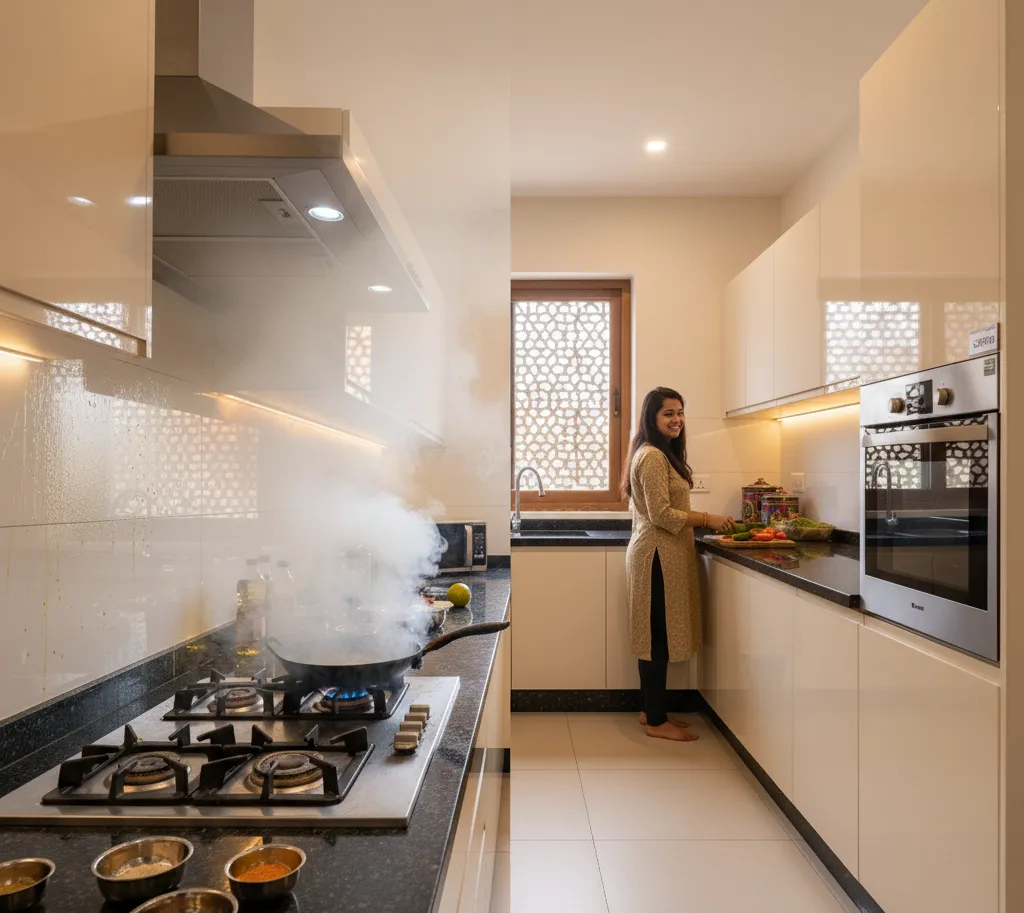
What I Actually Tell People Now
When Radhika asked me last month which chimney to get for her Jagatpura kitchen, I sent her a voice note that went on for probably too long. Here's the gist of what I said between the ums and the part where I paused to yell at my dog:
If you cook serious Indian food daily - tadka, frying, rotis on tawa, the works - get an auto-clean chimney with at least 1200 m³/hr suction. 60cm width if you have a 2-3 burner hob. 90cm if you have a 4-burner or wider cooktop. Budget ₹12,000-16,000. It'll last you 4-5 years minimum if you empty the oil cup regularly. That cup thing is non-negotiable. Set a phone reminder for every two weeks. I don't care if it feels excessive. Do it.
If you're on a tighter budget, get a baffle filter chimney - the kind with steel plates, not aluminium mesh. At least 1000 m³/hr. Budget ₹8,000-12,000. Clean the baffle filter once a month - soak in hot water with dishwashing liquid for 20 minutes, rinse, dry, put back. Honestly not that hard once you get into the habit.
Do NOT get a mesh filter chimney for Indian cooking. Just don't. I don't care how cheap it is. The mesh clogs in weeks, the cleaning is miserable, and the motor dies within a year or two. We learned this with ₹6,000 and fourteen months of frustration. You don't have to.
One more thing - install your chimney 24 to 28 inches above the gas stove. Not higher. Every inch higher you go, the suction efficiency drops because smoke disperses before reaching the chimney intake. I've seen chimneys installed 3 feet above the stove because the cabinet configuration forced it. Those chimneys look great and capture approximately 60% of the smoke they should. The other 40% goes to your ceiling and curtains.
Radhika went with a 1300 m³/hr auto-clean for ₹13,500. I told her about the oil cup. She set a reminder. She sends me photos of the full cup now. Last one had the caption "look at this disgusting thing" with a laughing emoji. I've created another kitchen monster.
The Ducting Thing Nobody Thinks About Until It's Too Late
Quick tangent because I almost forgot and this matters.
Chimneys come in two types of airflow - ducted and ductless. Ducted means the chimney pushes the dirty air OUT of your house through a pipe in the wall. Ductless means it filters the air and recirculates it back into the kitchen. For Indian cooking, you want ducted. Every time. No debate. Ductless chimneys are for studio apartments in Europe where someone is poaching an egg. Not for kitchens where the air turns yellow from hing tadka.
BUT - and this is important - the duct pipe needs to go somewhere. Through the wall. To the outside. Shortest path possible. Minimal bends. Every 90-degree bend in the duct pipe reduces suction by roughly 10-15%. My mummy's chimney has one bend. Works great. My uncle's first chimney had THREE bends because the contractor ran the pipe around a beam and through a false ceiling. Three bends meant 30-40% suction loss. No wonder it felt weak.
If you're renovating, plan the duct path BEFORE finalising the chimney position. Talk to your contractor about it on Day 2 - the boring pipes-and-wires day that determines everything. Not after the cabinets are up. By then it's too late and you end up with a duct pipe that takes a scenic route through your kitchen ceiling before finding a wall to exit.
Ask me how I know this. Actually don't. I'll get upset.
More kitchen survival advice for Jaipur homes? KitchenKaki - where every blog is a lesson someone in my family paid for.
