
Kitchen Work Triangle: What It Is & How to Plan It Right | Kitchen Kaki
My grandmother's kitchen had no counters — she cooked on a low platform, squatting on a stool, with everything in a radius she had spent decades optimising. Nobody told her about the kitchen work triangle. And yet the principle was embedded in every decision she made. Here's what the work triangle actually is, how it applies to every Indian kitchen layout, and the five mistakes that make kitchens work against you instead of for you.
Kitchen Work Triangle: What It Is & How to Plan It Right
My grandmother's kitchen had no counters.
Not in the modern sense - no continuous stone surface running along three walls with cabinets above and below. She cooked on a low platform that ran along one wall, squatting or sitting on a low stool, with everything organised around her in a radius she had spent decades optimising. The flour was here. The masalas were there. The vessel she needed next was always within arm's reach because she had put it there deliberately, based on the sequence of what she was making.
Nobody told her about the kitchen work triangle. She had never heard the phrase. And yet the principle - keep the things you use most within the shortest possible path between each other - was embedded in every decision she made about where things lived in that kitchen.
The kitchen work triangle is that principle, formalised. Named, measured, and turned into a planning concept that kitchen designers have used for the better part of a century. Understanding it properly - what it actually means, how it applies to the specific layouts found in Indian homes, and where it breaks down - makes kitchen planning significantly more rational and significantly less dependent on guesswork.
What the Work Triangle Actually Is
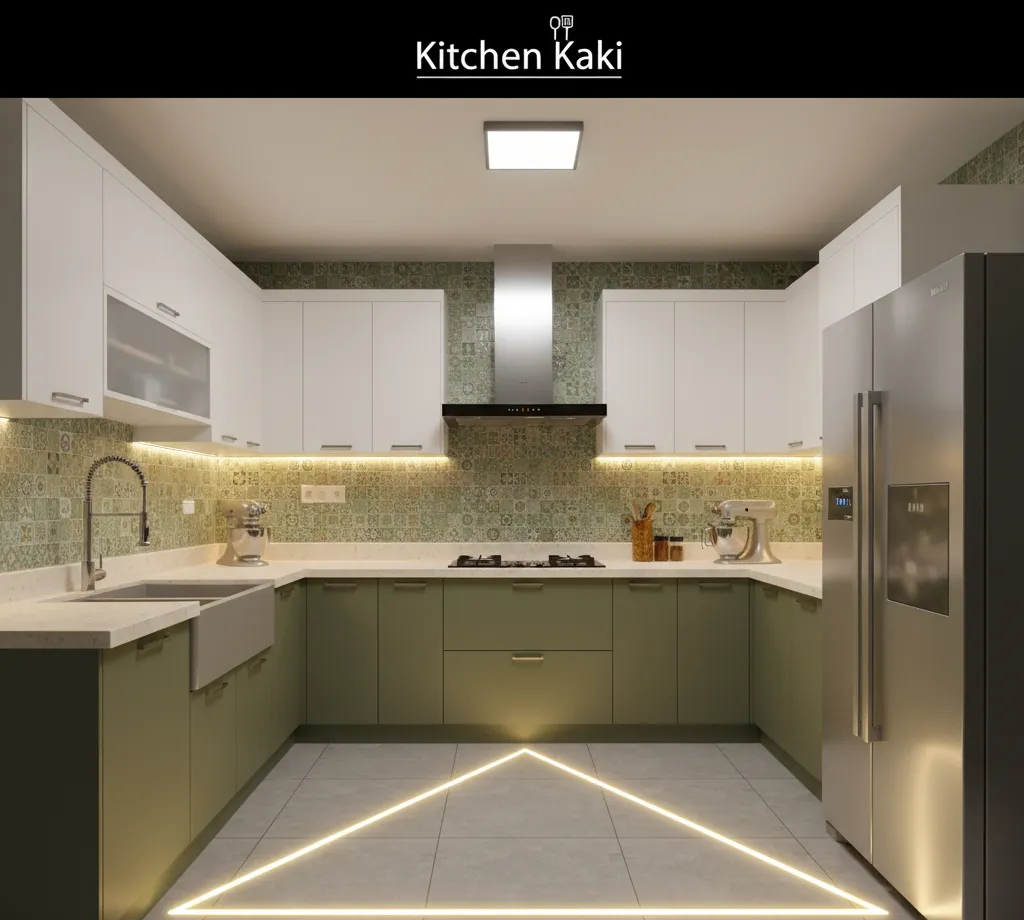
The work triangle is the imaginary triangle formed by connecting three points in a kitchen: the refrigerator, the sink, and the cooking hob.
These three points were identified as the primary activity zones of a kitchen based on how cooking actually happens - you take something from the refrigerator, you wash or prepare it at the sink, you cook it at the hob. The movement between these three points is the core movement of cooking. Everything else - the pantry, the spice storage, the serving area - is secondary.
The triangle has traditionally come with three measurements:
Each leg of the triangle - the distance between any two of the three points - should be between 4 feet and 9 feet. Too short and the three zones are cramped together. Too long and you're walking significant distances between essential activities.
The total perimeter of the triangle - all three sides added together - should be between 13 feet and 26 feet. A total below 13 feet means the kitchen is cramped. A total above 26 feet means excessive walking during cooking.
No major traffic path should cross through the triangle. If the path from the dining room to the back door runs through the middle of the cooking triangle, the cook is constantly interrupted by people passing through.
These measurements come from American kitchen research conducted in the 1940s and have been refined since. They are not sacred numbers - they're guidelines derived from observation of how people actually move while cooking. Understanding this makes it easier to apply them sensibly rather than follow them rigidly.
Why the Triangle Still Matters in Indian Kitchens
Indian cooking is more physically demanding of the kitchen than the single-cook, single-dish Western cooking the triangle was originally designed around. We've established this across several articles on this site. The multi-burner, multi-dish, multi-person nature of serious Indian cooking puts more pressure on kitchen efficiency than most international kitchen planning frameworks anticipate.
This makes the work triangle more important for Indian kitchens, not less.
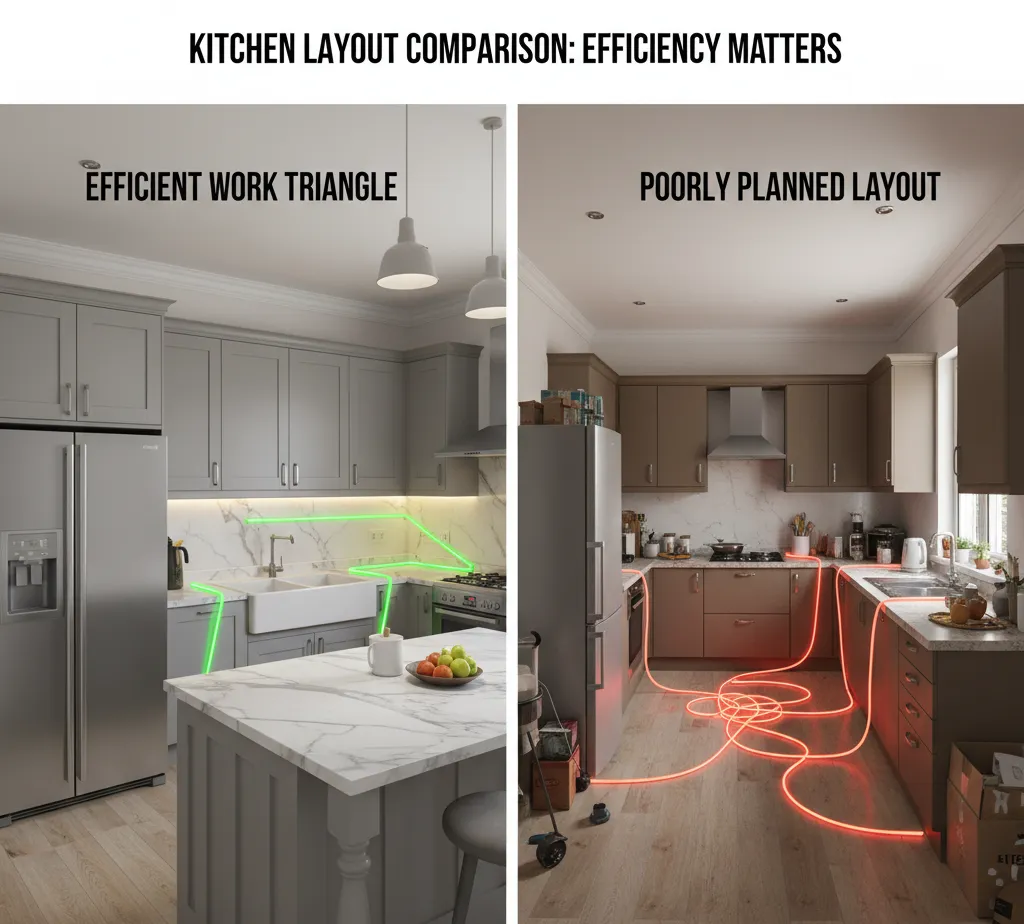
When the triangle is poorly planned - when the refrigerator is across the kitchen from the sink, or the hob is on the opposite wall from the prep area - the cook makes many more unnecessary movements per meal than the recipe requires. Each individual extra step is small. Accumulated over a full Indian meal - dal, sabzi, roti, rice, possibly a side - they add up to a cook who is genuinely more tired at the end of cooking than the cooking itself requires them to be.
This is the thing about a well-planned kitchen that's hard to prove to someone who hasn't experienced both. In a kitchen where the triangle works, cooking feels easier than the cooking itself. The kitchen is helping. In a kitchen where the triangle is broken, cooking feels harder than the recipe. The kitchen is adding friction to every task.
The Triangle in Different Kitchen Layouts
How the work triangle applies differs by layout - and in Indian kitchens, four layouts dominate.
Straight / Single Wall Kitchen
The most compact layout - everything on one wall. Refrigerator at one end, sink in the middle, hob at the other end or arranged in some variation of this sequence.
Strictly speaking, a single-wall kitchen doesn't have a triangle - all three points are on a line. It has a work corridor. The relevant measurement here is the total distance between refrigerator and hob with the sink somewhere in between. Keep this total distance under 10 to 12 feet if possible. Beyond that, the cook is walking significant distances along a single wall for every cooking sequence.
Sequence matters more than triangle geometry in a single-wall kitchen. The logical flow is refrigerator → sink → hob - ingredients come out of the fridge, get washed at the sink, go to the hob. Put the hob between the fridge and sink and you're carrying washed vegetables past the hob to the sink and then back - unnecessary movement.
L-Shaped Kitchen
Two walls in an L configuration. The triangle now has genuine geometry - the three points can be distributed across the two walls.
The ideal L-shaped triangle places the refrigerator near the entry end of one arm, the sink in the corner zone or along one arm, and the hob along the other arm. This distributes the work triangle so that no two high-activity zones compete for the same small area.
The corner itself - the internal corner of the L - is not ideal for any of the three triangle points. Corner zones are difficult to work in because you can't stand directly in front of them. Place the sink or a prep counter near the corner, not the hob or the refrigerator.
Parallel / Galley Kitchen
Two facing walls with a corridor in between. The triangle in a parallel kitchen lies across the corridor - typically the refrigerator and sink on one side, the hob on the other, or the sink on one side and both the refrigerator and hob on the other.
The corridor width becomes a triangle dimension here. A 900mm to 1100mm corridor means the distance between the two counter runs is exactly right for a functional triangle - the cook can turn from one side to the other with a single pivot rather than a walk.
The most common parallel kitchen triangle mistake: placing the sink and the hob on the same wall with the refrigerator on the opposite wall. This forces the cook to walk across the corridor to get ingredients from the fridge, back across to the sink, across again to the hob. The corridor crossing should happen once per cooking sequence - not three times.
Better: refrigerator at one end of one wall, sink on that same wall, hob on the opposite wall. The sink and hob face each other across the corridor - a short pivot - and the refrigerator is a short walk along one wall.
U-Shaped Kitchen
Three walls. The triangle has the most room to breathe in a U-shaped kitchen and is easiest to plan correctly.
The natural distribution: refrigerator on one arm of the U, sink at the base or on a second arm, hob on the third arm. Each point of the triangle occupies a different wall. The cook moves between walls - a short step or pivot - rather than along a single wall or across a corridor.
The risk in a U-shaped kitchen is over-spacing - making the triangle too large by placing the three points too far apart. A U-shaped kitchen where the refrigerator is at one far end of one arm and the hob is at the far end of the opposite arm has a very long triangle and a cook who walks a lot. Keep the active triangle points toward the centre of each wall rather than at the far ends.
The Multi-Cook Reality - Where the Triangle Breaks Down
The work triangle was designed for one cook. Indian kitchens frequently have two.
When two people cook simultaneously - one making rotis while the other manages dal and sabzi, or one doing prep while the other manages the active cooking - a single triangle is inadequate. Both cooks share the same three points and compete for access to them.
The modern update to the work triangle concept acknowledges this: the work zone approach.
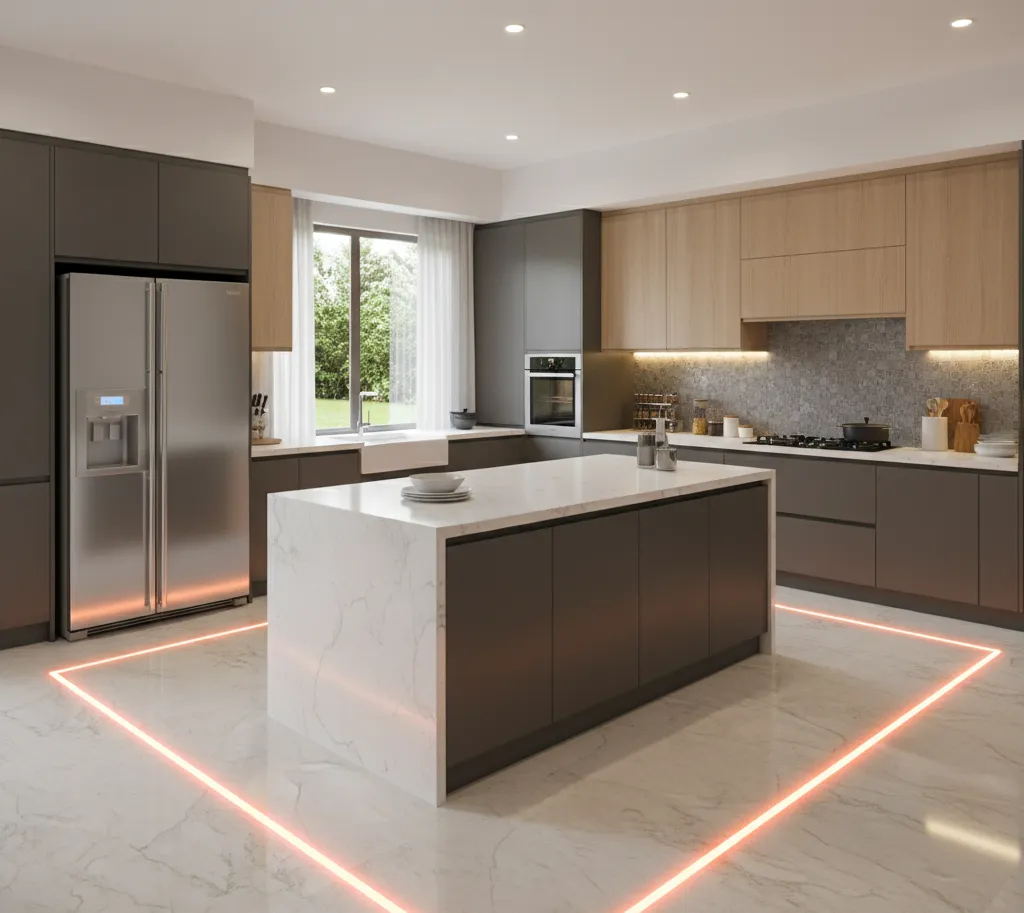
Instead of a single triangle, think of the kitchen as having multiple zones - a cooking zone (hob and immediate counter), a prep zone (sink area with counter), a storage zone (refrigerator and pantry), and a cleaning zone (sink and dishwasher area). Each zone is designed for a task and positioned so that two people can work in different zones without constantly crossing each other's path.
For Indian kitchens specifically, a dedicated roti-making zone - a section of counter at a comfortable height for rolling, with the chakla surface and atta storage immediately adjacent - is worth building into the zone plan. This is the one task in Indian cooking that most consistently conflicts with the main cooking triangle because it requires counter space near the hob (for putting rotis on the tawa) while also needing prep space for rolling.
Positioning the roti counter as a distinct zone adjacent to but not in the centre of the main triangle solves this without requiring the roti-maker and the main cook to compete for the same surface.
Common Triangle Mistakes in Indian Kitchen Planning
Mistake 1: Letting the contractor decide.
In many Indian kitchen renovations, the gas line and plumbing points are placed wherever is easiest for the contractor rather than wherever creates the best work triangle. The hob goes where the gas line runs, the sink goes where the plumbing runs, and the refrigerator goes wherever is left. The triangle is an accident of infrastructure rather than a plan.
The fix - decide the triangle first, then ask the contractor to route the gas line and plumbing to match the triangle. During a renovation, rerouting plumbing and gas lines is a fraction of the total project cost. Doing this correctly once costs less than living with the wrong triangle for ten years.
Mistake 2: The refrigerator at the far end.
A refrigerator placed at the far end of a kitchen - away from both the sink and the hob - creates a long triangle with one very long leg. Every time ingredients come out of the fridge, the cook walks a long distance before cooking begins. Place the refrigerator near the kitchen entry - close enough to the sink to make the fridge-to-sink leg of the triangle short.
Mistake 3: The corner hob.
A hob placed in or very near the corner of an L or U-shaped kitchen is difficult to work at. The cook can't stand directly in front of it. The counter on either side of the corner hob is awkward to use. Reaching across the hob to the back burners near a corner is uncomfortable and potentially unsafe. Keep the hob away from corners.
Mistake 4: Traffic through the triangle.
If the path from the kitchen entry to the dining area, or from the living room to the back of the house, passes through the work triangle - the cook is interrupted every time someone walks through. In open-plan kitchens especially, plan the kitchen so the main cooking activity zone is not in the direct path of household movement.
Mistake 5: Triangle too large for the cook.
A large kitchen is not automatically a good kitchen. A work triangle with a 24-foot perimeter is technically within the guidelines but means the cook walks a significant distance for every cooking sequence. In a large kitchen, keep the active work triangle compact and use the additional space for a second work zone, a prep island, or extended storage - not for stretching the triangle.
Measuring Your Own Triangle
If you're planning a kitchen renovation or evaluating an existing kitchen layout, here is the practical way to measure your own work triangle.
Find the centre point of the refrigerator, the centre point of the sink, and the centre point of the hob. Measure the straight-line distance between each pair of points - fridge to sink, sink to hob, hob to fridge. These three measurements are the three legs of your triangle.
Add them together for the perimeter. Is it between 13 and 26 feet (roughly 4 to 8 metres)? Are any individual legs shorter than 4 feet or longer than 9 feet? Is there a main traffic path cutting through the triangle?
This takes five minutes with a tape measure and tells you more about why your kitchen does or doesn't feel efficient than any amount of subjective assessment.
If you're planning a new kitchen - do this exercise with the floor plan before anything is finalised. Draw the triangle on the plan. Measure the legs. Make adjustments to the layout while adjusting still means moving a line on paper rather than rerouting a gas line through a finished wall.
The Triangle Is the Starting Point, Not the Whole Story
A kitchen planned with a good work triangle is not automatically a great kitchen. It's a kitchen with the right foundation - the primary movements of cooking are efficient, the cook isn't working against the layout for every basic task.
Everything else - storage placement, counter height, lighting, ventilation, the specific zones for Indian cooking tasks - builds on this foundation. A kitchen with a perfect triangle and no under-cabinet lighting, or a perfect triangle and no dedicated prep space near the sink, is still a kitchen that makes cooking harder than it needs to be.
But a kitchen without a functional work triangle is a kitchen where the fundamental problem cannot be fixed by better storage or better lighting or better anything. The layout is the structure. Get the triangle right first. Everything else can be refined. The triangle cannot be fixed after the kitchen is built without rebuilding it.
My grandmother never measured a triangle. She just knew, from decades of cooking, that the flour needed to be where she could reach it without standing up, the water within arm's reach, the fire directly in front. She had arrived at the principle without the framework.
The framework just lets us get there faster - ideally before the kitchen is already built.
More practical kitchen planning guides for Indian homes at Kitchen Kaki.
