
Low Budget Modular Kitchen Design Ideas Under ₹1.5 Lakh
My brother had ₹1.5 lakh for his entire kitchen. Including chimney. Including hob. Everyone said it wasn't enough. It was. Here's exactly how we built it.
Low Budget Modular Kitchen Design Ideas Under ₹1.5 Lakh
My brother got married last year. He and Priya moved into a rented 2BHK in Vaishali Nagar. The kitchen had bare walls, a gas connection, and a sink. That's it. No cabinets. No counter. No storage. Just a room that theoretically could become a kitchen if someone spent money on it.
The problem? They'd just spent a LOT on the wedding. My dad had opinions about how the money was going. Priya's parents had contributed. Everyone was financially bruised. My brother sat me down at a chai stall near Gaurav Tower and said, "I have ₹1.5 lakh. Total. For the entire kitchen. Including chimney and hob. Can it be done?"
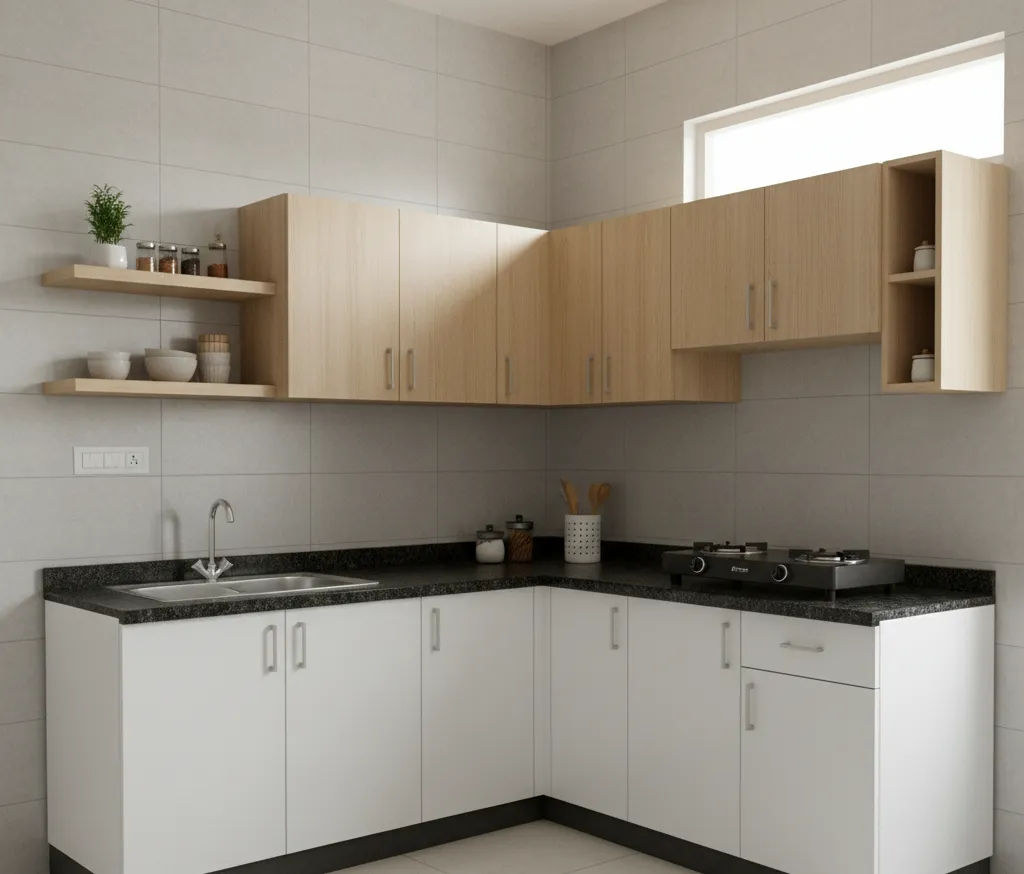
I told him honestly - it would be tight. ₹1.5 lakh for a complete modular kitchen is basically the floor. Below that you're either getting terrible materials or an incomplete kitchen. But at exactly ₹1.5 lakh, with smart choices and a few compromises? Yeah. It can be done.
And we did it. His kitchen works. Looks decent. Hasn't fallen apart. Priya cooks full meals in it every day. Here's how we got there, what we spent on, what we skipped, and the one decision I'd change if I could go back.
The First Conversation With the Kitchen Guy
We went to three modular kitchen showrooms on Ajmer Road. The first one quoted ₹2.8 lakh for a "basic" L-shaped kitchen. My brother and I looked at each other and walked out. The second one quoted ₹2.1 lakh but said they "might" be able to trim it. The word "might" in a sales conversation means "no."
The third guy - small operation, showroom was basically a garage with sample doors screwed to a wall - listened to our budget and didn't flinch. "₹1.5 lakh? Possible. But you'll need to make choices." I liked him immediately because he didn't pretend we could have everything.
He pulled out a calculator and started breaking it down right there on the sample counter. This is roughly what he said, and I wrote it on my phone because I knew I'd need the numbers later:
The cabinets - both base and wall units - would take about ₹70,000-80,000 of the budget. That's materials (plywood for carcass, laminate for shutters), hardware (hinges, drawer channels), and manufacturing plus installation. The countertop would be about ₹8,000-12,000 depending on material. Chimney ₹10,000-12,000. Hob ₹5,000-7,000. Sink ₹2,500-3,500. The rest would go to accessories, edge banding, silicone, electrical points, and whatever random costs always appear during installation. He called those "the surprises" and said budget ₹5,000 for them.
Looking at those numbers, ₹1.5 lakh was doable but there was no room for fancy anything. Every rupee had a job.
Where We Saved Money (And Where We Refused To)
This part was essentially a negotiation between what we wanted, what we needed, and what we could actually afford. My brother and Priya had different priorities. She wanted it to look nice. He wanted it to not collapse. I wanted the materials to last at least 8-10 years. Here's how the arguments went.
The carcass material was the first fight. The kitchen guy offered three options. Particle board - cheapest, about ₹35 per square foot. MDF - middle, about ₹45. BWR plywood - best, about ₹75-90.
I vetoed particle board immediately. My uncle's termite-destroyed kitchen was built with cheap board and I will never let anyone in my family make that mistake again. I will physically block them from signing the quotation if necessary. Priya knows this story by now because I've told it approximately forty times.
But BWR plywood at ₹75-90 per square foot for the entire kitchen would eat the budget alive. So we compromised. BWR plywood for the base cabinets - the ones near the floor that deal with moisture, water splashes, and potential termite entry from the wall. HDHMR board for the wall cabinets - cheaper than BWR but still dense enough to resist termites and moisture reasonably well. This split saved about ₹6,000-7,000 compared to doing full BWR everywhere while keeping the vulnerable bottom section protected.
The shutter finish was Priya's battle. She wanted matte acrylic. I showed her the price. She went quiet. We settled on textured laminate in a light grey-green colour that she picked after scrolling through the guy's sample book for 45 minutes. Laminate is maybe ₹700 per shutter versus ₹2,500+ for acrylic. Looks different? Yes. Looks bad? No. Honestly her laminate shutters look perfectly fine. Most visitors don't know the difference and the ones who do are the kind of people who inspect other people's cabinet surfaces, which is a concerning personality trait.
Hardware is where I refused to compromise. The kitchen guy's default quote had basic hinges - the kind with no soft-close mechanism that slam shut and loosen within two years. I'd watched my mummy's old carpenter kitchen die partly because of terrible hinges. I insisted on Hettich ↗ soft-close hinges. Added about ₹2,500 to the total. He also tried to give us basic drawer channels - the kind that don't extend fully and jam after a few months. I pushed for telescopic channels. Another ₹1,800 for the three drawers we were getting.
₹4,300 extra on hardware. Not nothing at this budget. But hinges and channels are the parts you touch every single day, multiple times a day. Cheap ones make a ₹1.5 lakh kitchen feel like a ₹50,000 kitchen. Good ones make the same kitchen feel like it costs twice what it did. That ₹4,300 was the best money we spent.
The Countertop Decision That Made My Dad Wince
Quartz was out. At ₹250+ per square foot for the slab alone, a quartz counter for even a small L-shaped kitchen would run ₹20,000-25,000. That's almost 15% of the total budget on one surface. Couldn't justify it.
Marble was out for different reasons. Stains. Etching. Maintenance. Jaipur's hard water would destroy white marble around the sink within months. Plus marble chips easily and my brother is the kind of person who drops steel vessels with alarming regularity.
We went with Indian granite. Black granite specifically - a variety called Absolute Black that's quarried right here in Rajasthan. ₹120 per square foot. For my brother's L-shaped counter, the total slab cost was about ₹6,500 including cutting and edge polishing. Installation was another ₹2,000 or so. Under ₹9,000 total. More than half the cost of quartz.
Black granite has one massive advantage at this price point - it hides everything. Stains, water marks, scratches, oil shadows - all invisible on a dark polished surface. Priya wipes it once after cooking and it looks like new. If they'd gotten a lighter colour, every haldi smear and oil drop would announce itself daily. My mummy's famous 2017 haldi stain on her light granite still haunts family conversations. We weren't repeating that.
Did we sacrifice the non-porous stain resistance of quartz? Yes. Is black granite going to show wear after 5-6 years without sealing? Probably. But at this budget, ₹9,000 versus ₹22,000 for countertop means the difference between affording a chimney and not affording a chimney. Granite won by financial necessity, not by preference.
The Chimney Situation
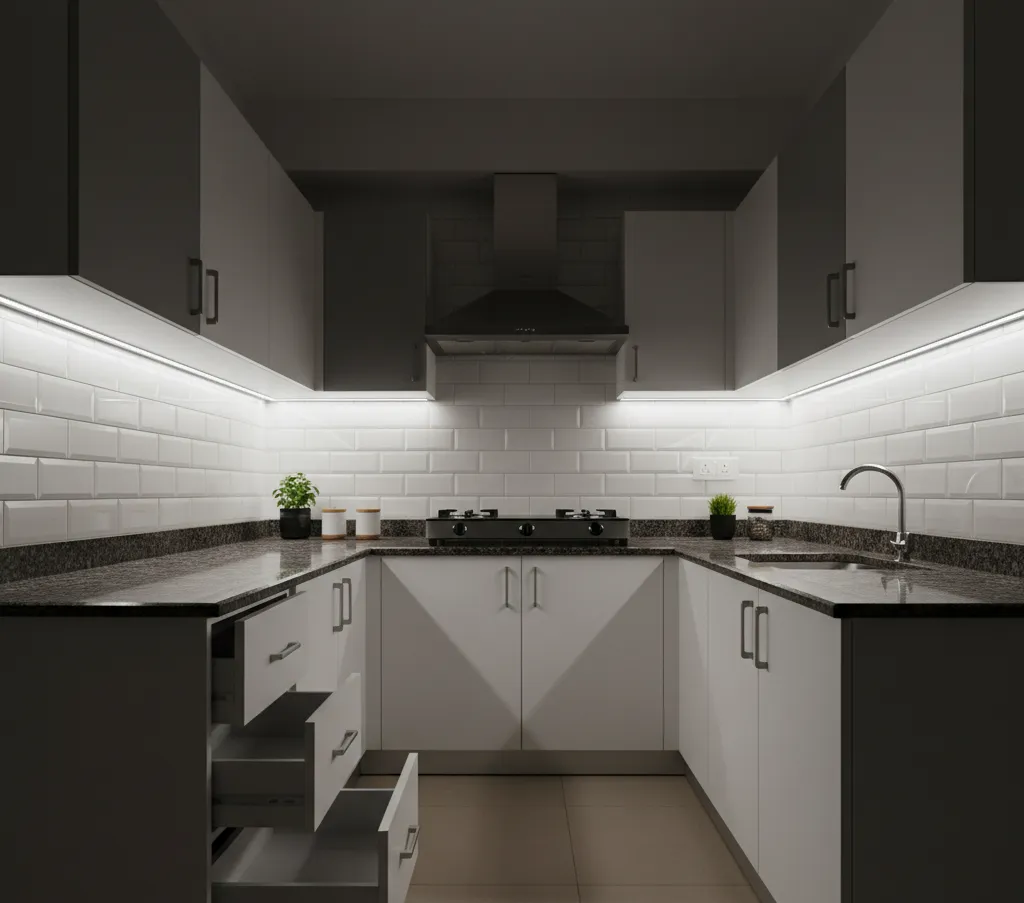
This is where most ₹1.5 lakh kitchen builds go wrong. People blow ₹12,000-15,000 on the chimney and then don't have enough left for proper cabinets. OR they skip the chimney entirely and say "we'll add it later" - but "later" never comes and they spend years cooking without exhaust in a closed kitchen, which is honestly just marinating your walls and cabinets in oil vapour.
We found a decent auto-clean chimney from a brand I hadn't heard of before - Priya found it during one of her midnight Amazon research sessions that my brother describes as "concerning but productive." ₹9,800 with a 60cm baffle filter and 1,200 cubic metres per hour suction. Not the most powerful. Not the quietest. But it works. Pulls smoke. Handles daily Indian cooking. The auto-clean feature means the oil collector heats up and drains into a small cup instead of you manually scrubbing the filter every month.
Hob was a basic 3-burner glass-top from Prestige. ₹5,200. Does the job. Nothing fancy. The glass is tempered so it handles heat. The burners light easily. Priya has no complaints eight months later. When you're watching every rupee, a basic hob from a reliable brand beats a fancy hob from a no-name brand every time.
Sink was a single-bowl stainless steel. ₹2,800. She wanted a double-bowl but the counter length couldn't accommodate it without sacrificing prep space. We measured. Twice. The single-bowl was the right call. She accepted it after approximately one day of silent protest.
What We Deliberately Left Out
This is the part people don't tell you about budget kitchens. It's not just about what you put in - it's about what you consciously leave out and plan to add later when money allows.
No tall pantry unit. Those gorgeous floor-to-ceiling pull-out pantries I keep recommending in other blogs? They cost ₹12,000-18,000 just for one unit. At this budget, impossible. Priya uses a steel rack from a local furniture shop - ₹2,200 - placed against the free wall for atta, rice, oil, and dal storage. It's not pretty. But it holds everything. She plans to replace it with a proper tall unit next year.
No corner carousel. The L-shape has a corner cabinet. It's a standard cabinet. Things get lost in the back. Priya deals with it by keeping only large items there - the cooker, the big kadai - stuff she can reach by arm without too much digging. A carousel would cost ₹2,800-3,200. It's on the "when we have money" list.
No under-cabinet LED lighting. ₹800. She'll add it herself eventually. USB-powered strips are easy to install without an electrician. For now, a ₹200 rechargeable motion-sensor light from Amazon sits under one cabinet. Does 60% of the job at 25% of the price.
No backsplash tile. The wall behind the counter is just painted. It works for now but will get oil stains over time. Priya stuck a large transparent plastic sheet on the wall behind the stove with double-sided tape. Ugly? Slightly. Functional? Completely. The oil splatters hit the plastic. She peels it off, wipes it, sticks it back. ₹100 solution. She'll tile it properly when the budget allows.
The Final Number
Everything installed. Kitchen functional. Here's where the ₹1.5 lakh actually went.
Cabinets, manufacturing, and installation - ₹78,000. Granite countertop - ₹8,700. Chimney - ₹9,800. Hob - ₹5,200. Sink and faucet - ₹3,400. Hardware upgrade (hinges + channels) - ₹4,300. Electrical points (four new ones) - ₹1,200. Silicone, edge banding, sundry items - ₹3,800. Plumber adjustments - ₹1,500. Total: ₹1,15,900. Call it ₹1.16 lakh.
Wait - that's under ₹1.5 lakh? Yeah. She had about ₹34,000 left over. That went to the steel storage rack (₹2,200), a basic microwave (₹6,500), a set of stainless steel containers for the new kitchen (₹4,500), and the rest went into savings for the eventual tall unit and corner carousel.
Coming in under budget wasn't the plan. It happened because we made material choices early, didn't let the showroom upsell us on things we didn't need, and had a kitchen guy who was honest about what ₹1.5 lakh could and couldn't do.
Eight Months Later
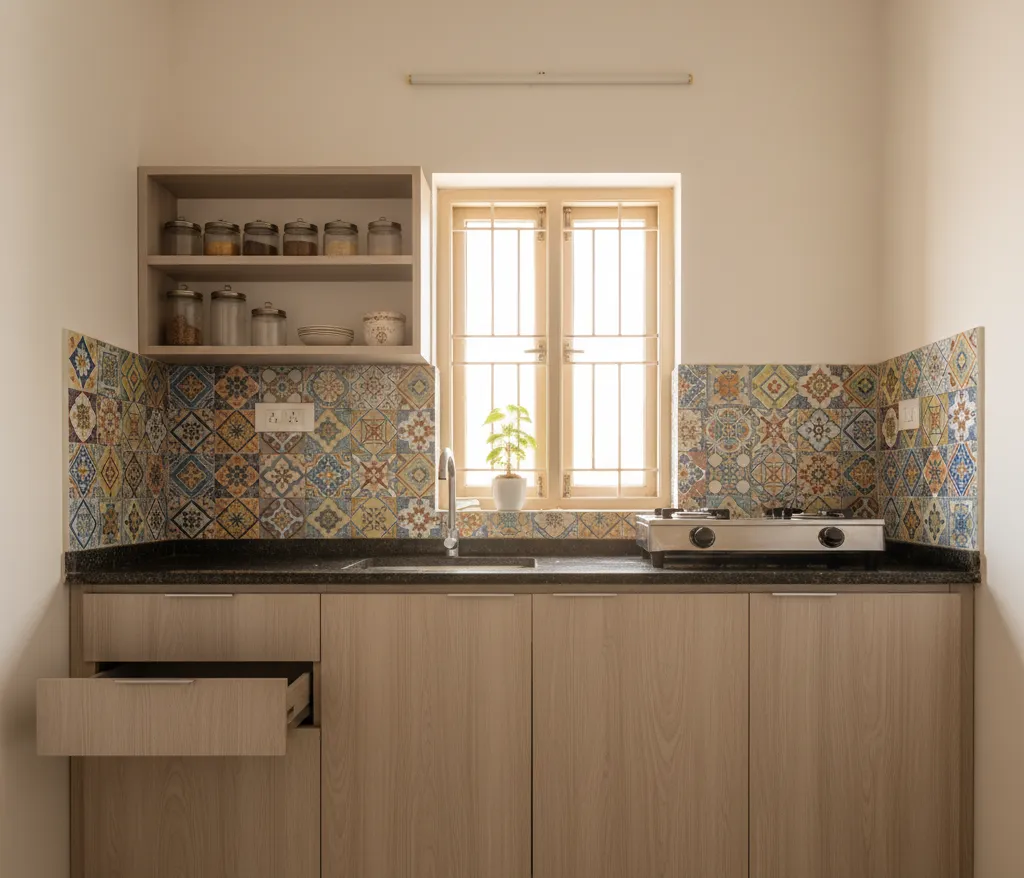
I visited last week. The kitchen is holding up. Laminate looks fine - no peeling, no fading. The granite has a faint oil shadow near the hob that Priya hasn't sealed against, but on black granite you literally can't see it unless you look at a specific angle in specific light. I pointed it out. She told me to stop inspecting her kitchen. Fair enough.
The soft-close hinges still close softly. The telescopic drawers still glide. The chimney's auto-clean cup needs emptying once a month. The plastic sheet behind the stove has been replaced once - she upgraded to a slightly thicker one. My brother still charges his phone from the kitchen outlet for reasons that remain a family mystery.
Priya made me chai. In her ₹1.16 lakh kitchen. In steel cups. On a ₹5,200 hob. And honestly? The chai was great. The kitchen was calm. Nothing was falling apart.
₹1.5 lakh isn't a fantasy budget. It's a real budget. It just requires you to know exactly what to spend on, what to skip for now, and when to tell the showroom guy "no thank you, the laminate is fine."
Need more budget-friendly kitchen ideas that don't pretend money grows on trees? KitchenKaki - real kitchens, real budgets, real chai.
