
Modular Kitchen Layouts for Joint Families in Jaipur
Five adults, two kids, one kitchen. Every morning was a negotiation. Then we renovated — and learned what actually works when multiple people cook daily in the same space.
Modular Kitchen Layouts for Joint Families in Jaipur: Maximizing Space & Storage
My dadi lived with us until 2019. Five adults, two kids, one kitchen. Every morning at 7am, my mummy and dadi would enter the kitchen together and what followed was a 90-minute negotiation disguised as cooking.
"You're standing in front of the masala shelf." "Move the kadai, I need the burner." "Who put the atta dabba behind the mixer?" "I was using that chopping board." "The cooker is whistling, SOMEONE turn it off, I can't reach past you."
This happened every single morning for years. Not because anyone was being difficult. Because the kitchen - a standard L-shape, maybe 8 by 10 feet - simply could not handle two people cooking different things simultaneously. Every surface was occupied. Every drawer was contested territory. The walking space was about 3 feet and when two women need to cross each other while one is holding a hot tawa and the other is carrying a pot of dal, 3 feet feels like 3 inches.
My mummy swore that if we ever renovated, the kitchen would be designed for TWO people minimum. Not as a luxury. As a survival requirement.
We renovated in 2020. And what we learned during that renovation - plus what I've picked up from three other joint family kitchens I've been nosy about since then - is what this blog is about.
The 2020 Renovation That Changed Everything (Almost)
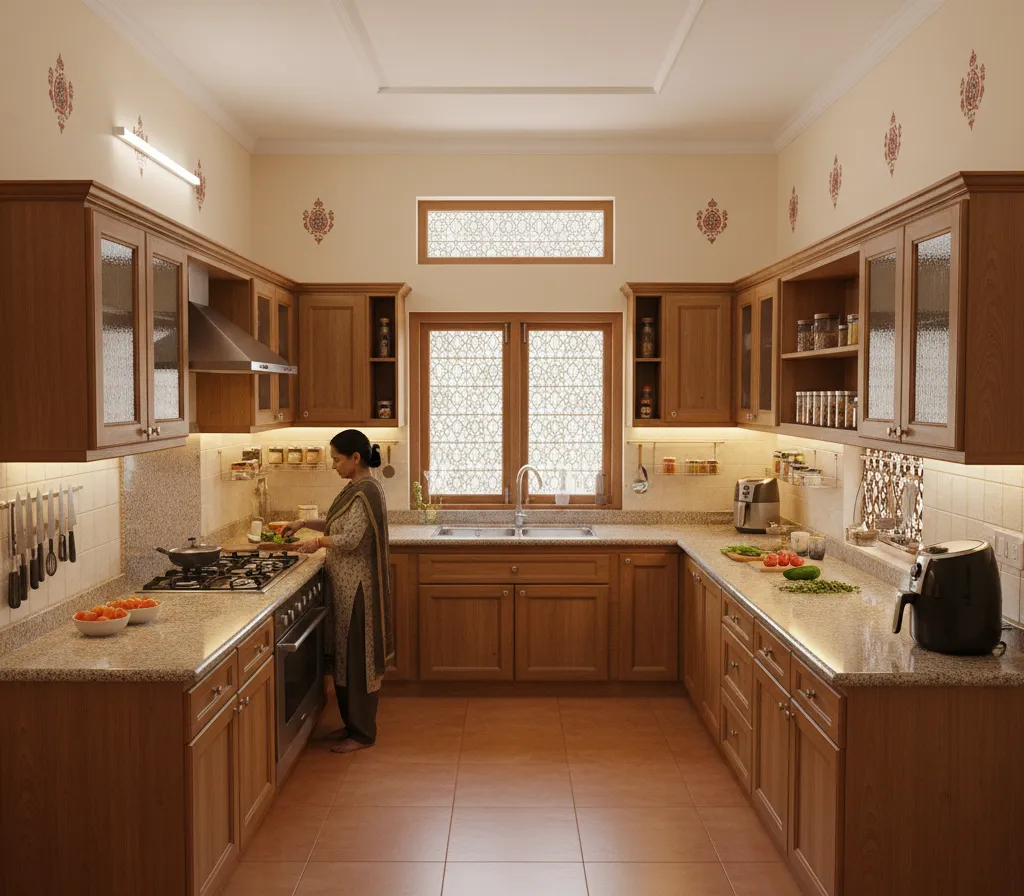
Our kitchen is in a 3BHK in Malviya Nagar. The room itself is about 11 by 10 feet. Before renovation, it was L-shaped. After renovation, it's U-shaped. Same room. Same walls. Same window. But a completely different experience.
Here's why my mummy insisted on U-shape and why she was right. In an L-shape, two people working means one person is constantly behind the other. There's one main counter run and one secondary run, and both people end up competing for the primary one because that's where the stove and the prep space are. With U-shape - three walls, three counter runs - suddenly there are zones. Mummy claimed the stove wall. Dadi (when she was still with us) claimed the opposite wall for prep work. The third wall had the sink, which either person could use without crossing the other's territory.
The middle of the kitchen is about 4.5 feet wide. Wide enough for two people to stand back-to-back at different counters without touching. Mummy can be at the stove doing tadka while someone else is at the opposite counter rolling rotis. Nobody asks anyone to move. Nobody does the sideways shuffle. Nobody holds a hot tawa and prays the other person gets out of the way in time.
₹3.5 lakh for the whole kitchen including chimney, hob, and soft-close everything because mummy refuses to live with slamming cabinet sounds. Worth every paisa, she says. And since she's the one who cooks twice a day, seven days a week, I believe her.
The Storage Problem That Joint Families Can't Escape
But here's what the U-shape alone didn't solve. And this is the part that EVERY joint family kitchen struggles with regardless of layout.
The volume of stuff.
When you're cooking for 5-7 people daily, you don't own one pressure cooker. You own three - a 2-litre for dal, a 3-litre for rice, and a 5-litre for rajma or chole. You don't own one kadai. You own at least two, different sizes. There's the big biryani handi that comes out twice a month. There's the roti tawa, the dosa tawa, the small milk pan, the chai pot that nobody's allowed to use for anything except chai because mummy says it's "seasoned."
Then there's the dry storage. Atta - 5 or 10 kg bag. Rice - 5 kg minimum. Four types of dal. Sugar. Tea. Oil - a 5-litre can that takes up as much space as a small child. Masalas - between the whole spices and the ground ones, we have maybe 15 to 20 different containers. My dadi also kept a separate stash of masalas because she "didn't trust" mummy's jeera quality. That was a whole thing.
And the crockery. Everyday steel plates and katoris for seven people. Guest crockery that comes out when visitors arrive. Festival thalis. The serving bowls nobody uses except during parties but nobody throws away because "they're still good."
All of this needs a home. In a kitchen. That's 110 square feet. Without looking cluttered. Without stacking things so deep that you need to remove four items to reach the one you want.
This is where I watched my mummy make decisions that I've since seen replicated in three other joint family kitchens in Jaipur, each time with the same "why didn't we do this years ago" reaction.
Tall Units or No Sanity
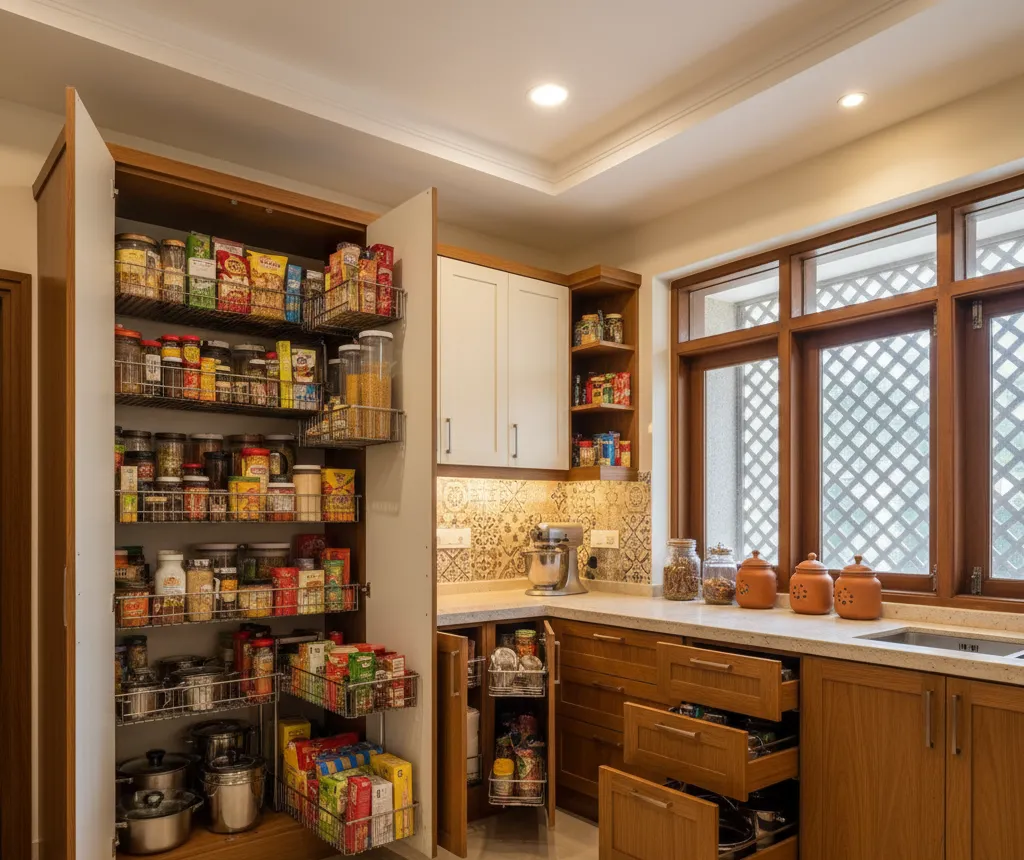
Mummy put two floor-to-ceiling tall units at the ends of the U. Each one is about 2 feet wide and goes all the way up - roughly 8 feet high.
The bottom sections of each tall unit have deep pull-out drawers. These hold the heavy stuff - pressure cookers, the biryani handi, the big kadai. You pull the drawer toward you and the 5-litre cooker slides out at waist height instead of you bending into a dark cabinet and dragging it out by the handle while your back screams.
The middle sections are pull-out pantry shelves. Atta, rice, dal packets, oil, sugar - everything is visible the moment you open the door. No shoving your arm to the back of a shelf. No items hiding behind other items. You see everything, grab what you need, close the door.
The top sections - the parts you need a stool to reach - store the stuff used once a month or less. Festival thalis. The guest crockery. The idli maker dadi bought in 2016 that's been used exactly three times. That section could honestly be sealed shut for 11 months a year and nobody would notice.
My mummy's friend in Vaishali Nagar visited after the renovation. She stood in front of the tall unit for a full minute. Opened it. Closed it. Opened it again. Then turned to my mummy and said, "Yeh toh supermarket jaisa hai." That's the highest compliment an Indian kitchen can receive apparently - being compared to a well-organised supermarket.
Cost for the two tall units? About ₹35,000-40,000 of the total ₹3.5 lakh kitchen budget. Roughly 10% of the cost for maybe 40% of the total storage. If your joint family kitchen has room for even ONE tall unit, put it in. You'll use it more than any other cabinet in the kitchen.
The Wet Zone vs Dry Zone Thing My Mummy Accidentally Got Right
I didn't learn this term until later but apparently professional kitchen designers talk about "wet zones" and "dry zones." Wet zone is the sink area, dishwashing, water-heavy work. Dry zone is prep, masala storage, roti rolling, dry ingredient access.
In joint family cooking, these two zones are ALWAYS active simultaneously. Someone's washing the dal while someone else is rolling rotis. If both activities happen on the same counter - which they did in our old L-shaped kitchen - the atta gets wet, the dal water splashes on the rolling board, and someone ends up saying "you're dripping everywhere" in an exasperated tone.
Mummy put the sink and dish-drying rack on one arm of the U. The prep counter and masala storage on the opposite arm. Stove in the middle arm. Now the wet work and dry work never intersect. The person washing vegetables isn't spattering water on the person kneading dough. The rolling board stays dry. The atta stays dry. The ₹200 masala that dadi brought from Pushkar stays dry.
She didn't know the terms. She just knew from twenty years of experience that water and atta don't belong within splashing distance of each other. Sometimes lived experience beats a design degree.
What I Learned From Sneaking Into Other People's Kitchens
I have a problem. I visit people's homes and immediately assess their kitchen layout. My wife says it's "creepy." I prefer "professionally curious." Regardless, here are three joint family kitchens I've studied in Jaipur and the one thing each taught me.
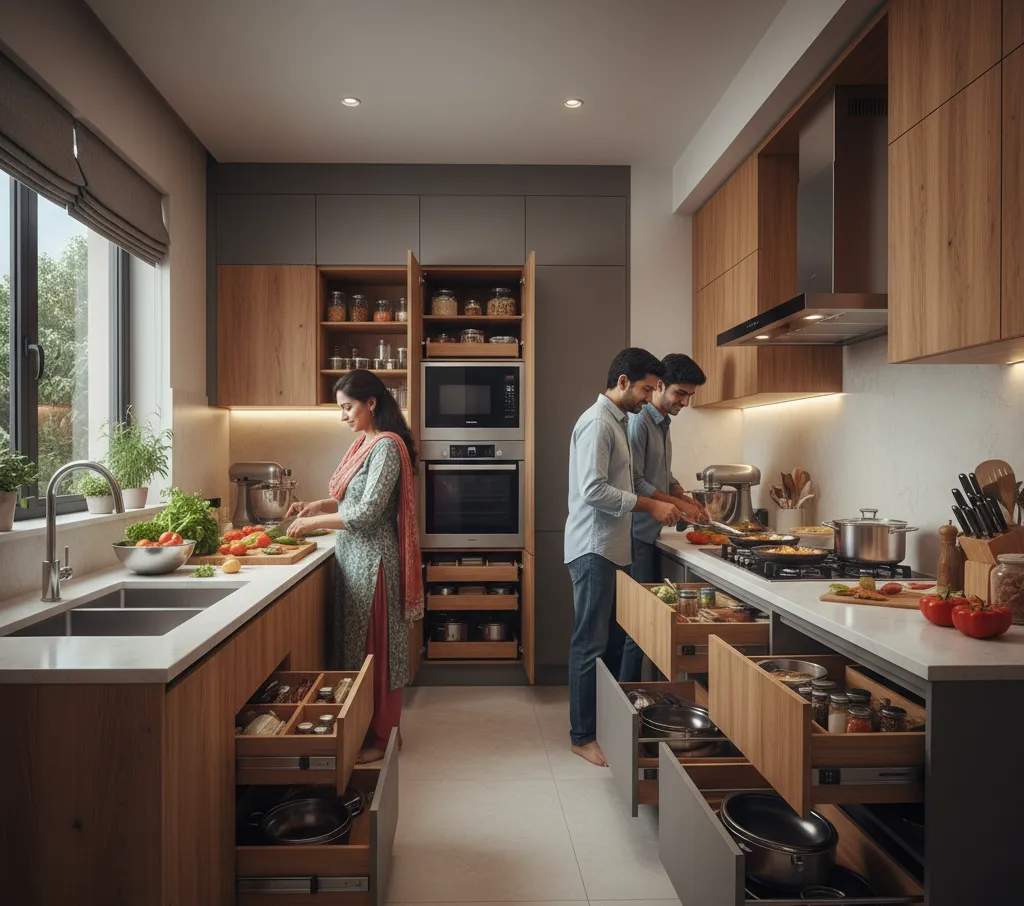
Tonk Road family. Six people. 3BHK. Kitchen about 10 by 12 feet. They did a parallel layout - counters on two opposing long walls. In theory, two people can work on opposite sides. In practice, I watched the mother and daughter-in-law cooking simultaneously and they kept turning around and bumping elbows. The clearance between counters was about 3.5 feet. When someone opens a base cabinet on one side, the walkway basically closes. The mother said - and I remember this exactly - "We've learned to announce when we're opening a drawer." That's not a kitchen design ↗. That's air traffic control.
If they'd gone U-shape on three walls instead of parallel on two, the clearance would've been wider because you're only encroaching from one direction at a time. Plus they'd have gotten a third wall of storage which they desperately need - the dal packets are currently stacked on top of the fridge.
Vaishali Nagar joint family. Eight people. Big kitchen - 12 by 11. They did U-shape with a peninsula. Basically a G-shaped layout. The peninsula sticks out from one end of the U and has bar stools on the outside. Kids sit there for after-school snacks. The grandmother shells peas there in the evening. It's the "not cooking" zone.
The genius part? The peninsula separates the cooking area from the dining area visually and physically. When the mother-in-law is making elaborate dinner, the mess - the peels, the scattered masala powder, the stack of dirty katoris - stays on the kitchen side. Guests in the dining area see a clean counter, not a warzone. For joint families who entertain frequently, that visual barrier is everything.
Mansarovar Extension family. Five people. Tiny kitchen - 8 by 9 feet. Joint family but tight budget. They couldn't do U-shape because the room was too small. Went with L-shape but did something clever - they put a narrow rolling cart (about 18 inches wide) against the free wall. The cart has three shelves. When two people are cooking, they roll it to wherever the second person is standing. Instant extra counter. When cooking's done, the cart rolls back against the wall and the walking space returns.
That cart cost ₹4,500. Doesn't sound like a real solution on paper. But I've watched the mother and her daughter-in-law use it and it genuinely works. The cart becomes the roti station, the salad station, or the "just put stuff here while I figure out where it goes" station. No construction needed. No permanent space commitment.
The Two Things Nobody Mentions About Joint Family Kitchens
First - multiple chimneys or a really powerful single one. Joint family cooking means longer cooking hours. Morning breakfast for seven, lunch, evening snacks, dinner. The chimney runs for maybe 3-4 hours total per day. A cheap chimney with a weak motor will burn out within a year at that usage rate. My mummy's first chimney lasted 14 months. The replacement - a proper auto-clean one with a more powerful motor - has lasted four years and counting. Spend on the chimney. Don't cheap out. ₹12,000-15,000 for a decent auto-clean chimney versus ₹6,000 for a basic one. That ₹6,000 difference saves you from buying a new chimney every year.
Second - more electrical points than you think you need. Joint family kitchens run the mixer, the grinder, the toaster, the microwave, and sometimes an induction cooktop all in the same morning. My mummy's old kitchen had four electrical points. After renovation she has eight. She uses seven of them regularly. The day she's running the mixer, the microwave, and the roti maker simultaneously while my brother charges his phone from the kitchen plug (I've told him to stop) - all eight are occupied.
Ask your electrician for double the points you think you need. During wall chasing and wiring, adding extra points costs maybe ₹200-300 per point. After the kitchen is installed? You're looking at extension boards and wires hanging everywhere, which is ugly AND a fire risk in a space full of oil and heat.
What My Mummy Would Say If She Were Writing This Blog
She'd skip everything I said and tell you three things.
"Build the kitchen for the person who cooks in it. Not for the person who pays for it."
"Two people need enough space to fight without physical contact."
"And for God's sake put a separate shelf for the chai pot."
She's not wrong about any of it.
More kitchen advice that understands how Indian joint families actually work? KitchenKaki - we've cooked in these kitchens. We know the chaos.
