
Modular Kitchen vs Carpenter-Made Kitchen: Which Is Better?
There is a carpenter in Jaipur named Rameshji who has been making kitchens for thirty-two years. My neighbour Dinesh swears by him — his kitchen is eleven years old and still opens and closes cleanly. Dinesh's brother-in-law has a modular kitchen that looks like a magazine cover. Both think they made the right choice. Both can point to things they'd do differently. Here's the honest comparison — what modular actually gets right, what carpenter-made actually gets right, and how to decide for your specific situation.
Modular Kitchen vs Carpenter-Made Kitchen: Which Is Better?
There is a carpenter in Jaipur named Rameshji who has been making kitchens for thirty-two years.
My neighbour Dinesh swears by him. Got his kitchen done eleven years ago - solid wood shutters, hand-fitted drawers, shelves exactly where Dinesh wanted them and sized exactly for his pressure cookers. Eleven years later, everything still opens and closes cleanly. The wood has a particular warmth that Dinesh's brother-in-law's modular kitchen - white acrylic, installed three years ago, looks like a magazine cover - simply doesn't have.
Dinesh's brother-in-law, on the other hand, has pull-out drawers that bring everything to him. His chimney housing was built as part of the kitchen structure. He can wipe down the entire kitchen in ten minutes. His kitchen is easier to live with even if it doesn't have the warmth of Dinesh's.
Both of them think they made the right choice. Both of them, if being completely honest, can point to things they wish they'd done differently.
That is where most real-world comparisons between modular and carpenter-made kitchens actually land - not at a clear winner but at a set of trade-offs that depend entirely on what you value, what you cook, how long you plan to stay, and frankly, who your local carpenter is.
This guide is an attempt to give you the actual information to make that call for your specific situation.
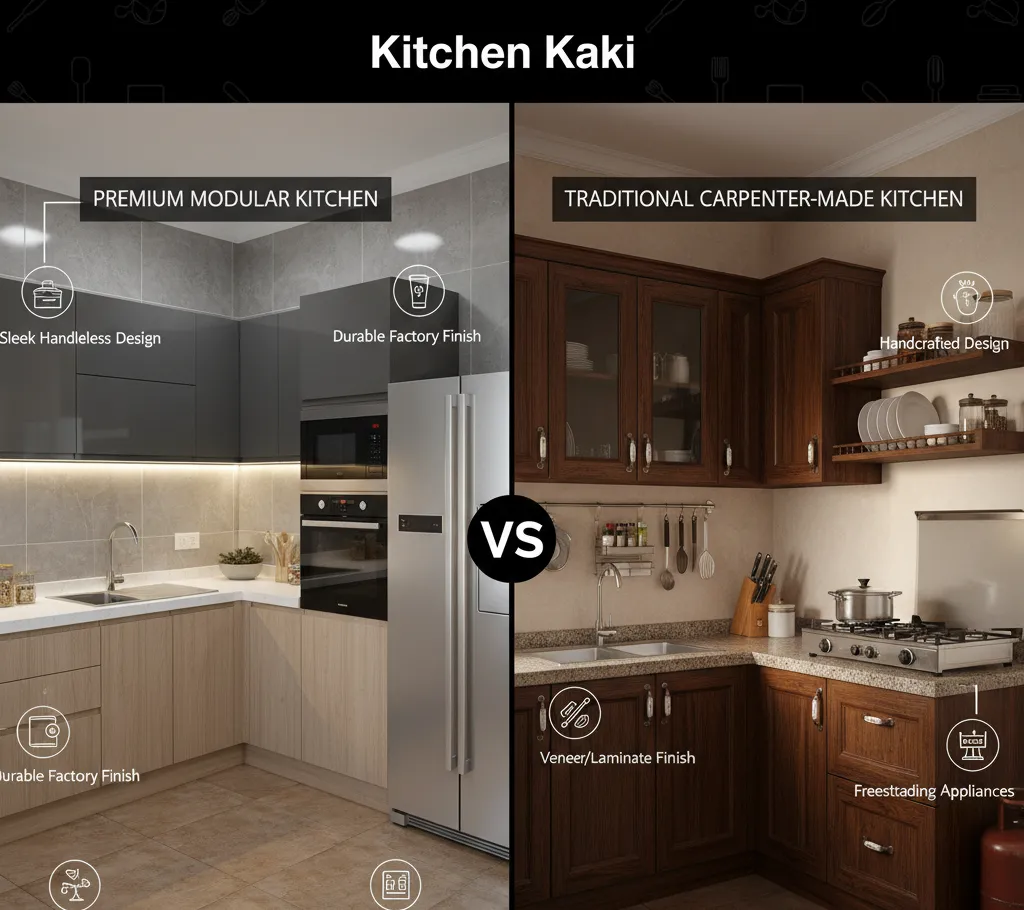
What We Mean by Each
Modular kitchen: Factory-manufactured cabinet units - called modules - produced to standard dimensions, delivered to the site, and assembled into the kitchen configuration. The carcasses (the boxes) are made in a factory. The shutters, countertop, and hardware are specified during design and fitted at installation. The degree of customisation is within the system - you choose from available configurations, sizes, materials, and finishes, but the underlying units are standardised.
Carpenter-made kitchen: Built on-site by a carpenter using raw materials - typically wood, plywood, or a combination - cut, assembled, and fitted in the kitchen itself. Every dimension can be customised to the exact space. Every shelf, every cabinet, every detail is built to specification rather than chosen from a catalogue. The quality of the outcome is directly linked to the quality of the carpenter.
Both can look similar from the outside - the same shutter material, the same countertop, the same hardware can be used in either. The difference is in the manufacturing process, the dimensional flexibility, the quality consistency, and the long-term maintenance profile.
The Case for Modular - Why It Has Become the Default
The modular kitchen has become the dominant choice in urban Indian renovations over the last decade and the reasons are real, not just marketing.
Factory precision and consistency.
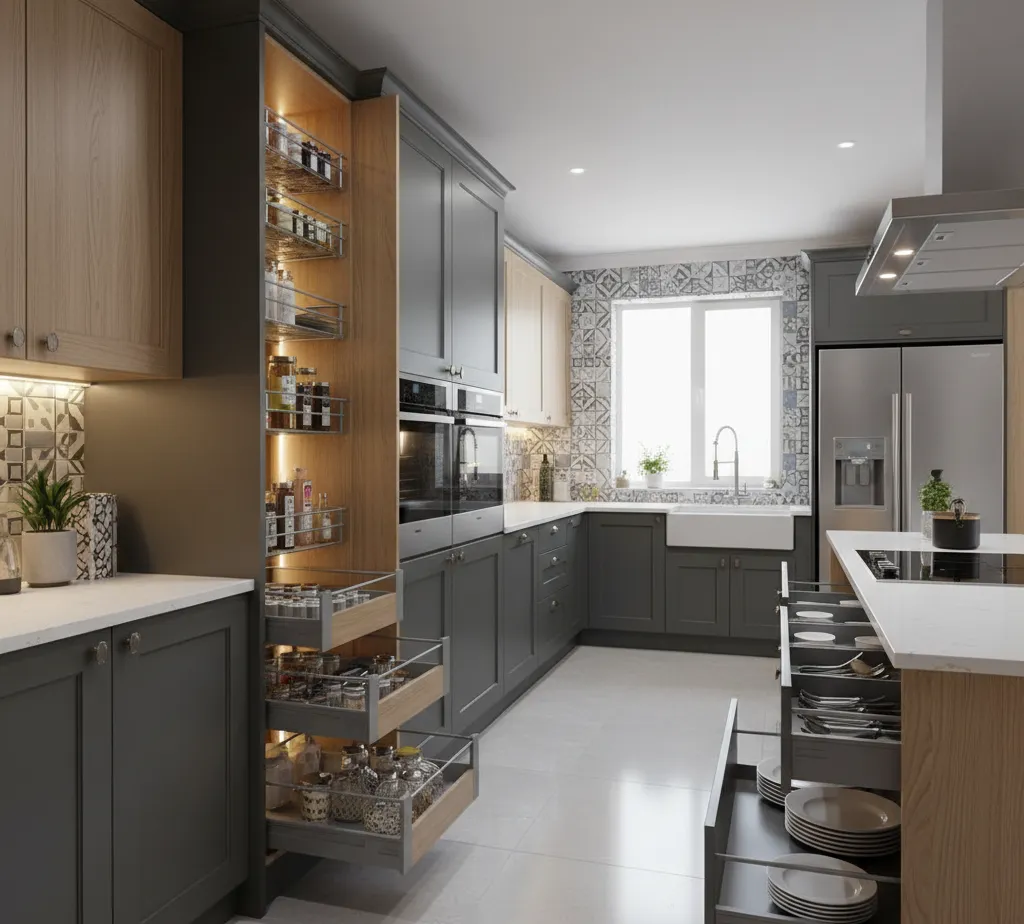
Cabinet boxes made in a factory under controlled conditions have consistent dimensions, consistent material thickness, and consistent quality in a way that site-built carpentry cannot match. A modular kitchen from a reliable brand has drawers that open and close smoothly because they were made to tolerance. The doors are aligned because the boxes they hang on are square. This isn't impossible to achieve with site carpentry - a genuinely skilled carpenter achieves it - but it's the baseline for a factory product.
Hardware quality and availability.
Modular kitchen systems are designed around specific hardware - Hettich or Hafele channels, soft-close hinges, lift-up mechanisms, magic corner units. This hardware is engineered for the modules it's installed in, is available for replacement if it fails, and works the way it's supposed to because everything was designed together. In a carpenter-made kitchen, the carpenter specifies and sources hardware - which may be good or may be whatever the local hardware shop had in stock that week.
Finish quality for shutters.
Acrylic, membrane-wrapped, and high-quality laminate shutters are factory processes. The finish on a factory-produced acrylic shutter is more consistent, more even, and more durable than paint or laminate applied on-site. The edges are cleaner. The colour is consistent across all shutters because they were made in the same batch. Site-applied finishes - even done well - show more variation.
Speed of installation.
A modular kitchen is typically installed in two to five days once the modules arrive at site. The fabrication happens in the factory while other site work is being done. A carpenter-made kitchen is built on-site, which typically takes three to six weeks - during which the kitchen space is occupied by work, materials, sawdust, and the carpenter's variable attendance.
After-sales service.
Major modular kitchen companies - Häfele, Godrej Interio, Sleek, Livspace - have service networks. If a hinge fails in year three, you call the company. If a drawer mechanism needs adjustment, there is someone to call. With a carpenter-made kitchen, the after-sales service is Rameshji - who may still be available, may have retired, or may be busy with three other projects when you need him.
The Honest Problems With Modular Kitchens
The modular kitchen is not without real limitations, and some of them specifically affect Indian homes.
Standard dimensions that don't always fit.
Modular kitchen units come in standard widths - typically in 100mm increments, from 300mm to 900mm per unit. Your kitchen wall may be 2,150mm long. Standard modules will either leave an awkward 150mm filler gap or require a non-standard unit that costs extra and takes longer to procure. In older Indian homes with walls that are not perfectly square, not perfectly plumb, and not exactly the dimensions on the plan, the rigidity of modular dimensions creates fitting problems.
The carcass material question.
A modular kitchen's visible quality is the shutter. The invisible quality - the carcass - depends entirely on what the company uses and whether you asked the right questions. Many modular kitchen companies, including some well-known names, use MDF or particle board carcasses in their standard ranges. In an Indian kitchen with steam, moisture from cooking, and the humidity that a heavily used cooking space generates - MDF carcasses swell, warp, and degrade over time. The kitchen that looked immaculate in year one starts showing problems in year four or five. Getting BWR (boiling water resistant) plywood carcasses in a modular kitchen means either choosing a premium range or specifically negotiating this - and getting it confirmed in writing on the quote.
The resale and repair problem.
A modular kitchen from a specific brand uses specific components. If the company changes its product range - which happens - or discontinues a particular finish - which happens regularly - replacing a single damaged unit, matching a faded shutter, or finding a replacement for a broken component becomes difficult or impossible. Carpenter-made kitchens don't have this problem because a carpenter can always make a replacement to match.
It looks like a modular kitchen.
This sounds frivolous but it's not. There is a particular aesthetic to modular kitchens - clean, uniform, organised - that some people love and some people find sterile. A hand-made wooden kitchen has a warmth and irregularity that modular kitchens don't replicate. In a home with character - older architecture, traditional elements, a certain kind of personality - the modular kitchen can look imported rather than belonging. This is an aesthetic preference and it's a valid one.
The Case for Carpenter-Made - What It Does That Modular Can't
Rameshji's kitchen for Dinesh is eleven years old and still works. That is not nothing. It's actually quite a lot.
True customisation.
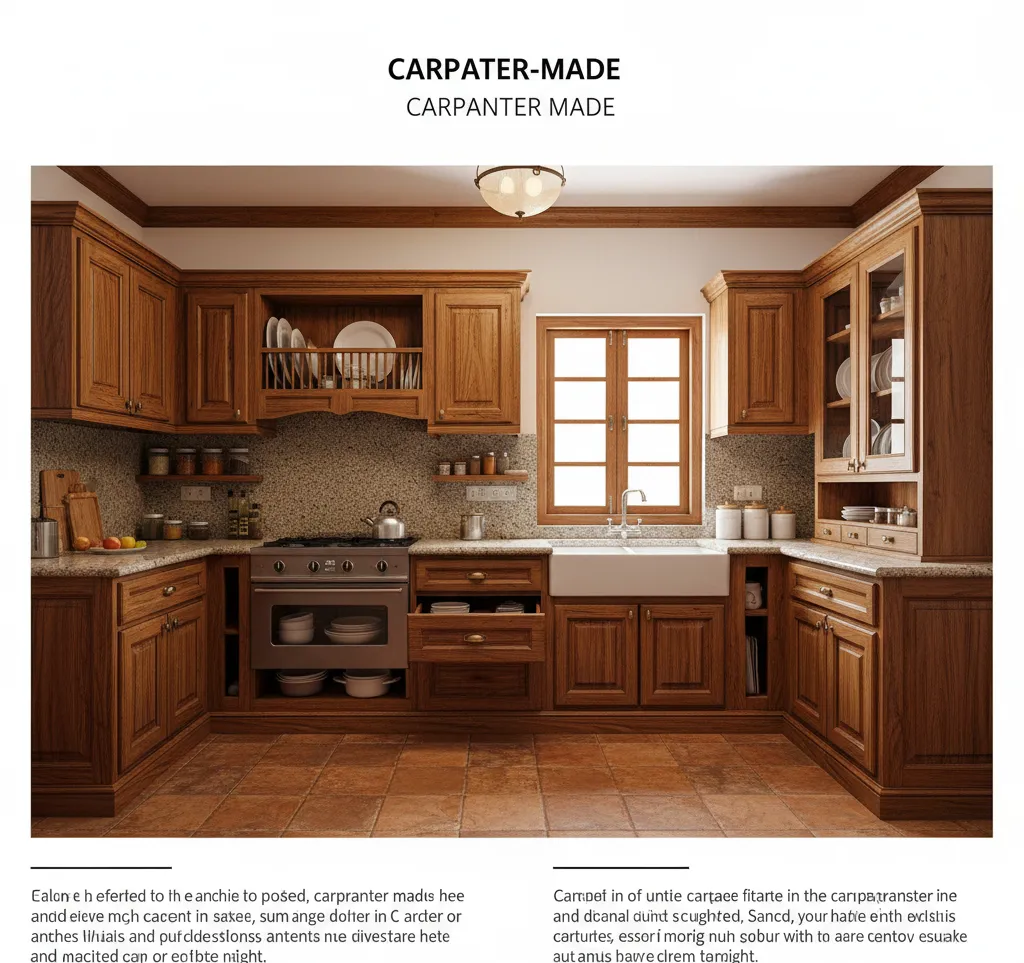
Every dimension can be exact. The shelf that fits your specific pressure cooker configuration. The drawer sized for your masala dabba collection. The cabinet built around the awkward wall where the pipe runs. The height adjusted for the cook's specific height. None of this requires compromise with catalogue dimensions or negotiating for non-standard sizes. The carpenter makes what you need in the size you need it.
For Indian homes with unusual wall configurations, lower ceilings, or structural irregularities that don't suit modular dimensions - carpenter-made kitchens solve problems that modular kitchens struggle with.
Material choices beyond the catalogue.
A carpenter can work with solid wood, real veneer, specific ply grades, materials sourced locally, reclaimed materials - any material that can be worked. Modular kitchens work within a defined material system. If the design calls for solid sheesham wood shutters, or a specific local stone, or a material not in any modular catalogue - the carpenter is the answer.
Local accountability.
Rameshji is in the neighbourhood. If something is wrong, he comes and fixes it. This sounds simple. In practice it's the difference between a problem that gets fixed the next week and a problem that requires scheduling a service visit from a brand's call centre, waiting for the visit, and then possibly waiting for parts.
A good local carpenter who values his reputation - who has been in the same neighbourhood for thirty years and whose livelihood depends on referrals from people like Dinesh - has a powerful personal incentive to do the work well and to fix it when something goes wrong.
The cost at the right quality level.
This is more complex than it sounds. A modular kitchen from a premium brand at genuine quality - BWR ply carcass, good hardware, quality shutters - costs ₹1,800 to ₹2,500 per square foot or more. A carpenter-made kitchen at comparable quality - good marine ply, same hardware (Hettich or Hafele), same shutter material - costs ₹1,200 to ₹1,800 per square foot with a skilled carpenter.
The cost advantage of a carpenter-made kitchen at equivalent quality is real. The catch is equivalent quality - which requires finding the right carpenter, specifying the materials precisely, and supervising the work. The budget modular kitchen and the budget carpenter-made kitchen are both false economies in an Indian kitchen that gets heavy use.
The Honest Problems With Carpenter-Made Kitchens
Quality depends entirely on the carpenter.
This is both the great strength and the great vulnerability of a carpenter-made kitchen. Rameshji with thirty-two years of experience and a reputation to protect is very different from the carpenter recommended by your contractor who subcontracts the work to someone else. There is no quality standard, no factory specification, no ISO process. The output is as good as the person doing the work.
In modular kitchens, the floor quality is established by the factory process. In carpenter-made kitchens, the quality range is enormous - from Rameshji's eleven-year-old kitchen that still works perfectly, to the site-built disaster where everything is slightly out of square, the drawers don't open cleanly, and the finish is uneven.
On-site work is disruptive and unpredictable.
Three to six weeks of carpentry work in the kitchen means three to six weeks of sawdust, noise, the carpenter arriving at inconsistent times, and the kitchen being unusable for cooking. In a home being renovated entirely this may not matter. In a home where only the kitchen is being redone and the family is living in the house - six weeks of disrupted cooking is a significant inconvenience.
Warping and moisture sensitivity.
Site-built carpentry using ply and wood is subject to the same moisture concerns as modular carcasses - but the material specification is in the hands of the carpenter and the supervision of the owner. Without specific instruction and supervision, carpenters sometimes use lower-grade ply for interior shelves and components that won't be immediately visible. Marine ply or BWR ply for all structural components needs to be specified explicitly and verified before work proceeds.
No finish process for certain materials.
The factory acrylic shutter finish cannot be replicated on site. If the design calls for high-gloss acrylic or membrane-wrapped shutters - materials that require factory processes - these need to be procured and installed by the carpenter rather than made by them. This is possible - the carpenter can use factory-made shutters - but at this point the distinction between carpenter-made and modular starts to blur.
The Situations That Clearly Favour One Over the Other
Choose modular if:
You are moving into a standard-dimension flat in a new building. Your walls are straight, your dimensions are regular, and the standard module widths will fit without significant gaps. You want the installation done quickly. You value the after-sales service network of a brand. You want a specific finish - high-gloss acrylic, specific lacquer colours - that requires factory processing. You are not confident in your ability to supervise carpentry work and specify materials correctly.
Choose carpenter-made if:
The kitchen space has irregular dimensions that don't suit standard module widths. The design calls for specific materials not available in any modular catalogue. You have a genuinely skilled carpenter whose work you can verify through references and past work. You are willing to supervise the material specifications and the work process closely. You want specific customisation - exact shelf heights, specific internal configurations - that modular systems can't provide. The home has a character that the modular aesthetic would work against.
Consider a hybrid if:
The carcasses and structure are carpenter-made - to custom dimensions and with specified materials - but the shutters, hardware, and countertop are procured from modular suppliers. This captures the dimensional flexibility of carpentry with the finish quality and hardware reliability of modular components. It requires a carpenter skilled enough to install hardware to modular tolerances, which not all carpenters are. But where it works, it's often the best of both.
The Questions Before the Decision
Before choosing between modular and carpenter-made, answer these honestly:
Do I have a carpenter whose past work I can see and verify? Not a reference - actual past work I can visit and inspect years after completion.
Does my kitchen space have any dimensional irregularities that standard modules would struggle with?
Am I willing to be present and involved in supervising site work for three to six weeks?
What is the total budget, and can it support the quality level I need in either system?
How long am I planning to stay in this home? A five-year stay favours modular for speed and resale presentation. A twenty-year stay in a home you own outright - Rameshji's kitchen starts making more sense.
The Honest Bottom Line
Neither modular nor carpenter-made is universally better. Anyone who tells you otherwise - a modular kitchen brand telling you site carpentry is always inferior, or a carpenter telling you modular is always overpriced - has a commercial interest in the answer.
The modular kitchen at a genuine quality level, from a company that uses proper carcass materials and reliable hardware, is a good kitchen that will serve well for ten to fifteen years with normal maintenance. The carpenter-made kitchen from a skilled craftsperson, built with properly specified materials and good hardware, is also a good kitchen that can last decades.
The bad modular kitchen and the bad carpenter-made kitchen are equally disappointing in different ways. The budget modular with MDF carcasses will swell and warp. The budget carpenter job with poor ply and cheap hardware will also fail - it will just fail differently.
The question is not modular versus carpenter. The question is who is doing the work, with what materials, to what specification, and for how long does the outcome need to last.
Answer those questions and the modular vs carpenter decision largely answers itself.
Dinesh and his brother-in-law are both happy with their kitchens. They just cook differently, live differently, and value different things. The kitchen each of them has is the right one - for them specifically.
More honest kitchen planning guides for Indian homes at Kitchen Kaki.
