
Upgrading Your Old Kitchen in Jaipur: From Carpenter-Made to Modern Modular in 7 Days
Crooked shelves. Stuck drawers. Cockroach gaps. Twenty-two years of carpenter-made kitchen. Seven days of renovation. And a first cup of chai that made it all worth it. Here's the whole story.
Upgrading Your Old Kitchen in Jaipur: From Carpenter-Made to Modern Modular in 7 Days
My mummy cooked in a carpenter-made kitchen for 22 years. Built by a guy named Ramu kaka who smoked beedis while measuring shelves and kept a pencil behind his ear that I never once saw him sharpen. The cabinets were plywood - fine for 1998, barely holding together by 2020. One shelf had a visible slope. You could put a marble on it and watch it drift left. We all knew about it. Nobody fixed it. It became furniture. Part of the house's personality. "Nothing in this house is straight," mum would say, looking at both the shelf and my father.
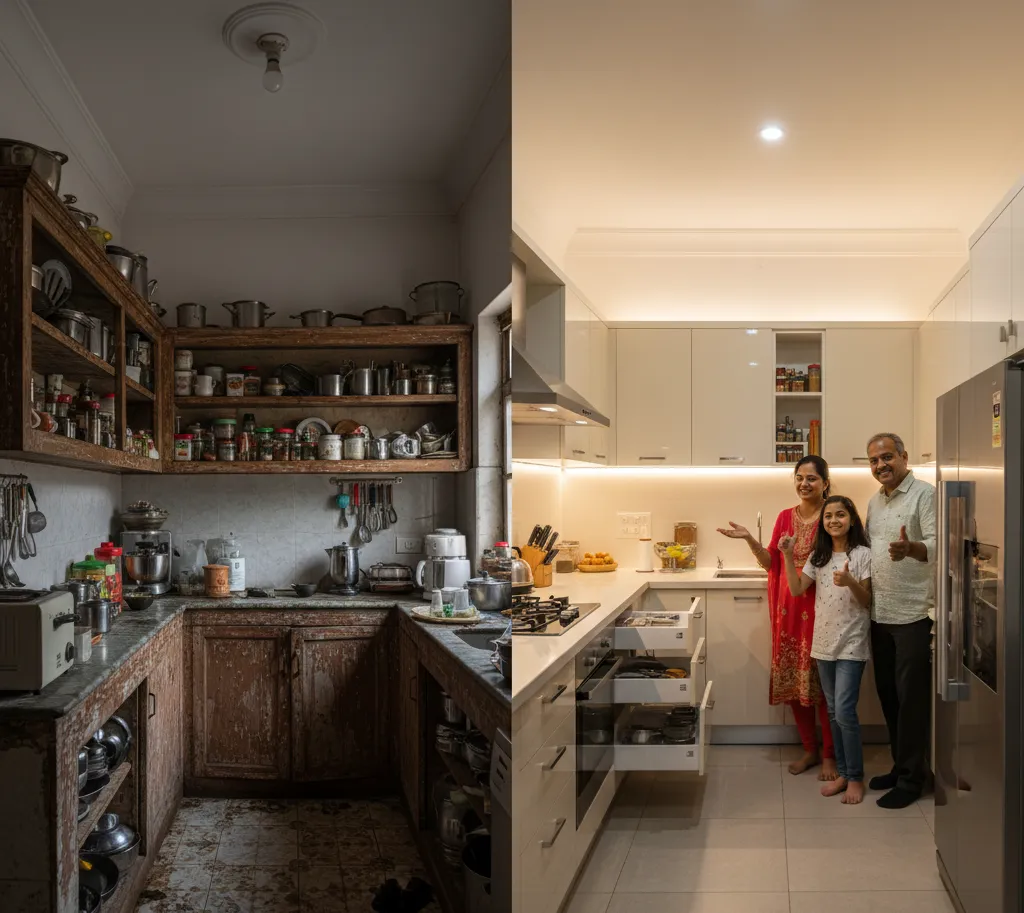
The drawers didn't have channels. They scraped on raw wood. Every morning I'd hear mummy dragging the masala drawer open and it sounded like someone moving a cupboard across a tile floor. Didn't know drawers could be quiet until I visited a friend's modular kitchen in college. His drawer slid open like it was floating. I stood there opening and closing it for an embarrassing amount of time. He asked me to stop. I did not stop.
By 2020, the plywood near the sink had swollen so bad the cabinet door wouldn't shut. One shelf had collapsed under three stacked pressure cookers - Ramu kaka's structural engineering did not account for the Indian joint family's cookware ambitions. The whole kitchen smelled of old oil that lived in the wood and laughed at phenyl.
"It's time," mummy said one evening.
Dad blinked. The long, resigned blink of a man who hears money leaving his wallet. "How much?"
About ₹3.5 lakh, as it turned out. Seven days of actual work. Plus two weeks of factory waiting. Plus nine days of mummy cooking on a single burner on the balcony while dad asked "When will the kitchen be ready?" every morning as if the factory workers could hear him.
Here's how the whole thing went.
Three Weeks Before Anything Visible Happened
The modular kitchen company sent a measurement guy. Small fellow with a laser tool and a clipboard. Spent 45 minutes in our kitchen. Measured every wall. Noted the window, the gas inlet, the water pipes, the electrical points, and the weird bump in our corner wall where the builder apparently forgot how bricks work.
Then - nothing. Two weeks of silence. The factory was building our modules somewhere in Sitapura. CNC machines cutting plywood sheets, laminating surfaces, drilling holes, edge-banding, pre-attaching hinges. All happening offsite while we just... waited.
Mummy didn't waste those two weeks though. She packed the entire old kitchen into cardboard boxes. Every steel plate. Every katori. Every dubious Tupperware from my sister's wedding. She labelled them with a marker: "DAILY USE," "GUESTS ONLY," "FESTIVAL," and my favourite - "DECIDE LATER." That last box contained maybe thirty things she couldn't commit to keeping or tossing. It's still sealed. Sitting in the guest room. Been two years. I think at this point we've decided.
She set up a balcony cooking station. Single gas burner. One tawa. One cooker. She made dal-rice and roti-sabzi on rotation for nine days without complaining. Dad complained daily. My brother called from Bangalore and asked how the kitchen was going. "Your father is the hardest part," mummy said. Accurate.
Demolition Day
I expected ceremonial dismantling. Maybe some respectful unscrewing. Twenty-two years of kitchen history gently removed.
What I got was two guys with crowbars at 9:15am.
Ramu kaka's plywood came apart with cracking sounds. The wood near the sink basically fell off in chunks - they barely needed tools for that section. By 1pm, the entire kitchen was bare walls. Everything Ramu kaka built was on the balcony in a pile. The kabadiwala came the next morning and took it all for ₹400. I'm sure Ramu kaka's ghost felt something. Probably annoyance.
Mummy watched from the doorway. She had complicated feelings, I could tell. Those shelves - ugly, crooked, infested - had held her masalas for two decades. Her mother's old brass measuring cups sat on the shelf that sloped. Memories attach themselves to kitchens, even bad kitchens. Especially bad kitchens.
Then she looked at the bare walls and snapped out of it immediately. "Paint them. Now. Before anything new goes up."
This was the single smartest thing anyone said during the entire renovation. Once modular cabinets go on the wall, the space behind them is sealed off permanently. If the wall is stained or cracked or has that weird green fungus Jaipur walls grow near water pipes - you'll never fix it without dismantling cabinets. Two workers painted all four kitchen walls that afternoon. White. ₹1,800. Three hours. One coat.
Should've done two coats. I was impatient. I can see a faint thin-coverage line behind the tall unit now where the paint didn't fully cover. Nobody else can see it because there's a cabinet blocking it. But I know it's there. And it nags at me at a frequency that probably requires therapy.
The Boring Day That Saved Us
Next morning. Plumber. Electrician. No drama. No Instagram content. Just two guys doing invisible work that would determine whether the rest of the renovation went smoothly or turned into a disaster.
Plumber moved one water outlet 6 inches left - the new sink position was slightly different from the old one. Extended the drain pipe. Tightened joints. Three hours. ₹2,200. My bhabhi's neighbour skipped this step. Their modular kitchen company installed the cabinets FIRST. Then realised an outlet was trapped behind a sealed cabinet. Had to partially dismantle a unit to access the wall. The words "partially dismantle" and "modular cabinet" should never appear in the same sentence but here we are.
Electrician added four new outlets. Mummy's old kitchen had four points total. She wanted eight. I thought eight was overkill. I was wrong. By 2022, every morning the mixer, microwave, toaster, and my brother's phone charger (I've TOLD him to charge in his room) are running simultaneously and all eight points are occupied. Should've asked for ten. During wall chasing, each extra point costs ₹200-300. After the cabinets are up? Extension boards and tangled wires draped across your beautiful new quartz counter. For ₹600 I could've prevented that. Didn't. Regret it.
He also moved the chimney power point higher because our new chimney had a different mounting height. ₹1,800 total electrical. Nobody photographed this day. There's nothing to photograph. Pipes and wires. But this is the day that prevents your renovation from becoming a horror story.
Counter Day and the White Quartz Argument
The old kota stone counter came out in angry pieces. Two guys with chisels. Dust EVERYWHERE despite mummy's bedsheet-barricade across the doorway. Kota stone doesn't leave gracefully. It cracks and fragments and sends particles into rooms it has no business reaching. Mummy stood three rooms away with every door closed and still found dust in her hair.
By afternoon the quartz arrived. Pre-cut. Two slabs. Light grey with white veining.
Quick sidebar about how we landed on light grey. Mummy wanted pure white. I physically positioned myself between her and the showroom catalogue. Actually blocked her. "This is Jaipur. You cook with haldi every single day. White quartz will break your heart within a month." She was annoyed with me for a week. Cold shoulder. Minimal eye contact. Then her friend got white quartz and had a yellow stain within three weeks. Mummy hasn't mentioned the white quartz since. She told my aunt she's happy with the grey. My aunt told my cousin. My cousin told me. That's how communication works in Indian families. Nobody says anything directly. Everything travels through at least two relatives.
₹28,000 for both slabs including cutting, edge polishing, installation. The guys levelled them, did one tiny adjustment with a grinder, and siliconed everything down. By evening the counter was in place. Mummy touched the smooth surface and smiled. Dad touched it too. "How much was this part?" he asked immediately. Some things are predictable.
Three Days of Boxes Becoming a Kitchen
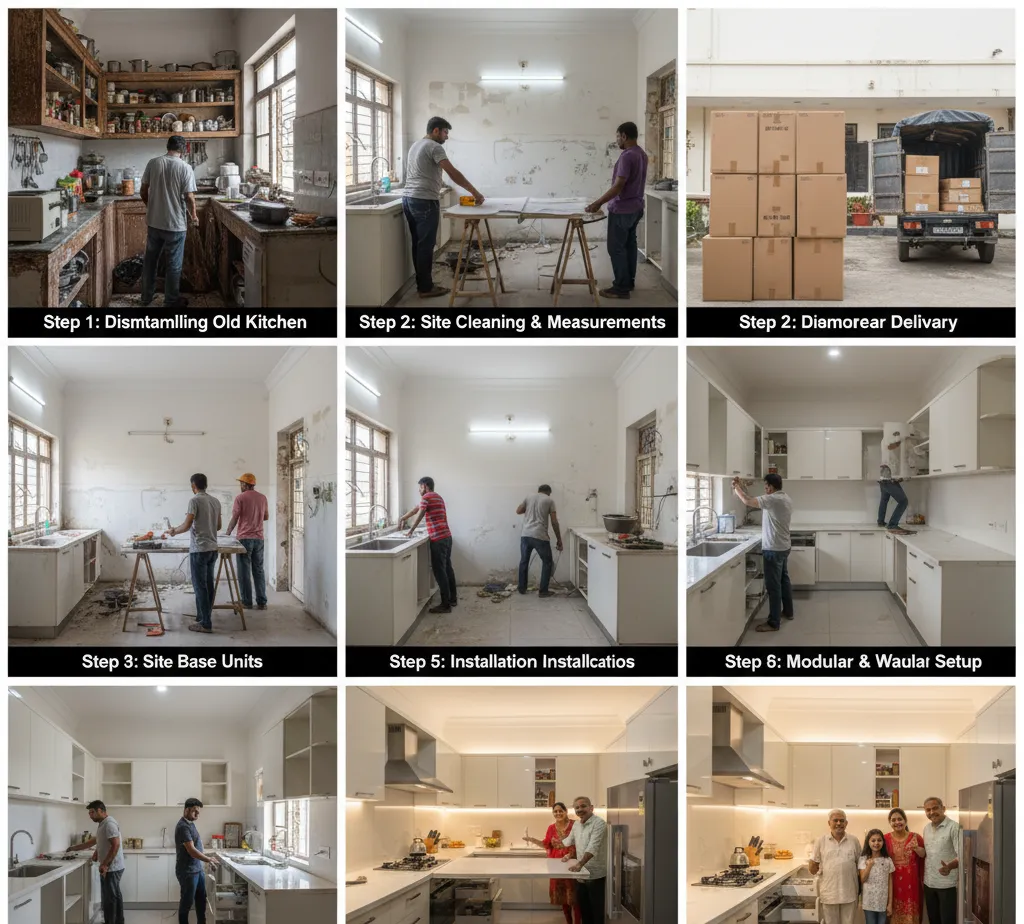
A truck arrived. Wrapped modules inside. Base units, wall units, tall pantry column, corner cabinets with carousels pre-installed. Everything factory-built. Pre-drilled, pre-hinged, pre-edged. The workers carried in large rectangles, unwrapped them, and started bolting things to walls.
No sawing inside our house. No wood being cut on our living room floor. No sawdust settling on the sofa. No carpenter sleeping on the balcony. No beedis.
First day of installation - base cabinets. All levelled. All connected. The under-sink unit got extra waterproofing because mummy's old kitchen taught me what happens when you don't protect that area - the plywood rots silently for months while you store Harpic bottles on top of it, blissfully unaware. I also put a PVC mat at the base of the under-sink cabinet. ₹150 fix from a different blog's lesson. My family thinks I have an under-sink obsession now. They're not wrong.
Second day - wall cabinets and the tall pantry unit. When the tall unit went up, mummy stood watching like she was witnessing a moon landing. Floor to ceiling. Eight feet of storage. She'd been dreaming about this since she saw her friend's tall unit in Vaishali Nagar and came home saying "Uska kitchen supermarket jaisa hai." She wanted her own supermarket.
The workers bolted the last bracket. Stepped back. Mummy immediately opened every single shelf. Ran her hand along the empty surfaces. "Finally," she said. One word. Twenty-two years of fighting for storage space compressed into six letters.
She also produced a spirit level from somewhere to check if it was straight. I didn't know we owned a spirit level. Where does she keep a spirit level? I've lived in this house for thirty years. I've never seen it before or since. It appeared for this one moment and then vanished back into whatever dimension mummy stores her secret tools.
Third day - doors, drawers, handles, soft-close mechanisms. The chimney went up. The hob dropped into the countertop cutout. Sink fitted, plumbed, connected.
The soft-close was the moment for dad. He opened a cabinet door. Let it go. Instead of slamming, the hinge caught it 2 inches before closing and eased it shut with a gentle whoooosh. He did this six more times. Each time with the same mildly astonished expression, like a man discovering technology for the first time. After 22 years of Ramu kaka's slamming doors, the silence was genuinely disorienting for him.
Three days. Boxes to kitchen. Ramu kaka took seven WEEKS in 1998. Seven weeks of our house being a workshop. The factory modules went up in three days and the workers left by 6pm each evening. Worth the premium. Every rupee.
That First Chai
Final morning. Silicone sealant around the sink edges. Silicone along the counter-backsplash joint. Two doors needed a quarter-turn hinge adjustment. Kick plates went on. The LED strip - mummy's one luxury request, ₹800, USB-powered, stuck under the upper cabinets - went up last. At night with the main light off, the kitchen glows warm amber. She asked for "something pretty." That's exactly what she got.
Workers left at 2pm. Mummy unpacked Box 1 at 2:30. Masala dabba into the new pull-out tray by 3pm. Pressure cookers into the tall unit's deep bottom drawer - the kind where the cooker slides toward you at waist height instead of you kneeling on the floor reaching into darkness while your back protests. By 4pm the sacred chai pot - the vessel nobody is EVER allowed to use for anything except chai because it's "seasoned," a rule enforced with genuine menace - was on the new hob.
She boiled milk. Added tea leaves. Ginger. Strained it into steel cups.
We stood around the counter. Nobody sat. We just stood, holding chai, opening drawers for no reason, testing soft-close yet again. My brother FaceTimed from Bangalore. We gave him a video tour. He said "nice" fourteen times because his vocabulary peaks at one adjective. Dad opened the same cabinet door AGAIN. I genuinely think he would've stood there opening and closing it all evening if mummy hadn't told him to drink his chai before it got cold.
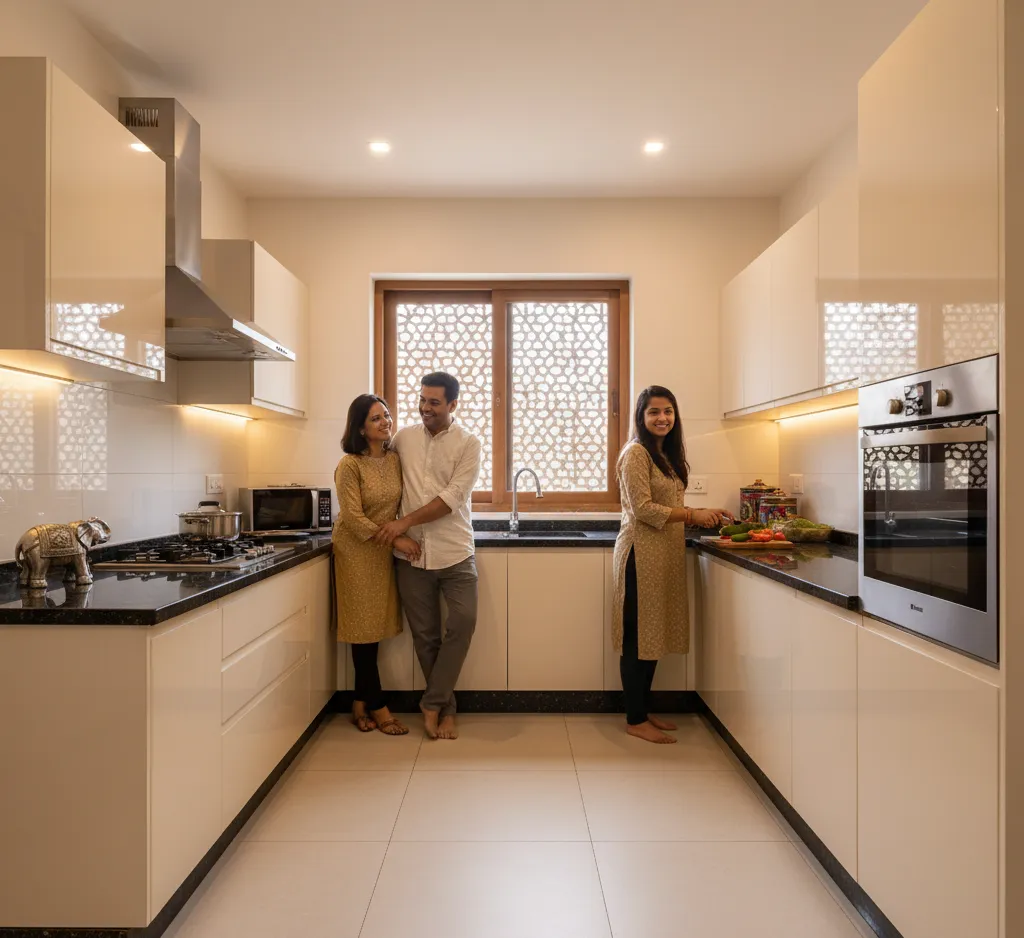
She leaned against the quartz counter. Cup in both hands. Quiet for a minute.
"The chai tastes the same. But the kitchen smells better."
Three weeks later I walked in for water at 7am. She was making parathas. Dough on the pull-out shelf. Tawa on the hob. Rolling board on the counter with empty space on BOTH sides. She wasn't shuffling things around. She wasn't fighting for room. She was just cooking. Calmly. In a kitchen that finally worked with her instead of against her.
"Aloo or gobi?" she asked without looking up.
Twenty-two years of Ramu kaka's kitchen. Seven days of renovation. And now the biggest decision in the morning is aloo or gobi.
I went with gobi.
Thinking about upgrading your old kitchen? KitchenKaki - we lived through the renovation so you'd know what to expect.
