
Open Kitchen vs Closed Kitchen: Which Suits Indian Cooking?
One cousin swears by her open kitchen. Her mother thinks it's a terrible idea. Who's right? Turns out, both — and the real answer for most Indian families is something in between.
Open Kitchen vs Closed Kitchen: Which Is Better for Indian Cooking?
This debate almost ruined Diwali dinner at my mama's house last year.
My cousin Priya had just moved into a new 3BHK in Malviya Nagar. Open-plan kitchen. Very Instagram. White quartz counter flowing into the living room, pendant lights, bar stools, the works. She was SO proud. Kept saying things like "it makes the flat feel so much bigger" and "I can talk to everyone while cooking."
My mama - her mother - walked in, looked at the kitchen for exactly four seconds, and said, "Beta, when you make tadka the whole sofa will smell like hing."
Priya rolled her eyes. Mama pursed her lips. Awkward silence. Then my uncle changed the subject to cricket.
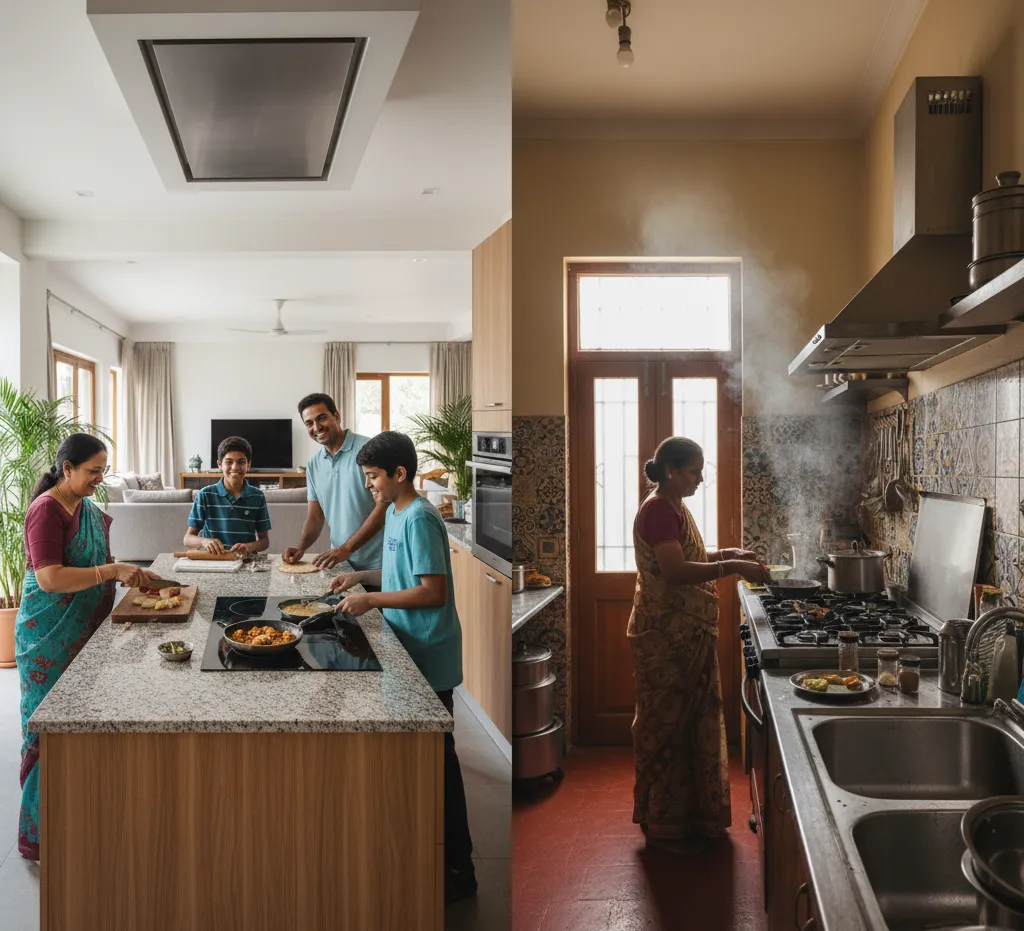
But here's the thing. They were BOTH right. And that's what makes this whole debate so tricky. There's no clean winner. It depends entirely on how you cook, who you cook for, and honestly - how much mess you're willing to show.
Let's Define the Two Options Real Quick
Closed kitchen: Four walls. A door. The kitchen is its own separate room. Traditional Indian setup. Your parents probably grew up with one. Mine definitely did - our Jodhpur house had a kitchen with a wooden door that my mom shut every single time she started the tadka.
Open kitchen: No wall between the kitchen and the living/dining area. The counter might face the drawing room directly. Some have an island or breakfast bar as a soft divider. But essentially - you cook, and everyone can see you, smell what you're making, hear the pressure cooker, and watch the chaos.
There's also a middle option - the semi-open kitchen - which I'll get to later because honestly it's the answer most Indian families actually need but nobody talks about.
The Case for Open Kitchens (And Why Priya Isn't Wrong)
Let me be fair to my cousin because she actually has some solid points.
Her flat is about 1,200 square feet. Not massive. With a closed kitchen, the living room would have felt noticeably smaller. By knocking out that one wall, her designer made the whole space breathe. The kitchen, dining, and living area flow into each other. Natural light from the balcony reaches the kitchen counter. It genuinely feels bigger than it is.
And the social thing? She's not making it up. Priya has friends over almost every weekend. She makes pasta, some grilled chicken thing, maybe a quick salad. Light cooking. Minimal oil. She genuinely enjoys chatting with people while she cooks. The open layout lets her do that without yelling through a wall.
For couples in smaller apartments - 1BHKs, studios, compact 2BHKs - open kitchens make even more sense. When your kitchen is 60 square feet and you close it off with walls, it becomes a tiny box you hate being in. Open it up and suddenly the same space feels workable.
And aesthetically? Yeah. Open kitchens look modern. There's no arguing that. If you care about your apartment looking like it belongs in 2026 and not 1998, an open layout does the job.
Now Let Me Tell You Why Mama Is Also Right
My mama has been cooking Rajasthani food for 40 years. She makes dal baati churma. She deep fries kachoris in a massive kadai of oil. She does a tadka with whole red chillies that makes everyone in the room cough. She pressure cooks rajma for 20 minutes straight.
Put all of that in an open kitchen and what happens?
Oil splatter travels. Not just on the counter - on the sofa fabric behind it, on the dining table, on the TV screen if it's close enough. Indian cooking uses way more oil than Western cooking. We temper in ghee. We fry in mustard oil. That grease doesn't stay put. It floats, settles, and coats everything within a 10-foot radius.
Smells take over the whole flat. Jeera, haldi, hing, chilli - these smells are intense. In a closed kitchen, you shut the door and turn on the chimney. Done. In an open kitchen, that hing tadka will reach your bedroom pillow. Not joking. My cousin noticed this about three weeks after moving in. She now keeps her bedroom door shut while cooking. Small detail nobody warned her about.
Noise carries everywhere. Pressure cooker whistling. Mixer grinding. Chimney running at full speed. In a closed kitchen, all that noise stays inside. In an open layout, your family hears every whistle during their TV show. It sounds minor but over weeks and months, it genuinely irritates people.
The mess is always visible. This is the one nobody admits upfront. Indian cooking generates dishes FAST. Two kadhais, three bowls, a rolling board with atta dust, the masala tray with spills - all visible from the living room. In a closed kitchen, you shut the door and deal with it later. Open kitchen? Your guests see the warzone in real time.
So What's the Actual Answer?
After watching Priya and Mama argue about this for a year - and after visiting maybe 30 kitchens across Jaipur in the last two years - here's my honest take.
If you cook light, modern meals most days - salads, sandwiches, pasta, grilled stuff, quick stir-fry - an open kitchen is perfectly fine. The oil load is low, smells are mild, and you'll love the open feel.
If you cook full-on Indian meals daily - dal, sabzi, rotis, rice, tadka, occasional deep frying - a closed kitchen will save you from a LOT of cleaning and smell problems. Your furniture will thank you. Your curtains will thank you. Your sanity will thank you.
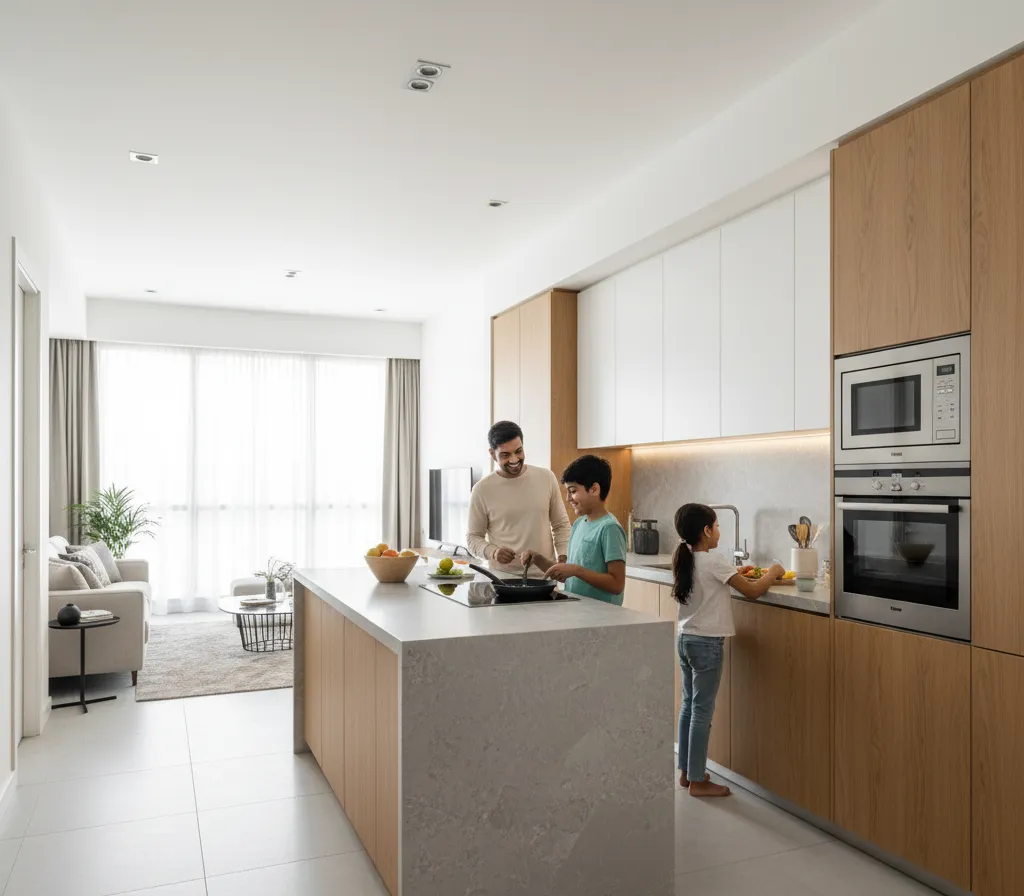
But most of us do both. We make maggi on Monday and biryani on Sunday. We grill paneer tikka one night and deep fry pooris the next. Our cooking style isn't one thing. It shifts constantly.
Which is why the real answer for most Indian homes is...
The Semi-Open Kitchen (The Option Nobody Talks About Enough)
I'm surprised more designers don't push this. It's the obvious middle ground.
A semi-open kitchen keeps three walls intact. The fourth wall - the one facing the living or dining room - has a partial opening. Maybe a big window-like cutout. Maybe a breakfast counter with a half-wall beneath it. Maybe a sliding glass door that you can leave open when you're making tea and shut when you're frying samosas.
That sliding door idea? Changed my perspective completely. I saw it in a flat in Mansarovar Extension. Three glass panels that slide and park on one side. When the lady of the house does regular cooking - doors open, kitchen feels connected, she talks to the kids in the living room. When she does heavy cooking - doors shut, chimney on, zero smell outside.
Cost for a basic aluminium-framed sliding glass partition? About ₹15,000 to ₹25,000 for a standard kitchen opening. That's it. And it solves 90% of the open-vs-closed debate in one shot.
Other semi-open tricks that work well - a pass-through window between kitchen and dining for serving food without walking around. A breakfast counter at the opening that acts as both a serving platform and a visual boundary. Or a jali-style MDF partition that blocks the direct view of the sink and stove but lets light and conversation pass through.
A Few Things to Decide Before You Pick
These questions actually matter more than "open or closed" as labels:
How often do you fry? If deep frying happens more than twice a week, you need walls. Or at minimum, a really powerful chimney AND a closable partition.
Do you have a separate utility area? Some apartments have a small utility/washing area behind the kitchen. That changes things. You can use THAT space for heavy cooking - frying, tempering - and keep the main open kitchen for lighter prep and serving. Smart families split cooking duties this way.
Who else is in the flat during cooking? If it's just you and your partner, an open kitchen is fine. If you have elderly parents, babies, or guests visiting often - smells and noise from open cooking WILL bother them daily. Factor that in.
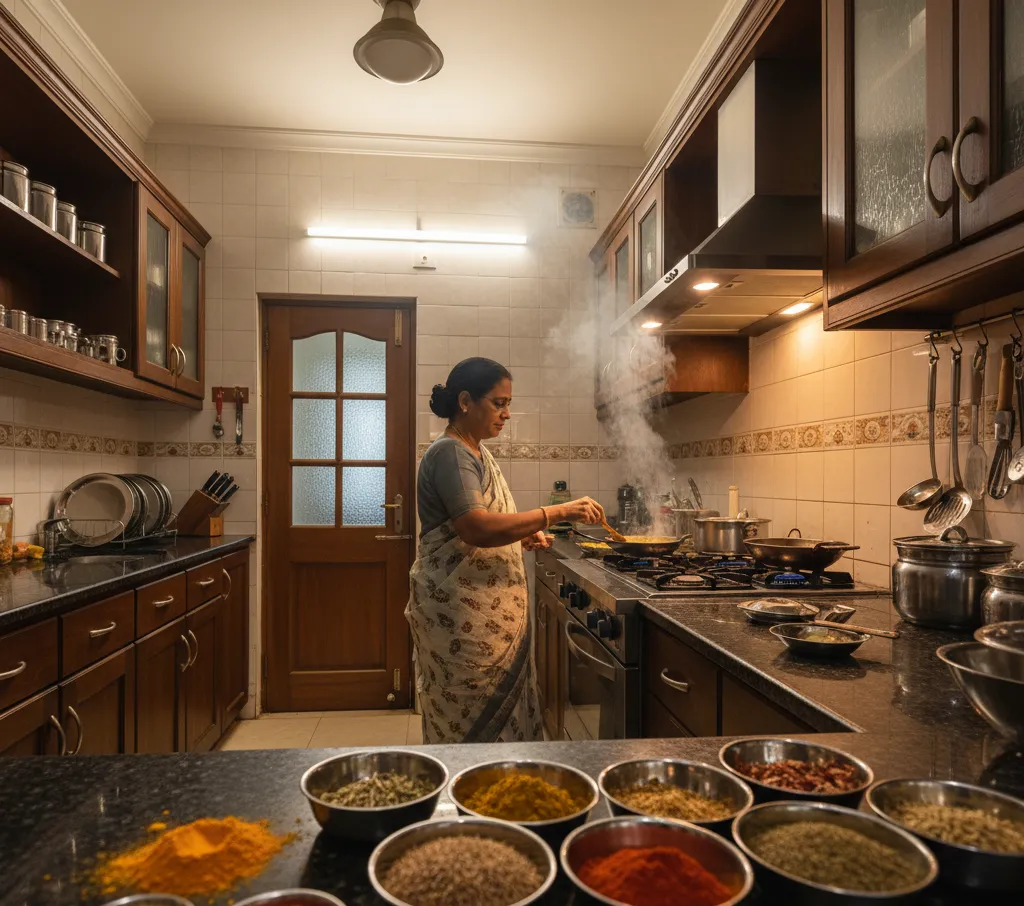
How disciplined are you about cleaning as you cook? Open kitchens only look good if you clean constantly. Every spill, every splash, immediately. If you're the "I'll do dishes after dinner" type - and no shame in that, I am too - a closed kitchen hides the evidence.
What I'd Do If I Were Building Tomorrow
I'd go semi-open. Three walls, one sliding glass partition on the living room side. A small breakfast bar on the outside of the partition for casual eating. A proper chimney on the cooking wall. And if the budget allows - a small enclosed utility space behind the kitchen for the pressure cooker, deep frying, and the mixer grinder that sounds like a construction site.
That combo gives you the modern open look when you want it, the closed privacy when you need it, and the sound buffer when Mama's cooker is going at full blast.
Priya might not agree with me. But I bet Mama would.
Want more honest kitchen comparisons? We break it all down at KitchenKaki - no sugarcoating, just real advice for Indian homes.
