
Parallel Kitchen Design: Space-Saving Tips for Indian Flats
I spent two years telling myself my 7-foot kitchen was "fine." It wasn't. One renovation later — parallel layout, same four walls — I cook completely differently now. Here's everything I wish someone had told me before I started, from getting the aisle width right to why your masalas need to be next to the hob and nowhere else.
Parallel Kitchen Design: Space-Saving Tips for Indian Flats
Okay so here's a confession - I spent almost two years convincing myself my kitchen was "fine."
It wasn't fine. It was 7 feet of chaos with a single counter, a wall that had somehow accumulated four different calendars, and a corner where things went to die. Every evening I'd be simultaneously chopping, stirring, and doing that thing where you balance the kadai lid on your forearm because there's nowhere to put it.
My sister visited from Hyderabad, took one look, and said "bhaiya yeh kitchen nahi, penalty box hai."
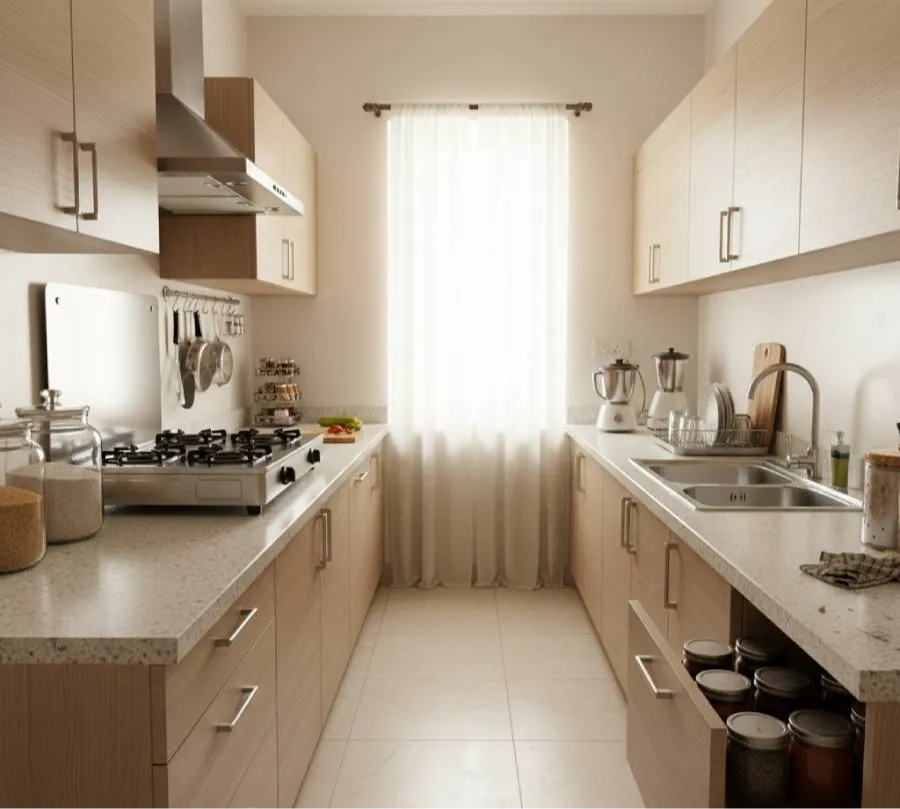
She wasn't wrong.
When I finally renovated - small budget, old flat in Jaipur, the kind of building where the electrician and the plumber are mysteriously always the same unavailable man - the designer suggested a parallel layout. I'd seen them in modular kitchen showrooms and always assumed they were for bigger spaces. Turns out I had it completely backwards.
The Idea Is Simple. Almost Annoyingly Simple.
Two counters. Opposite walls. Corridor in between.
That's a parallel kitchen. No fancy name needed. Ships have used this layout for centuries because when space is limited and efficiency is everything, putting your work surfaces on both sides of a walkway just makes sense. You reach left, you reach right, everything is there. You don't walk anywhere.
I know "galley kitchen" sounds more impressive if you're describing it at a dinner party. Same thing.
Why It Works for Us Specifically
And by us I mean people cooking Indian food daily. Not the "throw a salad together in ten minutes" kind of cooking. The real kind.
Think about what's actually happening when you make a proper meal. There's dal on the burner, you're waiting for it to boil so you can turn it down, meanwhile the onions for the sabzi need to go in right now before they burn, you're chopping tomatoes, someone just asked where the haldi is, the cooker is about to whistle and needs to be moved to the small burner -
It's not cooking. It's orchestration.
A single counter handles none of this gracefully. You're constantly rotating, moving things to make space for other things, putting hot vessels on the floor (we've all done it, don't pretend), and generally operating at the edge of mild chaos.
The parallel layout splits this into zones. Hot side, wet side. Cooking stays on one wall, washing and prep on the other. The moment I stopped having my cutting board six inches from the active gas flame, I realised how unnecessarily stressful the previous arrangement had been.
Two people cooking together especially - my wife makes the rotis while I handle everything else, and in the old kitchen this was essentially a contact sport. Now we each have a side. Revolutionary concept, I know.
The Width. Please Get This Right Before Anything Else.
I'm going to say something and I need you to take it seriously: measure the corridor width before you order a single cabinet.
Not approximately. Actually measure.
For one person - 900mm minimum. Less than that and you'll be doing the Macarena every time you need to open the base cabinet on the opposite side.
For two people sharing the kitchen - 1050mm to 1100mm. Enough to pass each other without becoming briefly very intimate.
Don't go over 1200mm unless you have a specific reason. The advantage of a parallel kitchen is that both sides are close. Stretch it too wide and you've just built a very long, thin regular kitchen.
Also - and this one catches everyone - measure with the doors open. The fridge door. The oven door. The overhead cabinet shutters. One of my neighbors measured her corridor perfectly and then discovered that when the fridge door was open, she couldn't fully open the base cabinet directly opposite. Six months of kitchen renovation and she still can't use both at the same time. Don't be her.
Two Sides, Two Jobs. Stop Treating Them the Same.
The kitchens that don't work - and I've been in a few belonging to friends who then complained their parallel kitchen "didn't feel any different" - almost always made this mistake. Both walls filled identically. Sink somewhere random. Hob somewhere random. Everything accessible but nothing organised.
Here's how to actually divide it:
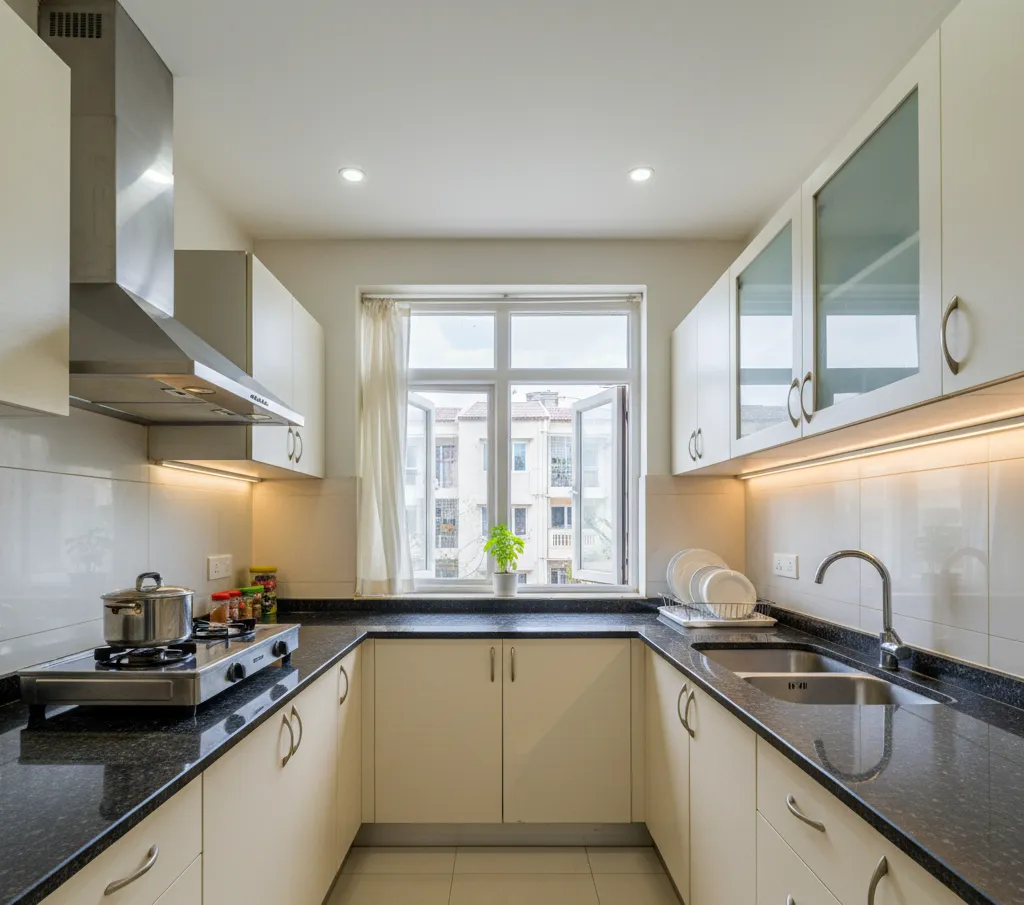
The wet side: sink here. Full stop. Washing dal, soaking dishes, rinsing vegetables, defrosting things under running water - all of it happens on this side. Put prep space right next to the sink so the distance between "washed" and "chopped" is about twelve inches.
The cooking side: hob here. Counter on both sides of it for hot things to land. Microwave above at eye level - not on the counter eating up prep space, not so high you're lifting heavy dishes above your head. This side runs hot and you want everything a cook needs during active cooking within arm's reach.
Fridge at the entry end of the kitchen. This matters more than people think. Groceries come in from outside, they should be able to go straight into the fridge without you carrying them through the entire cooking zone. Same logic when you're cooking - step in, open fridge, grab what you need, step into the kitchen. Clean movement.
The reason this matters beyond efficiency - it naturally keeps raw and cooked separated. Raw chicken on the wet side being prepped, cooked food on the hot side being finished. No contamination risk, no discipline required, just geography doing the work.
Storage. Let's Be Real About What We're Dealing With.
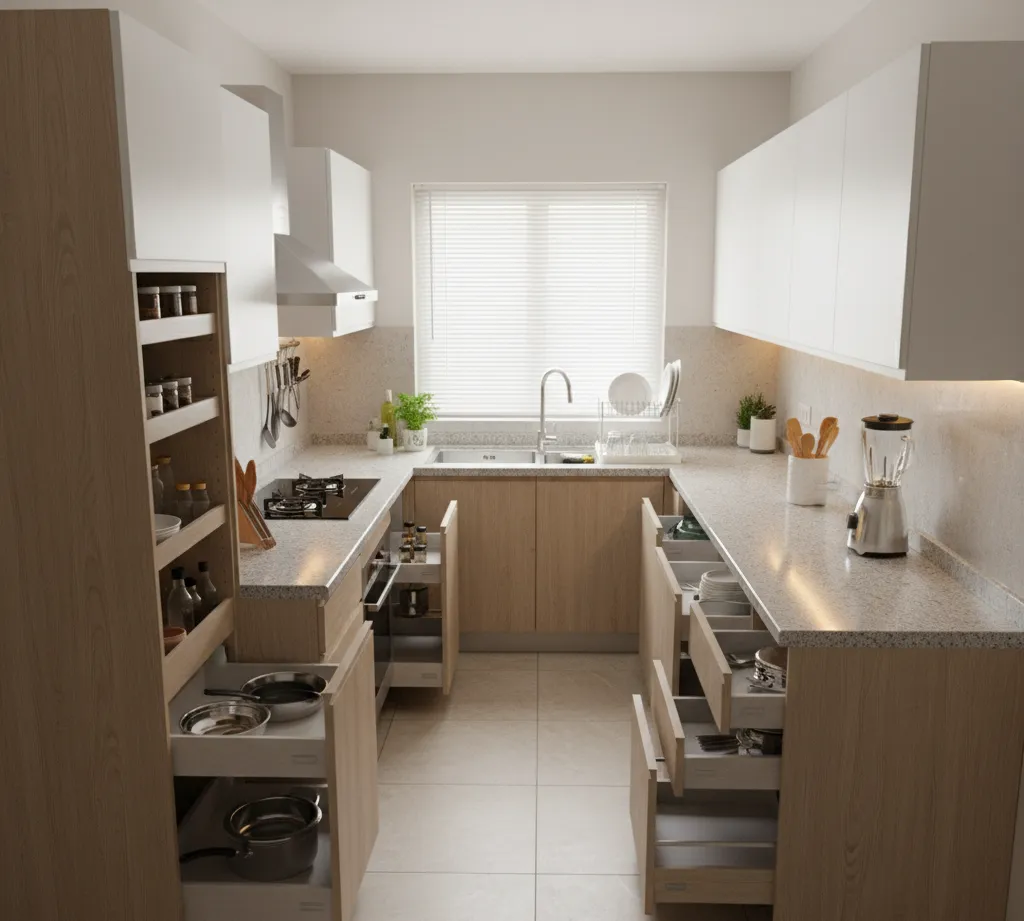
I have - and I counted once out of curiosity - twenty-three spice containers. This does not include the ones in the overflow cabinet. My household is not unusual. Most Indian kitchens contain more equipment per square foot than a small restaurant.
Pressure cookers in two or three sizes. A kadai for everyday use and a bigger one for when people visit. The tawa that cannot under any circumstances be washed with soap because the seasoning took three years to develop. Mixer-grinder. Possibly a second mixer because the first grinding jar works better for some things. Steel dabba sets. The giant patila that comes out when the whole family arrives.
Standard hinged-door base cabinets are not designed for this reality. You open the door, you see the front row, and the back half exists in a theoretical sense - you know things are there, you occasionally rediscover them, you cannot reliably access them without removing everything in front first.
Pull-out drawers - the full-extension kind that come all the way out - fix this in a way that feels almost embarrassingly obvious once you have them. Everything visible. Everything reachable. The pressure cooker at the back as accessible as the one at the front.
Yes they cost more. No I will not tell you they're optional.
Masalas - next to the hob, not nearby. Actually next to it. When one hand is stirring and you need to add something with the other, that spice needs to be reachable without moving your feet. Slim pull-out column, a drawer with inserts, wall-mounted rack - format doesn't matter, location does.
Overhead cabinets - change the shutter direction. Standard shutters open outward toward your face while you stand at the counter below. Lift-up mechanisms go upward and stay there. The difference sounds small until you're opening overhead cabinets forty times a day.
Tall units at the ends. Pantry column, refrigerator housing, tall appliance unit - end of the kitchen, not middle. The central working zone should be counter height on both sides. A tall unit in the middle cuts your workflow and makes the space feel like a storage corridor.
Lighting. Still Somehow an Afterthought.
One ceiling bulb. That's standard in most Indian flats. And it means you stand at the counter and cast a perfect shadow exactly where your hands are working. Every single time.
Under-cabinet LED strips solve it. Not expensive - a decent strip for one counter side costs a few hundred rupees. Electrician installs it in an hour. Lights the counter from slightly above and in front, directly where work happens, zero shadows.
I resisted for two years thinking it was unnecessary. It changed how the kitchen felt more than almost anything else I changed. Sometimes I still feel mildly stupid about this.
If there's a window - even a small awkward one on the short end wall - don't cover it. Natural light moving through a corridor kitchen changes the whole mood, especially in morning cooking when overhead lights feel like an interrogation.
Chimney, Briefly
It goes above the hob. Everyone knows that part.
What people get wrong is the duct. Straight line to the nearest exterior wall, fewest bends possible. Every 90-degree turn loses suction. Installers suggest longer routes sometimes to avoid drilling in inconvenient spots - that's their convenience not yours.
Daily Indian cooking - oil, high flame, tempering, regular deep-frying - needs at least 800 m³/hour, ideally 900 to 1000. A struggling chimney means cooking smells that should leave your kitchen slowly become part of your walls instead.
Plan the duct path before cabinets are installed. Retrofitting it later means at least one cabinet ends up slightly wrong. This is not a hypothetical.
Very Small Kitchens
Some flats just have 6 feet per wall, sometimes less. The building was designed when kitchens weren't considered important. Here we are.
Don't run overhead cabinets the full length of both walls. The tunnel feeling is real and the kitchen becomes unpleasant to spend time in.
Open shelves on one side, closed on the other. The open side breathes, feels faster for daily dishes, breaks the enclosed look. You lose dust protection but if you're cooking daily those things get used and washed regularly anyway.
Fold-down counter at one end - down when needed, flat when not. If the kitchen opens toward a dining space it doubles as a serving counter. Sounds minor, feels significant during a family dinner when you're plating six things at once.
The Actual Point
My renovation cost more stress than money. Designer was good, contractor occasionally missing, cabinets arrived wrong colour the first time. Typical.
But I cook differently now. Not because I got better at cooking. Because the kitchen stopped arguing with me every evening.
That's what a properly planned parallel kitchen does - it gets out of your way. The layout isn't the point. The point is whether the person at 7pm, tired from work, standing in that corridor trying to get dinner done - whether they have what they need, where they need it, without thinking about it.
If yes, it works. Everything else is just cabinetry.
More kitchen design ideas for real Indian homes at Kitchen Kaki.
