
Pull-Out Kitchen Drawers: Types, Benefits & Where to Use
My mummy pulled a wooden drawer 65,000 times in 22 years. The wiggle-pull-reach-push ritual ended the day her modular kitchen arrived with telescopic channels. Here's every drawer type and where it belongs.
Pull-Out Kitchen Drawers: Types, Benefits & Where to Use
My mummy's old kitchen had three drawers. Wooden boxes sliding on raw wood rails. No channels. No bearings. No mechanism of any kind. Just wood on wood.
To open the masala drawer, she'd grab the handle and pull. The drawer would resist. She'd pull harder. It would jerk forward two inches and stop. She'd wiggle it side to side - a technique she'd perfected over twenty years - and it would reluctantly slide another three inches. Then she'd reach inside, feel around for the haldi dabba because the drawer was only halfway open and the back half was in shadow, grab it, and push the drawer back. The push involved the same wiggle in reverse.
This happened eight to ten times a day. For twenty-two years. That's roughly 65,000 times she performed the wiggle-pull-reach-push ritual on a single drawer. I calculated this during a boring meeting once. It horrified me.
When her new modular kitchen was installed in 2020, the drawers came with telescopic channels. Full-extension. Soft-close. She pulled the first drawer open and it glided out - the entire thing, all the way, smooth, silent, revealing every item inside from front to back. She stared at it. Pushed it back. It caught two inches before closing and eased itself shut without a sound.
She opened and closed it four more times. Then she looked at my dad and said, "Twenty-two years I was pulling that wooden thing. TWENTY-TWO YEARS."
Dad wisely said nothing.
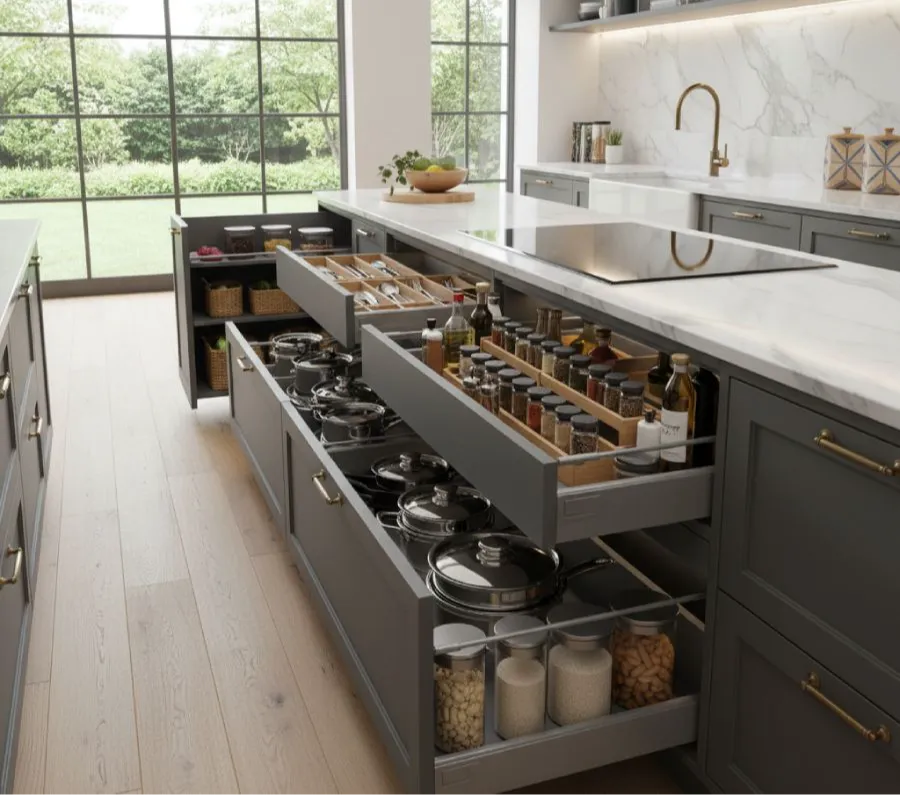
The Thing Nobody Explains: Drawers Are Not All the Same
When I started getting involved in family kitchen renovations - a role I didn't ask for and now can't escape - I assumed a drawer was a drawer. You pull it. Stuff is inside. You push it back. What's complicated about that?
Turns out there are at least four completely different drawer systems used in Indian modular kitchens and the difference between them is the difference between my mummy's wooden nightmare and bhabhi's butter-smooth tandem box. Let me explain each one based on who in my family has it and what living with it actually feels like.
Basic Ball-Bearing Channels (What Most Budget Kitchens Get)
My brother's ₹1.16 lakh kitchen has these. Standard ball-bearing telescopic channels. The drawer sits on two metal rails - one on each side - with small steel balls inside that allow the rail to extend outward.
They work. They're functional. They're a massive upgrade from raw-wood-on-wood. But they're not perfect and after ten months I can already see the limitations.
First - they're partial extension. The drawer pulls out about 75% of the way. The back 25% is still inside the cabinet. Which means items stored at the back of the drawer are hard to see and hard to reach. Priya stores her masala dabbas in a base cabinet drawer. The ones at the front? Easy. The garam masala hiding in the back? She has to lean forward and fish around. It's a milder version of mummy's old problem.
Second - load capacity is okay but not great. Standard ball-bearing channels handle about 20-25 kg. For a cutlery drawer or a masala drawer, that's plenty. For the drawer where Priya stores her three pressure cookers? She says it feels slightly strained. The drawer glides out fine when empty. When loaded with 8-10 kg of steel vessels, there's a heaviness to the motion. A slight reluctance. Like the drawer is sighing.
Third - no soft-close. When Priya pushes the drawer shut, it closes with a thud. Not a slam - the ball bearings prevent the violent bang of raw wood - but a definite thud. At 6:30am when the rest of the house is sleeping, that thud carries.
Cost: ₹200-400 per pair. For a kitchen with maybe 6-8 drawers, you're spending ₹1,200-3,200 on channels. At my brother's budget, this was the right call. Every rupee was allocated and soft-close channels at ₹600-900 per pair would've added ₹3,000-4,000 to the budget for a feature that's nice but not structural.
Full-Extension Soft-Close Channels (The Sweet Spot)
This is what my parents' kitchen has. Telescopic channels with full extension - the drawer comes ALL the way out, 100% - plus a soft-close damper that catches the drawer before it slams and eases it closed in a quiet, controlled motion.
The difference between 75% extension and 100% extension sounds minor in numbers. In practice it's transformative. When mummy pulls her masala drawer out fully, she can see EVERYTHING inside. Front to back. No shadows. No hidden corners. She doesn't reach and fumble. She looks, grabs, done.
The soft-close is what my dad can't stop demonstrating to visitors. He'll open a drawer, give it a push, and then hold up one finger as if conducting an orchestra while the drawer whispers shut on its own. He's done this maybe a hundred times in four years. It still amuses him. Mummy rolls her eyes every time but I've also caught her doing the same demonstration when her friends visit. They don't admit it but the soft-close has become a point of household pride.
Load capacity: 30-40 kg on good branded channels. Mummy stores her heaviest kadais in a deep drawer with these channels. They handle the weight without hesitation. No sighing. No reluctance. Smooth in, smooth out, regardless of what's inside.
Cost: ₹600-1,200 per pair depending on brand and load rating. Hettich ↗ and Hafele are the premium brands - ₹800-1,200. Indian brands like Ebco and Olive run ₹500-800. For a kitchen with 6-8 drawers, total investment is ₹3,600-9,600. My parents paid about ₹5,400 total for all their drawer channels. Six years later, every single one still works exactly as it did on Day 1. Not one has loosened. Not one has jammed. Not one has lost its soft-close dampening.
If your budget allows even ONE upgrade from basic ball-bearing to soft-close full-extension, do it on the heaviest-use drawer. The one you open most - usually the cutlery or daily masala drawer. That single upgrade changes your kitchen's daily feel more than you'd expect.
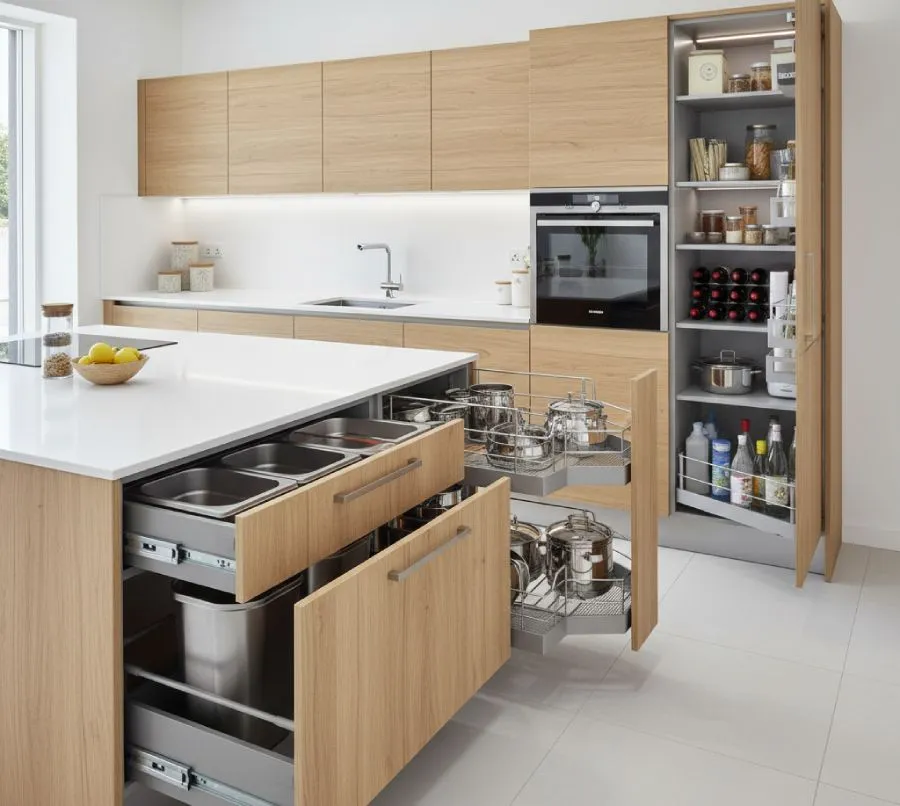
Tandem Box Drawers (The Fancy Ones Bhabhi Has)
This is where kitchen drawers stop being drawers and start being... furniture. I don't know how else to describe what bhabhi has.
A tandem box is a metal-sided drawer system. Instead of a wooden box sitting on two channels, the drawer IS the channel. Double-walled steel sides - one outer wall, one inner wall - with the slide mechanism built INTO the wall itself. The base is usually a wooden or metal panel that clips into the steel sides.
The visual difference is immediate. Standard drawers are wooden boxes with channels screwed to the outside. Tandem drawers are sleek metal structures that look like miniature filing cabinets. When you open one, the steel sides are visible - usually in grey or white - with a thin profile that maximizes internal storage space.
But the FEEL is what sold me. I opened bhabhi's tandem drawer on the day her kitchen was installed. One finger. The drawer glided out with a motion so smooth it felt like pushing a cloud. No resistance. No wobble. Complete silence except the faintest whisper of steel sliding on steel. Full extension. Then I pushed it back. Soft-close caught it. The drawer eased shut with a motion that can only be described as dignified.
I turned to bhabhi and said something articulate like "whoa."
Load capacity on tandem boxes is serious - 40-50 kg on standard ones, more on heavy-duty versions. Bhabhi stores her entire pressure cooker collection in one deep tandem drawer. Three cookers, two lids, a total weight of maybe 12-14 kg. The drawer doesn't know they're there. Same glide empty or loaded.
The gallery rails on top - thin steel rods running along the upper edge of the drawer sides - keep contents from bouncing out if you pull the drawer enthusiastically. This sounds like a niche feature until you pull a loaded cutlery drawer fast and realize that without gallery rails, spoons would be launching themselves onto the kitchen floor.
Cost: this is where it gets real. Basic tandem box systems from Indian brands - ₹2,000-3,500 per drawer. Mid-range from Hettich Arena or similar - ₹4,000-7,000 per drawer. Premium Blum Tandembox systems - ₹6,000-12,000+ per drawer.
For a kitchen with 6 drawers, basic tandem boxes add ₹12,000-21,000 to the budget. Premium ones add ₹36,000-72,000. That's why tandem boxes are standard in ₹3-5 lakh kitchens and rare in budget builds.
Bhabhi's kitchen has four tandem drawers at the mid-range level. About ₹20,000 total for the drawer systems. In a ₹2.8 lakh kitchen, that's roughly 7% of the budget on drawers alone. She considers it the best 7% she spent.
Internal Drawers (The Hidden Ones Inside Drawers)
This one blew my mind when I first saw it at a showroom and I need to tell you about it even though nobody in my family has one yet.
An internal drawer is a shallow drawer that sits INSIDE a deep drawer. You pull out the main deep drawer. Inside it, at the top, is a separate smaller drawer that slides independently. So you have two layers of storage in one drawer space - the deep main section below for big items, and the shallow internal section above for small items.
The showroom demo had a deep base drawer for pots and pans. Inside it, a shallow internal drawer for lids. You pull the main drawer - pots right there. You pull the internal drawer independently - lids right there on top. Two storage systems in one footprint.
In an Indian kitchen context, I immediately thought: deep drawer for the kadais and cooker bodies. Internal drawer for lids, silicone mats, small tools. No more stacking lids on top of vessels and having them slide off every time you open the drawer.
Cost: ₹3,000-6,000 for the internal drawer mechanism on top of whatever the main drawer system costs. Available mostly in premium Hettich and Blum systems.
Bhabhi doesn't have one. But next time she upgrades or when my brother eventually builds a bigger kitchen - this is the first thing I'm recommending. The lid-organization alone justifies the cost for any Indian kitchen that owns more than two pressure cookers. Which is every Indian kitchen.
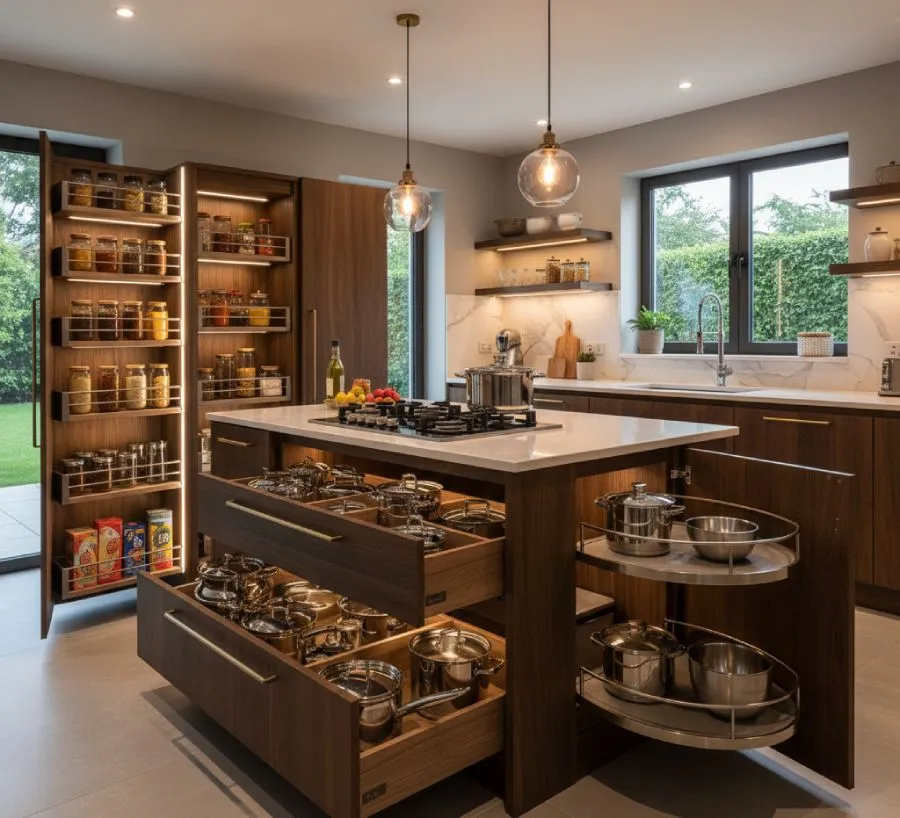
Where Each Type Goes in a Real Kitchen
After watching four family kitchens operate daily, here's what I've figured out about which drawer goes where.
The cutlery drawer - the one you open 10+ times a day, the one everyone in the house uses - deserves the best channel you can afford. If that's tandem, great. If it's full-extension soft-close, also great. Don't cheap out here. This is your most-touched drawer.
The masala or daily-use spice drawer - second most opened. Full-extension is critical here because you need to see everything. The coriander powder hiding behind the red chilli jar at the back of a partial-extension drawer will stay hidden until you run out and buy a second jar, only to discover the first one a week later. This happens in Priya's kitchen. She now owns two coriander powder jars. She's annoyed about it.
The deep vessel drawer - where pressure cookers, kadais, and heavy pots live. Load capacity matters most here. At minimum, full-extension soft-close channels rated for 30+ kg. Tandem box if your budget allows.
The utility drawer - cleaning supplies, cling wrap, aluminium foil, zip bags, random stuff. Basic ball-bearing channels are FINE here. This drawer opens once or twice a day. Nobody cares if it's partial-extension. Nobody needs soft-close for the drawer that holds garbage bags.
Don't put the same quality everywhere. Match the channel to the drawer's daily-use frequency and load. The cutlery drawer and the garbage-bag drawer do not need the same investment. That ₹5,000 difference per drawer is better spent on one amazing cutlery drawer than on upgrading a drawer you open twice a week.
The Sound Test I Do at Every Showroom Now
Before committing to a drawer system, I do the same thing at every showroom. I load the sample drawer with whatever's available - usually the showroom guy's chai cups and random samples - and then open and close it ten times rapidly.
Cheap channels develop a grinding sound by pull five. Good channels stay smooth. Tandem boxes stay silent.
Then I push the loaded drawer in from full extension and listen. A thud means no soft-close. A whoooosh means soft-close is working. A barely-audible click followed by the drawer easing itself shut - that's a good damper.
My mummy suffered the grinding-thud combination for 65,000 cycles. Nobody in my family ever will again. Not on my watch.
More kitchen hardware advice from someone who opens and closes drawers obsessively? KitchenKaki - we count cycles so you don't have to.
