
Stainless Steel Modular Kitchen: Honest Pros, Cons & Maintenance
Sharma aunty's plywood kitchen was destroyed by termites. She replaced it with full stainless steel. Three years later — zero termite risk, zero water damage, but she wipes fingerprints twice daily. Here's the full honest story.
Stainless Steel Modular Kitchen: Pros, Cons & Maintenance Tips
My parents' neighbour in Malviya Nagar - Sharma uncle - got a full stainless steel modular kitchen installed in 2022. We all thought he'd lost his mind.
"Steel kitchen? Like a restaurant?" my dad said, peering through the shared wall as if he could see through it. "It'll look like a dhaba."
Sharma aunty was the one who wanted it. She'd read something online about stainless steel kitchens being termite-proof, waterproof, and lasting "forever." Given that their previous plywood kitchen had been destroyed by termites in under four years - a story that sounds familiar if you've been reading our blogs - she was done with wood. DONE. "I don't want to see plywood again in my life," she told my mummy over chai. Exact words.
So they got a full SS 304-grade stainless steel modular kitchen. Cabinets, shutters, drawers, internal shelves - everything metal. The countertop is granite because even Sharma aunty drew the line at a steel counter. ("I'm not running a canteen.") Cost them about ₹4.5 lakh. That's roughly 25-30% more than a comparable plywood modular kitchen would've been.
I've been watching this kitchen for three years now. Going over for chai, peeking into cabinets when Sharma aunty isn't looking, asking annoying questions that she tolerates because I'm "the kitchen blog boy" - her words, not mine. Here's what I've actually observed.
Year One - The Honeymoon Phase
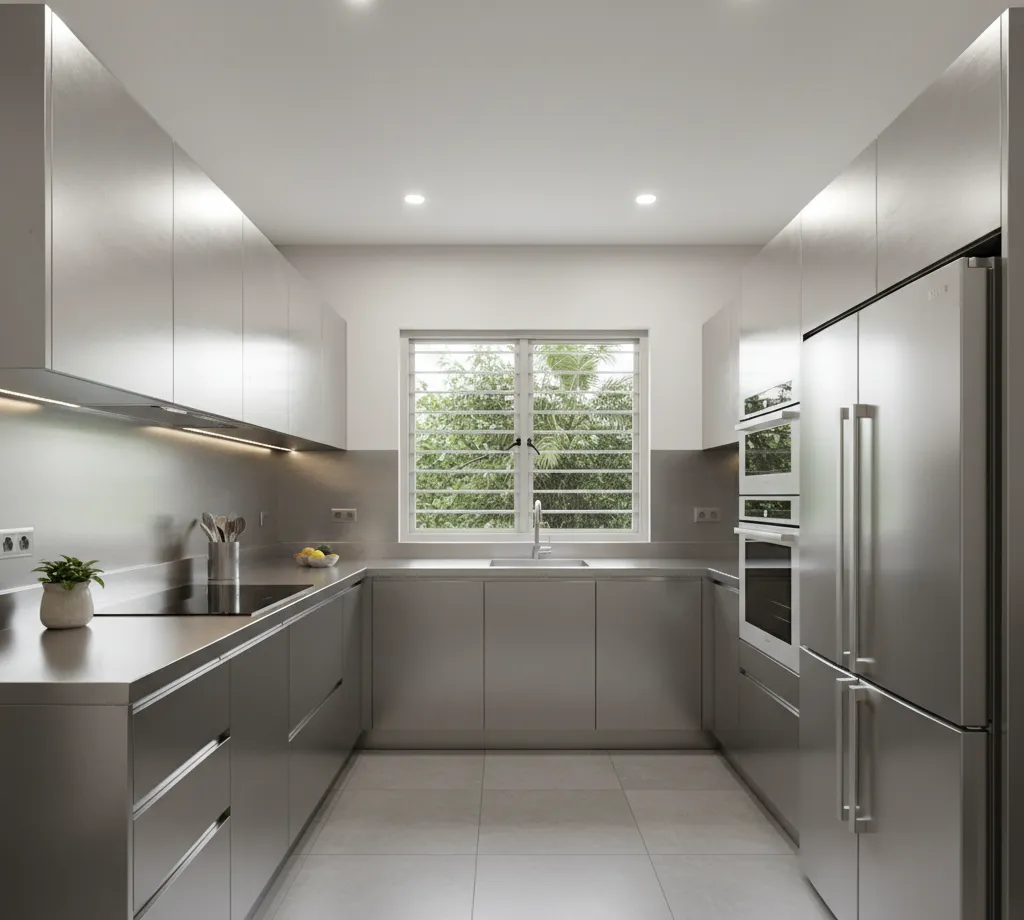
The kitchen looked stunning in the beginning. I'll admit this even though I'm a plywood loyalist. The steel had a brushed matte finish - not mirror-shiny, not industrial, somewhere in between. The light grey tone matched their white granite counter surprisingly well. The cabinets felt solid when you opened them. Heavy. Substantial. Like opening a bank vault designed for masalas.
Sharma aunty was evangelical about it for the first six months. She'd pull visitors into the kitchen and demonstrate features like a showroom salesperson. "See - no termites. EVER. See - water doesn't do anything to it. Look - I spilled haldi yesterday, wiped it, gone." She once poured water directly on a cabinet surface during a dinner party to prove it wouldn't swell. My mummy watched with an expression that said "I would never do that to my kitchen but I respect the confidence."
The termite thing is legitimate and I need to give full credit here. Steel is metal. Termites eat cellulose. There is zero cellulose in stainless steel. In Jaipur, where I've watched termites eat bookshelves, window frames, shoe racks, and one entire kitchen in my own family - a material that termites literally cannot interact with is genuinely appealing. Sharma uncle's previous kitchen died from termites. His stainless steel kitchen will never face that problem. Not in ten years. Not in fifty. The termites could hold a conference on his kitchen floor and accomplish nothing.
Water resistance is the other genuine superstar feature. Monsoon humidity, sink splashes, the slow drip under the sink that nobody notices - steel doesn't care about any of it. It doesn't swell. It doesn't warp. It doesn't develop that mushy soft spot that plywood gets near water. Remember my mummy's old under-sink cabinet that a plumber's thumb went through? That CANNOT happen with stainless steel. The concept doesn't even apply. You could submerge a steel cabinet in a swimming pool and pull it out looking exactly the same.
Year Two - When Reality Showed Up
Month fourteen or so. I went over for chai. Sharma aunty was wiping a cabinet door. Not unusual - she'd always been attentive about cleaning. But this time she was wiping with a specific cloth and a specific motion, and there was a tightness in her jaw that I recognised from watching bhabhi wipe her acrylic shutters.
"Fingerprints," she said without me asking. "Everywhere. All the time. I've started hating the word fingerprint."
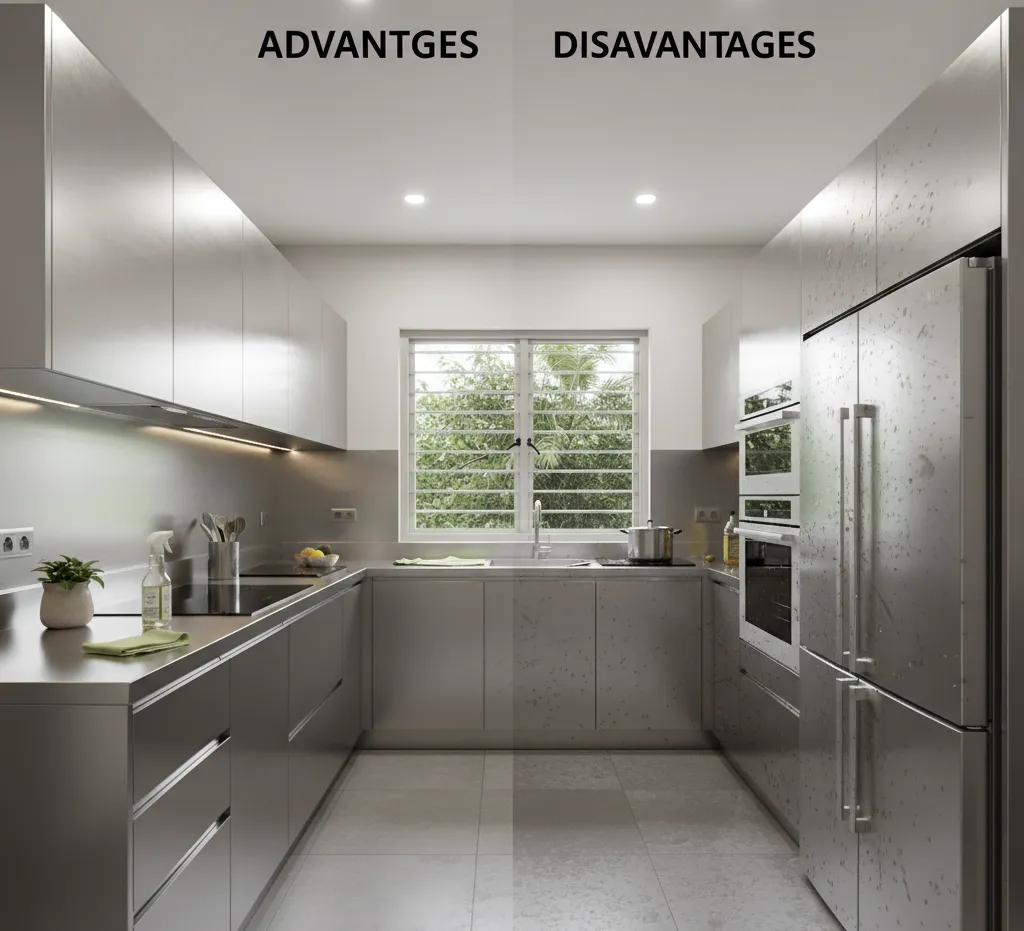
The brushed matte finish - which looked so sophisticated in month one - turned out to be a forensic record of every human touch. Her husband opens a cabinet? Fingerprint. Her grandchild grabs the drawer handle? Tiny greasy fingerprint. She opens the cabinet to get a masala jar? Her OWN fingerprint. Every single interaction with the kitchen surface left evidence.
She was wiping cabinets maybe twice a day. Not because of cooking grease or dust. Because of HANDS. Human hands touching metal surfaces and leaving marks that are invisible on laminate, invisible on matte paint, invisible on wood - but glaringly obvious on stainless steel in certain light.
"At night when the kitchen light hits from the side," she said, "it looks like twenty people had an argument in here."
The scratches showed up around the same time. Fine, hairline scratches from steel vessels being placed against the cabinet surface. From a serving spoon handle accidentally swinging into a door. From the pressure cooker lid bumping the lower cabinet during storage. None of these scratches would register on laminate or wood. On the smooth steel surface, each one caught the light at a specific angle and announced itself.
Sharma aunty bought a scratch-removal kit from Amazon. It helped with the finest lines but the deeper ones - the one from the kadai handle, the one from her husband's belt buckle when he leaned against the counter (yes, really) - those are permanent features now.
The Noise Nobody Warned Them About
This is the thing that surprised me most because I'd never read about it in any stainless steel kitchen review online.
Steel is LOUD. Closing a steel cabinet door - even with soft-close hinges - makes a different sound than closing a plywood door. There's a metallic resonance. A faint tinny ring. Like tapping a steel thali with your finger. It's not a bang. It's more of a... tone.
Open a drawer. Put steel katoris inside. Close the drawer. The katoris slide and clink against the metal drawer base. In a plywood drawer, the wood dampens the sound. In a steel drawer, every movement of every vessel has an acoustic dimension.
Sharma aunty says she's gotten used to it. Sharma uncle - who works from home some days - says the morning kitchen sounds carry through the wall to his study. "I can tell what she's making based on the clanking pattern," he told me once. He was partly joking. But only partly.
My mummy - who shares a wall with them - mentioned casually that she can sometimes hear Sharma aunty's kitchen sounds through the wall during quiet afternoons. This would not happen with a plywood kitchen. The density difference between wood and metal changes the acoustic profile of daily cooking. Nobody thinks about kitchen acoustics until they live next to a steel kitchen.
Year Three - The Honest Verdict From Inside
I sat with Sharma aunty last month. Three years in. Chai. Her kitchen. The steel cabinets gleaming under the LED strip she'd added last year.
"Would you do it again?" I asked.
She thought about it for longer than I expected. Maybe fifteen seconds. Which in conversation time feels like a full minute.
"The termite thing - yes. I'll never worry about that again. The water thing - yes. My under-sink cabinet looks exactly like the day it was installed. Those two things alone are worth it. My old kitchen was dead in four years. This one will outlast me."
"But?"
"But the fingerprints make me crazy. The scratches make me sad. And the sound..." she paused. "The sound makes the kitchen feel like a kitchen in a hospital. Clean but cold. My mother's kitchen was wood. It was warm. It smelled like wood and ghee and masala. This kitchen smells like... nothing. Steel doesn't absorb anything. It also doesn't give anything back."
That last line stuck with me. Steel doesn't absorb anything. It also doesn't give anything back. There's something philosophical about that, but also something very practical. A plywood kitchen absorbs oil smells over twenty years. That smell becomes part of the kitchen's identity. Steel stays perfectly neutral. Some people find that hygienic and appealing. Others find it sterile and impersonal.
The Maintenance Stuff That Actually Matters
Based on three years of watching Sharma aunty's kitchen, here's what she actually does to maintain it. Not what the brochure says. What she DOES.
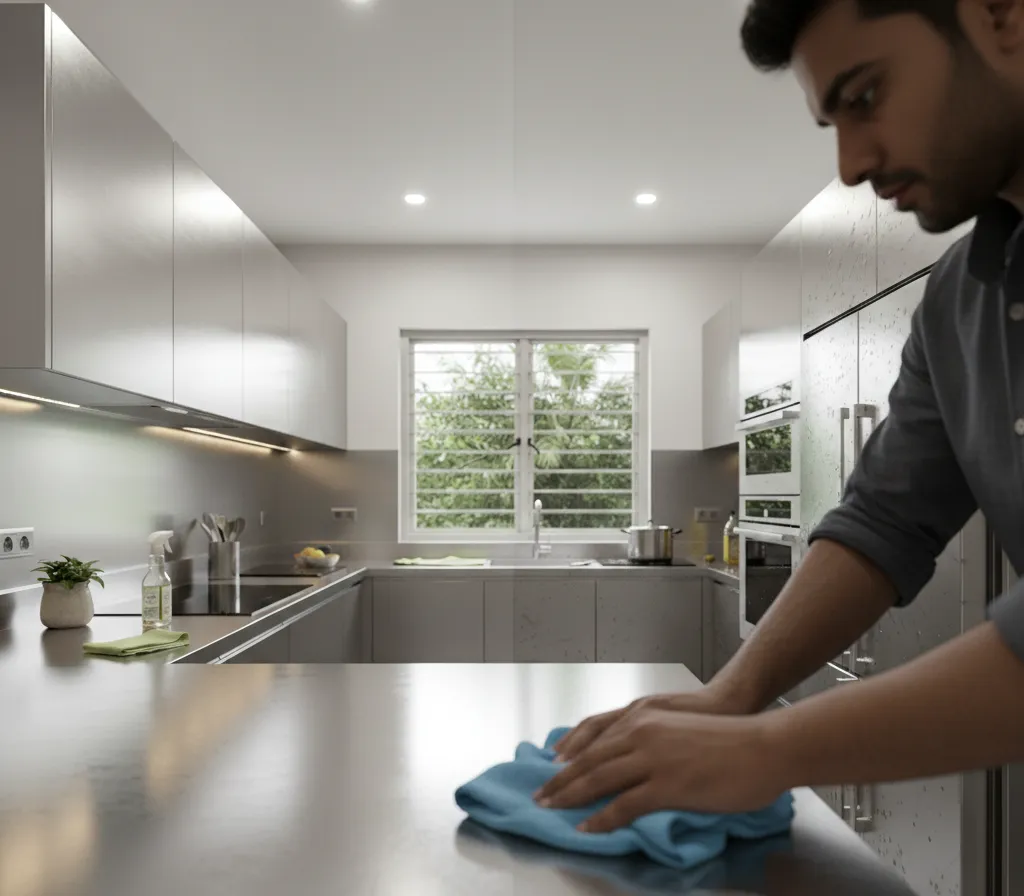
She wipes the cabinet surfaces every evening with a damp microfibre cloth. Not because they're dirty - because fingerprints from the day's cooking need clearing before the morning light reveals them. Takes maybe ten minutes. She's built it into her post-dinner routine between washing vessels and wiping the counter. She says it's automatic now. Like brushing teeth. You just do it.
For the stainless steel interior shelves, she uses a thin rubber shelf liner - the kind you get in rolls from Amazon for about ₹300. This serves two purposes: stops steel vessels from clanking against steel shelves when she pulls them out, and prevents scratches on the shelf surface from heavy kadais and cookers sliding.
Once a month she uses a stainless steel cleaner spray - about ₹250 per bottle - to remove any water spots near the sink area. Jaipur hard water leaves mineral deposits on steel just like it does on everything else. The difference is that hard water marks on steel are more visible because of the reflective surface. On matte laminate, you'd barely notice them. On brushed steel, they show up as cloudy patches.
For scratches - she's given up. The fine ones are there. The deep ones are there. She's stopped fighting them. "It's like wrinkles," she said. "Eventually you accept them." The kitchen still looks good. Just not showroom-good. Lived-in-good.
She never has to worry about sealing, termite treatment, monsoon damage, or plywood swelling. That's the tradeoff. More visual maintenance. Zero structural maintenance.
Who Should Actually Get One
After three years of observation and approximately forty conversations with Sharma aunty about her kitchen - she now introduces me to visitors as "the boy who inspects my cabinets" - here's my honest take.
Get stainless steel if your previous kitchen was destroyed by termites or water damage and you NEVER want to deal with that again. If you live in a high-humidity area - coastal cities especially, but also Jaipur during monsoon months. If your budget allows the 25-30% premium over plywood. If you can genuinely commit to daily surface wiping and you don't mind the metallic sound profile.
Stick with BWR plywood if you prefer warmth in your kitchen - the look, the feel, the sound. If visible fingerprints and scratches would bother you more than the risk of termite damage you can prevent with annual treatment. If your budget is under ₹3 lakh. If you like the idea of a kitchen that feels like a kitchen and not like a commercial prep station.
Sharma aunty doesn't regret her choice. But she wouldn't recommend it to everyone. "It's like buying a white car," she told me. "Beautiful. But you spend your life wiping it."
More honest material comparisons for Indian kitchens? KitchenKaki - we don't sell kitchens. We just stare at other people's kitchens and have opinions.
