
U-Shaped Modular Kitchen: Benefits, Cost & Best Designs
My sister-in-law's kitchen has four feet of counter and she cooks full Indian meals in it every day — it's basically Tetris with hot vessels. When I was planning our new kitchen, I assumed a U-shape was only for big homes. Completely wrong. Here's everything about U-shaped modular kitchens — real costs, what the corners actually need, and whether this layout is right for the way you cook.
U-Shaped Modular Kitchen: Benefits, Cost & Best Designs
There's a specific kind of frustration that comes from a kitchen that simply doesn't have enough counter space.
Not "I wish I had a little more" frustration. The real kind. Where you're rolling out dough on one end, the cooker is whistling on the other, and somewhere in the middle there's a colander of washed spinach that has absolutely nowhere to go except on top of the microwave, which isn't even a good surface for that but here we are.
I lived with this problem for longer than I should have. My sister-in-law still lives with it. Her kitchen has exactly one stretch of counter, approximately four feet long, and every meal she cooks is basically a game of Tetris with vegetables and hot vessels.
When we started planning the kitchen for our new flat - third floor, decent sized room, finally enough wall space to do something properly - the designer laid out three options. L-shaped, parallel, U-shaped.
I'd already done my research on the first two. The U-shape I'd always assumed was for bigger homes. Turns out the assumption was completely wrong and I want to talk about why.
What a U-Shaped Kitchen Actually Is
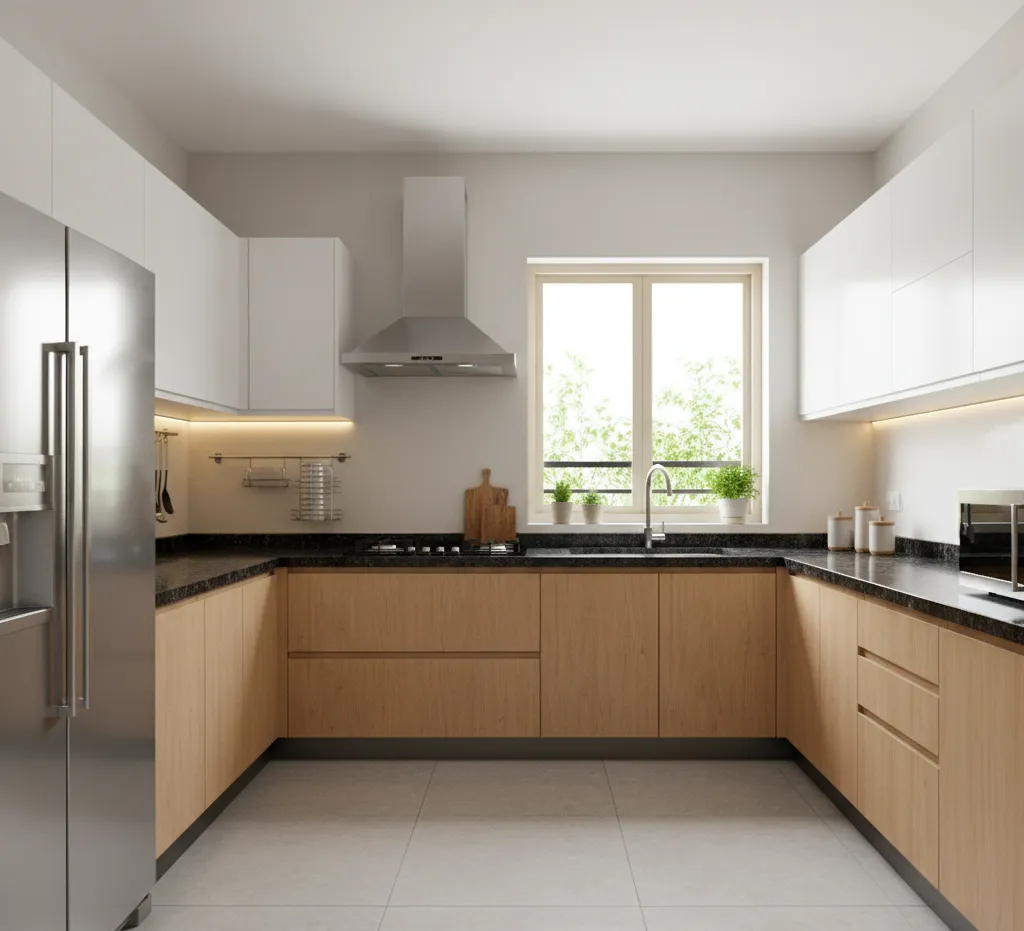
Three walls of cabinets and counters, arranged in - you guessed it - a U shape.
One wall usually has the sink. One has the hob. The third becomes your primary prep and storage zone. All three connect at the corners, so the counter runs continuously without interruption. You stand in the middle of the U and everything - and I mean everything - is within arm's reach.
It sounds simple because it is. The reason it works so well is the same reason the parallel kitchen works - it keeps your movement small and your reach large. You're not walking across the kitchen to grab things. You pivot. Turn slightly. It's there.
The work triangle - the imaginary line between your fridge, sink, and hob - is almost automatically optimised in a U-shaped kitchen because the three points naturally land on three different walls.
Who Actually Benefits From This Layout
Let me be specific here, because "U-shaped kitchens are great" is advice that helps nobody.
You'll genuinely benefit if:
You cook full Indian meals daily. Multiple dishes simultaneously. The kind of cooking where every inch of counter matters because something is always occupying it. The U-shape gives you more counter than any other layout in the same footprint. That's not marketing - it's geometry.
Two or sometimes three people are in the kitchen at the same time. Joint families, couples who both cook, homes where the cook and the helper are working simultaneously. The U-shape has enough room and enough counter that two people rarely need to be in each other's way.
You have a room - not a corridor - to work with. This is important. A U-shaped kitchen needs width on both sides. The minimum is about 8 feet across, ideally closer to 10. If your kitchen room is wide enough, the U-shape gives you something no other layout does: the feeling that the kitchen is genuinely complete.
You want storage. Lots of it. Three walls of cabinets means overhead storage on three sides, base cabinets on three sides, and if you plan the corners right, not a single cubic foot wasted.
The Real Benefits - Not the Brochure Version
Kitchen designers will tell you about the "efficient work triangle" and "maximum storage potential." All true. But here's what it actually feels like to cook in a U-shaped kitchen:
You stop putting things on the floor. This sounds small. It isn't. Every Indian cook has put a hot vessel on the floor because there was nowhere else. In a U-shaped kitchen with continuous counter on three sides, this basically stops happening. There's always somewhere to put things down.
The mess stays contained. Everything happens inside the U. Splatter, crumbs, the turmeric that goes everywhere no matter what - it all stays within the three-wall zone. Cleanup is genuinely faster because the chaos has boundaries.
You can have a dedicated baking or atta section. In most Indian kitchens, the person making rotis is fighting for counter space with whoever is chopping vegetables. In a U-shaped kitchen, you can designate one entire wall as the roti-making station. Chakla permanently on the counter, belan right there, atta dabba in the cabinet below. Nobody is competing for that surface.
Guests can watch you cook without being in your way. The U-shape naturally positions the cook inside the kitchen with their back to the room. Family can stand at the open end and talk to you while you cook without actually entering the workspace. This is one of those things you don't realise you want until you have it.
The Downsides - Because There Are Some
A U-shaped kitchen is not perfect for everyone and I'd rather tell you the problems now than let you discover them after the carpenter leaves.
It needs space. If your kitchen room is less than 8 feet wide, a U-shape will leave you with a corridor so tight it defeats the purpose. The minimum comfortable width between the two parallel arms of the U is 4 feet - enough to open cabinet doors and still stand at the opposite counter. Less than that and you've built a very expensive trap.
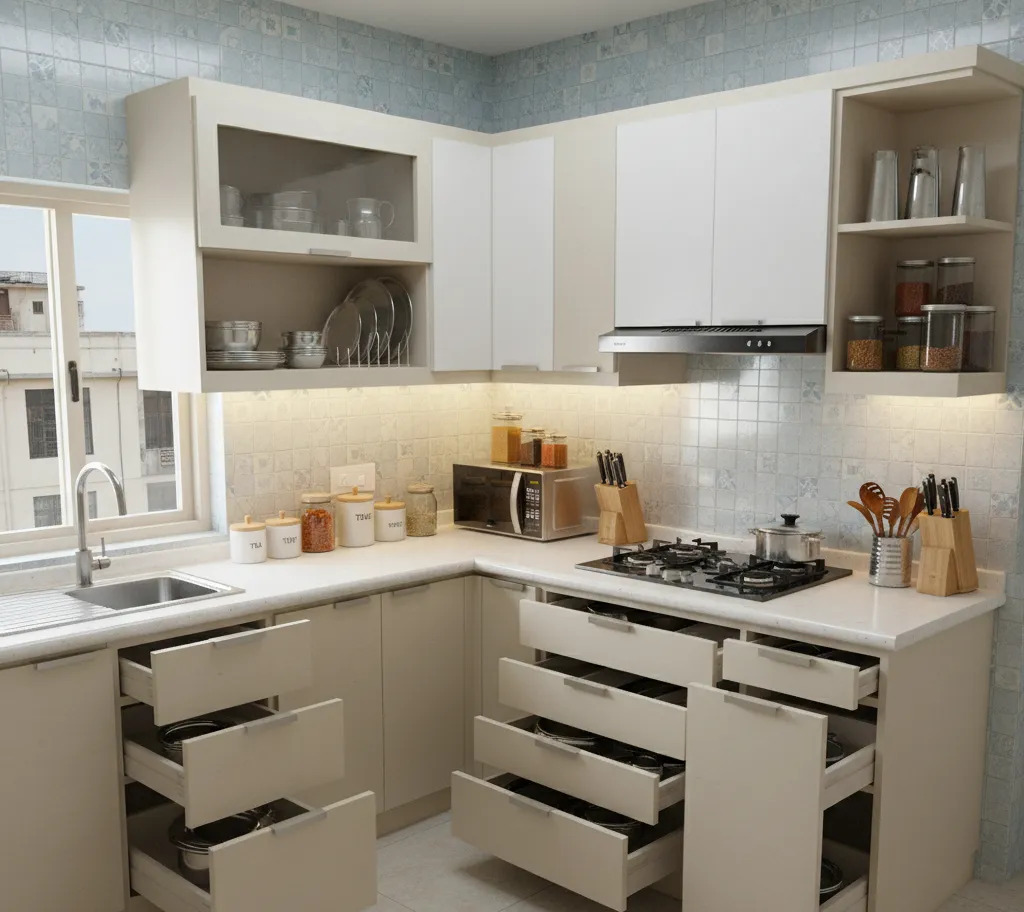
The corners are complicated. Where two walls meet inside a U-shaped kitchen, you get a deep corner cabinet. These are notoriously difficult to use. The back of a corner cabinet is almost unreachable without a carousel, magic corner unit, or pull-out system. These solutions exist and work well - but they cost more and need to be planned from the beginning. Don't design a U-shaped kitchen and then figure out the corners later.
It can feel closed off. Unlike an open kitchen that flows into the living space, a U-shaped kitchen puts you firmly inside it. If you like being part of the household activity while cooking, this layout asks you to turn your back to the room. Some people genuinely dislike this. Worth thinking about before committing.
One entry point. A U-shaped kitchen has one opening. In a fire or emergency, that's the only way out. More practically - if you're the cook and someone needs to come in and get something from a cabinet, they have to come past you. In a joint family situation where the kitchen gets crowded, this can feel claustrophobic.
Cost - Let's Talk Real Numbers
This is the section everyone actually wants and nobody writes honestly about. I'll try.
A U-shaped modular kitchen in India - decent quality materials, standard hardware, no imported fittings - will cost somewhere between ₹2.5 lakh and ₹6 lakh for an average-sized kitchen of 80 to 120 square feet. That range is wide because the variables are genuinely enormous.
What pushes the cost up:
Shutter material. Acrylic shutters cost more than membrane, which costs more than laminate. The difference between a laminate and an acrylic finish on the same cabinet box can be ₹300 to ₹800 per square foot. Multiply that across three walls and it adds up fast.
Corner solutions. A basic corner with a dead cabinet is cheap. A magic corner unit or carousel can cost ₹8,000 to ₹20,000 per corner. You have two corners in a U-shaped kitchen. Budget accordingly.
Counter material. Granite is the most common and most affordable - ₹150 to ₹400 per square foot depending on variety. Quartz starts around ₹600 and goes up from there. The counter in a U-shaped kitchen is long. This matters.
Hardware. Soft-close hinges, full-extension drawer channels, lift-up mechanisms for overhead shutters - good hardware costs more than basic hardware and lasts significantly longer. Cheap hinges on heavy Indian cooking cabinets fail within two or three years. Budget for Hettich or Hafele hardware if you're doing this properly.
Chimney and appliances. Not always included in kitchen quotes. Ask specifically what's in the quote and what isn't.
A realistic budget for a U-shaped modular kitchen that will last ten years without problems and not embarrass you in year three - ₹3.5 lakh to ₹5 lakh for a mid-sized kitchen. Below ₹2.5 lakh you're compromising on something important, whether you're told that or not.
Best Designs for Indian Homes - What Actually Works
The Classic U with Island Counter (for larger kitchens)
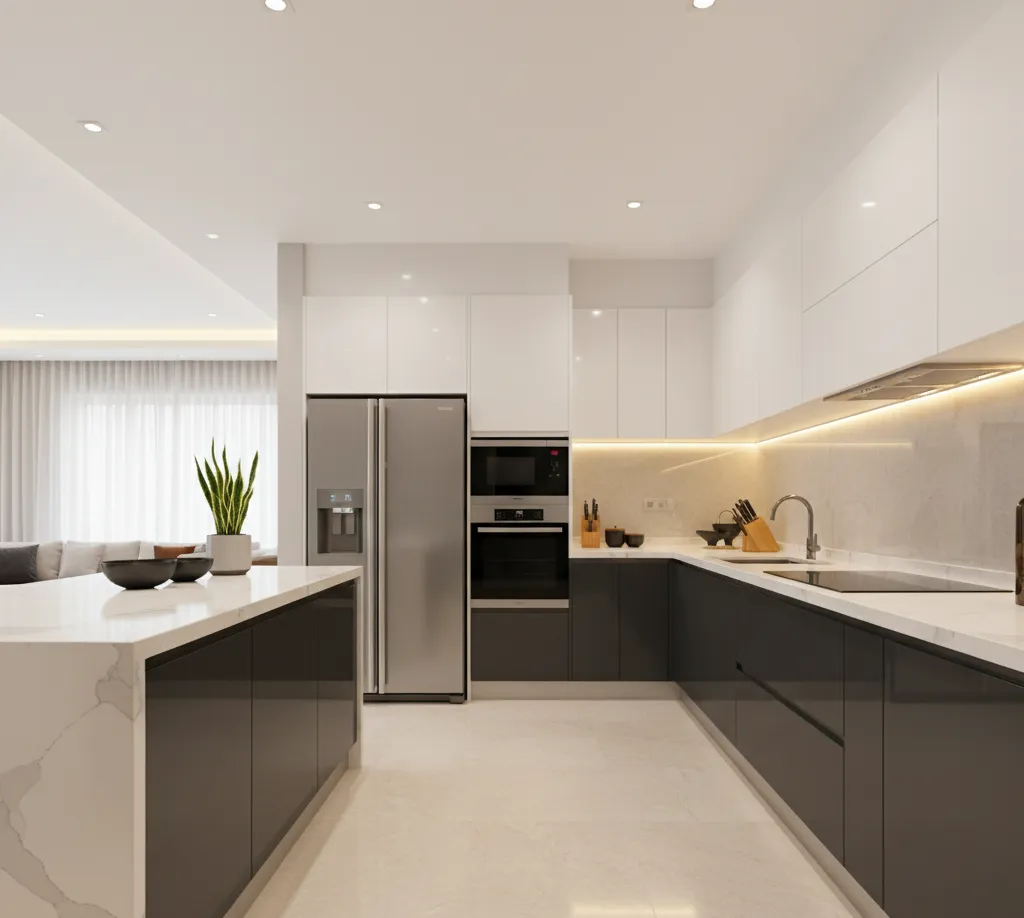
If the kitchen room is 12 feet or wider, leaving space for a small island or breakfast counter in the centre of the U changes everything. The island becomes the everyday dining spot for chai in the morning, kids doing homework while you cook, spouse sitting and talking while dinner gets made. It turns the kitchen from a workspace into a room. Only do this if the space genuinely allows it - a cramped island is worse than no island.
All-White or Light Grey with Matte Finish
For Indian kitchens specifically, light matte finishes on shutters are practical in a way that gloss isn't. Oil mist from daily cooking settles on gloss surfaces and shows every fingerprint. Matte hides it better and cleans just as easily. A light base - white, off-white, light grey - also makes the enclosed three-wall space feel less heavy. If you want colour, bring it in through a contrasting island counter or a coloured back wall, not across all three walls of cabinets.
One Open Shelf Wall
Take one of the three walls - usually the one with least heavy-use storage - and replace some of the overhead cabinets with open shelves. It breaks the visual weight of three full walls of cabinets, gives you a space to display the things worth displaying (nice masala jars, a plant, the one piece of pottery you actually like), and makes the kitchen feel curated rather than industrial. Aesthetics aren't everything but you're going to spend a lot of time in this room.
Handleless Shutters in Compact Spaces
If the kitchen room is on the smaller side - just barely meeting the minimum width - handleless shutters with a push-to-open mechanism or a J-pull profile make the space feel less cluttered. Handles sticking out in a tight space catch on clothes, catch on each other when opposite doors are open simultaneously, and just add visual noise. In a compact U, clean lines help.
Dedicated Appliance Wall
In one of the three walls - often the one directly opposite the entry - build in your appliances. Microwave at eye level. OTG below if you use one. Refrigerator at the end. This way the appliances aren't sitting on the counter, the counter is fully clear for working, and the appliance wall has a planned, intentional look instead of the "we ran out of space so we put things here" look that most kitchens end up with.
The Corner Problem - How to Actually Solve It
I mentioned corners are complicated. Here's what the options actually are:
Carousel / Lazy Susan: A rotating circular shelf inside the corner cabinet. Decent solution, not perfect. Things still fall off the edges and the rotation means you can only access part of the shelf at a time. Budget option - works.
Magic Corner: A pull-out system where the shelves slide out and swing forward in a single motion. Much better than a carousel. Everything is accessible. Costs more but if you're spending ₹4 lakh on a kitchen, don't save money on the corners.
Le Mans Unit: Similar to a magic corner but with kidney-shaped shelves that swing out more fully. Best access of any corner solution, highest cost. For large corner cabinets storing heavy items - worth considering.
Dead Corner with a Drawer Above: If budget is genuinely tight, the simplest solution is to accept that the very back of the corner cabinet will be hard to reach, store only rarely-used items there, and put a full-extension drawer in the section above the corner. The drawer compensates for the lost corner utility by being extremely functional. Not ideal but honest.
Before You Sign the Quote
A few things I wish someone had told me:
Ask to see the actual carcass material, not just the shutter sample. The shutter is what you see. The carcass is the box underneath it - it's what determines whether your kitchen holds up in five years or starts warping. Marine ply or BWR ply carcass is what you want. MDF carcass in a kitchen with steam and moisture will cause problems.
Get the corner solution confirmed in writing before work starts. "We'll figure out the corners" is not an acceptable answer. The corner units need to be on the quote with the specific mechanism named.
Ask about the countertop joint locations. In a U-shaped kitchen, the counter runs across three walls with two corner joins. These joints, if done poorly, collect water and bacteria. Good fabricators plan joint placement away from wet zones and seal them properly. Ask how they handle this.
Measure the room yourself before the designer does. Know your own numbers. Not because designers are dishonest - most aren't - but because the room is your space and you should understand its dimensions before anyone starts drawing plans.
The Honest Summary
A U-shaped modular kitchen is the most functional layout you can have for serious Indian cooking - more counter space, better organisation, natural workflow, and enough storage that you might actually stop keeping things in cardboard boxes in the corner of the dining room.
It costs more than other layouts because you're building on three walls instead of two. The corners need proper solutions. The room needs to be wide enough. These are real constraints, not excuses.
But if your kitchen room has the space and the budget allows - even a modest budget, done honestly - the U-shape is the layout you'll stop thinking about after the first month. Which is the whole point. A good kitchen disappears. You just cook.
Looking for modular kitchen designs that actually suit Indian homes? Visit Kitchen Kaki for more.
