
Vastu for Modular Kitchen: Dos and Don'ts You Must Follow
My mother-in-law walked into our newly renovated kitchen, looked around for forty-five seconds, and said — with the calm certainty of someone announcing a weather forecast — "the stove is in the wrong direction." We had spent four months planning that kitchen. Here's everything I learned after six weeks of negotiation and one Vastu consultation — organised so you don't have to learn it the same way I did.
Vastu for Modular Kitchen: Dos and Don'ts You Must Follow
My mother-in-law walked into our newly renovated kitchen, looked around for approximately forty-five seconds, and said - with the calm certainty of someone announcing a weather forecast - "the stove is in the wrong direction."
We had spent four months planning this kitchen. Layout, cabinets, countertop material, chimney placement, lighting, hardware. Every decision discussed, debated, and eventually agreed upon. The stove was where it was because the gas line was there, the chimney wall was there, and the kitchen designer had placed it there after measuring the room three times.
None of this information was relevant to my mother-in-law's assessment.
The stove, she explained, should face east or south. Ours faced north. This was a Vastu problem. The cook facing north while cooking was not auspicious. There would be - and here she paused for emphasis - consequences.
What followed was a six-week period of negotiation, research, and a consultation with a Vastu expert my father-in-law knew from his office. At the end of it I had learned two things. First, Vastu for kitchens is more detailed and more specific than most people realise. Second, many Vastu concerns can be addressed without rebuilding the kitchen - if you know what the actual principles are and which remedies are practical.
This guide is everything I learned, organised so that someone planning a kitchen doesn't have to learn it the same way I did.
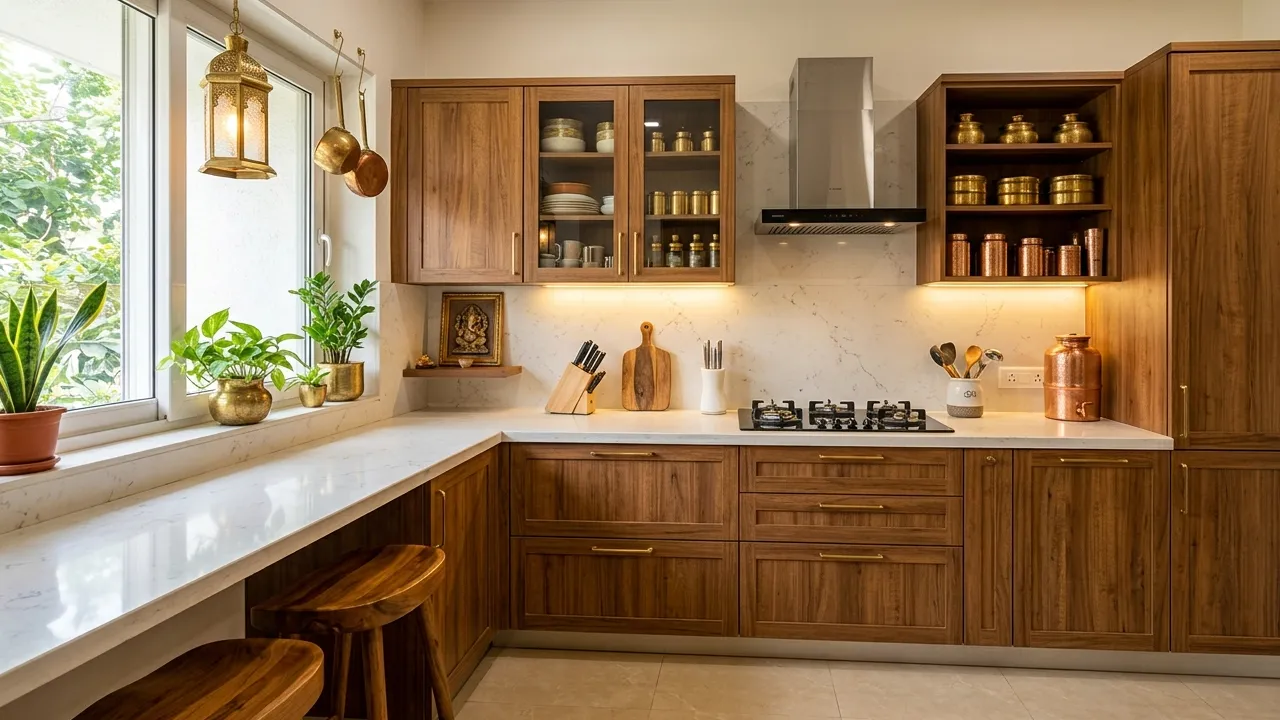
What Vastu Shastra Actually Says About Kitchens
Vastu Shastra - the ancient Indian system of architecture and spatial arrangement - treats the kitchen as one of the most energetically significant spaces in a home. The reasoning is elemental in the literal sense: the kitchen is associated with the fire element (Agni), and fire has a specific directional energy in Vastu theory.
The southeast direction is governed by Agni in Vastu - it's called the Agni corner. This is why the ideal placement for a kitchen in a home is the southeast corner of the house, and why the ideal direction for the cook to face while cooking is east.
This isn't arbitrary. The southeast catches the morning sun - light that has genuine practical benefits for a cooking space. East-facing cooking means cooking toward the sunrise, which carries symbolic significance in Vedic tradition. The principles have both practical roots and spiritual dimensions that have been observed in Indian domestic architecture for centuries.
Understanding this underlying logic makes it easier to understand which Vastu guidelines are significant and which are peripheral - and which remedies actually address the principle rather than just applying a workaround.
The Ideal Vastu Kitchen - What to Aim For
Direction of the kitchen in the home
Southeast is the ideal. If your flat or home has the kitchen in the southeast corner - count yourself in a fortunate position from a Vastu perspective and read on for the internal arrangement.
South is acceptable. Northwest is considered workable with some remedies. Northeast is the most problematic kitchen placement in Vastu - addressed in detail in the companion piece to this article.
Direction the cook faces while cooking
East is ideal. The cook faces east, the stove faces east, the fire element aligns with the rising sun direction. This is the most important directional principle in kitchen Vastu and the one that comes up most consistently.
South is acceptable as a secondary option.
North and west are considered unfavourable directions for the cook to face - north specifically because it's the direction of water element and Kuber (the deity of wealth), and fire facing water direction is considered a directional conflict in Vastu theory.
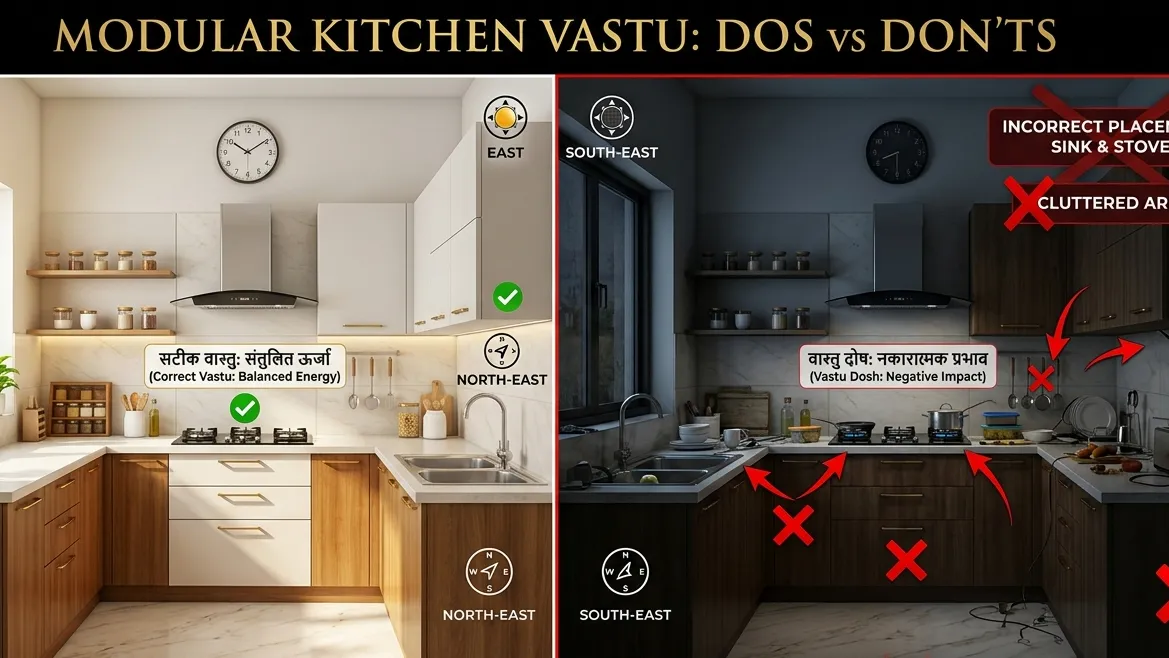
Placement of the cooking platform and stove
The stove or cooking platform belongs on the eastern or southeastern wall of the kitchen. Not in the centre of the kitchen - the centre is considered the Brahmasthana (energetic centre) and should ideally be kept open and unobstructed. Not on the northern wall - the water-fire directional conflict again.
A stove placed in the southwest is considered particularly problematic in Vastu - southwest is the earth element zone and placing fire there is seen as creating elemental imbalance.
The Kitchen Sink and Water Elements
Water and fire are opposing elements in Vastu - they should not be placed in direct opposition or in close proximity without separation.
Where the sink should go
The northeast or north is the ideal zone for water elements including the sink. East is also acceptable for the sink. The sink should not be directly adjacent to or directly opposite the stove - maintain some distance or a visual break between them.
In practice - in a modular kitchen where everything is arranged on continuous counter runs - the sink and stove will often be on the same counter. The guidance here is to keep them separated by some distance rather than immediately adjacent, and to avoid placing them directly facing each other across a parallel kitchen corridor.
The northeast corner specifically
The northeast corner of the kitchen is considered particularly sensitive for water placement. A sink in the northeast corner of the kitchen interior - especially in a kitchen that is itself in the northeast of the home - is considered beneficial in Vastu. More on this in the companion piece.
Storage and Refrigerator Placement
Refrigerator
The southwest, west, or south directions are considered appropriate for the refrigerator in Vastu. Northwest is also workable. The refrigerator should not be placed in the northeast corner - northeast is associated with light, space, and spiritual energy in Vastu and heavy appliances here are considered obstructive.
Heavy storage
Heavy storage - pantry units, tall cabinets, the significant storage weight of the kitchen - belongs on the south and west walls. The southern and western walls are associated with earth and stability in Vastu, making them appropriate for weight and storage.
The north and east walls should be kept lighter - fewer heavy tall units, more open shelving or lighter storage. This aligns with the general Vastu principle of keeping the north and east directions open and unobstructed.
Grains, pulses, and dry goods storage
The west direction is considered ideal for storing grain and dry food supplies. In a modular kitchen, if a pantry cabinet or larder unit is planned for grain and dal storage, the western wall is the Vastu-preferred location.
The Colour Principles
Vastu has colour associations for kitchen spaces that align with the fire element and the southeast direction.
Favourable kitchen colours in Vastu
Orange, red, and yellow - fire element colours - are considered auspicious for the kitchen. They don't have to be dominant or overwhelming - an orange accent wall, yellow tiles on the backsplash behind the stove, a warm terracotta tone for the kitchen overall.
Pink and chocolate brown are also considered acceptable in Vastu for kitchen ↗ spaces.
White - particularly in the eastern portion of the kitchen - is considered clean and appropriate.
Colours to avoid in Vastu kitchen planning
Black is considered inauspicious for the kitchen in Vastu - it is associated with the absence of light and is considered contradictory to the fire element that the kitchen represents. This doesn't mean black is forbidden - it means it's worth being thoughtful about where and how much black appears in a kitchen if Vastu is a consideration. A full black kitchen is a significant Vastu concern. Black hardware or accents are a different matter.
Blue and dark grey in large quantities - associated with water and heavy earth elements - are considered less appropriate for kitchen spaces in Vastu.
Flooring and Windows
Kitchen flooring
Vastu recommends avoiding black flooring in the kitchen - same reasoning as the colour guidance above. Light to medium toned flooring - cream, beige, light grey, terracotta - is preferred.
Flooring should be kept clean. This sounds obvious but Vastu specifically connects the cleanliness of the kitchen floor to the energy of the space - a kitchen floor that is regularly unclean is considered energetically problematic regardless of the direction or placement of appliances.
Windows and ventilation
East and north windows in the kitchen are considered highly beneficial in Vastu. They bring morning light (east) and are associated with positive energy flow (north). If the kitchen has a window, it ideally faces one of these directions.
A kitchen without a window - common in some flat configurations - is considered to create stagnant energy in Vastu. Adequate artificial lighting and ventilation through a chimney is the practical remedy, but a window is genuinely preferred.
The Dos - Summary of What to Follow
Do place the stove on the eastern or southeastern wall. The cook should face east or southeast while cooking. This is the central principle of kitchen Vastu and the one with the most significant traditional importance.
Do keep the northeast corner of the kitchen light and clean. No heavy storage, no garbage bin, no cluttered corner here. The northeast is the most auspicious directional zone in Vastu and the kitchen's northeast corner should reflect that.
Do place the sink in the north or northeast area of the kitchen interior. Water elements belong in the water direction zone.
Do use warm, fire-element colours. Orange, yellow, red, warm terracotta - even as accents - support the elemental energy the kitchen is associated with.
Do keep the kitchen clean, specifically the stove area. Vastu places significant emphasis on the cleanliness of the stove - it represents Agni, the sacred fire. A neglected, grease-covered stove is considered energetically harmful in Vastu, not just practically unhygienic.
Do place heavy storage on the south and west walls. Tall pantry units, heavy appliances (except the fridge which goes southwest or west), bulk storage - all of this on the southern and western walls.
Do ensure the kitchen has adequate light. Natural light from east or north windows is ideal. Artificial light that fully illuminates the cooking and prep areas is the minimum.
The Don'ts - What Vastu Says to Avoid
Don't place the stove in the northeast corner. This is considered one of the most significant kitchen Vastu violations - the fire element placed in the water and spiritual energy zone creates elemental conflict that Vastu associates with health and financial difficulties.
Don't place the stove and sink directly adjacent or directly opposite. Water and fire in immediate opposition creates the elemental conflict Vastu is specifically designed to avoid.
Don't keep the kitchen - especially the stove area - unclean. Vastu does not separate the spiritual and the practical here. A clean kitchen is a Vastu kitchen. A dirty kitchen violates Vastu regardless of how correctly the stove is placed.
Don't use the northeast corner for the garbage bin or heavy storage. This is one of the most commonly violated kitchen Vastu principles in Indian homes - the corner that collects the things that have nowhere else to go. Keep it clear.
Don't place the refrigerator in the northeast. Heavy appliances in the northeast corner are a Vastu concern. Southwest, south, or west is where the refrigerator belongs.
Don't use excessive black in the kitchen. A full black kitchen is a Vastu concern. Use it as an accent if the design calls for it, not as the dominant colour.
Don't position the kitchen so the toilet is directly above or below it. In multi-storey homes this is a Vastu concern - the kitchen and the toilet sharing a vertical plane is considered inauspicious. Where the layout of the home doesn't allow for this to be avoided, remedies include keeping both spaces particularly clean and using specific Vastu elements.
When the Kitchen Isn't Where Vastu Wants It
Most Indian flats were not designed with Vastu in mind. The kitchen is where the builder put it - which may be northwest, northeast, north, or wherever suited the building's structural and plumbing requirements. This is the reality for the majority of urban Indian households.
When the kitchen location cannot be changed - which is essentially always the case in an apartment - Vastu recommends working with remedies within the existing space rather than accepting the placement as entirely fixed.
The most effective remedies for a kitchen in a non-ideal location:
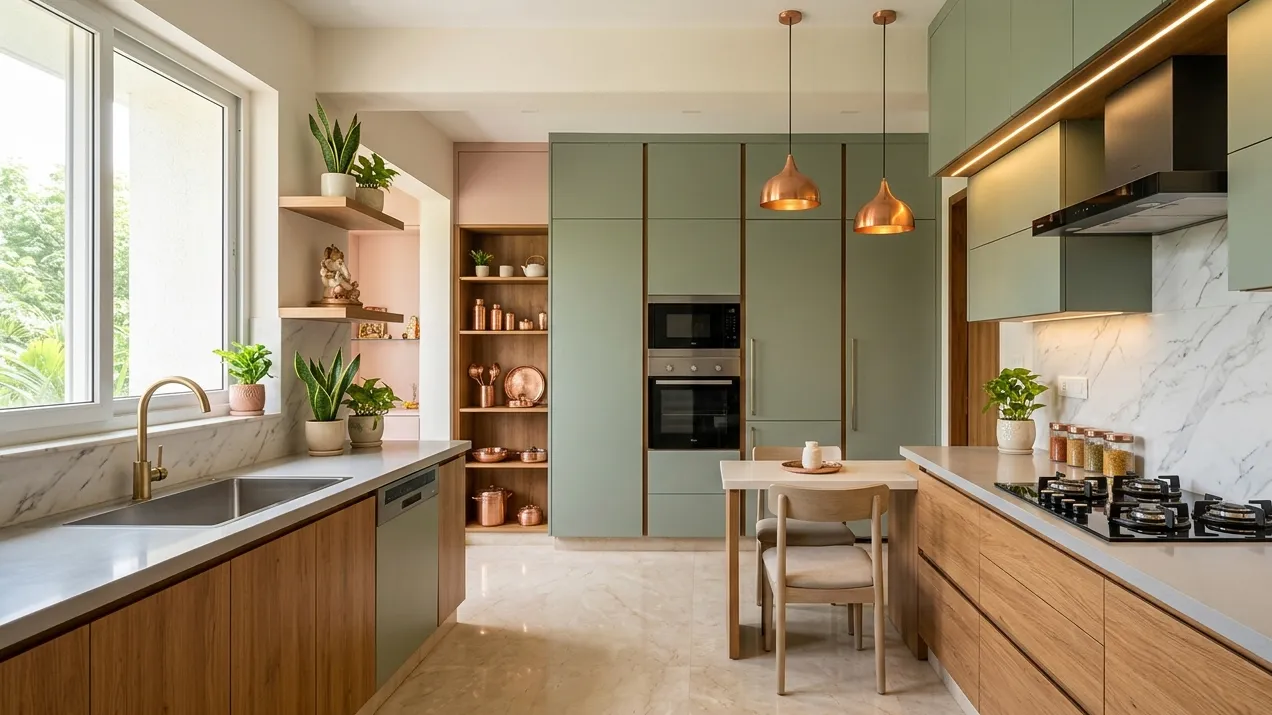
Stove placement within the kitchen. Even if the kitchen itself is not in the southeast of the home, positioning the stove on the eastern or southeastern wall of the kitchen interior, so the cook faces east, addresses the most important directional principle.
The Vastu pyramid or copper strip. A copper strip or small Vastu pyramid placed in the northeast corner of the kitchen is a commonly recommended remedy for kitchen energy correction. Not structural, not visible, but considered effective by Vastu practitioners for addressing elemental imbalances.
Green plants in the northeast kitchen interior. A small plant - tulsi, money plant - in the northeast corner of the kitchen interior is considered beneficial. Tulsi specifically is considered purifying in Vastu across all contexts.
Salt remedy. A small bowl of sea salt placed in the kitchen - particularly near corners - is a traditional Vastu remedy for energy cleansing. Changed weekly.
Consistent cleanliness. This is not a fallback remedy - it's the primary remedy. A spotlessly clean kitchen with a functioning, maintained stove is considered the most important Vastu correction regardless of directional challenges.
A Word on Balance
Vastu is a system with internal logic and centuries of observational tradition behind it. It also exists in modern Indian homes where the kitchen is where the builder put it, the gas line is where the plumber ran it, and the modular kitchen designer has already placed the stove before the Vastu question came up.
The approach that works - the one that doesn't require rebuilding the kitchen or moving the gas line - is to understand the principles well enough to apply them where they can be applied. Face east while cooking if possible. Keep the northeast corner uncluttered. Put heavy storage on the south and west. Keep the stove clean. Use warm colours. Keep the space light and well-ventilated.
These are not small or meaningless adjustments. They address the core directional and elemental principles that Vastu kitchen guidance is actually built on. And most of them are compatible with any kitchen design, any layout, any budget.
My mother-in-law, after the Vastu consultation, was satisfied with the arrangement of a copper strip behind the stove and a repositioning of the spice rack to the southeast corner. The stove itself stayed where it was. The consequences she had predicted have not materialised.
The dal still turns out well. She has not entirely given up on having opinions about the kitchen. But that part, I think, has nothing to do with Vastu.
For more kitchen planning advice for Indian homes, visit Kitchen Kaki.
