
White Modular Kitchen Design Ideas: Clean, Minimal & Elegant
Everyone has an opinion about white kitchens. My mother thinks they're impractical. My architect friend thinks they're the only intellectually honest kitchen choice. My neighbour Kavitha got one three years ago and is still defending it to every visitor — not because it's failing her, but because the questions never stop. Here's the truth about white kitchens in Indian homes — what works, what doesn't, and why the white you choose matters more than you think.
White Modular Kitchen Design Ideas: Clean, Minimal & Elegant
Everyone has an opinion about white kitchens.
My mother thinks they're impractical. "White in a kitchen," she says, with the specific tone she reserves for decisions she considers self-evidently wrong. "You'll be cleaning it every five minutes." My architect friend thinks they're the only intellectually honest kitchen choice - "colour is a trend, white is a decision." My neighbour Kavitha got a white kitchen three years ago and has spent considerable energy since then defending it to anyone who visits, not because it's failing her but because the questions never stop.
The truth about white kitchens is somewhere in the middle of all these opinions and it's more nuanced than any of them suggest.
White kitchens are not impractical if you choose the right white, the right finish, and the right countertop. They are not the safe default choice - a badly done white kitchen is just as depressing as a badly done kitchen in any other colour, possibly more so because white is unforgiving of poor planning. And they are not going anywhere regardless of what trends come and go, because the reasons people choose white kitchens are not about fashion.
They're about light. About the feeling of space. About the particular kind of calm that a kitchen without visual noise creates. These things don't become unfashionable.
What follows is everything worth knowing about designing a white modular kitchen in an Indian home - the real decisions, the honest trade-offs, and the specific ideas that make white kitchens work rather than just look good in the showroom.
Why White Works - And Why It's Harder Than It Looks
White is the colour that reveals everything about the design decisions around it. In a white kitchen, the quality of the countertop is immediately obvious. The hardware choice is immediately obvious. The proportions of the cabinets, the gap between counter and overhead cabinets, the way light moves through the space - all of it is visible in a way it isn't in a kitchen with colour or pattern to distract from.
This is what makes white kitchens look extraordinary when they're done well and ordinary - or worse - when they're done carelessly.
A white kitchen with a cheap countertop looks cheap in a way that the same countertop in a dark kitchen simply doesn't. A white kitchen with mismatched hardware looks scattered in a way a coloured kitchen absorbs. The white provides no cover. Every decision either adds to the kitchen or detracts from it, clearly and immediately.
This is not an argument against white. It's an argument for making the decisions carefully.
The White Is Not One Colour Problem
Here's something that confuses almost everyone the first time they encounter it: white is not one colour.
There are warm whites - with yellow, cream, or pink undertones. There are cool whites - with blue or grey undertones. There are neutral whites that read differently depending on the light. Two white cabinets from two different manufacturers can look completely different next to each other and both be described as white on the specification sheet.
This matters enormously in an Indian kitchen because the quality and direction of your natural light determines which white will look like white and which will look off, yellowed, or slightly grey on your walls.
North-facing kitchens get cool, indirect light. In this light, cool whites look fine but can feel clinical. Warm whites - ivory, cream-white, off-white - look more natural and liveable. A pure bright white in a north-facing Indian kitchen often looks slightly grey by afternoon.
South and west-facing kitchens get warm, direct light. Here, warm whites can look almost yellow in the afternoon, which is not always desirable. A cooler, slightly greyer white holds its tone better in strong warm light.
The test nobody skips: before finalising any white cabinet colour, get a large sample - not a small tile, an actual door panel if the company will provide one - and live with it in the kitchen for two or three days. Look at it in morning light, afternoon light, evening artificial light. Only then decide.
Types of White Kitchens - Because They're Not All the Same
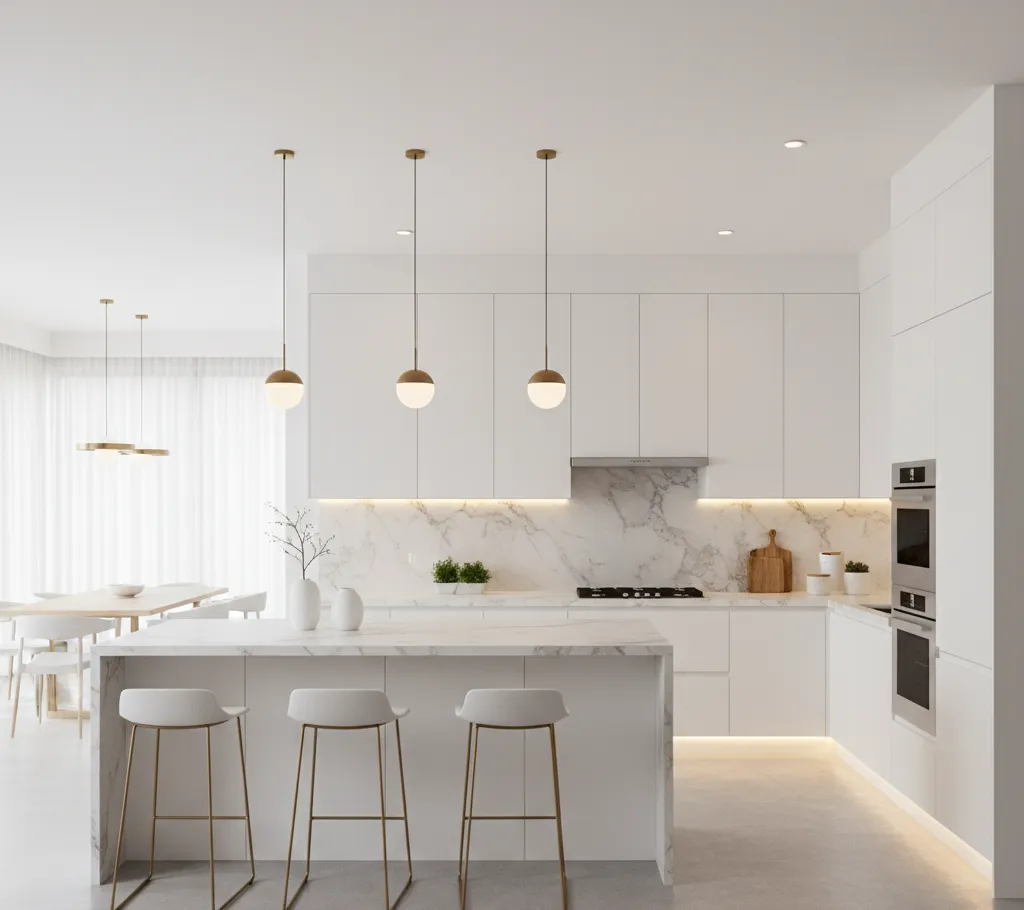
The Pure Minimal White
Everything white. White cabinets, white countertop, white backsplash, white walls. The only contrast comes from hardware, appliances, and whatever is actually being used in the kitchen.
This version is the most visually dramatic and the most demanding to execute. It needs exceptional light to not feel sterile. It needs flawless installation - any uneven gap, any misaligned cabinet door, any visible join in the countertop is immediately obvious against all that white. And it needs to be genuinely committed to - a single dark appliance or a mismatched handle breaks the entire composition.
When it works - in a kitchen with large windows, high ceilings, and meticulous attention to detail - it's one of the most serene and beautiful interiors possible. When it doesn't work, it looks like an unfurnished showroom.
The White and Wood
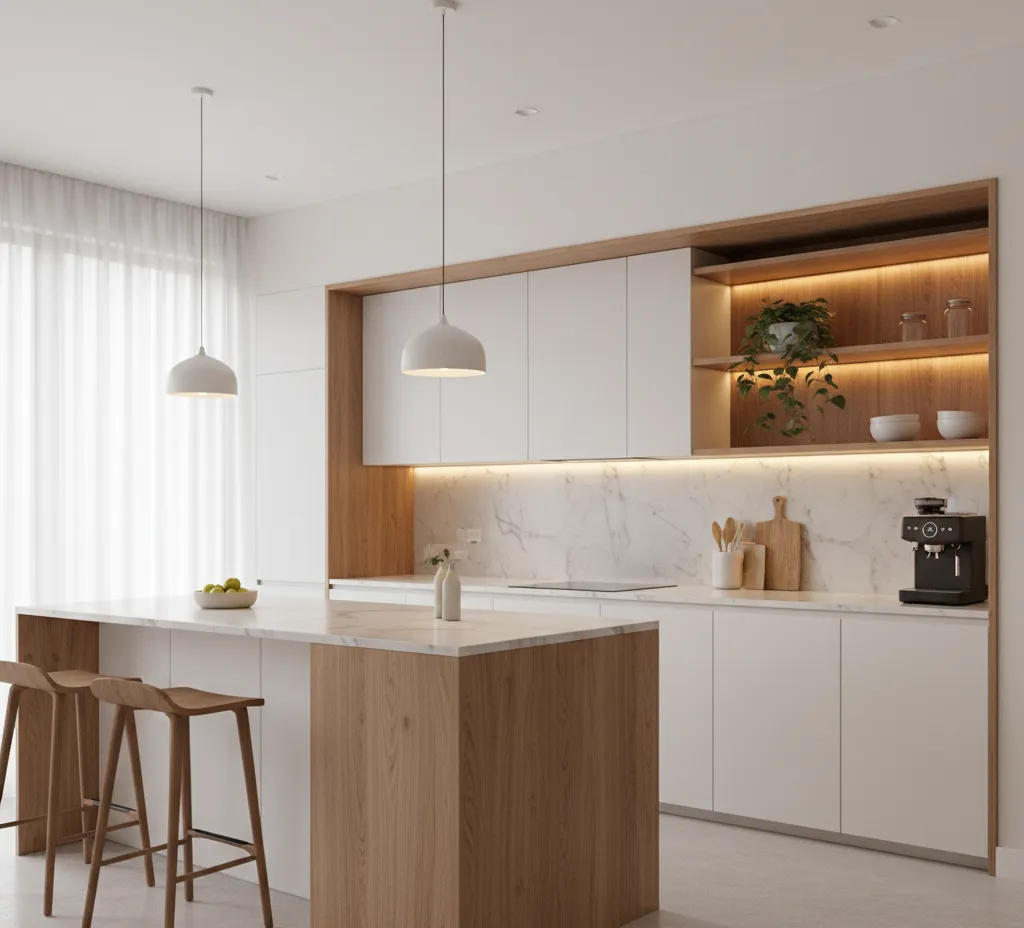
White cabinets - usually the upper cabinets or the full perimeter - with natural wood tones brought in through open shelves, a kitchen island, a section of lower cabinets, or even just a floating shelf on one wall.
This is the white kitchen combination that works in the widest range of Indian homes and the one that ages the most gracefully. The wood adds warmth that pure white alone doesn't have, grounds the kitchen so it doesn't feel clinical, and brings in a material quality that no laminate or paint can fully replicate.
The wood tone matters. A warm teak or walnut reads completely differently from a cool ash or light pine. In most Indian homes, warmer wood tones - teak, acacia, sheesham - feel more natural because they reference the furniture and material culture most of us grew up around. Cooler Scandinavian-style wood tones look beautiful but can feel slightly foreign in certain settings.
The White and Black
White cabinets with matte black hardware, black tap fittings, and either a dark countertop or a dark-veined light countertop. This is the combination that photographs most reliably and looks most considered in person.
The black hardware on white cabinets works because the contrast is clear and intentional. There's no ambiguity about whether the hardware was chosen deliberately or just happened to be what the showroom had. It reads as a decision.
The countertop can go either way - a pure white or light quartz countertop with black hardware keeps everything clean and graphic. A black or charcoal countertop with white cabinets and black hardware creates a stronger contrast and a more dramatic overall effect. Both work. It comes down to whether the kitchen should feel light and airy or striking and bold.
The White and Colour
White as the base with a single accent colour used intentionally - a coloured island, a coloured back wall, coloured lower cabinets while the uppers stay white, or even just a coloured backsplash in an otherwise all-white kitchen.
This is the version that gives people the cleanliness of white with an escape hatch - if you change your mind about the colour in a few years, you're not repainting the entire kitchen. The white base accommodates any accent colour because it's neutral enough to work with anything.
Popular accent pairings in 2026: white with sage green lowers, white with dusty blue island, white with terracotta backsplash, white with forest green open shelves. All of these are showing up in well-designed Indian kitchens right now and all of them work because white is generous enough to make any colour look intentional.
The Finish Question - Matte, Gloss, or Something In Between
This is the decision that determines how much time you spend maintaining the kitchen. In an Indian home where cooking is daily and serious, it's not a minor decision.
High-gloss white shutters look spectacular in showrooms. They reflect light, they make the kitchen feel larger, and in photographs they look expensive and clean. In a working Indian kitchen they require constant attention. Every fingerprint shows. Every splash shows. Every smear from a slightly oily hand opening a cabinet shows. You will wipe them every day or they will not look the way they looked in the showroom.
If the kitchen sees very light use, or if there's household help who maintains the kitchen regularly, high-gloss white is viable. For a family where heavy daily cooking happens and not every person who touches the cabinets wipes their hands first - and this is most Indian households - gloss white is a commitment that becomes a source of low-level daily frustration.
Matte white shutters are more forgiving. Fingerprints are less visible. Small splashes are less dramatic. The trade-off is that when matte surfaces do stain - turmeric, oil, tomato - the stain can be harder to remove cleanly than from a gloss surface. A quick wipe on a gloss surface removes most things. On matte, some stains need a slightly damp cloth and a little more effort.
Satin or semi-matte sits between these two. More wipe-clean than matte, less fingerprint-visible than gloss. This is the finish that tends to work best in Indian kitchens that want white cabinets - enough sheen to clean easily, enough matte to not show every touch.
The honest answer for most Indian families: satin or semi-matte finish in a warm white. Practical enough for real life, beautiful enough to still look like a considered decision.
Countertop Choices for White Kitchens
The countertop in a white kitchen carries more visual weight than in a coloured kitchen because there's nothing else competing with it. Choose carefully.
White quartz countertop with white cabinets. This is the pure, seamless look. The kitchen reads as one continuous surface. It looks extraordinary but requires commitment - any stain on the countertop is immediately visible against the white cabinets because there's no colour to absorb it. Quartz is non-porous so staining is rare with proper care, but it's not zero-risk.
Grey or veined quartz. White cabinets with a light grey or white-and-grey veined quartz countertop. This is the most popular combination in white modular kitchens right now because it gives you contrast without colour, visual interest without pattern, and a material that's forgiving to maintain. The grey tones in the countertop balance the white cabinets without fighting them.
Black or dark grey countertop. White cabinets with a black granite or dark quartz countertop. High contrast, graphic, very intentional-looking. Works particularly well with black hardware - the countertop and hardware read as a coordinated choice rather than two separate decisions. Practical benefit: a dark countertop hides nearly every stain an Indian kitchen can produce.
Wooden countertop section. A section of the countertop - typically the island or breakfast counter, not the main work surface - in a warm wood tone against white cabinets. This adds warmth and material interest without committing the entire kitchen to wood, which requires significant maintenance as a primary cooking surface.
Light Indian granite. Kashmir white, colonial white, river white - these are Indian granites with a predominantly light background that work beautifully with white cabinets at a significantly lower cost than quartz. The natural variation in the stone means no two countertops are identical, which adds a quality that engineered surfaces don't have. Needs sealing, but genuinely beautiful and more affordable than imported quartz.
Hardware: The Detail That Makes or Breaks a White Kitchen
In a white kitchen, the hardware is one of the few places where a clear material choice can be made. It lands loudly. Choose deliberately.
Matte black handles on white cabinets. The combination that works most consistently across different white tones and different cabinet profiles. The contrast is clear, the choice is readable, and it hasn't become a cliché because it keeps working.
Brushed brass or antique gold. Brings warmth into a white kitchen in a way that black doesn't. If the overall direction of the kitchen is warm - warm white cabinets, warm wood accents, warm stone countertop - brass hardware reinforces that direction. If the kitchen is cool-toned, brass can feel slightly at odds.
Brushed nickel or stainless. The quietest hardware choice. Less contrast than black, less warmth than brass. In a white kitchen that's meant to feel completely calm and minimal - where even the hardware shouldn't draw attention - brushed nickel disappears appropriately.
Handleless. Push-to-open or J-profile edge-pull cabinets with no visible hardware at all. This is the most minimal version of a white kitchen and the one that looks most like a single continuous surface. Works beautifully. Requires cabinets with precisely aligned doors because with no hardware to distract the eye, any misalignment is completely visible. Also requires that every family member remembers where the push point is on each cabinet - a small thing that becomes slightly irritating if you're in a hurry.
Backsplash Ideas for White Kitchens
The backsplash in a white kitchen is an opportunity - it's the surface where you can introduce texture, pattern, or subtle colour without committing the cabinet colour to change.
White subway tile. Classic, works, somewhat expected. If you're going to use white subway tile, vary the grout colour - white grout makes the backsplash read as one flat surface, grey grout emphasises the tile pattern and adds visual interest. In Indian kitchens, grey or dark grout is more practical because it doesn't show turmeric staining the way white grout does.
Large format white tile with minimal grout lines. Cleaner than subway tile, easier to maintain, reads as more contemporary. A 600x300mm or larger white tile with thin light grey grout lines - this is the backsplash choice that bothers nobody and looks right in ten years.
Glass backsplash in white or pale grey. No grout lines, completely non-porous, wipes perfectly clean. In a white kitchen the glass backsplash disappears and what you see is the wall colour - which in this case is white - giving a seamless, continuous look that's very difficult to achieve with tile.
A single accent tile wall behind the hob. Everything else white, but the wall directly behind the hob gets a different tile - handmade zellige in an off-white or cream, a patterned encaustic tile in muted tones, or a natural stone in light beige. Used with restraint, one different tile surface in an otherwise all-white kitchen adds character without noise.
White Kitchens in Small Indian Flats
This is where white does its most useful work.
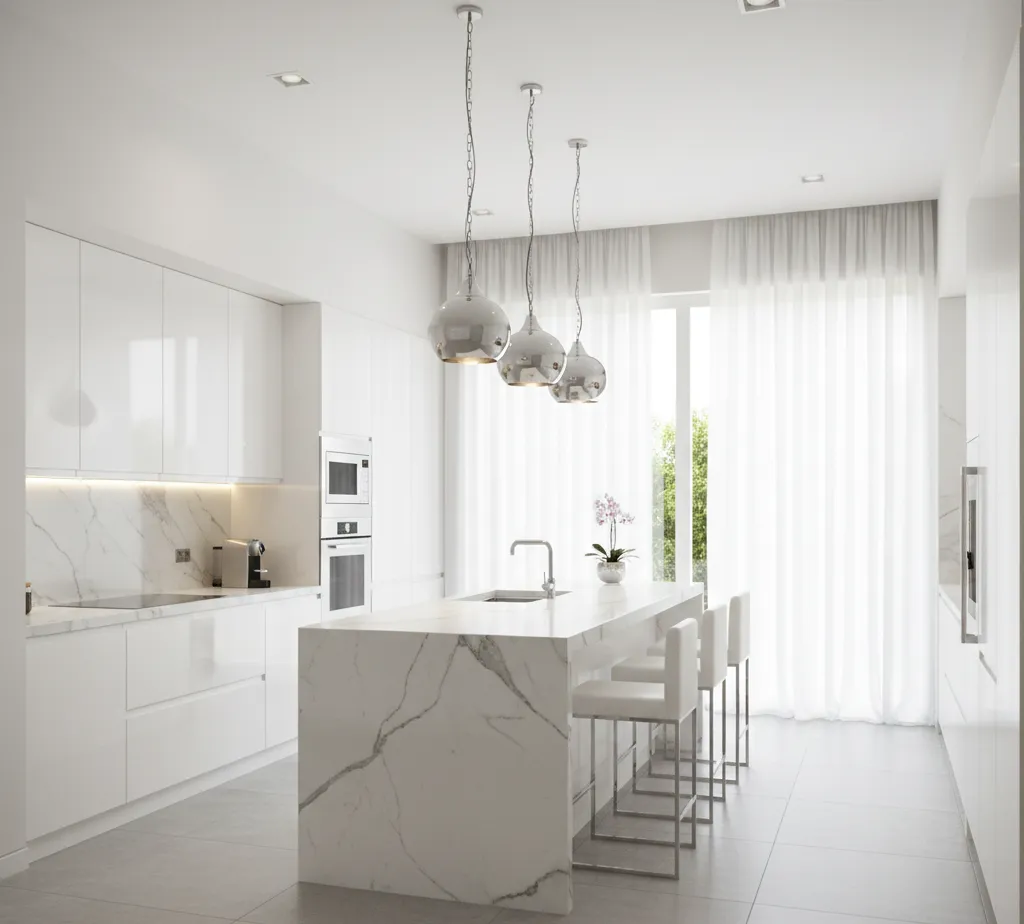
Small kitchens feel larger in white. Not just appear larger - actually feel larger when you're standing in them, because white reflects light rather than absorbing it, and light is what makes spaces feel open or closed.
In a compact L-shaped or parallel kitchen in a 2BHK or 3BHK flat - the kind of kitchen where every square foot is spoken for - white cabinets give back visual space that dark or coloured cabinets would take. This is not a small benefit. In a kitchen where you're going to spend years cooking in a limited footprint, feeling comfortable in the space matters every single day.
Specific choices for small white kitchens:
Handleless cabinets to remove visual interruption across the surfaces. One open shelf section instead of all closed overhead cabinets - open shelves read lighter than closed cabinets. Light countertop to extend the visual continuity. Under-cabinet lighting to eliminate the shadow zone at the counter. A light or reflective backsplash - glass is ideal - to bounce light back into the space.
Avoid: patterned tiles in a small white kitchen (they create visual noise that shrinks the space), dark hardware in large quantities (a few dark handles are fine, full dark hardware in a small white kitchen can feel heavy), and dark countertops that are too large in proportion (a small section as contrast is fine, the entire counter in black in a small kitchen reads as a mistake).
Maintenance - The Honest Conversation
My mother isn't entirely wrong. White kitchens do require more conscious maintenance than dark ones. But "cleaning every five minutes" is not the reality of a properly finished white kitchen.
The real maintenance picture:
Daily: wipe the countertop after cooking. In a dark kitchen this can sometimes wait. In a white kitchen, turmeric and tomato on a light countertop need to be addressed the same day or they set. This is a two-minute task, not a significant burden, but it does require the habit.
Weekly: wipe cabinet doors. In a white satin or semi-matte kitchen, a weekly wipe with a damp cloth keeps everything looking clean. Fingerprints accumulate - around handles especially - and a weekly pass is enough to reset.
Occasionally: the grout. If tile backsplash with cement grout - use epoxy grout, addressed earlier. The area around the sink and hob gets the most attention. Once a month or so, a slightly more thorough wipe of the backsplash zone is usually enough.
The family member who will not wipe up spills, who leaves turmeric-stained hands on cabinet doors, who puts a wet vessel directly on the countertop without a trivet - that person exists in many households and a white kitchen does require a conversation with them. Not because white kitchens are impractical. Because white kitchens make the consequences of those habits visible in a way dark kitchens don't.
One Thing Worth Saying
The white kitchen question is really a question about what you want a kitchen to feel like.
Energetic and warm and full of colour and personality - then white is probably not the right direction, and there's nothing wrong with that.
Calm. Light. A space that feels like it's been cleared of visual noise so the actual business of cooking - and eating, and talking, and the daily life that happens in a kitchen - can just happen without the room itself demanding attention.
That's what a well-designed white kitchen offers. Not just a colour. A quality of presence.
Whether that's worth the occasional conversation about wiping up turmeric is a decision only you can make.
For more kitchen design ↗ ideas that suit real Indian homes, visit Kitchen Kaki.
