
What Happens When Your Kitchen Hinges Break? The Importance of Real Warranties in Jaipur
My chachi's cabinet door fell off after 14 months. The kitchen company's phone was disconnected. The warranty covered everything except what actually broke. Here's the full story — and what to demand before you sign.
What Happens When Your Kitchen Hinges Break? The Importance of Real Warranties in Jaipur
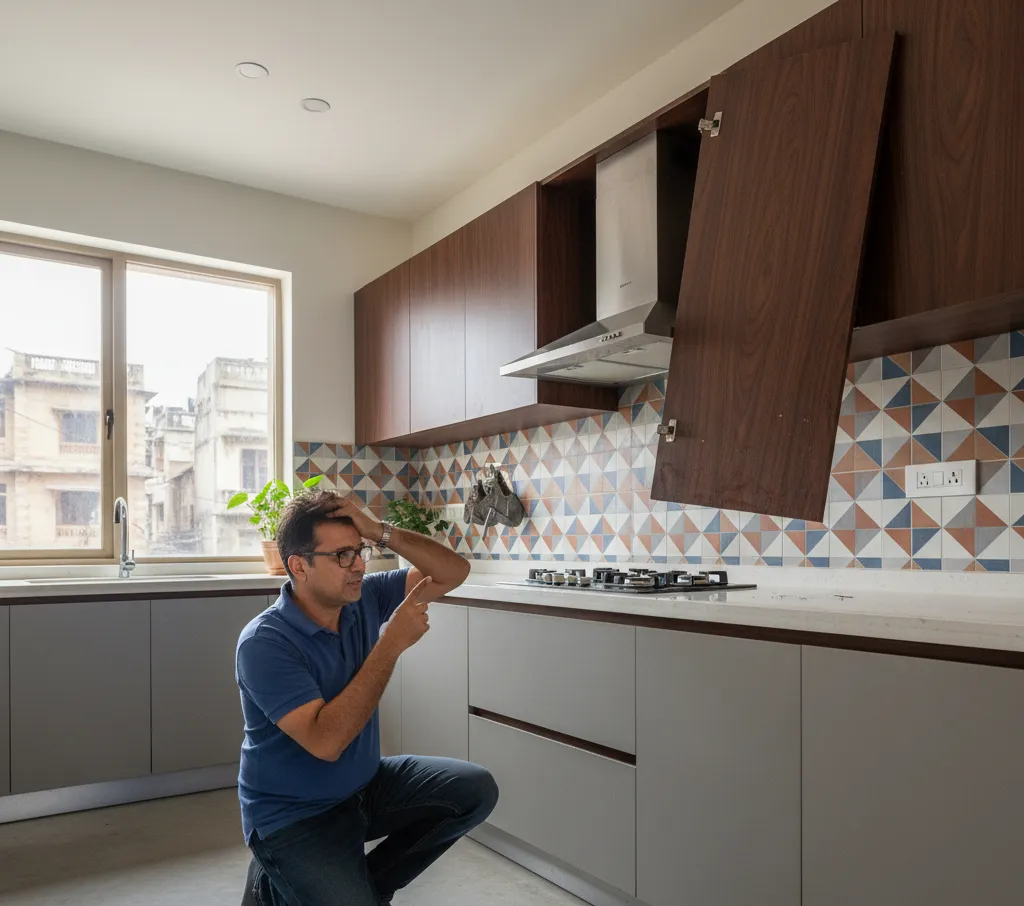
My chachi's kitchen cabinet started drooping on a Wednesday. Just one door. The one above the stove. She didn't think much of it - pushed it back into position, it held for a few hours, then drooped again. By Friday the hinge on top had completely given out and the door was hanging at an angle like a broken arm. By Saturday the second hinge started grinding. By Sunday the door came off entirely and she was staring into an open cabinet with her masala jars exposed to chimney grease and Jaipur dust.
She called the modular kitchen company. The number on the invoice. The same people who'd installed the kitchen 14 months earlier. The phone rang. And rang. And rang.
Nobody picked up.
She tried the next day. A guy answered. Listened to the problem. Said "I'll send someone." Nobody came. She called again two days later. Different guy. Same promise. Same result. She called a third time. This time the person said - and I swear my chachi repeated this to me word for word because she was FURIOUS - "Madam, the warranty was for 12 months. Your kitchen is 14 months old. This is not covered."
Fourteen months. The kitchen lasted fourteen months before hardware started failing. And the warranty - which nobody had explained clearly at the time of purchase - had expired eight weeks earlier.
Welcome to the modular kitchen warranty game in Jaipur. It's a mess. Let me tell you what I've learned from my chachi's disaster and from obsessively reading the fine print on four different kitchen quotations since then.
What Actually Broke and Why
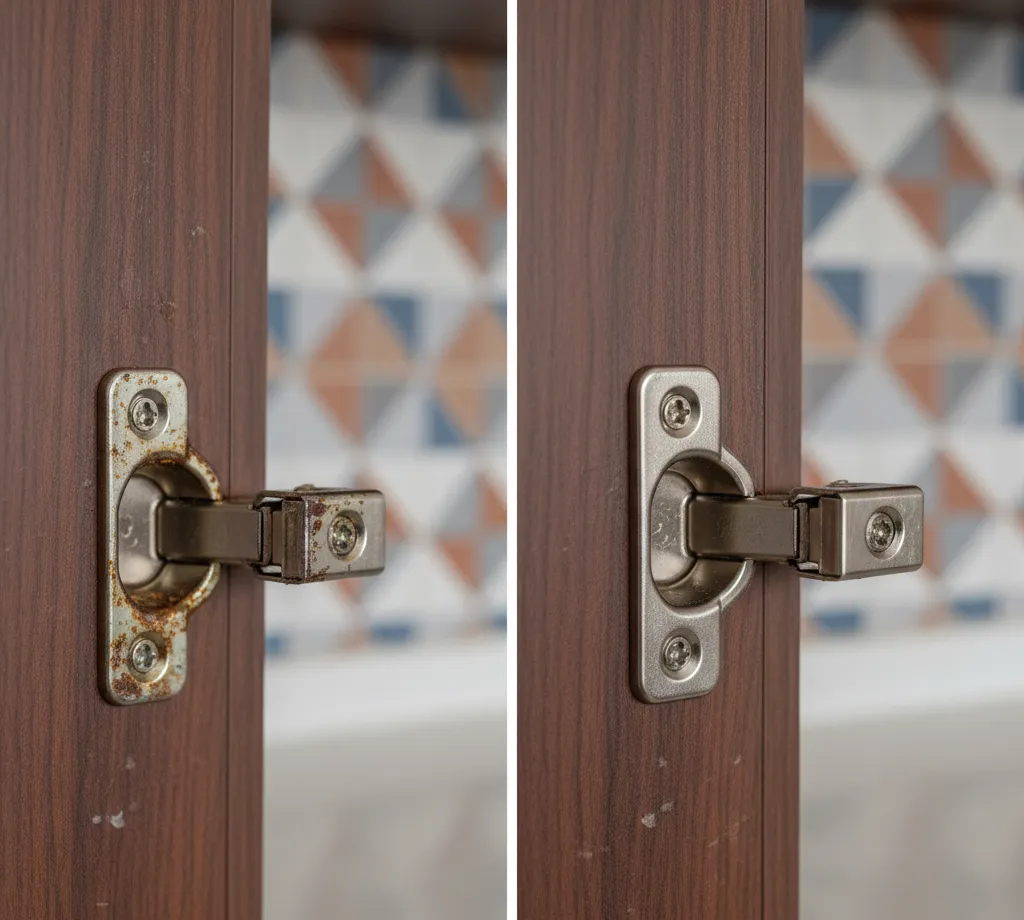
The hinges on my chachi's cabinets were unbranded. I didn't know this until the whole thing fell apart and I looked at the broken hinge sitting on her kitchen counter. No logo. No stamp. No brand marking. Just a generic silver hinge with a spring mechanism that had lost its tension after roughly 14 months of daily opening and closing.
Here's some context. An average kitchen cabinet door gets opened and closed maybe 5-8 times a day. For the cabinet above the stove - where the most-used masalas live - probably more like 10-12 times. That's roughly 4,000-5,000 cycles per year. A decent Hettich ↗ or Hafele hinge is rated for 80,000-100,000 cycles. That's 15-20 YEARS of daily use before it should start showing wear.
The unbranded hinge on my chachi's cabinet made it to about 5,000 cycles. One year. Then it died.
When I asked the kitchen company what brand of hinges they'd used, the showroom guy got vague. "Imported," he said. From where? "Overseas." Where overseas? He changed the subject. "Overseas" in kitchen hardware language usually means unbranded Chinese imports that cost ₹25-30 per hinge versus ₹150-250 for genuine Hettich. In a kitchen with 20-25 hinges, that's the difference between ₹500-750 total and ₹3,000-5,000 total. The kitchen company saved maybe ₹3,000 on hinges. My chachi lost a cabinet door in 14 months.
The Warranty Document Nobody Reads
After my chachi's experience, I went back and read the warranty card - a single printed sheet that came with the kitchen. Most families shove this into a drawer and forget about it. I know because I did exactly that with my parents' kitchen warranty and had to spend 20 minutes searching for it last year when we had an issue with a drawer channel.
Here's what my chachi's warranty actually said - and I'm paraphrasing because the original was written in the kind of English that makes you wonder if the writer was actively trying to be confusing:
The "structural warranty" - covering the carcass, meaning the plywood boxes - was 10 years. Sounds impressive until you realize plywood doesn't really fail in 10 years unless you bought garbage material or your kitchen has a water leak. This warranty covers the thing least likely to break.
The "hardware warranty" - covering hinges, channels, lift-ups, and accessories - was 1 year. ONE year. For the components that take the most daily abuse. The parts you touch, pull, push, and slam multiple times every day. One year.
The "surface warranty" - covering the laminate or shutter finish - was 1 year. Laminate peeling, discolouration, fading - all covered for 12 months and not a day longer.
The chimney and hob had their own manufacturer warranties - usually 1-2 years depending on brand.
So when the kitchen company says "10-year warranty" in their brochure and on their showroom poster and in the salesman's confident pitch - they're technically not lying. The plywood has a 10-year warranty. But the HINGES that are failing? One year. The DRAWER CHANNELS that jam? One year. The LAMINATE that's peeling near the sink? One year.
It's like a car company offering a 10-year warranty on the chassis but only 12 months on the engine. The chassis will probably outlast you. The engine is what actually breaks.
What Hettich and Hafele Actually Promise
After my chachi's fiasco, I went down a rabbit hole reading warranty documents from actual branded hardware manufacturers. Because if the kitchen company's warranty is designed to cover their backside, maybe the hardware brand's warranty is more useful?
Hettich offers what they call a "functional warranty" on their furniture fittings. Their hinges and drawer systems carry warranties that range from 5 to 25 years depending on the product category. Their Sensys soft-close hinges - the ones my mummy's kitchen uses - are warranted against mechanical manufacturing defects for multiple years. But there's a catch. The warranty is void if the product was installed improperly, used with "unapproved accessories," exposed to chemicals or corrosive environments, or damaged by "misuse or mishandling."
In a Jaipur kitchen - where oil vapour, steam, masala dust, and hard water are constant companions - that "corrosive environment" clause is vague enough to make me nervous. Would daily exposure to chimney grease count as a corrosive environment? Would hard water splashing on a hinge near the sink void the warranty? I genuinely don't know. And I suspect most warranty claim conversations involve the brand pointing at these exclusion clauses.
Hafele has a similar setup. Their products come with warranties but you need to buy from an authorized dealer and retain the original invoice. The warranty covers manufacturing defects, not wear and tear. And the replacement only covers the product cost - not the labour to actually swap out the broken hinge, which in Jaipur means calling a carpenter, paying ₹500-800 for a visit, and hoping he shows up on time.
The bottom line? Branded hardware warranties are better than unbranded hardware warranties (which are literally nonexistent). But they're not the magic shield the salesman implies. You need the original invoice, authorized dealer purchase, proper installation, and a defect that clearly falls under "manufacturing" rather than "wear and tear." That's a lot of conditions.
What My Mummy Did Differently (And Why Her Hinges Are Fine)
Mummy's kitchen was installed in 2020. Six years old. Same kitchen. Same hinges. Every single one works perfectly. I know because after my chachi's disaster I went around opening every cabinet in mummy's kitchen like a paranoid inspector. Nineteen cabinets. Thirty-something hinges. All smooth. All catching softly. Not a single droop.
Two reasons. First - she has Hettich Sensys hinges. Branded. Stamped. The logo is right there on the hinge cup. She can VERIFY what's in her kitchen. My chachi can't verify anything because her hinges are anonymous.
Second - and this is the one I want you to remember - my mummy got her hardware itemized separately in the quotation. Not bundled into "modular kitchen ₹3.5 lakh." She has a line item that says "Hettich hinges x 32 - ₹8,000" and "Hettich telescopic channels x 6 - ₹5,400" and so on. The brand name is on the invoice. If anything fails, she can go directly to Hettich with the invoice and claim under THEIR warranty, bypassing the kitchen company entirely.
My chachi's invoice says "hardware - ₹4,500." That's it. No brand name. No breakdown. No model numbers. Just a lump sum that tells her nothing. When the kitchen company ghosted her, she had nothing to fall back on. No brand warranty to invoke because she can't prove what brand was installed. No recourse except paying a carpenter ₹1,200 to fit new hinges out of pocket.
₹1,200 doesn't sound like much. Until you realize she'll probably need to replace more hinges in the coming months - the same unbranded batch is in every cabinet - and each replacement means another carpenter visit. Over a few years, those ₹1,200 visits add up to more than the ₹3,000-4,000 she would have spent upfront on branded hardware that actually lasts.
The Three Questions I Now Ask Every Kitchen Company
After all this, I've become that annoying person at kitchen showrooms who asks uncomfortable questions. The salesmen see me coming and their smiles tighten slightly. I've accepted this as my role in life.
"What brand of hinges and channels are you using? Can you show me the box?" If they say "imported" or "standard" or anything other than a specific brand name - they're using unbranded hardware. Walk away or demand branded alternatives with a specific price difference.
"Can you itemize the hardware separately on the invoice with brand names and model numbers?" If they refuse or say "it's all included in the package" - they don't want you to know what you're getting. That's a red flag the size of a bedsheet.
"What exactly does your warranty cover and for how long - specifically for hardware, not just the carcass?" Make them say it out loud. "One year on hardware" sounds very different spoken in a showroom than it does printed in fine print on a sheet you'll shove in a drawer.
What Happened to My Chachi's Kitchen Eventually
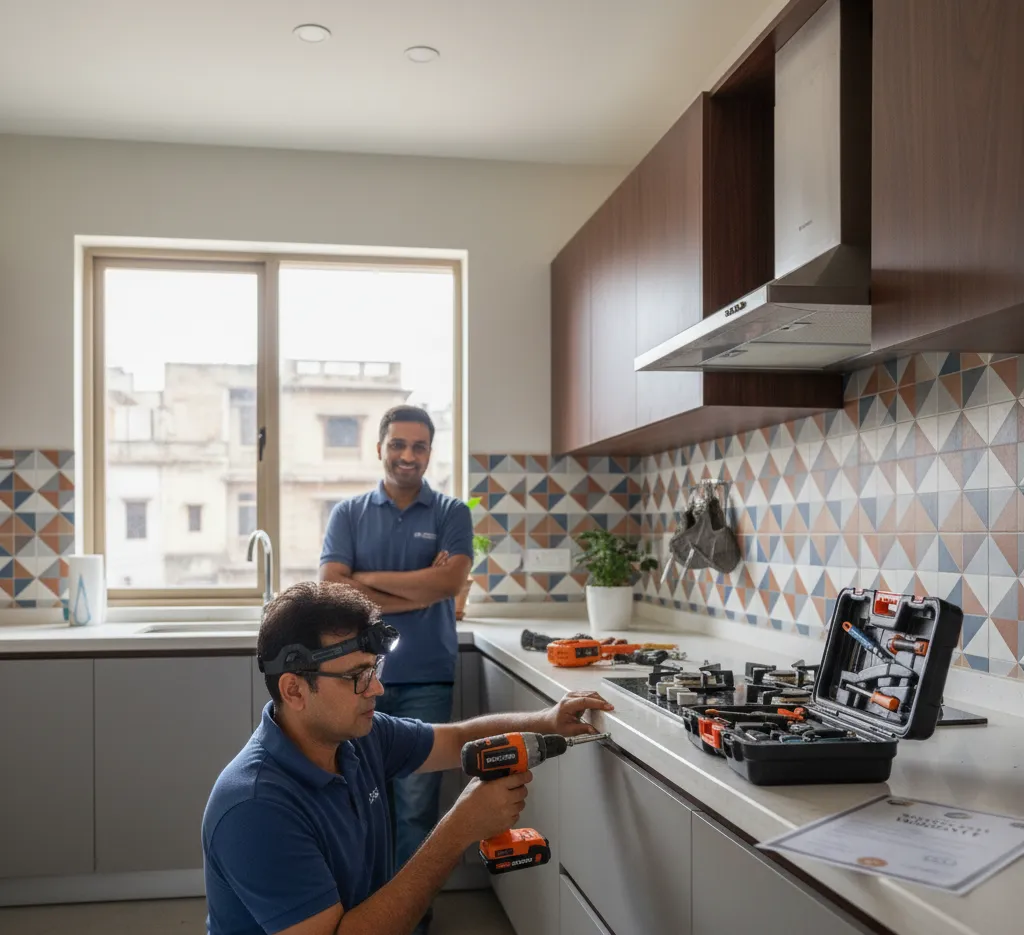
She paid a local carpenter ₹1,200 to replace the two broken hinges with Hettich soft-close ones. The carpenter bought them from a hardware shop on MI Road. ₹190 each. ₹380 for the pair. Labour was ₹800. And honestly? Those two doors now close better than every other door in her kitchen - which is both satisfying and depressing because it means the remaining 18 cabinet doors with unbranded hinges are living on borrowed time.
She's started a small savings fund - her words, not mine - for when the next batch fails. She expects it within the year. I asked her if she wanted me to help her replace all remaining hinges preemptively. She said she'd think about it. It would cost roughly ₹4,000 for hardware and ₹2,000 for the carpenter to do the whole kitchen. ₹6,000 total. She's still thinking.
Meanwhile, she called the kitchen company one more time last month. Just to see. The number is now disconnected.
I wish I could say this is unusual. It's not. I've heard variations of this story from at least three other families in Jaipur. Kitchen company installs. Warranty period ends. Phone stops working. The end.
Your kitchen is only as good as the warranty you can actually use. Get the brand name on the invoice. Keep the invoice somewhere you can find it. And never accept "imported" as an answer to "what brand are these hinges?"
More kitchen advice from someone who's seen it all go wrong? KitchenKaki - we learn from family disasters so you don't have to.
