
Kitchen Basket Types and Uses: Complete Guide With Prices
The showroom had a 38-page basket catalogue. My bhabhi came home with a headache. We went back, picked seven baskets, and one year later — five were essential, one was useless, one became the most-used thing in her kitchen.
Kitchen Basket Types and Uses: Complete Guide With Prices
The day my bhabhi went to choose kitchen baskets, she came home with a headache and a 47-second voice note that was just her saying "there are TOO MANY OPTIONS" in increasingly frustrated tones.
I get it. I went with her to the hardware showroom the following Saturday. The guy behind the counter pulled out a catalogue that was - no exaggeration - 38 pages of stainless steel baskets. Thali baskets. Plain baskets. Cup and saucer baskets. Partition baskets. Cutlery trays. Grain trolleys. Bottle pull-outs. Vegetable baskets. Under-sink organizers. Detergent pull-outs. Perforated baskets. Non-perforated baskets. Baskets with solid bottoms. Baskets with wire mesh bottoms. Chrome baskets. SS 304 baskets. SS 202 baskets.
Bhabhi looked at me. I looked at the catalogue. The showroom guy looked at both of us like he deals with this exact expression twenty times a day.
"Tell me what you cook and I'll tell you what you need," he said. Smart man. Instead of walking us through 38 pages, he asked questions. How many people in your family? Do you store steel plates or ceramic? How many pressure cookers? Do you keep onions and potatoes in the kitchen or outside? How much masala variety?
Based on bhabhi's answers, he recommended exactly seven baskets. Not 38. Seven. And after a year of watching bhabhi use her kitchen daily, I can tell you that five of those seven were genuinely useful, one was unnecessary, and one turned out to be the single most used thing in her entire kitchen.
Let me walk you through each one - what it is, what it actually does in a real Indian kitchen, what it costs, and whether bhabhi would buy it again.
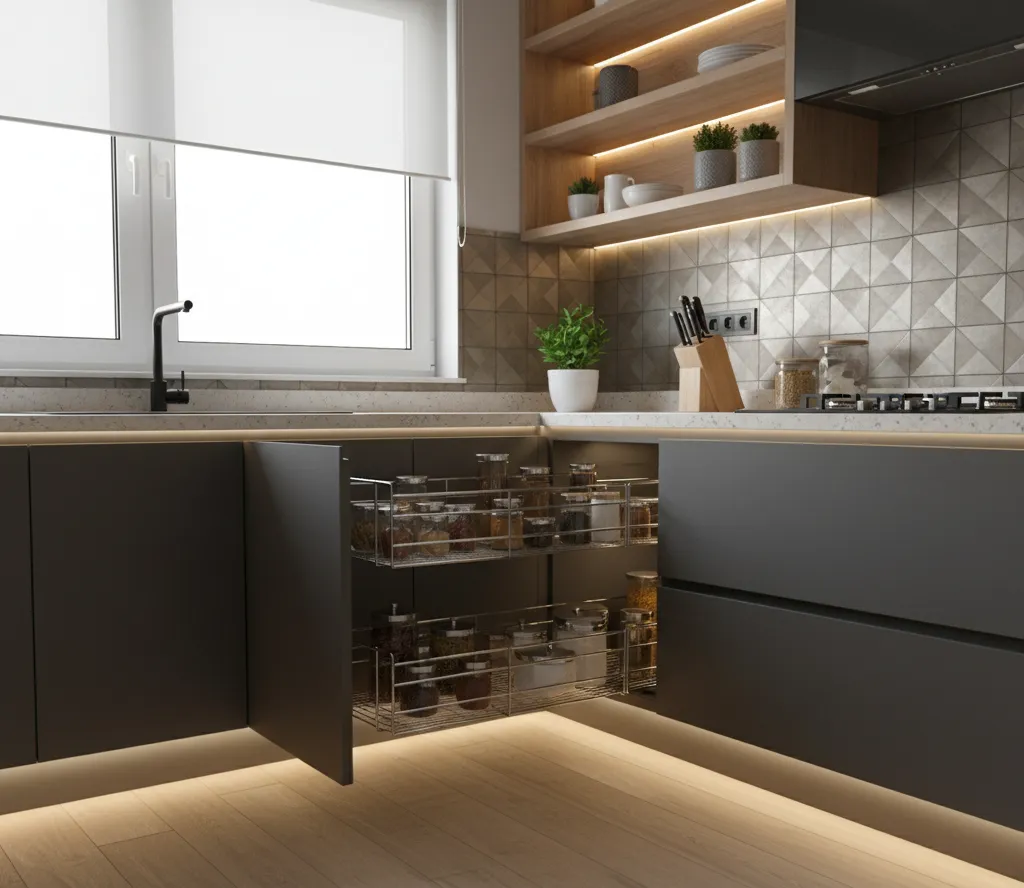
The Thali Basket (The One She Uses Most)
If your family eats on steel thalis - and in Rajasthan, that's basically every family - this basket will change your after-dinner routine.
A thali basket has vertical slots inside. Like a dish rack but enclosed in a pull-out wire basket that lives inside a base cabinet. You slide the basket out, slot each thali into its own vertical partition, push the basket back in. Done. The thalis stand upright, air-dry naturally through the wire mesh, and take up a fraction of the space they'd occupy stacked horizontally.
Before the thali basket, bhabhi stacked her thalis in a regular cabinet. Pulling out the bottom thali meant lifting the six thalis above it. Putting them back meant restacking carefully so they didn't topple. A minor daily annoyance that compounds into "why is putting dishes away the worst part of cooking."
The thali basket she got fits 12 thalis. SS 202 grade. 17 inches wide, 20 inches deep, 8 inches high. Mounts on telescopic channels that slide in and out of the cabinet smoothly. Cost: ₹2,200 including the basket and channels.
She uses it multiple times daily. After washing dishes - thalis go in standing up. Before serving - she pulls one or two out in one motion. No stacking. No unstacking. No toppling tower of steel.
Would she buy it again? "It's the first thing I'd buy," she said. "Before the chimney. Before the countertop. This basket."
She's being dramatic. But only slightly.
The Plain Basket (The Workhorse Nobody Gets Excited About)
A plain basket is exactly what it sounds like. A rectangular stainless steel wire basket with no internal partitions, no special compartments, no clever design. Just... a basket. On telescopic channels. Pull it out, put stuff in, push it back.
Boring? Yes. Essential? Also yes.
Bhabhi has two plain baskets. One stores her daily cooking vessels - the medium kadai, the smaller saucepan, the tawa lifter, a couple of steel bowls. The other stores random kitchen items that don't belong anywhere else - the grater, the lemon squeezer, the potato masher, the weird silicone spatula she bought during a Flipkart sale and uses maybe twice a month.
Plain baskets come in multiple heights - 4 inches, 6 inches, 8 inches. The 4-inch is basically a tray. Good for flat items. The 8-inch can hold tall vessels standing upright. Bhabhi has one 4-inch and one 8-inch.
Cost: ₹800-1,500 each depending on size and steel grade. Hers were ₹1,100 and ₹1,350. SS 202. Chrome finish. They slide smoothly on basic telescopic channels.
Not glamorous. No showroom guy will recommend these with enthusiasm because the margin is thin and the product is boring. But bhabhi says the plain baskets get more daily use than almost anything else in the kitchen. "They're my junk drawers," she said. "Every kitchen needs junk drawers."
The Cup and Saucer Basket (The Controversial One)
The showroom guy recommended this and bhabhi almost said no because it sounded too specific. A basket just for cups? Who needs a dedicated cup basket?
A cup and saucer basket has two tiers. The upper tier has hooks or arched wire holders where you hang cups upside down. The lower tier - a flat mesh tray - catches dripping water and holds saucers or small bowls. It mounts inside an upper wall cabinet, usually near the stove or chai station.
Bhabhi's family drinks chai four times a day. That's at least 12-16 cups washed daily in a family of four. Before the basket, cups lived in a regular cabinet, stacked precariously. The saucers lived... honestly nobody knew where the saucers were half the time. They migrated around the kitchen like they had independent lives.
Now - cups hang upside down after washing. They air-dry inside the cabinet. Saucers sit on the lower tray. When it's chai time, she opens the cabinet and every cup is right there, dry and ready, hanging in a neat row. It takes maybe two seconds to grab four cups. Before the basket, it was a 30-second search-and-stack operation.
Cost: ₹850-1,300. Bhabhi's was ₹1,100 for a 10-cup capacity in SS 202. Mounts with two screws inside the wall cabinet.
Would she buy it again? Here's the thing - she would, but only because her family drinks a LOT of chai. If your household uses 2-3 cups a day? Maybe skip this and use the cabinet space for something else. If you're a 12-cup-a-day chai family? This basket earns its rent.
The Cutlery Tray (Seems Obvious but Most People Get the Wrong One)
Every kitchen needs a cutlery organizer. Spoons, forks, ladles, serving spoons, knives, the occasional chopstick from that one time you ordered Chinese and kept the chopsticks because "we might use them."
There are two types. The insert tray - a compartmented plastic or steel tray that sits inside a drawer. And the pull-out cutlery basket - a wire basket with built-in compartments on telescopic channels.
Bhabhi got the pull-out version. SS 304 grade because cutlery is wet when it goes in after washing. The basket has five compartments - big spoons in one, small spoons in another, forks, knives, and a wider section for the big serving ladles and the karchi. A perforated bottom lets water drain through instead of pooling.
SS 304 matters here because 202 grade corrodes faster in consistently wet conditions. Cutlery goes into this basket damp. If you wash dishes twice a day, the basket is handling moisture twelve hours out of every twenty-four. SS 304 handles this without developing that brownish water-stain discolouration that 202 gets after a few months.
Cost: SS 304 perforated cutlery basket - ₹1,800-2,500. The SS 202 version is ₹800-1,200 but bhabhi's designer specifically recommended 304 for the cutlery basket because of the constant wet contact. The ₹1,000 difference in material grade saves you from replacing a corroded basket in 18 months.
The Grain Trolley (The One That Solved the Atta Problem)
Every Indian kitchen has large containers of atta, rice, dal, sugar, and various other dry staples that weigh 2-5 kg each. These heavy containers traditionally sit on the floor of a base cabinet or on a low shelf. Getting them out means bending, lifting, and carrying - which is fine when you're 25 and annoying when you're 55.
A grain trolley is a tall narrow pull-out unit - usually two or three wire shelf levels - that stores these heavy containers vertically and slides out on heavy-duty telescopic channels. You pull the handle, the entire trolley glides out, and your atta, rice, and dal containers are right there at waist height.
Bhabhi's grain trolley has three shelves. Bottom shelf: 5 kg atta container and 5 kg rice container. Middle shelf: dal containers - four different dals, because it's an Indian kitchen and one dal is never enough. Top shelf: sugar, tea, smaller packets.
The trolley is about 15 inches wide and sits in a narrow cabinet that would otherwise be an awkward gap between the fridge space and the counter edge. This is the kind of narrow dead space that most kitchens waste. The grain trolley turns it into the most organized dry-storage in the house.
Cost: ₹3,500-4,500 for a three-shelf unit with heavy-duty channels. Bhabhi's was ₹4,100. SS 202 because the grains are dry - no moisture issue here, so 304 grade isn't necessary.
This was the showroom guy's most enthusiastic recommendation. "Every Indian kitchen should have one," he said while pulling the demo model out with one finger to show how smoothly it glides. He wasn't wrong. Bhabhi says this trolley eliminated the "I have to bend into the cabinet to scoop atta" ritual she used to do twice a day.
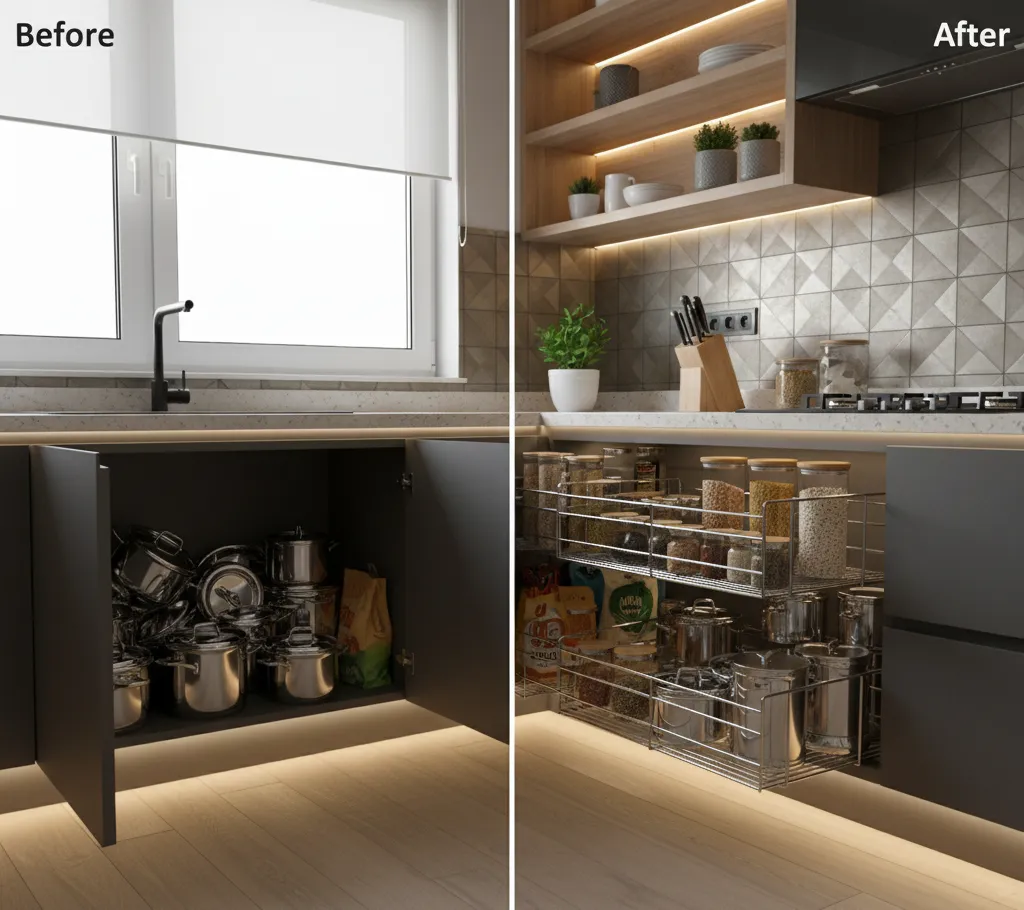
The Bottle Pull-Out (Useful but Narrow Use Case)
A bottle pull-out is a slim, tall basket - maybe 6 inches wide - with two or three shelves designed to hold bottles upright. Oil bottles. Vinegar. Soy sauce. That one bottle of ginger-garlic paste that always falls over in regular cabinets.
Bhabhi has one. It lives next to the stove. She keeps the cooking oil there, the mustard oil, the sesame oil for certain Rajasthani dishes, and a couple of sauce bottles. Pulls it out during cooking, grabs what she needs, pushes it back.
Cost: ₹1,200-2,000 depending on height and number of shelves. Bhabhi's was ₹1,500. Two shelves. Slim enough to fit in a 6-inch gap beside the hob cutout.
Here's the honest truth - she uses it but doesn't love it. The bottles clink against each other when she pulls the basket out. The slim width means only thin bottles fit. Her big 5-litre mustard oil can doesn't fit at all - it lives in the grain trolley instead. If she were doing the kitchen again, she might skip the bottle pull-out and just keep bottles on the counter or in the grain trolley's top shelf. It's the one basket she's lukewarm about.
The One She Didn't Get (And Regrets)
The under-sink organizer. The showroom guy suggested it. Bhabhi said no - she thought she'd just put a plastic bin under the sink for cleaning supplies. Save the ₹1,500-2,500 an under-sink basket would cost.
A year later, her under-sink cabinet is a chaotic mess. Vim bottle, Harpic, sponges, spare plastic bags, the drain cleaner she bought six months ago and lost behind the Harpic until last week. Everything just dumped in there. The plumbing pipes take up irregular space, making stacking impossible. Things fall over behind the pipes and become invisible.
An under-sink basket is specifically designed to work AROUND the plumbing. It has cutouts for pipes. Adjustable shelves that fit the irregular space. Everything stays visible and accessible.
She's ordering one next month. "I should've listened to the showroom guy," she told me. That's the only time I've heard her say that sentence about any purchase ever.
The 304 vs 202 Decision (Ask This One Question)
The showroom guy's rule was simple and I've never heard it explained better: "If the basket will be wet regularly - 304. If the basket will be dry - 202."
Cutlery basket? Wet. 304. Thali basket? Wet - thalis go in after washing. 304 ideally, though bhabhi got away with 202 because she dries thalis partially before slotting them in. Grain trolley? Dry. 202 is fine. Plain baskets for cooking vessels? Mostly dry. 202. Bottle pull-out? Dry. 202. Under-sink organizer? WET. Definitely 304.
The price difference between 202 and 304 is about 30-40% per basket. In a kitchen with seven baskets, going full 304 everywhere might add ₹3,000-5,000 to the total. Worth it for the wet-zone baskets. Overkill for the dry ones.
Total Basket Budget for a Real Indian Kitchen
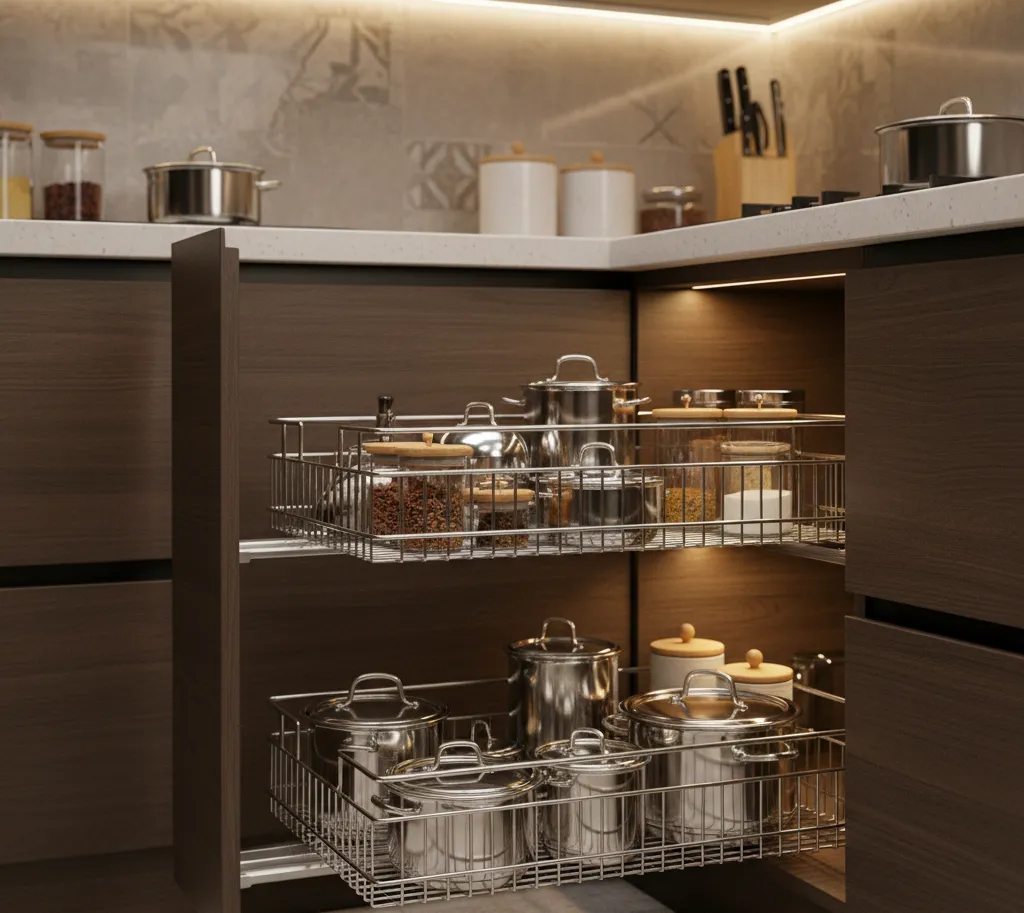
Bhabhi's seven baskets - thali basket, two plain baskets, cup and saucer basket, cutlery tray, grain trolley, and bottle pull-out - cost about ₹13,200 total including all telescopic channels and mounting hardware.
That's roughly 5% of her total ₹2.8 lakh kitchen budget. For accessories that she uses multiple times every single day. On a per-use basis, these are probably the cheapest items in her kitchen in terms of daily value delivered.
My brother's kitchen has zero baskets. Budget didn't allow it. His wife Priya uses the cabinets with regular shelves and stores everything by stacking. It works. She's fine. But when she visits bhabhi's kitchen and pulls out the thali basket, she gets this look on her face. The same look my mummy gets when she sees the magic corner.
The baskets aren't mandatory. The kitchen functions without them. But once you've pulled a thali basket out and grabbed a plate in two seconds instead of unstacking six - it's hard to go back to the old way.
More kitchen accessory advice based on actual cooking, not catalogue photos? KitchenKaki - we pull every basket out. Daily. Twice if there's rajma.
