
Kitchen Tall Unit Design: Smart Storage for Indian Kitchens
I've become the guy who asks to see people's tall units. Twelve kitchens later, I've found five completely different types — and most families pick the wrong one. Here's what each type does and what it costs.
Kitchen Tall Unit Design: Smart Storage for Indian Kitchens
I've become the guy who asks to see people's tall units. Not at parties - I haven't lost ALL social sense - but whenever I visit someone's home and they mention they recently got a modular kitchen, I immediately ask: "Do you have a tall unit? Can I see it?"
My wife finds this deeply embarrassing. My mummy finds it funny. The homeowners usually find it flattering - nobody ever asks to see inside their kitchen cabinets. They're happy to show off.
Over the past three years, across kitchen visits in Jaipur, Noida, and Pune, I've seen about a dozen tall units. And the thing that surprised me most is that they're NOT all the same. A tall unit isn't just "a tall cabinet." There are at least five completely different types, each solving a different storage problem, and most Indian families don't know they have options. They get whatever the designer suggests and hope for the best.
Let me walk you through the five types I've actually seen in real Indian kitchens - not showroom demos, not catalogue renders - with what each one costs, what it stores, and the one honest complaint from each homeowner.
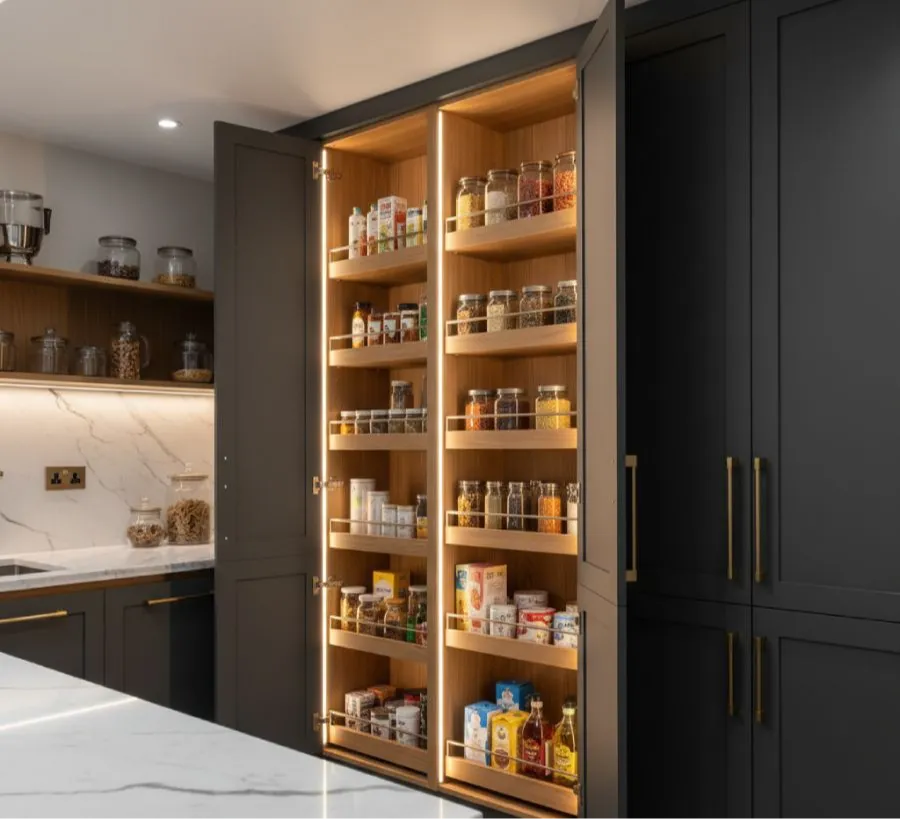
The Pull-Out Pantry (The One Everyone Should Start With)
Mansarovar. A family of five. The wife - Kanika - had been storing atta, rice, dal, oil, sugar, and about fifteen masala containers in a standard base cabinet. Crouching. Reaching. Knocking things over. The usual.
Her designer put in a pull-out pantry tall unit. About 2 feet wide, 8 feet tall. When you open the door and pull the handle, six wire baskets glide out toward you on telescopic channels. Each basket sits at a different height. The whole thing comes out about three-quarters of the way, and suddenly you're looking at every single pantry item she owns - visible, accessible, at heights ranging from knee to shoulder.
Bottom two baskets: heavy stuff. 5 kg atta container, 5 kg rice bag, the big bottles of oil that weigh enough to count as exercise when you lift them. Middle baskets: dal containers, sugar, tea, the specialty flours she buys for festival cooking. Top baskets: lightweight items - papads, dried fruits, those random snack packets everyone accumulates but nobody finishes.
Kanika's one complaint: "The bottom baskets are hard to see into because they're low and the wire mesh is dense. I have to bend slightly to check what's left." She solved this by putting the atta in a clear container so she can see the level from a standing angle. ₹200 container. Problem mostly fixed.
Cost of the mechanism: about ₹12,000-18,000 depending on brand. The cabinet itself (plywood carcass, laminate shutter) adds another ₹8,000-12,000. Total installed: roughly ₹20,000-30,000.
For a standard Indian kitchen that stores 15-25 kg of dry groceries at any given time, this is the most practical tall unit you can get. It's the one I recommend first to everyone.
The Built-In Appliance Tower (The Counter-Space Saver)
Vaishali Nagar. Young couple. Amit and Deepa. Kitchen was 8 by 9 feet. They had four countertop appliances: microwave, OTG oven, mixer grinder, and a toaster. On a counter that was maybe 6 feet of usable length. You can see the problem - appliances were eating 40% of their prep surface.
Their designer built a tall unit specifically to house appliances. Not a pantry - an appliance tower. Four cubby holes at different heights, each with its own electrical point wired inside. Microwave at chest height. OTG below it. Mixer on a pull-out shelf at counter height so Deepa could pull it forward to use it and push it back when done. Toaster on the top shelf - they use it maybe twice a week so reaching up is fine.
Every appliance was off the counter. Counter went from 60% usable to 100% usable. In a 72-square-foot kitchen, that recovered counter space is the difference between "I can barely chop here" and "I have room to roll rotis AND prep sabzi at the same time."
Deepa's complaint: "The OTG generates a lot of heat. The cubby doesn't have enough ventilation at the back. After 30 minutes of baking, the cabinet wall behind the OTG gets warm." They've since left the OTG's cubby partially open at the back - cut a 4-inch gap in the backing panel - for airflow. Solved the heat issue but looks slightly unfinished from behind.
This is the lesson: appliance towers need ventilation planning from Day 1. Tell your designer which appliances will go inside AND how much heat each generates. A microwave needs moderate ventilation. An OTG needs serious airflow. A mixer needs none. Plan the gaps accordingly.
Cost: similar to a pull-out pantry in cabinet cost - ₹15,000-25,000 - but the electrical wiring inside adds ₹1,500-2,500 for four dedicated outlets. Total installed: ₹17,000-28,000.
The Half-Pantry Half-Appliance Hybrid (The Practical Compromise)
This is what my bhabhi has in Jagatpura and it's honestly the smartest configuration I've seen for a family kitchen where budget allows only ONE tall unit.
Bottom half: pull-out wire baskets for dry groceries. Atta, rice, dal, sugar - the heavy daily stuff. Three baskets, each on telescopic channels.
Middle section: an open cubby with an electrical point. The microwave lives here. Pull-out shelf so she can slide it forward when loading heavy bowls. This is the cubby I described in the microwave placement blog - it's part of her tall unit, not a standalone setup.
Top half: fixed shelves behind the shutter door. Festival utensils, guest crockery, the idli maker from 2016 that's been used exactly three times, and whatever else gets accessed once a month or less.
Three functions in one vertical column. Pantry at the bottom where weight is best supported. Appliance in the middle where ergonomics are best. Rarely-used storage at the top where accessibility matters least. It's a hierarchy of frequency - daily items low and middle, monthly items high.
Bhabhi's complaint: "I wish the microwave cubby was 2 inches wider. Sometimes when I put a large plate inside the microwave, the door can only open about 120 degrees because the cubby walls are close. A wider cubby would've cost the same." Valid point. If you're planning a hybrid unit, measure your microwave's door swing radius. Add 2 inches of clearance on each side. Don't assume the designer checked this - mine didn't.
Cost: about ₹25,000-35,000 installed with the pull-out mechanism, electrical point, and fixed shelves. The hybrid is slightly pricier than a pure pantry because you're combining mechanisms - pull-outs at the bottom, a pull-out shelf in the middle, and fixed shelves at the top.
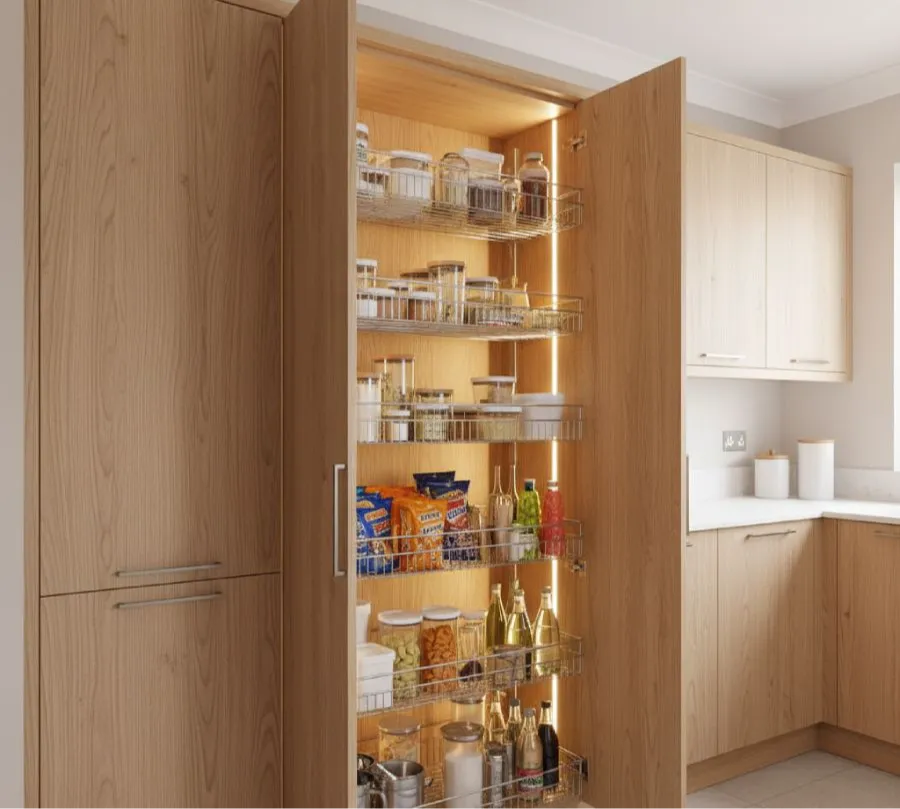
The Broom and Utility Tower (The One Nobody Thinks About Until It's Too Late)
A friend in Tonk Phatak - joint family, three-bedroom flat - has a narrow tall unit tucked next to the fridge. About 15 inches wide. 8 feet tall. From outside it looks like a regular skinny cabinet.
Inside? A broom. A mop. A handheld vacuum. A dustpan. Two rolls of kitchen towels standing upright. A shelf at the top with cleaning supplies - Lizol, Colin, a scrub brush, spare sponges.
Before this unit existed, the broom lived behind the kitchen door. The mop leaned against the washing machine. The cleaning supplies were under the sink fighting for space with the Harpic and the spare garbage bags. The dustpan was... actually, nobody knew where the dustpan was most of the time. It migrated.
The utility tower gathered everything into one 15-inch-wide column that's invisible from outside. Door closed? Looks like a skinny cabinet. Door open? Your entire cleaning arsenal, organized vertically.
His wife's complaint: "We should have put hooks inside the door. Right now the broom just leans against the back wall and sometimes falls when I open the door fast." She's since stuck two adhesive hooks on the inner door face. The broom and mop hang from them now. Another ₹100 fix for a ₹200 annoyance.
Cost: this is the cheapest tall unit because there's no pull-out mechanism. No wire baskets. No electrical points. Just a tall plywood box with a door, two fixed internal shelves, and maybe a hook strip. ₹8,000-12,000 installed. The narrowest standard size is 300mm (about 12 inches) - fits in gaps that would otherwise be dead space between the fridge and the wall or between the counter end and the kitchen doorway.
Every joint family kitchen generates cleaning supplies that have no home. This unit gives them one. It's the least glamorous tall unit and the one that gets the most grateful reaction from whoever does the actual cleaning.
The Glass-Front Display Unit (The Showing-Off One)
A designer I met at an exhibition in Jaipur showed me photos of a tall unit he'd done for a Vaishali Nagar client. Upper half: glass shutter doors. Lower half: solid shutter doors. The glass section displayed the family's fancy crockery - bone china, crystal glasses, those decorative serving bowls you get as wedding gifts and use twice a decade.
LED strip inside the glass section. Warm light. The crockery glowed softly behind the glass. It looked like a boutique display case that happened to be in a kitchen.
Beautiful? Yes. Practical for daily Indian cooking? Debatable.
Glass shutters in a kitchen mean visible interiors at all times. If you're the kind of family that keeps your display crockery pristine and dust-free - great. If you're the kind of family that shoves random things into cabinets and relies on solid doors to hide the chaos - glass will betray you daily.
Also - and the designer acknowledged this - glass near a cooking zone collects a grease film faster than solid surfaces. The crockery inside stays clean because the glass protects it. But the glass itself needs wiping every few days or the "display" starts looking like it's behind a frosted window.
The Vaishali Nagar client loves it. But she also has a full-time house helper who wipes the glass daily. For most Indian households where the person cooking is also the person cleaning? A glass-front tall unit is aspirational more than practical.
Cost: ₹25,000-40,000 installed. The glass shutters cost more than solid laminate - roughly ₹2,000-4,000 extra for the glass plus aluminium framing. The LED strip adds ₹800-1,500.
My honest take? If you want to display crockery, do it in the dining area where grease isn't a factor. Use the kitchen tall unit for actual kitchen storage. Let the display case live somewhere it won't need daily degreasing.
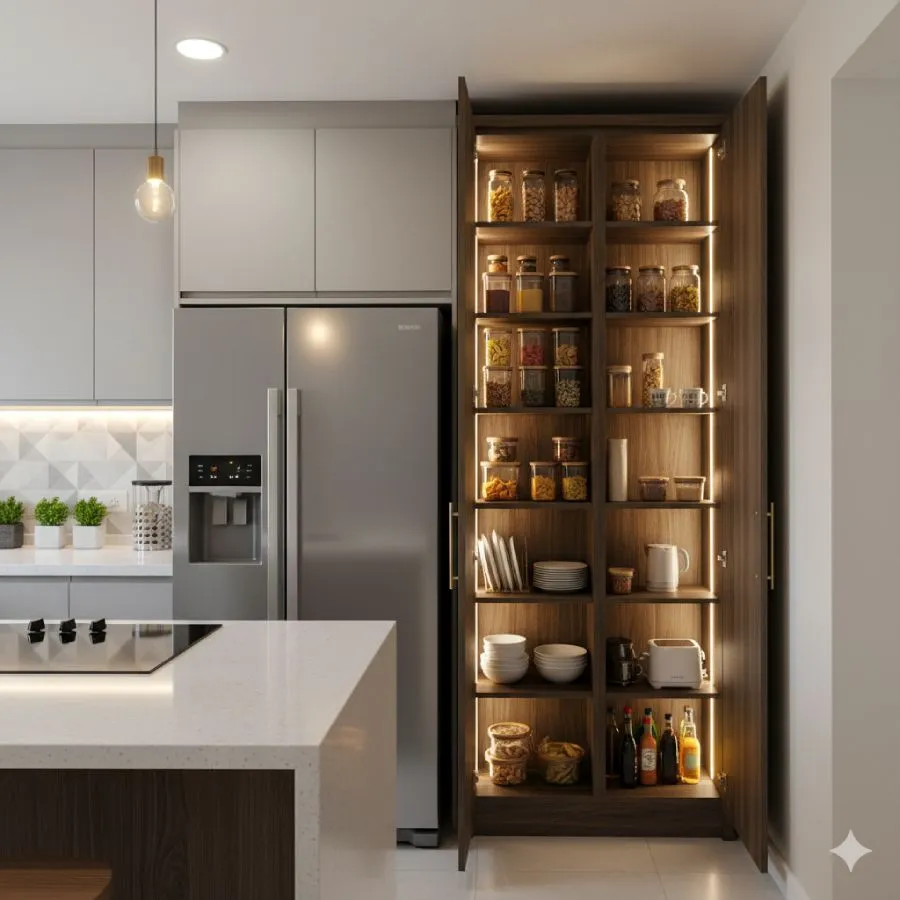
How to Decide Which Tall Unit Your Kitchen Needs
The showroom will show you all five types. The designer will suggest the fanciest one. Your budget will whisper in your ear.
Here's the filter I use when family members ask me - and they all ask me now because apparently I've become the Tall Unit Advisor of Malviya Nagar:
If your biggest problem is dry grocery storage - you're always running out of counter space because atta and rice containers are sitting on it - get the pull-out pantry. It solves 80% of storage complaints in Indian kitchens.
If your countertop appliances are eating your prep space - the microwave, OTG, mixer, and toaster are taking up two feet of counter - get the appliance tower or the hybrid.
If you can only afford ONE tall unit - which is most families - get the hybrid. Pantry at bottom, appliance in middle, rarely-used stuff on top. Best value per rupee.
If you have a weird narrow gap of 12-15 inches somewhere in your kitchen - don't waste it. Put a utility tower there. Your broom finally gets a dignified home.
If your mother-in-law is visiting and you need to impress her - okay fine, get the glass-front unit. But don't come to me when you're wiping it every three days.
More kitchen storage advice from someone who asks strangers to open their tall units? KitchenKaki - we go vertical so your counter stays clear.
