
Where to Put the Microwave? Smart Appliance Integration in Modern Jaipur Kitchens
My family has been arguing about microwave placement for four years. Counter wastes space. Under-counter caused a burn. Above the chimney was dangerous. Here's every option — tested for real.
Where to Put the Microwave? Smart Appliance Integration in Modern Jaipur Kitchens
The microwave argument in my family has been going on since 2020. Four years. Four kitchens. Zero consensus. We cannot agree on where this appliance belongs. It's become a running joke at family dinners except nobody's actually joking.
It started when mummy got her new modular kitchen and did what every Indian household does - plonked the Samsung right on the counter, next to the hob, in the exact spot it had occupied in the old kitchen for fifteen years. The kitchen company had designed a beautiful U-shaped counter with plenty of prep space. Mummy immediately sacrificed two square feet of it to an appliance she uses maybe three times a week.
"Mummy, the microwave is eating your counter space."
She looked at me over her glasses. "Where else will it go?"
That question has haunted four kitchen renovations. Because the answer isn't simple. There IS no single right spot. It depends on your kitchen size, how often you use the thing, and whether you're the kind of person who reaches for a trivet before setting down a hot bowl or the kind who just... sets it down wherever. (Mummy is the second kind. Always has been. Probably always will be.)
The Counter Problem Nobody Admits Is a Problem
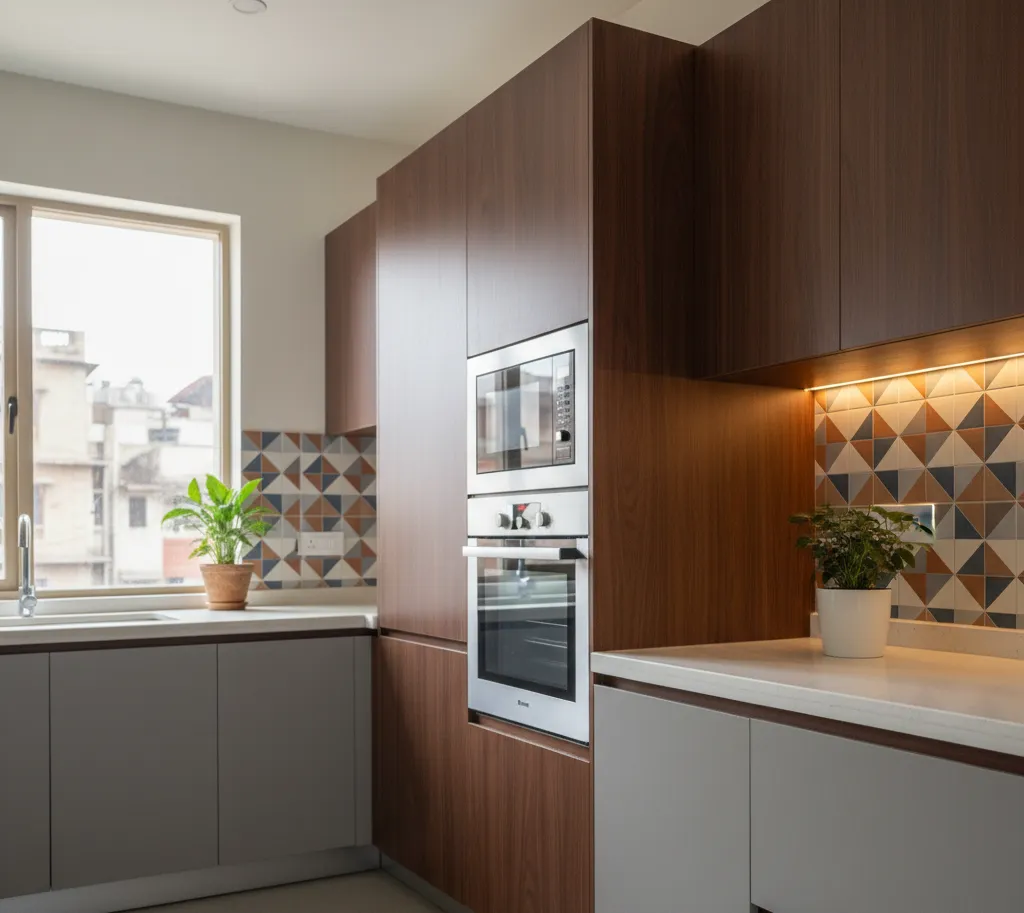
I've watched mummy cook hundreds of times in the new kitchen. And there's this little choreography she does that she doesn't even notice anymore. She starts prepping - chopping board out, masala katori ready, mixer in position. Then she needs the rolling board for rotis. But there's no room because the microwave is sitting there occupying 24 inches of prime counter real estate. So she pushes it backward against the backsplash. Gains maybe two inches. Angles the rolling board diagonally. Proceeds to roll rotis in a space that's technically sufficient but visually stressful.
When she needs to heat something later, she pulls the microwave forward again. Power cord gets tugged. Sometimes the cord pulls the phone charger plug out of the adjacent outlet - my brother charges his phone from the kitchen, a habit that remains unexplained and universally mocked - and then there's a whole secondary drama about the phone falling off the counter.
Also - and this is the gross part nobody talks about - the space BEHIND a counter microwave in a Jaipur kitchen is horrifying. Mummy does tadka twice a day. Oil vapour rises, hits the wall, condenses, drips down behind the microwave into a narrow gap between the appliance's back panel and the backsplash tile. I pulled the microwave out to clean behind it last Diwali. Four months of accumulated grease had formed this sticky amber strip that peeled off like a fruit roll-up. Mummy was mortified. She'd been wiping the TOP of the microwave regularly but never thought about the back because who pulls out their microwave to clean behind it? Nobody. That's the answer. Nobody.
Every kitchen I've visited in Jaipur has this exact situation. Counter microwave, pushed against the wall, slowly developing a grease archive behind it that nobody will discover until they move to a new house or the microwave dies and they lift it off the counter and gasp.
What Bhabhi Did Instead (And Why I Bring It Up at Every Family Gathering)
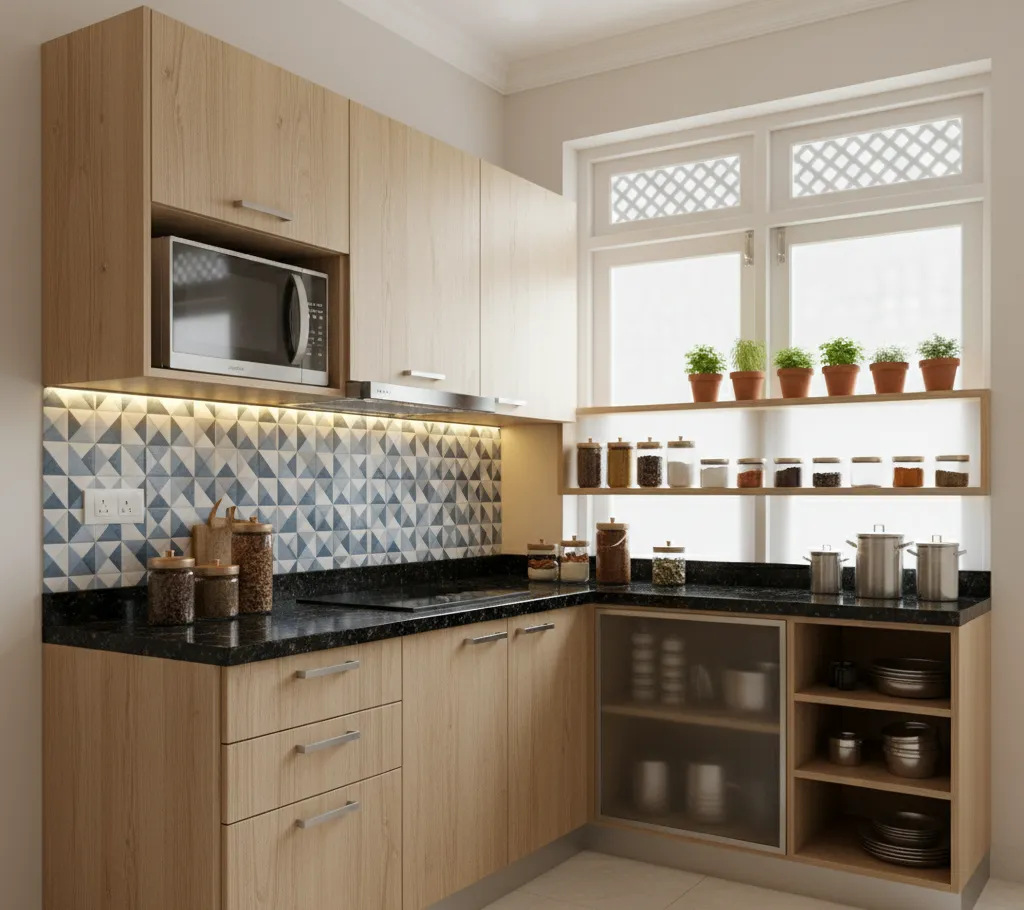
So bhabhi designs her Jagatpura kitchen last year. Her designer - young guy, clearly watches too many YouTube kitchen tours but also genuinely talented - suggests building the microwave into the tall pantry unit. Not on the counter. Not on a shelf. INSIDE the tall unit itself.
He designed an open cubby at about chest height - roughly 4 feet off the ground - with a dedicated electrical point wired inside. The microwave slides in on a pull-out shelf. She loads heavy bowls from the front, pushes the shelf back when done, and the microwave sits flush with the tall unit's face. From outside it looks like a built-in appliance. Clean. Intentional. Like those European kitchen photos where everything has a home.
The pull-out shelf was important and I want to explain why because it addresses the one real safety concern with built-in microwaves. When you heat a full bowl of dal - maybe 800 grams of hot liquid - you need to lift it out carefully. If the microwave is recessed into a cubby and you're reaching INTO the shelf to grab a hot bowl, there's an awkward angle where your wrist is bent and the bowl is tipping toward you. The pull-out shelf fixes this. You slide the microwave forward on the shelf until the door clears the cubby frame, open it, and lift the bowl out with your arms straight. Much safer.
Cost of the whole setup? About ₹2,500-3,000 for the cubby modification during manufacturing, plus ₹300 for the electrician to run a dedicated outlet inside. The tall unit was already being built. Adding one open shelf at a specific height wasn't a major change.
Bhabhi's counter has zero appliances on it now. Zero. The microwave is in the tall unit. The mixer lives in a base cabinet and comes out only when she's grinding chutney. The toaster is on a pull-out shelf inside another base cabinet - she pulls it out, makes toast, pushes it back in, done. Her counter surface is just... surface. Chopping board, rolling area, plating zone. Nothing competing for space.
"It's like having a bigger kitchen without actually having a bigger kitchen," she told me about two months after installation. I've been quoting her to every relative who'll listen. Most of them nod politely. My mummy rolls her eyes. She still thinks the counter is fine.
One thing bhabhi did mention - casually, almost as an afterthought - is that her mother-in-law, who visits every few weeks, finds the chest-height cubby uncomfortable because she has wrist stiffness and prefers to lift things at a lower angle. For her mother-in-law, the counter would actually be easier. So the "best" placement depends on who's using it. Bhabhi is 30 and healthy. Her mother-in-law is 62 with joint issues. Same microwave, different ideal height. Worth thinking about if your household spans multiple generations, which in Jaipur basically means every household.
The ₹1,400 Wall Shelf Versus the ₹2,500 Tall Unit Cubby
My brother and Priya couldn't afford a tall unit. Their whole kitchen was ₹1.16 lakh. A tall unit would've added ₹12,000-18,000 they simply didn't have. But Priya also refused to put the microwave on the counter because their kitchen is 7 by 8 feet and every inch of counter is existentially important.
Amazon. Heavy-duty metal brackets. ₹1,400. Rated for 30 kg each. She had the carpenter mount a shelf on the wall about 4.5 feet high, in the gap between the upper cabinets and the counter. Crucially - NOT directly above the hob. I say crucially because a friend on Tonk Road made exactly that mistake and I'll get to her in a second.
The microwave sits on the shelf. Cord runs down the wall to an outlet. Priya taped the cord to the wall with white electrical tape. It mostly blends in. Mostly. If you're looking for it you can see a thin white line running vertically down the tile. It bothers me. It doesn't bother Priya. We have different thresholds for visible cord management.
Looks a bit DIY? Absolutely. The brackets are visible. It's not as seamless as bhabhi's cubby. But the counter is free. In 56 square feet of kitchen, that's the difference between "I can cook comfortably" and "I'm playing Tetris with vegetables and appliances every evening."
Total cost including the carpenter's drilling and mounting: under ₹2,000. For a rental apartment where you can't permanently modify the modular setup, this is genuinely the smartest approach. When they move, the shelf comes off, holes get filled with wall putty, deposit returned.
I insisted on the 30 kg brackets. Priya thought I was being paranoid. I showed her a Reddit thread - actually it might have been Twitter, I can't remember - where someone posted a photo of their microwave shelf that had ripped out of the wall at 2am. Plaster chunks everywhere. Microwave face-down on the counter. Scary photo. Priya ordered the heavy-duty brackets that same evening. Paranoia has its uses.
Where You Should NOT Put It (Learned the Hard Way by Two People I Know)
My uncle tried under the counter. Base cabinet. Open cubby at knee height. Made sense on paper - counter stays free, no wall shelf needed, no tall unit required. He lasted one month.
Bending down to put a plate in a microwave at shin level is fine once. Doing it four times a day becomes genuinely annoying by week two. His wife burned her wrist once - not seriously, but enough to leave a red mark - while angling a hot bowl of rajma out of the knee-height cubby. The bowl tilted. The edge caught her inner wrist. She said, "I'm not using this microwave anymore until it moves somewhere normal."
It moved to the counter the next week. The base cubby now holds the water purifier, which is honestly a GREAT use for it because the purifier just sits there filtering. You don't interact with it physically the way you do with a microwave. Happy accident.
Then there's my Tonk Road friend. She mounted her microwave on a shelf directly above the chimney. Space-saving logic - the chimney's already there, use the wall above it. Three problems showed up fast.
The chimney exhaust generates heat. That heat rises into the microwave. Electronics and persistent external heat don't mix. After three months, her microwave started making a faint buzzing sound during operation that it had never made before.
She's also 5'3". The shelf was about 6 feet high. Reaching a microwave at 6 feet with a hot plate in your hands while standing on a kitchen stool near a gas stove - I watched her do this once and my entire body tensed. I couldn't say anything because it was her kitchen and her choice but I was mentally composing the text I'd send her later suggesting she move it. I sent the text. She was annoyed. She moved it a month later anyway after the buzzing got louder.
The shelf above the chimney now holds three decorative ceramic jars she bought at a handicraft fair. They've been there untouched since. Better use for that spot.
The Landing Spot Thing Nobody Plans For
One last thing that I noticed across all five kitchens and that none of the design blogs I've read ever mention.
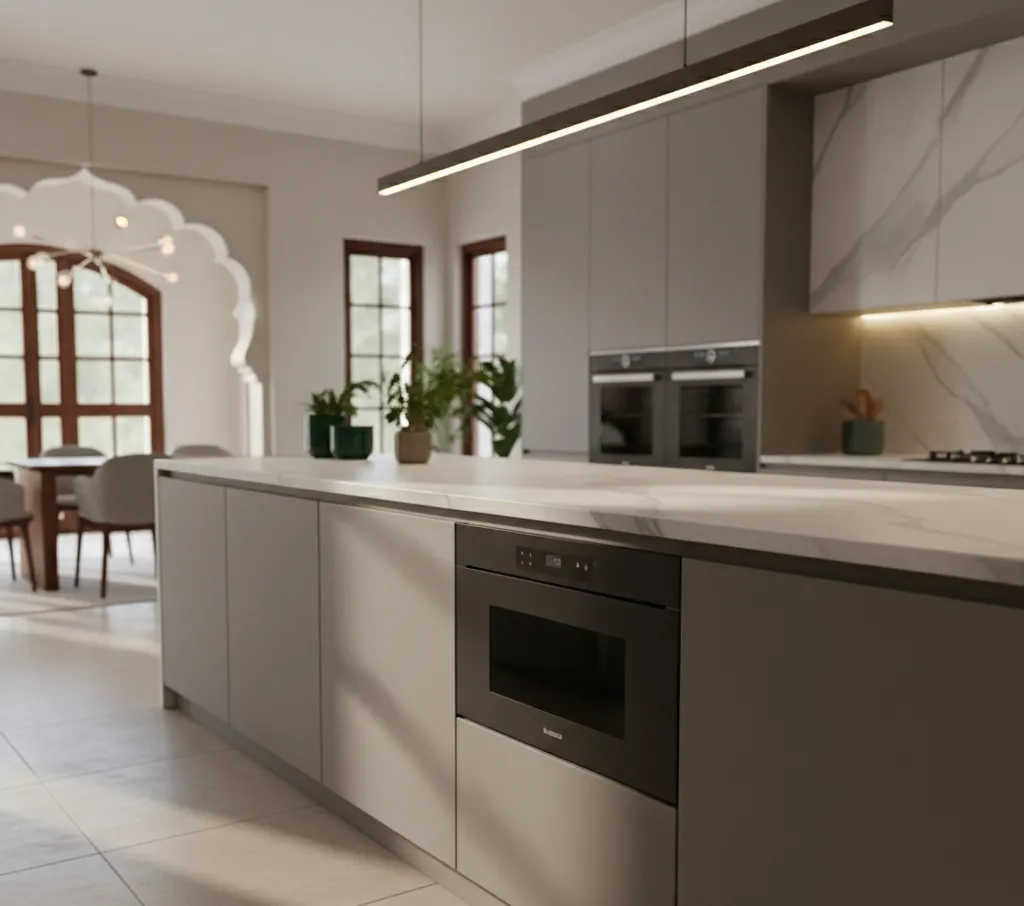
Wherever your microwave is - counter, tall unit, wall shelf, wherever - there needs to be a flat surface IMMEDIATELY next to it where you can set down a hot plate the moment it comes out.
Bhabhi has a small pull-out shelf next to her cubby. Smart. She extends it, takes out the hot bowl, sets it on the shelf, closes the microwave, pushes the shelf back in.
Priya keeps a wooden cutting board on the counter directly below her wall shelf. She takes the bowl out, turns 90 degrees, puts it down. One smooth motion.
My Tonk Road friend - when the microwave was still above the chimney - had NOTHING nearby. She'd take a hot plate out at 6 feet, climb down from the stool, walk two steps to the counter, and set it down. While holding a plate at oven temperature. With one hand because the other was steadying herself on the stool. No.
Plan the landing spot. Not just the microwave spot. The two go together. If there's no landing zone within arm's reach, you're going to burn yourself eventually. It's not a matter of if. Just when.
Mummy's counter microwave, for all its faults, has one advantage - the landing spot is the counter itself, three inches away. She takes the bowl out and sets it right down. No climbing. No turning. No walking.
Maybe she's been right this whole time. Don't tell her I said that.
More kitchen solutions from a family that argues about appliance placement at dinner? KitchenKaki - we test things so you can skip the mistakes.
