
Under Sink Kitchen Storage Ideas That Actually Work
The under-sink cabinet is the most ignored and most damaged spot in every Indian kitchen. After watching four family kitchens rot from invisible leaks, here's what actually works — starting with a ₹150 PVC mat.
Under Sink Kitchen Storage Ideas That Actually Work
The space under my mummy's old kitchen sink was a horror movie. I've told this story in pieces across other blogs but let me give you the full picture because it's the reason I now open the under-sink cabinet in EVERY kitchen I visit, which is weird behaviour and I'm aware of that.
December 2023. Kitchen tap was dripping. Dad ignored it for three weeks. Plumber came. Opened the under-sink cabinet. Moved aside the Harpic, the Vim bar, the three plastic bags stuffed with more plastic bags, the bucket nobody uses but nobody throws away, and the bottle of drain cleaner so old the label had partially dissolved.
Pressed his thumb into the cabinet base. It went through. Like poking wet bread. The plywood had been absorbing drip water for months - maybe longer - and had turned into soft, dark, faintly smelly mush.
The plumber wasn't surprised. He sees this in Jaipur kitchens every week. Moisture from drips. Hard water mineral damage. Bad ventilation inside a closed cabinet. And nobody checks because the cabinet doors stay shut and everything looks fine from the outside.
That incident turned me into an under-sink inspector. I checked my chachi's kitchen. Swollen panel edges. Checked bhabhi's. Faint water stain spreading from the pipe joint. Checked my mama's. Musty smell when you put your nose near the base. Four kitchens. Four versions of the same slow disaster.
Here's what each family did to fix their under-sink situation - and what I've since learned about storage solutions that prevent the whole mess from happening in the first place.
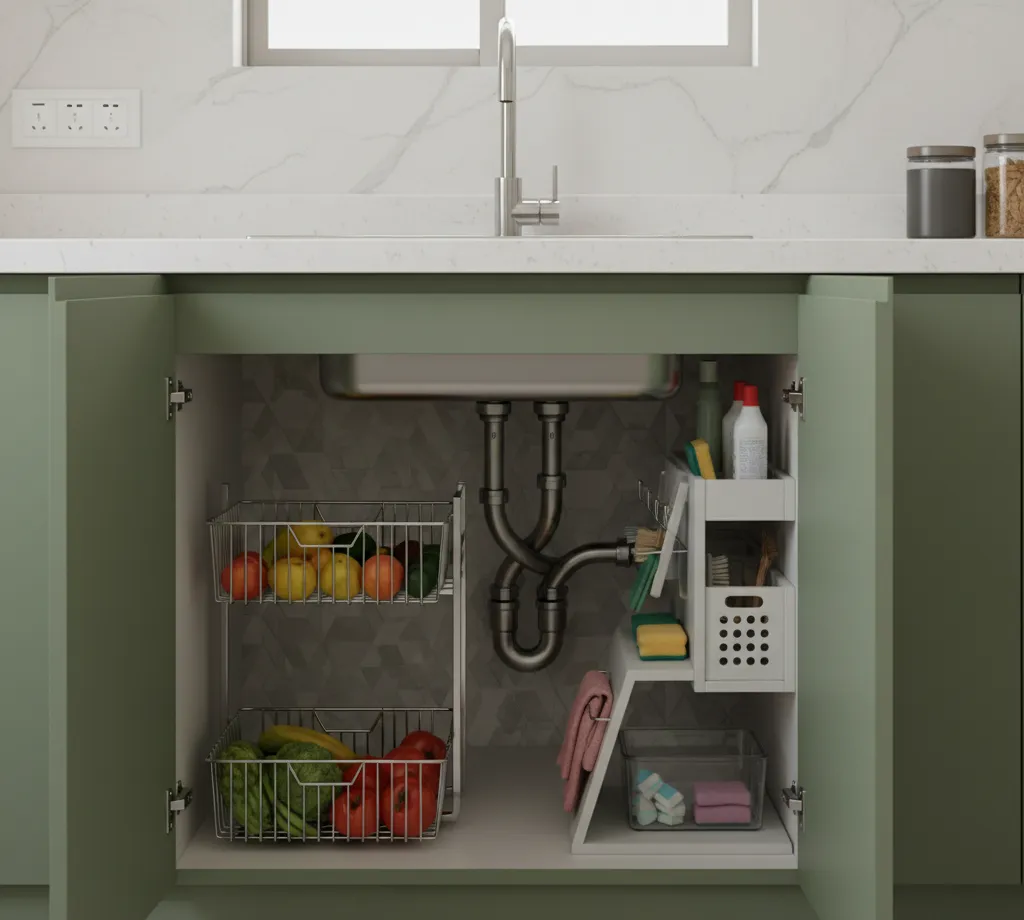
Step Zero: The PVC Mat (Before Anything Else)
Before talking about storage ideas, let me talk about the ₹150 fix that matters more than any organizer.
After mummy's base panel was replaced - ₹3,500 for the panel and plumber combined - I went to the hardware shop on MI Road. Bought a thick PVC sheet. Cut it to size with regular scissors at home while mummy supervised and told me I was cutting it crooked. Laid it flat at the bottom of the under-sink cabinet.
That mat does one job. Any drip - from the pipe joints, from the tap connection, from a leaky waste coupling - lands on the PVC instead of soaking into the plywood. Every Sunday mummy moves the bottles aside and checks the mat. If it's dry, good, no leaks. If it's wet, she knows something is dripping BEFORE it destroys the panel again.
She found a wet mat once - three months after installation. Small drip from a loosened pipe joint. Called the plumber. He tightened it. ₹200 visit. Without the mat? She'd have discovered the problem six months later when the panel was mush again. ₹3,500 repeat.
₹150 PVC mat. Twenty minutes to cut and lay. Saves thousands in repair costs. This is Step Zero. Do this before you buy any organizer, any basket, any fancy pull-out. Protect the floor of the cabinet first. Then organize what goes on top of it.
The Tension Rod Trick (Chachi's ₹120 Game-Changer)
My chachi's under-sink cabinet was pure chaos. Spray bottles lying sideways because they kept falling over. The Lizol behind the Colin behind the Harpic - three deep, impossible to grab the one in the back without knocking the other two. A sponge collection she'd been accumulating since possibly 2018.
I was scrolling through something on Instagram one evening - kitchen organization content, because apparently that's what my algorithm serves me now - and saw a stainless steel tension rod installed inside an under-sink cabinet. The spray bottles hung from it by their trigger handles. Upside down. In a neat row. Everything visible. Everything accessible. No falling over.
I bought a tension rod from Amazon. ₹120. Adjustable width. Stainless steel. Went to chachi's house the next weekend. Wedged the rod between the two side walls of her under-sink cabinet, about 8 inches from the top. Hung her spray bottles from the rod by hooking the trigger handles over it.
Four spray bottles - Lizol, Colin, Harpic, and a kitchen degreaser - all hanging neatly in a row. The entire bottom of the cabinet was suddenly FREE. Where four bottles had been lying sideways taking up the entire floor space, now there was nothing. Just empty flat surface.
Chachi stared at it for maybe ten seconds. "Why didn't I think of this ten years ago?" she said.
The space below the hanging bottles now holds her bucket, a pack of sponges, spare garbage bag rolls, and a scrub brush - all visible, all accessible. Before the rod, these items were hidden BEHIND the spray bottles on the floor. She hadn't used the scrub brush in months because she'd literally forgotten it was there.
₹120. No drilling. No carpenter. No modification to the cabinet. Just a tension rod and gravity. If you do ONE thing from this entire blog, do this one.
The U-Shaped Shelf (Mummy's Solution for the Plumbing Problem)
The biggest challenge with under-sink storage - and literally every homeowner I've talked to mentions this - is the plumbing. The pipes take up weird, irregular space in the middle of the cabinet. You can't put a normal shelf across the full width because the P-trap pipe is right there. You can't stack things high because the waste pipe runs at a diagonal. The plumbing turns a rectangular cabinet into an obstacle course.
Mummy's solution - suggested by her plumber, who at this point is basically the family's kitchen consultant - was a U-shaped shelf. It's a small shelf unit with a notch cut out of the back to fit around the plumbing pipes.
She bought one from a local hardware shop in Mansarovar. Stainless steel. ₹650. The notch fit around her pipes with about an inch of clearance on each side. The shelf sits inside the cabinet creating TWO levels of storage - stuff below the shelf and stuff on top of the shelf - while the pipes run through the notch unbothered.
Below the shelf: heavy and tall items. The big Lizol bottle. Spare dish soap. The container of dishwasher salt.
On top of the shelf: lighter, frequently used items. The daily scrub sponge. The small Vim liquid bottle she's currently using. A box of garbage bags.
Before the shelf, everything sat on the floor in one layer. After the shelf, she has two layers in the same vertical space. It sounds so obvious. But when you're living with a messy cabinet, you don't think about vertical space - you just keep shoving things in horizontally until nothing fits.
One issue mummy ran into - the shelf was slightly too tall for her cabinet and the top of the shelf touched the underside of the sink basin. She asked the hardware shop guy if he had a shorter one. He didn't. She put two small rubber feet under the shelf legs to prevent scratching the PVC mat underneath, and she keeps slightly shorter items on the top shelf now. Adjusted, not perfect. But 90% better than the chaos it replaced.
The Cabinet Door Organizer (Bhabhi's Favourite)
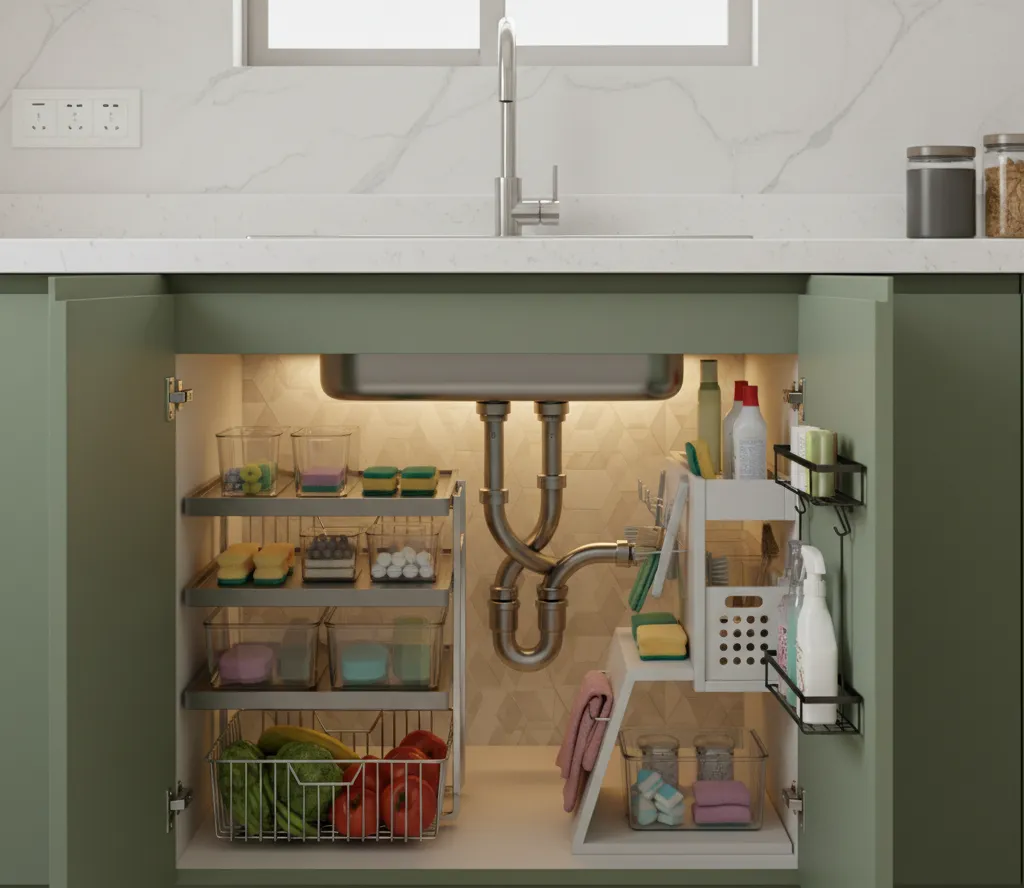
Bhabhi did something different. Instead of organizing the inside of the cabinet, she organized the DOOR.
She stuck an adhesive-mounted wire rack on the inside of the under-sink cabinet door. ₹350 from Amazon. Three small shelves. Holds sponges, scrub pads, a small bottle of hand soap, and those little steel wool rolls she buys in bulk.
The beauty of door-mounted storage is that it uses a surface that's otherwise completely wasted. The inside of a cabinet door is flat, empty, and accessible every time you open the cabinet. Nothing else can go there because the door swings. But a thin mounted rack fits in the few inches of clearance between the door surface and the nearest pipe.
Bhabhi's rack holds about 1.5 kg total - which is the weight limit for adhesive mounting on a laminate surface. She originally tried a heavier rack with a dish soap bottle on it and the adhesive gave up after three days. Crashed onto the cabinet floor at 6am. Scared the entire household. She now keeps only lightweight items on the door rack and stores the heavy bottles on the cabinet floor.
If you want to mount something heavier on the door - like a spray bottle holder - use screw-mounted racks instead of adhesive. Two small screws into the door won't weaken it and the holding power is dramatically better. Bhabhi is considering upgrading to a screw-mounted holder but hasn't committed because she doesn't want to drill into her ₹2.8 lakh kitchen's cabinet door. I've told her two screws won't damage anything. She's "still thinking."
The Pull-Out Under-Sink Basket (The One Bhabhi Regrets Not Buying)
I wrote about this in the kitchen basket blog and I'm bringing it up again because it's the single most regretted skipped accessory across every kitchen in my family.
A proper under-sink pull-out basket is a wire basket system specifically designed to work INSIDE under-sink cabinets. It has cutouts for pipes. Adjustable internal shelves. The whole thing slides out on telescopic channels like a drawer - so instead of kneeling and reaching into a dark cabinet, you pull the basket toward you and everything comes into view.
Cost: ₹2,500-4,500 depending on brand, material, and size. It requires installation during the kitchen build or a retrofit by a carpenter afterward.
Nobody in my family has one. Bhabhi skipped it to save ₹2,500 during her kitchen build. She now spends approximately five minutes every day kneeling, reaching, and rummaging under her sink. She told me last month - directly quoting the basket blog - "I should've listened to the showroom guy."
If you're building a new kitchen, tell the designer to include an under-sink pull-out basket in the quotation from Day 1. The ₹2,500-4,500 you spend now prevents years of daily kneeling. Your knees will age. Your under-sink habits shouldn't have to.
The Plastic Bin Method (My Brother's Ultra-Budget Approach)
Priya's under-sink cabinet uses zero accessories. No shelf. No rod. No door organizer. Her total budget for under-sink organization: ₹200.
She bought two rectangular plastic bins from the local market. One large, one small. The large bin holds all cleaning bottles - Lizol, Harpic, Vim, the kitchen surface cleaner. Standing upright. In a single bin. When she needs one, she slides the entire bin out, grabs the bottle, slides it back. No reaching behind pipes. No kneeling into darkness.
The small bin holds sponges, gloves, spare scrubbers, and a small bag of steel wool. Sits next to the large bin.
That's it. Two bins. ₹200.
Is it as smooth as a pull-out basket? No. As clever as the tension rod? No. As organized as the U-shaped shelf? No. But it's functional. It groups items. It makes retrieval faster than loose bottles rolling around on the cabinet floor. And it cost less than a cup of coffee at Starbucks.
For families on extremely tight budgets - or for rental apartments where you don't want to drill or modify anything - the bin method is honestly good enough. Don't let kitchen Instagram make you feel bad about plastic bins. If they work, they work.
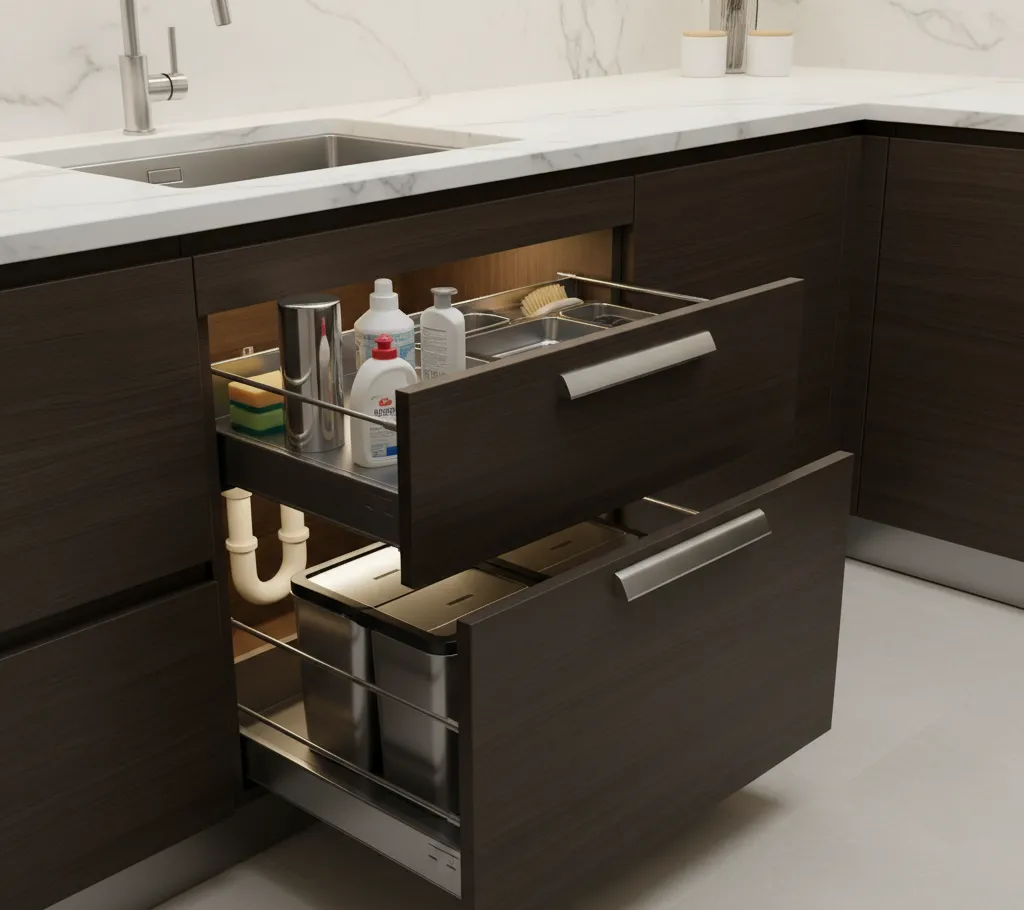
My Under-Sink Setup (The Paranoid Version)
I've seen too much. I know too much about what water does to plywood. I've pushed my thumb through rotting cabinet bases. I've smelled the musty pre-mould dampness. I'm traumatised and I've built my under-sink setup accordingly.
PVC mat on the base. ₹150. Non-negotiable.
Tension rod for spray bottles. ₹120. Four bottles hanging neatly.
One plastic bin for sponges and scrubbers. ₹80.
A rechargeable battery-operated moisture alarm - ₹450 from Amazon - sitting on the PVC mat in the back corner behind the pipes. If water touches it, it beeps. Loudly. At any hour. I will know about a leak the MOMENT it happens, not six months later when the plywood surrenders.
Total under-sink investment: ₹800. My wife says the moisture alarm is "excessive." I say my mummy's ₹3,500 repair bill was excessive. The alarm has never gone off. Which means either there are no leaks or the alarm doesn't work. I choose to believe the first option.
Every kitchen in my family now has a PVC mat. Three of four have tension rods. One has a moisture alarm. None have had a panel replacement since 2023.
Prevention is cheaper than repair. Always has been. Always will be.
More under-sink advice from someone who's been inside too many cabinets? KitchenKaki - where ₹150 solutions prevent ₹3,500 problems.
