
Best Countertop Materials for Indian Kitchen in 2026
Our countertop decision took three weeks, two showrooms, one family argument, and my mummy rejecting marble in three sentences. Here's every material we considered and what killed each one.
Best Countertop Materials for Indian Kitchen in 2026
When my parents renovated their kitchen in 2020, the countertop decision took longer than the entire cabinet selection. Cabinets - we picked BWR plywood, chose a colour, moved on. Took maybe two days. The countertop debate lasted three weeks, involved two showroom visits, one argument at the dinner table, my dad Googling things at midnight, and my mummy calling her friend in Vaishali Nagar four times to ask "what did you get again?"
The problem wasn't lack of options. It was too MANY options. Granite. Quartz. Marble. Corian. Nano white. Tiles. Kota stone. Each one sounded perfect in the showroom and had a fatal flaw that somebody in the family couldn't accept.
Here's how we went through every single material and what killed each one until we finally picked something and stuck with it. If you're in the middle of the same confusion right now, this might save you three weeks.
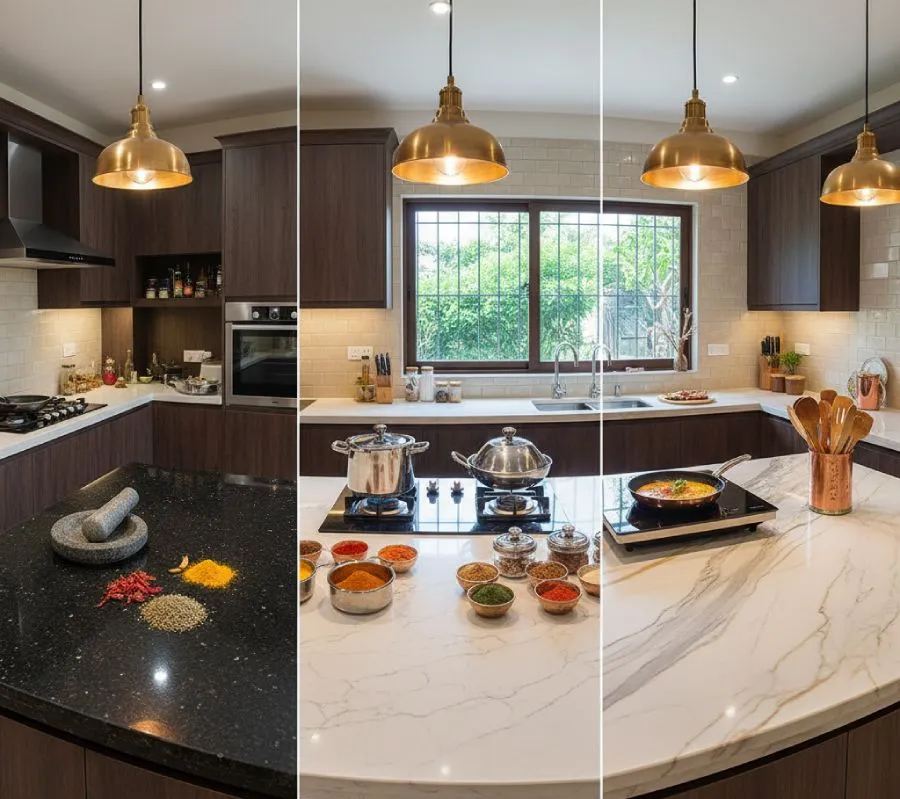
Kota Stone - Where Most Jaipur Kitchens Start and Most Should Leave
My mummy's old kitchen had kota stone. Twenty-two years. Cracked in two places near the sink. Dull grey surface that no amount of polishing could make look anything other than... institutional. Like a government office counter. It worked. But it looked like it was there because nobody bothered to choose something better.
Kota stone is cheap. Like, aggressively cheap. ₹25-40 per square foot. For a full kitchen counter you're spending maybe ₹2,000-3,000 total. And in Rajasthan, where kota stone comes from literally our own state, it's everywhere - every contractor knows it, every mason can lay it, and every budget kitchen defaults to it.
My mummy used kota stone because in 1998 that's what everyone used. But in 2020, when the kitchen was being rebuilt, she looked at the old cracked slab sitting in the demolition pile and said, "Not again." No explanation needed.
Kota stone is fine for flooring. It's fine for outdoor areas. For a kitchen counter in 2026 where you're spending ₹1.5-3.5 lakh on modular cabinets? It's like putting bicycle tyres on a car. Technically possible. Functionally absurd.
Marble - The Material My Dad Fell in Love With and My Mummy Killed in Three Sentences
My dad wanted marble. Of course he did. He'd seen Italian marble counters at his boss's house during a Diwali party and came home convinced that marble was the answer to everything. "It looks elegant," he kept saying. "Very classy."
My mummy's three sentences:
"Does your boss make chhonk in his kitchen? Does his wife grind masala on the counter? Does he know what haldi does to white stone?"
Silence from dad.
She was right. Marble is porous - more porous than granite. Haldi stains it. Lemon juice etches it - the acid literally dissolves the surface, creating dull spots that can't be polished out without professional help. Tomato sauce marks it. Vinegar marks it. Every single ingredient in Indian cooking is basically marble's enemy.
Marble also scratches if you look at it wrong. Our kitchen sees steel pressure cookers dragged across the surface. Tawas dropped on it. Heavy kadais placed and lifted daily. Marble would've looked like a crime scene within a month.
The one thing I'll say for marble - Makrana marble specifically, since that's also Rajasthani - is that it looks genuinely spectacular in a kitchen where cooking is light. Salads. Sandwiches. The occasional pasta. If you're a family that orders from Swiggy five days a week and makes maggi on the other two, marble might actually survive. But if you cook full Indian meals daily? Walk away. Run away.
Price: Makrana white starts at ₹250-400 per square foot. Italian marble - the stuff my dad was dreaming about - goes ₹800-1,500+. For a counter that will stain within weeks of heavy Indian cooking, that's not investment. That's donation.
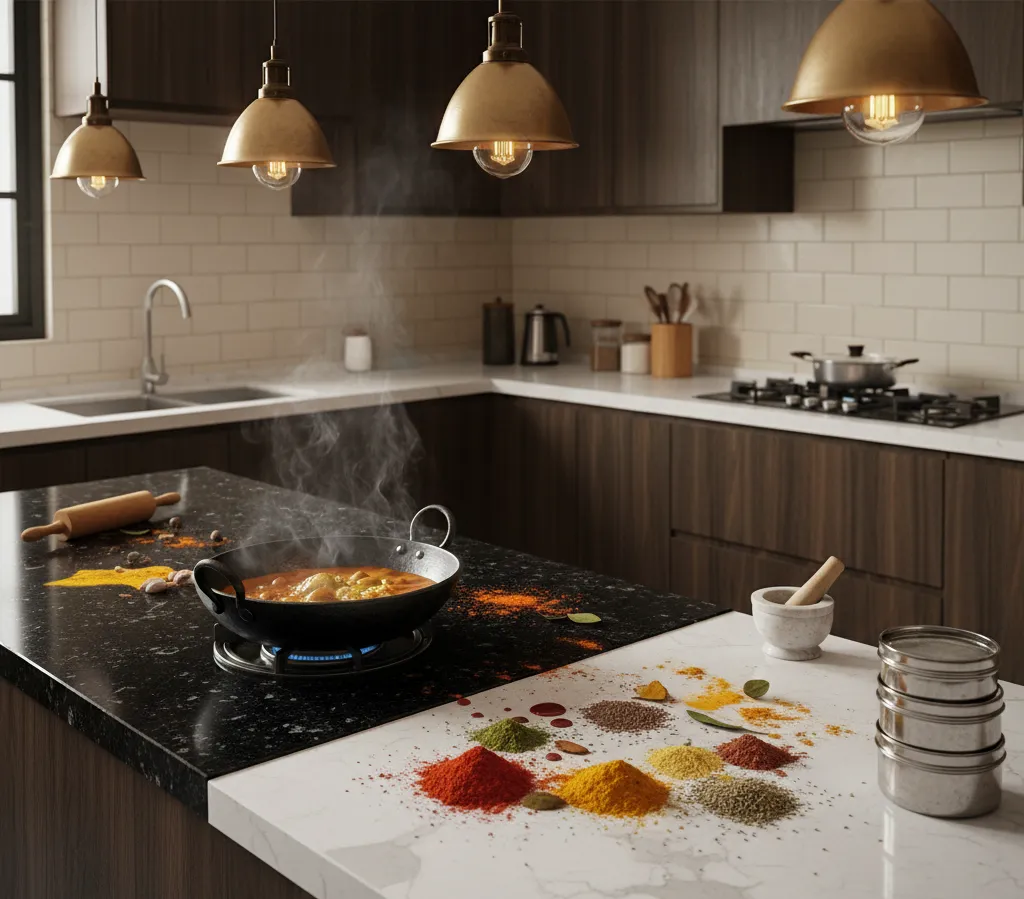
Corian - The Smooth Talker That Didn't Survive Cross-Examination
Somebody - I think it was my brother - mentioned Corian. "Seamless joints," he said. "You can mould it into curves. The sink can be integrated into the counter so there's no gap where dirt collects."
He'd been watching YouTube videos again. The integrated sink thing IS genuinely cool. Corian - technically called solid surface - is a blend of acrylic and mineral particles that comes in thick sheets. You heat it, bend it, shape it. Joints become invisible after bonding. It looks like one continuous piece of material flowing across your counter and down into the sink basin. Very modern. Very sleek.
We went to a showroom. Touched the sample. Smooth. Warm - unlike stone, which feels cold. Nice colour options. The salesman was excellent. Almost had us.
Then I asked: "What happens when you put a hot tawa on it?"
He paused. "We recommend using a trivet."
"What if you forget the trivet?"
Longer pause. "It can leave a mark."
I pressed harder. "Can it burn? Melt? Deform?"
He admitted - reluctantly, like a dentist telling you that you need a root canal - that Corian's heat resistance is lower than granite and quartz. Direct contact with cookware above 150°C can discolour or even blister the surface. In an Indian kitchen where hot metal hits the counter multiple times a day, that's a real problem.
Corian is also softer than stone. You can scratch it with a knife. You CAN sand out scratches - that's the repair advantage - but who's going to sand their countertop every few months? My mummy can barely be convinced to reseal granite. She's definitely not sanding Corian.
Price: ₹250-650 per square foot depending on brand. DuPont and Samsung are the premium ones. Installation requires specialists - not your regular granite guy. Total cost for a standard kitchen: ₹20,000-45,000. Not cheap. And for that money, you get a surface that can't handle a hot tawa.
We left the showroom. My mummy's verdict: "Bahut nakhre hain iska." Too high-maintenance.
Nano White - The Instagram Darling We Almost Bought
Nano white is everywhere on Instagram right now. Brilliant white. Mirror-smooth. Looks like marble but is actually an artificial stone imported mostly from China. Made using some kind of nano-crystallisation process that I Googled three times and still don't fully understand.
It's gorgeous. I'll admit that. The showroom sample was SO white and SO smooth that my mummy actually reached out and touched it with both hands like it was a baby. "This is beautiful," she said. First time she'd been genuinely excited during the entire countertop search.
Benefits are real - it's non-porous, so stains wipe off. It's reasonably tough. It comes in that pure white finish that natural marble can't match without veining.
But.
Heat resistance is questionable. Some nano white manufacturers claim it handles heat fine. Others quietly admit that sustained contact with very hot surfaces can cause discolouration. The material hasn't been around in Indian kitchens long enough for there to be reliable ten-year data. Everyone I talked to - the showroom guy, Mahesh bhai on Tonk Road, a contractor friend - said some version of "it's probably fine but we don't really know yet."
"Probably fine" is not what I want to hear about a surface that costs ₹350-450 per square foot and will have hot tawas landing on it daily.
Also - and this is niche but it bothered me - nano white is almost exclusively imported. If a slab cracks or chips during installation, getting a replacement match is harder than with locally available granite. The lead time can be weeks. Granite from Kishangarh? You can get a replacement slab the next day.
We came close to buying nano white. Really close. Mummy was emotionally attached by this point. But she ultimately chose practicality over beauty, which is the most mummy thing she's ever done.
Tiles - The Suggestion That Got Me Uninvited From the Decision
I made the mistake of suggesting kitchen counter tiles. Ceramic tiles on the counter surface. Like some older Indian kitchens used to have.
My mummy looked at me with an expression I usually see reserved for when I forget to take off my shoes at the door. "Tiles? On the counter? What is this, 1985?"
In my defence, some modern kitchens use large-format porcelain tiles as countertops and they look stunning. But the grout lines between tiles collect oil, masala residue, and grime. In an Indian kitchen, those grout lines become permanent yellow-brown stripes within months. No amount of scrubbing fixes grout once it's absorbed turmeric and oil simultaneously.
Large-format tiles reduce grout lines but don't eliminate them. And the edges around the sink and stove - where water and oil concentrate - are exactly where grout fails fastest.
Tiles on walls? Great. Tiles as a backsplash? Perfect. Tiles on the counter where you're kneading dough, rolling rotis, and grinding masala? No. Mummy was right. It IS 1985.
I stopped making suggestions after this.
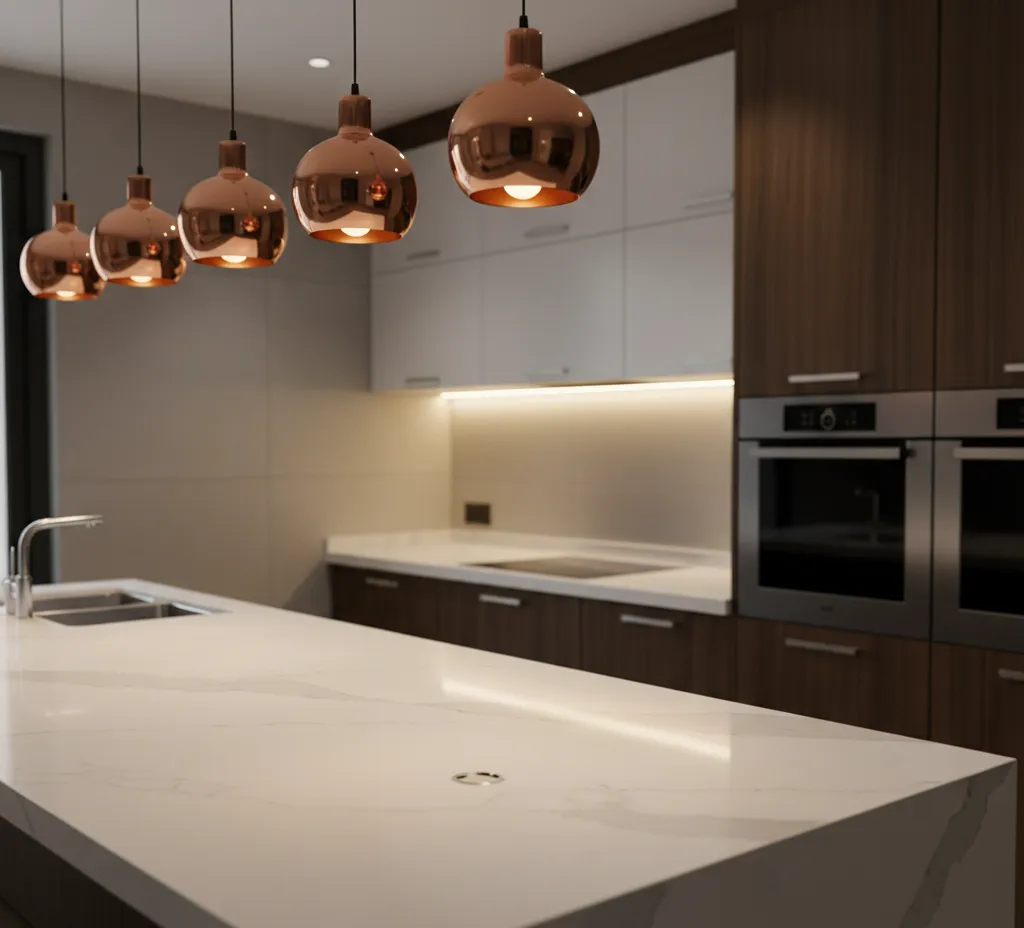
Where We Actually Landed
After three weeks, two showrooms, one dinner argument, and my tile humiliation - granite. Black granite. Absolute Black from Rajasthan. ₹120 per square foot. Total counter cost including cutting, polishing, and installation: about ₹9,000.
Not because granite is perfect. It's porous. It stains if you don't seal it. Light granites show every haldi mark. My mummy has a famous yellow stain from 2017 on her old lighter granite that still comes up at family dinners.
But dark granite - specifically Absolute Black - hides stains completely. It handles heat without flinching. A hot pressure cooker straight from the gas? Granite was literally formed inside the earth at temperatures that make your cooker look like a candle. It's available in Rajasthan - Kishangarh is 90 minutes from Jaipur. If a slab chips, replacement is a phone call and a day away. And at ₹9,000 for the whole counter, it left budget for the chimney, the hob, and the soft-close hinges that mummy wanted.
Six years later the counter is fine. Not stunning. Not Instagram-worthy. Not the kind of surface that makes guests touch it with both hands. Just fine. Doing its job. Taking abuse. Not complaining.
My bhabhi went quartz last year. Paid ₹28,000 for the same size counter. Her kitchen looks noticeably more modern. Stain resistance is genuinely superior - she leaves haldi sitting for hours and wipes it clean without a trace. But she keeps a trivet permanently next to the stove because one time she forgot and got a faint heat ring that she's never fully forgiven herself for.
If I were building a kitchen tomorrow with a comfortable budget? I'd do what Mahesh bhai - the Tonk Road countertop dealer - tells his own family. Granite near the stove. Quartz everywhere else. Two materials. Two zones. Best of both.
If I were building on a tight budget? Full black granite, sealed once at installation. ₹9,000. Done. Move on with your life.
The best countertop material isn't the fanciest one. It's the one that matches your cooking, your budget, and your willingness to maintain it. Everything else is showroom romance.
More kitchen material decisions made honest? KitchenKaki - we've touched every sample in every showroom so you don't have to.
