
PVC Kitchen Cabinets: Are They Worth It in 2026?
A full modular kitchen for ₹68,000. Sounds too good? My friend Deepak did it with PVC cabinets. Two years later, some things are perfect and some things are loosening. Here's the honest verdict.
PVC Kitchen Cabinets: Are They Worth It?
My friend Deepak has a PVC kitchen. Full PVC. Cabinets, shutters, everything. He got it installed in his rented 2BHK in Mansarovar about two years ago and paid ₹68,000 for the whole thing. Sixty-eight thousand. For a complete L-shaped modular kitchen with chimney and hob.
When he told me the price, I didn't believe him. I'd just finished helping my brother build a kitchen for ₹1.16 lakh and we'd cut corners to get there. Deepak spent almost half that. I had to see this kitchen for myself.
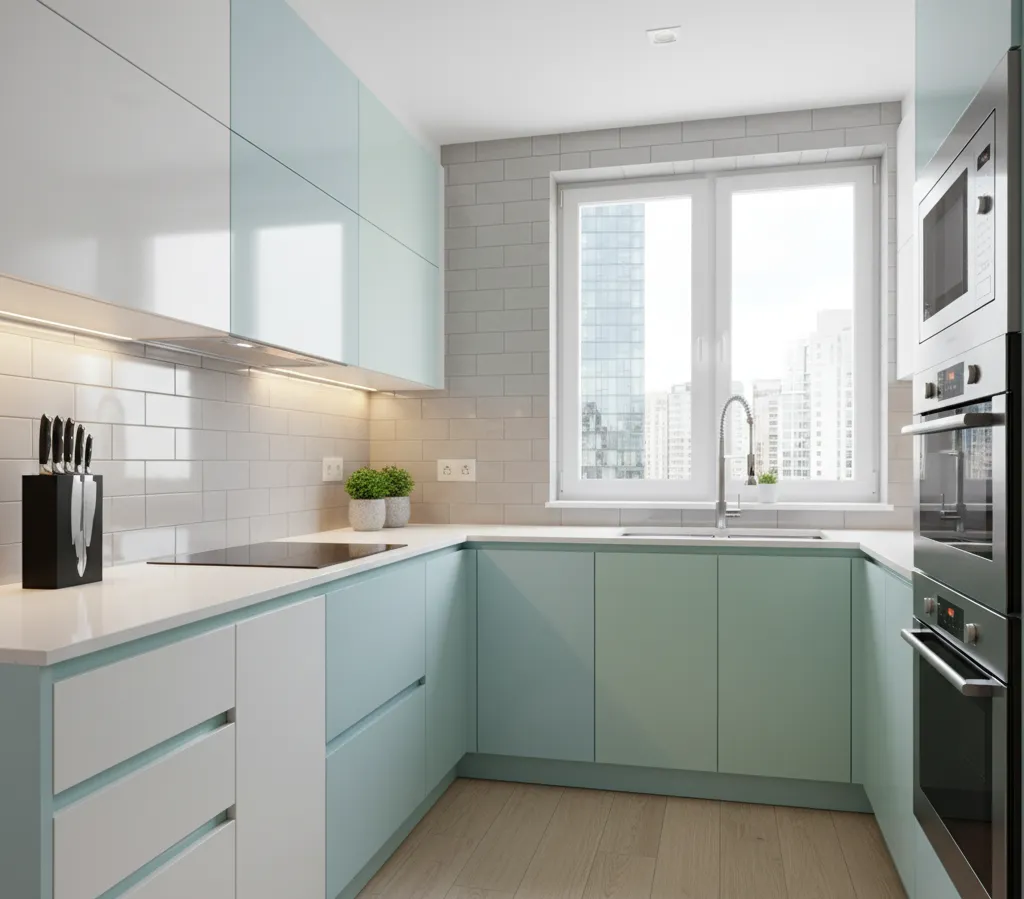
So I went over. And honestly? It looked fine. Clean white shutters. Neat layout. Everything aligned. If you walked in not knowing the material, you'd think it was a regular modular kitchen. Maybe slightly different in feel - the doors were lighter when you opened them, and the surface had a subtle plastic sheen that's hard to describe but you'd recognise it if you touched it back-to-back with laminate on plywood.
"Feels like plastic," I said.
"It IS plastic," Deepak said, completely unbothered. "That's the whole point."
He wasn't wrong. And after watching his kitchen for two years, and comparing it honestly with the plywood kitchens in my family, I've developed opinions about PVC that are more nuanced than "cheap material, avoid it" - which is what I assumed going in. The truth is messier than that.
What PVC Actually Is (Because Most People Get This Wrong)
I thought PVC kitchen meant regular PVC pipes somehow formed into cabinets. I was embarrassingly wrong. Deepak's designer had to explain this to me and I could tell he was trying not to laugh.
PVC kitchen boards come in two types. Foam boards - solid PVC with a dense foam core, usually 12-18mm thick. These feel substantial. You can drill into them, screw hinges, mount them on walls. They're the kind used in proper PVC modular kitchens. Then there's hollow boards - PVC sheets with air channels running inside, like corrugated cardboard made of plastic. These are lighter, cheaper, and considerably weaker. Most budget PVC kitchens use hollow boards for the carcass and foam boards only for the shutters, which is how Deepak's kitchen was built.
This distinction matters A LOT and nobody explains it upfront. When a kitchen company quotes you ₹60,000-70,000 for a "PVC kitchen," you need to ask: foam board carcass or hollow board carcass? Because a hollow board cabinet holding a 5-litre pressure cooker is a different engineering situation than a foam board cabinet holding the same cooker. One will handle it. The other might not in two years.
Deepak's base cabinets are foam board. His wall cabinets are hollow. He stores heavy stuff - cookers, kadais, the big biryani handi - in the base cabinets only. The wall cabinets hold masala jars, steel glasses, light containers. He figured this out instinctively because the first time he put a heavy steel container on a hollow-board wall shelf, he heard a faint creak and immediately moved it. Smart man.
The Two Things PVC Does Better Than Anything Else
I'll give PVC full credit on two things. Because they're genuine advantages, not marketing fluff.
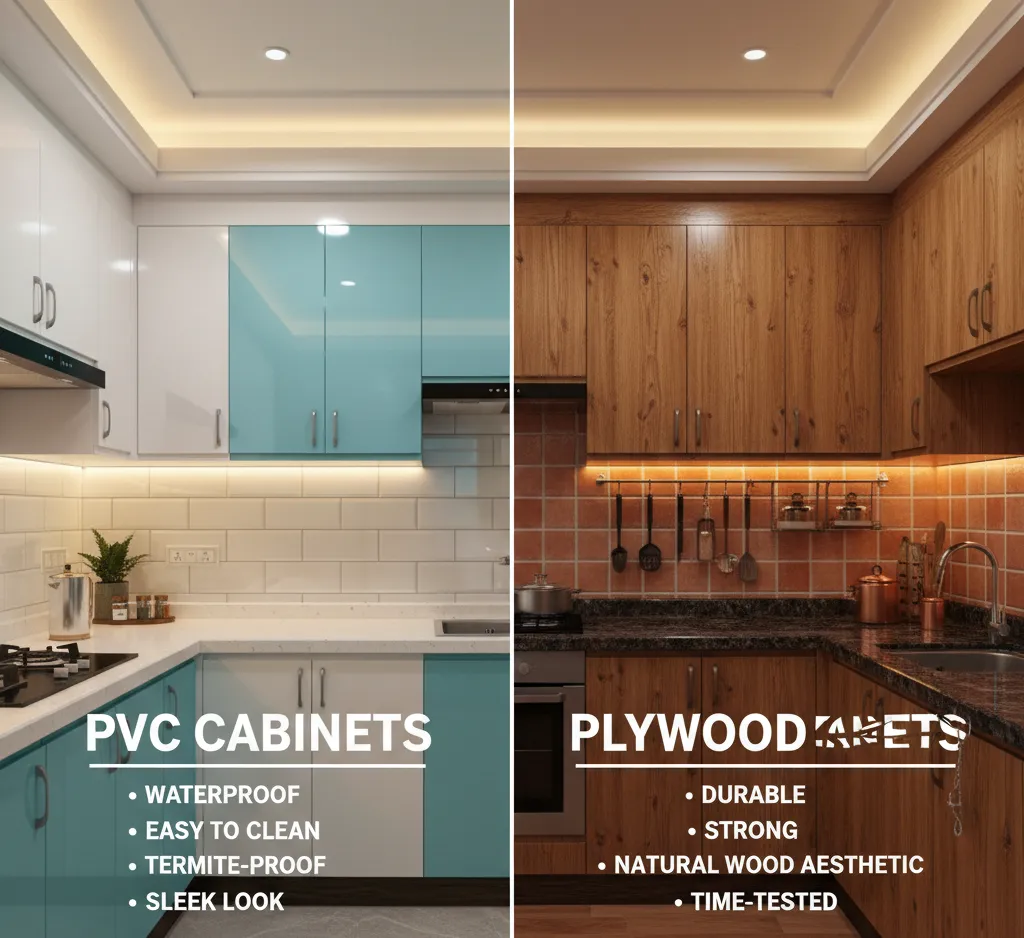
Water does absolutely nothing to it. Nothing. Deepak's under-sink cabinet has had slow drips, direct splashes, and two years of daily dishwashing moisture. The cabinet base looks exactly like it did on installation day. No swelling. No warping. No discolouration. No smell. Nothing. I pushed my thumb into the base panel - the same test that went through my mummy's old plywood base like cardboard - and it was completely solid.
I thought about my cousin Rohit's particle board cabinet that swelled after two monsoons. About my mummy's old plywood base that rotted from a slow drip nobody noticed. About the PVC mat I put inside her new kitchen's under-sink cabinet as a preventive measure. Deepak doesn't need a PVC mat. His entire cabinet IS PVC. The irony wasn't lost on me.
Termites are also completely irrelevant. PVC is plastic. Termites eat cellulose - wood fibre. There is no cellulose in PVC. Zero. My uncle lost ₹38,000 to termites eating his plywood kitchen. Deepak's kitchen could sit in a termite colony and emerge untouched. In Jaipur, where I've watched termites destroy bookshelves, window frames, shoe racks, and an entire kitchen in my own family - this isn't a small thing. It's a very big thing that I didn't appreciate until I'd personally dealt with the alternative.
Now the Problems (And Deepak Admits These Too)
Month four. Deepak was frying pakoras. Oil splatter hit the base cabinet next to the hob. He wiped it immediately. But the next morning he noticed a faint mark on the shutter surface - not a burn exactly, but a slight texture change. Like the PVC surface had softened momentarily from the heat and then re-hardened with a slightly different finish.
PVC softens at around 75-80°C. A gas burner's ambient heat in the immediate vicinity can get close to that. Plywood and HDHMR don't care about heat at this level. But PVC reacts. Deepak now keeps a thin aluminium sheet between the hob and the adjacent cabinet. ₹200 solution. But the fact that he NEEDS a heat shield tells you something about PVC's thermal limitations.
Screws loosen. This is the one that worries me most about PVC's long-term durability. Deepak's cabinet hinges are all screwed into PVC foam board. Foam board holds screws - but not as firmly as plywood. The screw bites into compressed plastic foam instead of layered wood. Over time, with daily opening and closing, the screw hole can gradually widen in PVC in a way it doesn't in plywood.
One of Deepak's base cabinet doors - the most-used one, under the stove where he keeps tawas - has started feeling slightly loose at the top hinge. Not falling off. Not drooping. Just... a tiny bit of play when you swing the door that wasn't there a year ago. In plywood, I've seen hinges hold tight for 6+ years in my mummy's kitchen. In PVC, Deepak is seeing early looseness at 20 months.
His carpenter said he can re-drill the screw into a slightly different spot and it'll hold again. Fair enough. But this is a maintenance reality that plywood kitchens don't have at 20 months. And over 5-10 years, with 25+ hinges all gradually loosening? That's a lot of re-drilling.
The white is yellowing. Just slightly. Deepak's white PVC shutters have developed a very faint cream tint compared to a new PVC sample I held up against them. You wouldn't notice unless you were looking for it - which of course I was, because I'm that person. Deepak hadn't noticed until I pointed it out. He shrugged. "It's been two years in a kitchen with turmeric and oil fumes. What do you expect?"
Fair point. But my bhabhi's white quartz countertop hasn't yellowed at all. And my brother's laminate shutters in grey-green look identical to day one. PVC's UV and heat sensitivity means white and light colours will shift over time. Darker PVC colours apparently resist this better but I haven't seen enough dark PVC kitchens to confirm.
The Question Nobody Asks: How Long Is This Kitchen Supposed to Last?
This is where the whole PVC conversation changes depending on who you're talking to.
My mummy's plywood kitchen is designed to last 15-20 years. She expects to cook in it until she physically can't anymore. Every material choice - BWR plywood, quartz countertop, Hettich ↗ hinges - was made with longevity in mind. Her kitchen was an investment. ₹3.5 lakh for two decades of daily use.
Deepak's PVC kitchen is designed to last... well, he doesn't know. And he doesn't particularly care. He's renting. He'll probably move in 3-4 years. Maybe less. He needed a functional kitchen NOW, at a price that didn't hurt, made from materials that wouldn't get eaten by termites or ruined by Jaipur's hard water in the meantime.
₹68,000 for 3-4 years of use. That's about ₹1,400-1,900 per month. Less than what some families spend on eating out in a week. If a hinge loosens, he'll tighten it. If a shelf sags, he'll reinforce it. If the whole thing falls apart in year five - he'll probably have moved by then anyway.
For renters, for temporary housing, for bachelor apartments, for PG accommodations, for first kitchens on a tight budget - PVC makes financial sense that I can't argue with even though I'm a plywood person at heart.
For owned homes where you're planning to live for 10+ years? Where the kitchen needs to survive two decades of daily Indian cooking? PVC's hinge loosening, heat sensitivity, and general structural limitations make it a risky long-term bet. At that timescale, BWR plywood's extra cost pays for itself in durability.
What Deepak Would Change
I asked him last month. He thought about it for maybe five seconds - he's not the overthinking type, unlike some people in this blog's universe - and said two things.
"I'd get foam board everywhere instead of hollow board for the wall cabinets. They creak when I accidentally put something heavy on a shelf and it freaks me out."
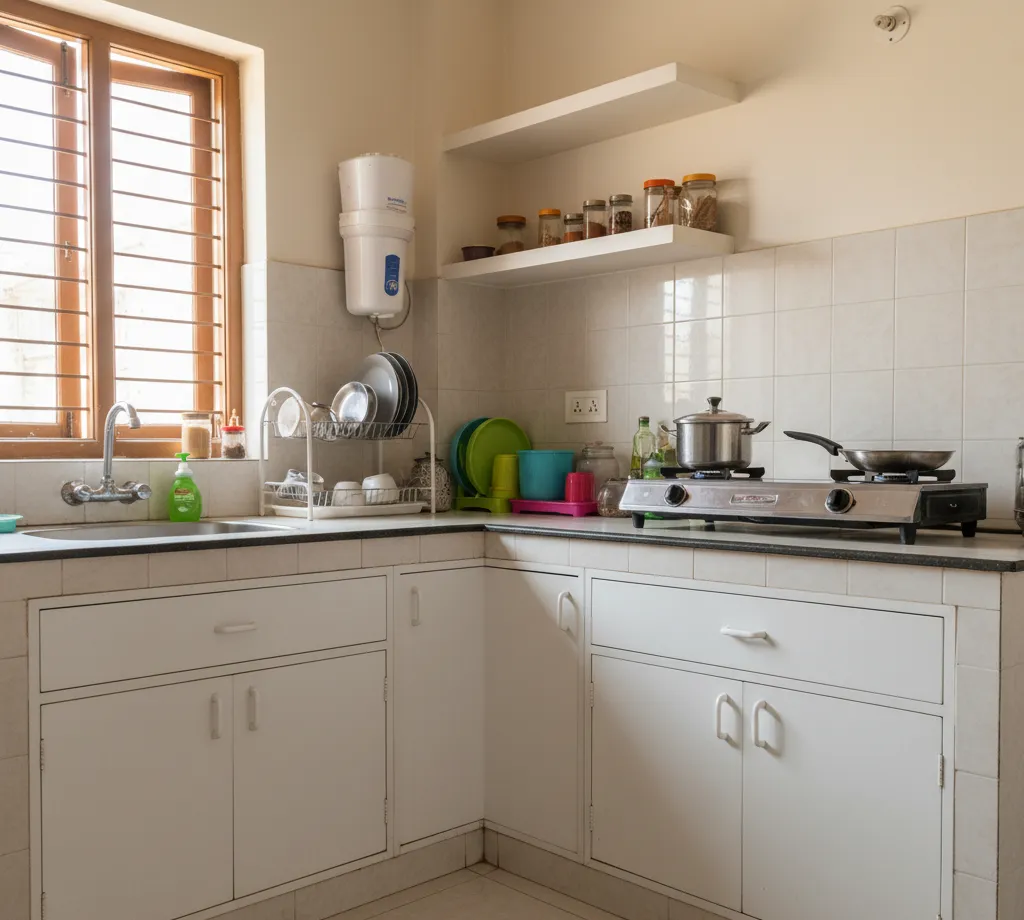
"And I'd get a darker colour. The white was a mistake. Not because it's yellowing - I don't care about that. Because haldi shows up on white PVC like a crime scene. I wipe it off but the two seconds between the splatter and the wipe, my whole kitchen looks like a turmeric factory."
He didn't say he'd switch to plywood. He didn't say he regretted PVC. He just wanted better PVC. Which honestly, tells you everything about where this material sits - it works, but it works within limits. Know the limits, work within them, and your ₹68,000 kitchen does its job without drama.
Expect it to be plywood and you'll be disappointed. Expect it to be a practical, affordable, waterproof, termite-proof kitchen that lasts you 5-7 years with minor maintenance? Then yeah. It's worth it.
More honest material comparisons for Indian kitchens? KitchenKaki - we test everything against daily dal and haldi. Not lab conditions.
