
Granite vs Quartz Countertop: Which One Should You Choose?
Mahesh bhai has sold countertops for fifteen years. He keeps a drawer of customer samples with stains and heat damage. Here's what he actually tells people off the record — and what he recommends to his own family.
Granite vs Quartz Countertop: Which One Should You Choose?
There's a countertop shop on Tonk Road that I've been visiting for three years now. Not because I keep buying countertops. Because the owner - Mahesh bhai - is the most honest building materials dealer I've ever met, and every time I go there I learn something that no kitchen blog has ever told me.
Last month I sat with him for about an hour. Had chai. Watched customers come and go. Listened to him explain the same granite-versus-quartz question to four different people in four completely different ways, depending on what he knew about their cooking habits, their budget, and - this is the part I found fascinating - how much maintenance he thought they'd realistically do.
One lady wanted white marble. He talked her out of it in under three minutes. "Aapki kitchen mein haldi hai ki nahi?" She nodded. "Toh marble bhool jaiye." Forget marble.
Another couple wanted the cheapest granite available. He showed it to them but also showed them the sealing it would need. The husband looked at the wife. The wife said, "We're not going to seal anything." Mahesh bhai nodded and said, "Then get a dark colour. At least the stains won't show."
That kind of honesty is rare. Most salespeople tell you what you want to hear. Mahesh bhai tells you what the stone will do in YOUR kitchen based on YOUR behaviour. Here's everything I learned from him across multiple visits, arranged not as granite-vs-quartz but as the problems he actually deals with.
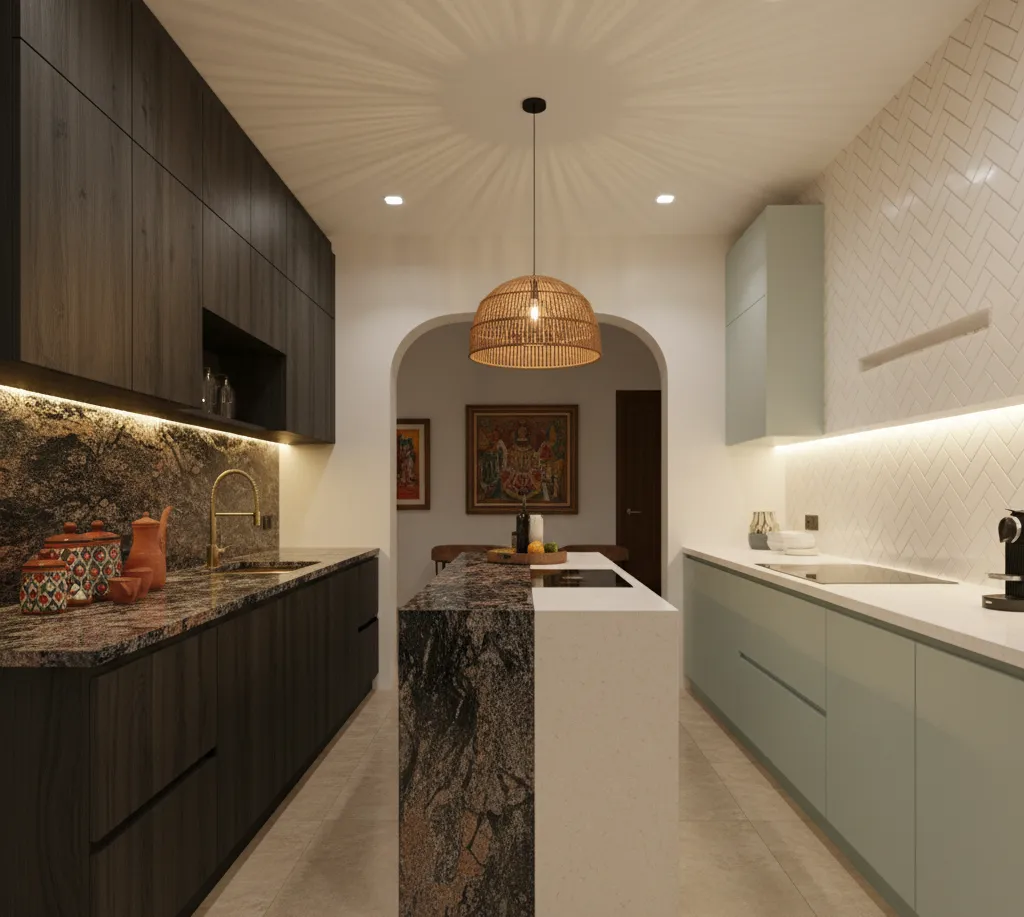
"Ninety Percent of Granite Complaints Are About Staining"
Mahesh bhai keeps a drawer behind his counter with samples that customers have brought back. Not for returns - you can't return a cut countertop - but to show him the problem they're facing and ask for solutions.
He pulled out a piece of light grey granite with a distinct yellow splotch. "Haldi. Three months old. Client put turmeric paste on the counter while grinding masala, forgot about it for an hour, came back and it had soaked in. Now it won't come out."
Another sample - a beige granite with a dark ring near one edge. "Hot oil. Client put a kadai with oil residue on the bottom directly on the counter. The oil seeped into the pores over repeated contact. Same spot, every day, for months."
And a white granite with a pinkish tint in one area. "Beetroot juice. Cut beetroot, juice ran across the counter, nobody wiped it for twenty minutes. Done."
"Granite is porous," he said, in the tone of someone who's said this sentence approximately ten thousand times. "It has tiny holes you can't see. Liquids go in. Colour stays. If you seal it, the pores close temporarily. But you have to reseal every 1-2 years. How many of my customers reseal?" He held up his hand in a zero. "This many."
He estimates maybe 5% of his granite customers ever reseal their countertops. The other 95% install, cook, and wonder why their counter looks patchy after three years. The stone hasn't degraded. The surface just absorbed a decade of spills, one microscopic drop at a time.
His advice for people who won't seal - and he asks this directly, "Will you reseal every two years? Honestly?" - is always the same. Go dark. Absolute Black. Dark brown. Deep green. On dark granite, stains are invisible. Not absent. Invisible. The turmeric is still IN the stone. You just can't see it. For most Indian families, invisible stains are functionally the same as no stains.
"Quartz Complaints Are Always About Heat"
He opened a different drawer. Smaller collection. Quartz samples with problems.
A white quartz piece with a faint brown ring. "Pressure cooker bottom. Client took it straight off the gas, placed it on the quartz. The resin in the quartz discoloured from the contact heat. Maybe 200-250 degrees."
Another quartz sample with a cloudy patch. "Hot tawa. Same thing. Direct heat contact for maybe thirty seconds. Resin changed colour underneath the surface."
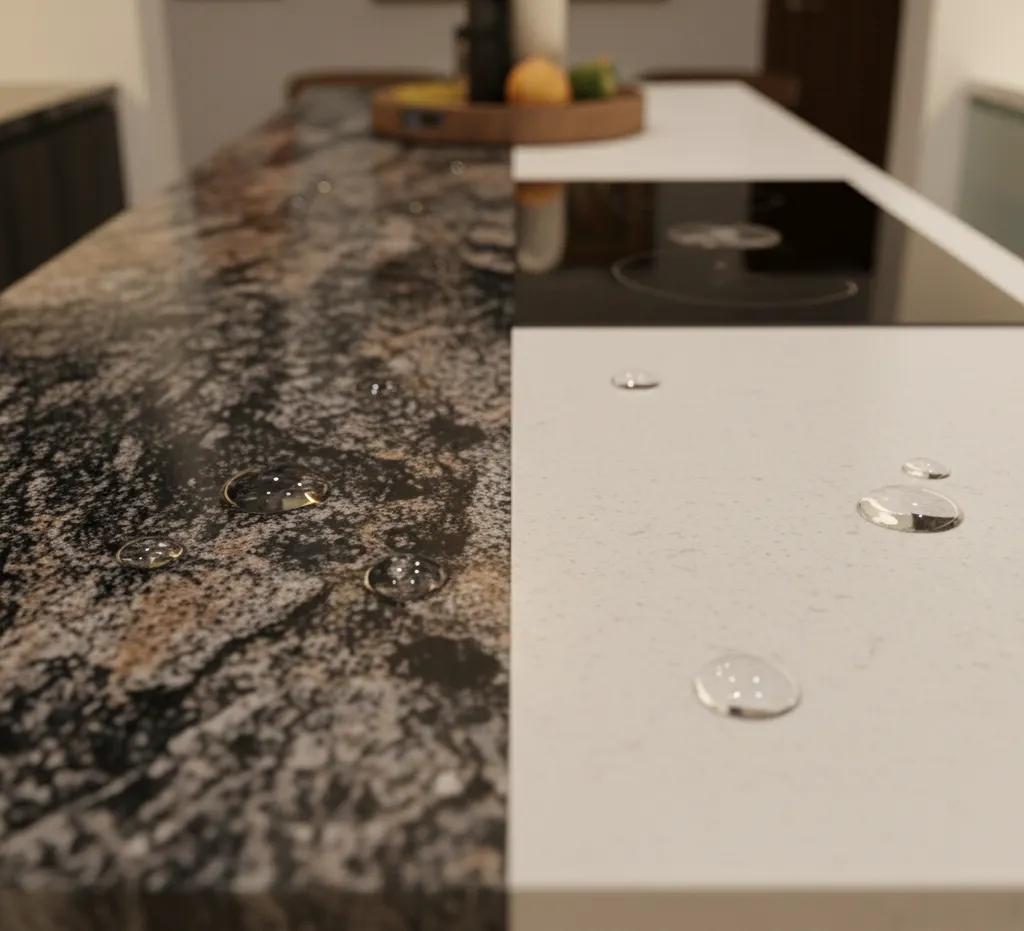
"Quartz doesn't stain," he said. "I can pour haldi paste on it, leave it for a full day, wipe it off, nothing. Not a trace. Lemon juice, beetroot, tomato - nothing penetrates. It's non-porous. Factory-sealed from manufacturing. No resealing needed ever. For STAINS, quartz is perfect."
Then he leaned forward.
"But for HEAT? Granite doesn't care. You can put lava on granite. It came FROM lava. It's been through worse. Quartz has resin holding it together. Resin doesn't like heat above 150-180 degrees. A hot pan at 250 degrees? Granite shrugs. Quartz flinches."
That's the fundamental tradeoff. He's been explaining this to customers for fifteen years and says most people don't understand it until they see the samples in the drawer. Stains versus heat. Pick your battle.
The Slab Surprise Nobody Warns You About
This one I hadn't heard before Mahesh bhai told me, and it's specifically about granite.
Granite is a natural stone. Every slab is different. The sample piece you see at the showroom - maybe a 6-by-6-inch square - represents that ONE part of that ONE slab. Your actual countertop comes from a different section of a different slab, possibly from a different batch quarried at a different time.
Mahesh bhai showed me two pieces of Kashmir White granite side by side. Same name. Same quarry origin. One had a pinkish undertone. The other was almost pure grey-white. Both are legitimately called Kashmir White.
"Clients pick Kashmir White from the sample. I cut their counter from the available slab. They come to the shop and say 'this doesn't match the sample.' Of course it doesn't. It's NATURAL stone. It's not manufactured in a factory. Every piece is different."
He says this causes more disappointment than actual defects. People fall in love with a sample and expect the installed counter to look identical. It rarely does. The veining might run differently. The speckles might be denser or sparser. A dark streak might appear in one section that wasn't visible in the sample.
Quartz doesn't have this problem. Because it's manufactured - crushed quartz mixed with resin, pressed into slabs under controlled conditions - every slab of the same design looks essentially identical. The Calacatta pattern you picked at the showroom? That's what you get at home. No surprises. No colour shifts. No sudden dark streaks.
For people who need predictability - who chose a specific counter colour to match their backsplash tile and cabinet shade - quartz offers certainty that granite fundamentally cannot.
For people who like natural variation and don't mind a bit of unpredictability - "It's what makes it real," Mahesh bhai says - granite's uniqueness is actually the appeal.
What He Tells People Off the Record
I asked Mahesh bhai what he tells family members. Not customers. Family. People whose kitchens he actually cares about lasting twenty years.
He thought about it for a few seconds. Then:
"Base counter ke paas - jahan gas hai, jahan hot vessels rakhte hain - granite. Always. Black granite. Don't overthink it. It handles heat, it's cheap, and if haldi stains it you won't see it anyway."
Translation: Near the stove where hot vessels land - granite. Always. Black.
"Baaki jagah - prep area, serving area, breakfast counter - quartz. Light colour, clean look, no maintenance, no staining."
Translation: Everywhere else - quartz.
"Agar pura kitchen ek hi material mein karna hai and budget tight hai - full granite, dark colour, seal it once at installation."
Translation: If you're doing one material everywhere on a tight budget - full dark granite, sealed once.
"Agar pura kitchen ek hi material mein karna hai and budget comfortable hai - full quartz, but rakh trivet stove ke paas. Permanently."
Translation: If budget allows one material everywhere - full quartz, but keep a trivet permanently near the stove.
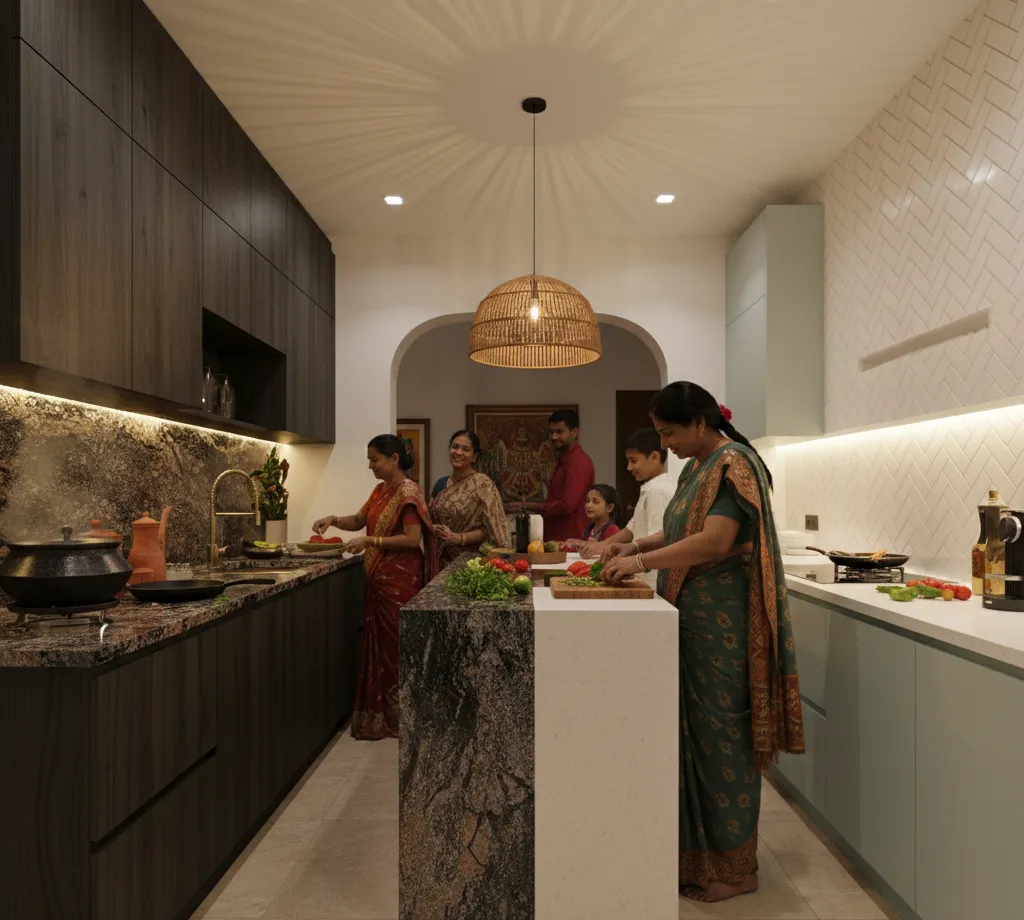
He says most people making the decision get stuck comparing granite and quartz as if they have to pick a winner. They don't. "Kitchen mein do zones hain," he said. "Ek hot zone, ek cold zone. Dono ke liye alag material lelo. Problem solved."
Two zones. Two materials. Problem solved.
I asked him how many customers actually do the split approach. He smiled. "Maybe ten percent. The rest want one clean surface across the whole counter. It looks better. I understand. But then they come back with either a haldi stain or a heat ring, depending on which material they picked."
The Price Conversation
Mahesh bhai's pricing - and he says this is representative of most Jaipur dealers - runs like this.
Indian granite ranges from ₹60 per square foot for basic grey or brown varieties to about ₹400 for premium imported patterns. The most popular choice for kitchens in Jaipur? Absolute Black. About ₹100-140 per square foot. A standard L-shaped counter needs roughly 25-35 square feet of slab. So the granite itself costs ₹2,500-5,000. Add cutting, edge polishing, sink cutout, and installation - total lands around ₹8,000-12,000. That's the whole counter.
Quartz starts at about ₹250 per square foot for basic Indian brands and goes up to ₹600+ for premium patterns from brands like Caesarstone or Kalinga Stone. Same L-shaped counter in mid-range quartz: slab cost ₹7,000-12,000. With fabrication and installation: total ₹18,000-28,000.
So quartz costs roughly double what dark Indian granite costs. For a family spending ₹1.5 lakh on their kitchen total, that price difference is the gap between having a chimney and not having a chimney. For a family spending ₹3.5 lakh, it's a manageable upgrade.
Mahesh bhai sells more granite than quartz. "India is still a granite country," he said. "Eight out of ten kitchens I supply are granite. The quartz customers are mostly younger couples building their first home. They've seen quartz on Instagram and they want that clean white-marble look without the marble maintenance. I don't blame them. Quartz IS easier to live with. It's just not cheaper to buy."
The One Thing He Wishes Every Customer Knew
I asked this at the end of our conversation. One thing. If he could tell every person walking in to buy a countertop.
"Get a piece of the actual slab you're buying - not the sample, the SLAB - and test it at home before installation. Put haldi on it. Put oil on it. Put a hot cup of chai on it. Wait an hour. Wipe it clean. See what happened. If you can live with the result, buy it. If you can't, try a different material or a different colour."
He says almost nobody does this. They pick from a sample, sign the quote, and discover the material's behaviour AFTER it's installed in their kitchen. By then it's too late.
"Slab kaatne ke baad return nahi hota," he said. Cut slabs don't come back.
Test first. Decide later. It's the simplest advice and the most ignored.
More countertop advice from people who actually work with stone? KitchenKaki - honest kitchen talk, no polish.
