
Plywood vs MDF vs HDHMR: Best Material for Kitchen Cabinets
A carpenter told me he'd never put MDF in a kitchen. A showroom owner dipped three board samples in water to prove why. Here's what I learned about plywood, MDF, and HDHMR after a Saturday I'll never get back.
Plywood vs MDF vs HDHMR: Which Is Best for Kitchen Cabinets?
A carpenter named Suresh ji told me something last year that changed how I think about kitchen cabinets. He was fixing a shelf in my chachi's house - different job, nothing to do with kitchens - and we started talking. I asked him what material he'd use if he were building his OWN kitchen today. Not for a client. For himself.
He put down his drill. Looked at me. And said, "Main toh plywood hi lagaunga. Lekin client ko budget kam ho toh HDHMR bol deta hoon. MDF toh kitchen mein kabhi nahi."
Translation: "I'd use plywood. But if the client has a tight budget, I suggest HDHMR. MDF in a kitchen? Never."
Then he told me a story about an MDF base cabinet he'd installed three years ago that had swollen so badly the client thought there'd been a water leak. There was no leak. Just three monsoons' worth of kitchen humidity doing what humidity does to MDF. "It looked like a sponge that forgot to stop absorbing," he said.
That conversation sent me down a rabbit hole. I visited two showrooms, badgered three kitchen designers, ruined a perfectly good Saturday watching plywood and HDHMR testing videos on YouTube, and eventually came out the other side understanding things about wood fibre density that no normal human being should know. Here's what I found - told in a way that doesn't require an engineering degree.
The Showroom Experiment I Talked Them Into
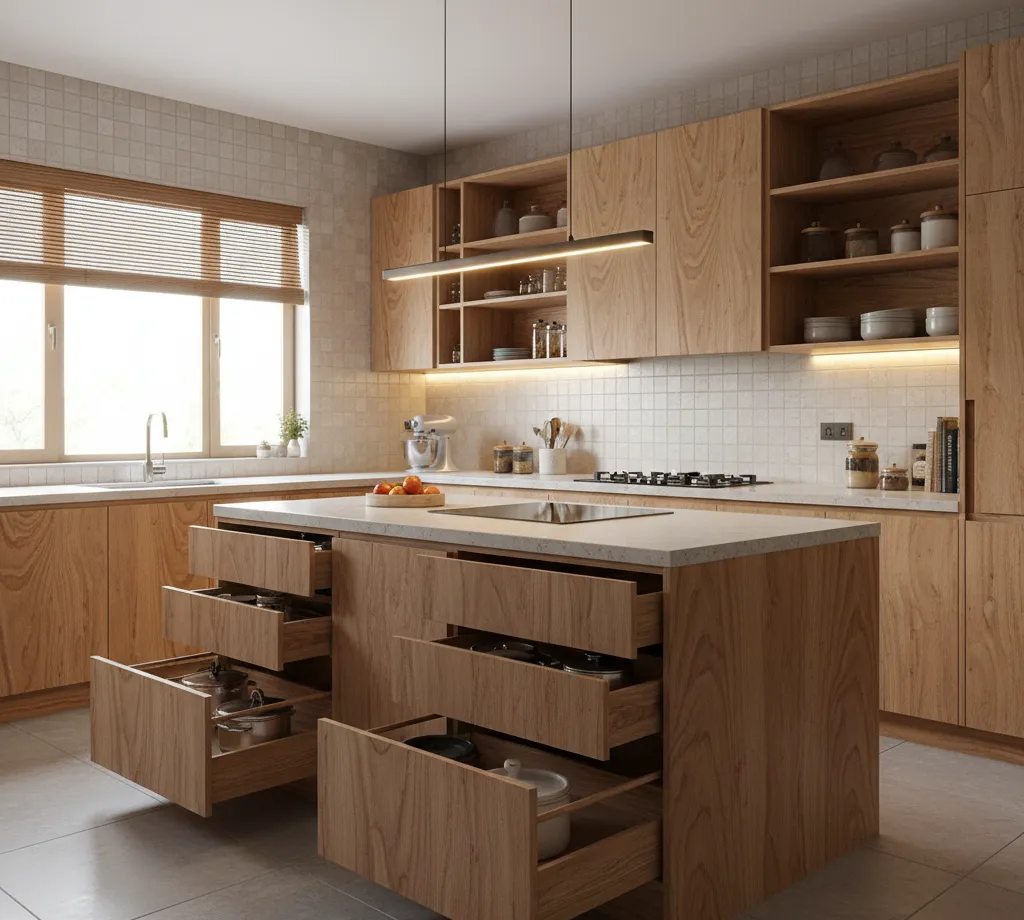
Second showroom I visited - Ajmer Road, the same one where my brother got his kitchen - I asked the owner if I could see the actual boards. Not the finished cabinets. The raw boards. The stuff that goes INSIDE the laminate face that you never see once the kitchen is installed.
He pulled out three samples. Stacked them on the counter. Let me hold them.
The MDF sample was light. Weirdly light for its size. Smooth on both faces - like touching a sheet of thick cardboard that had been ironed. The edge was uniform, almost creamy in colour, no visible grain or layers. When I pressed my thumbnail into the edge, it left a small dent. Not deep, but noticeable. The fibres compressed under pressure without much resistance.
I asked: "What happens when this gets wet?" He took a small piece of scrap MDF, dipped the corner in a glass of water on his desk, and left it sitting there. We continued talking. Fifteen minutes later he pulled it out. The dipped corner had swollen visibly - maybe 2-3mm thicker than the dry part. The surface had gone from smooth to slightly fuzzy. The fibres had puffed up like they were trying to return to being sawdust.
"Ab socho kitchen mein kya hoga," he said. "Imagine what happens in a kitchen." Three years of steam, sink splashes, monsoon humidity. Every microscopic gap in the laminate or edge banding lets moisture creep in. And once MDF gets wet from the inside, the swelling is irreversible. You can't dry it back to shape. It's done.
The BWR plywood sample was heavier. Noticeably. You could see the layers on the edge - alternating sheets of wood veneer glued at 90-degree angles to each other. That cross-grain construction is what gives plywood its strength. One layer resists pulling in one direction; the next layer resists in the perpendicular direction. Together they create something surprisingly tough.
He did the same water test. Dipped a scrap corner. Fifteen minutes. Pulled it out. The plywood was barely affected. Maybe a slight darkening of the edge where water had contacted the outer veneer. No swelling. No puffing. The cross-lamination and phenol formaldehyde resin in BWR grade created a barrier that the water couldn't easily penetrate in that timeframe.
"Six months in a kitchen, even BWR will show some wear if the edge banding fails," he admitted. "But it takes YEARS to fail. MDF? Months."
The HDHMR sample was somewhere in between. Weight similar to plywood. Surface smoother than plywood - almost as smooth as MDF actually. Edge colour was a deep brownish tone, much denser-looking than MDF's pale cream. When I pressed my thumbnail into it - nothing. No dent. The density was high enough to resist fingernail pressure completely.
Water test. Dipped corner. Fifteen minutes. Pulled it out. Very slight colour change at the dipped edge. No measurable swelling. The showroom owner said HDHMR is made from wood fibres compressed at extremely high pressure with moisture-resistant resin - which is why "High Moisture Resistance" is literally in the name.
"HDHMR ka fayda yeh hai ki yeh plywood jaisa strong hai aur MDF jaisa smooth," he said. "Iske upar laminate chipkana bahut aasan hai." Translation: HDHMR's advantage is that it's strong like plywood but smooth like MDF. Sticking laminate on it is very easy.
That smoothness matters because laminate adhesion is stronger on flat, uniform surfaces. Plywood has a slightly uneven surface due to the veneer layers and occasional knots. MDF and HDHMR are manufactured surfaces - perfectly flat. So laminate bonds more completely to them, reducing the risk of edge lifting over time.
Where Each One Actually Belongs in a Kitchen
After the showroom visit and approximately forty YouTube videos later, I've formed opinions. Strong ones. My wife says "too strong" but she also hasn't spent a Saturday watching MDF swell in real-time so she doesn't understand.
MDF has exactly ONE job in a kitchen - shutter faces. The visible doors and drawer fronts. MDF's smooth surface takes laminate beautifully, holds paint perfectly, and can even be CNC-routed for decorative patterns. Those shaker-style kitchen doors you see in European photos? Routed MDF. You can't route plywood - the grain tears. You can't route HDHMR as cleanly - it's too dense and tends to chip.
But MDF as a carcass - the box that actually holds your pressure cookers and masala jars? Absolutely not. Not for base cabinets. Not for wall cabinets near the stove where steam rises constantly. Not for the under-sink zone where water exposure is a daily reality. MDF as a structural material in an Indian kitchen is a countdown to swelling. Suresh ji has replaced more MDF base cabinets than he can count. "Sab same story hai - two-three saal mein phool jaata hai." Everyone has the same story - it swells in two to three years.
BWR plywood is the reliable workhorse. Base cabinets, especially near the sink and under the stove area, should ideally be BWR. Its cross-laminated construction gives it structural strength that compressed fibre boards can't match under heavy loads. Your 5-litre pressure cooker sitting on a shelf? Plywood handles that weight without sagging over years. HDHMR handles it too - but plywood's natural resilience under sustained heavy loads is slightly better because the wood veneers flex rather than compress.
HDHMR is the smart middle ground. Wall cabinets - the ones that hold lighter items like masala jars, steel containers, glasses - don't need the heavy-duty strength of plywood. HDHMR works perfectly here. Lighter than plywood (easier on wall anchors and mounting brackets), smoother (better laminate adhesion), cheaper by about ₹15-25 per square foot, and resistant enough to handle kitchen humidity from its position above counter height where direct water splashes don't reach.
The Split That Every Smart Kitchen Designer Recommends
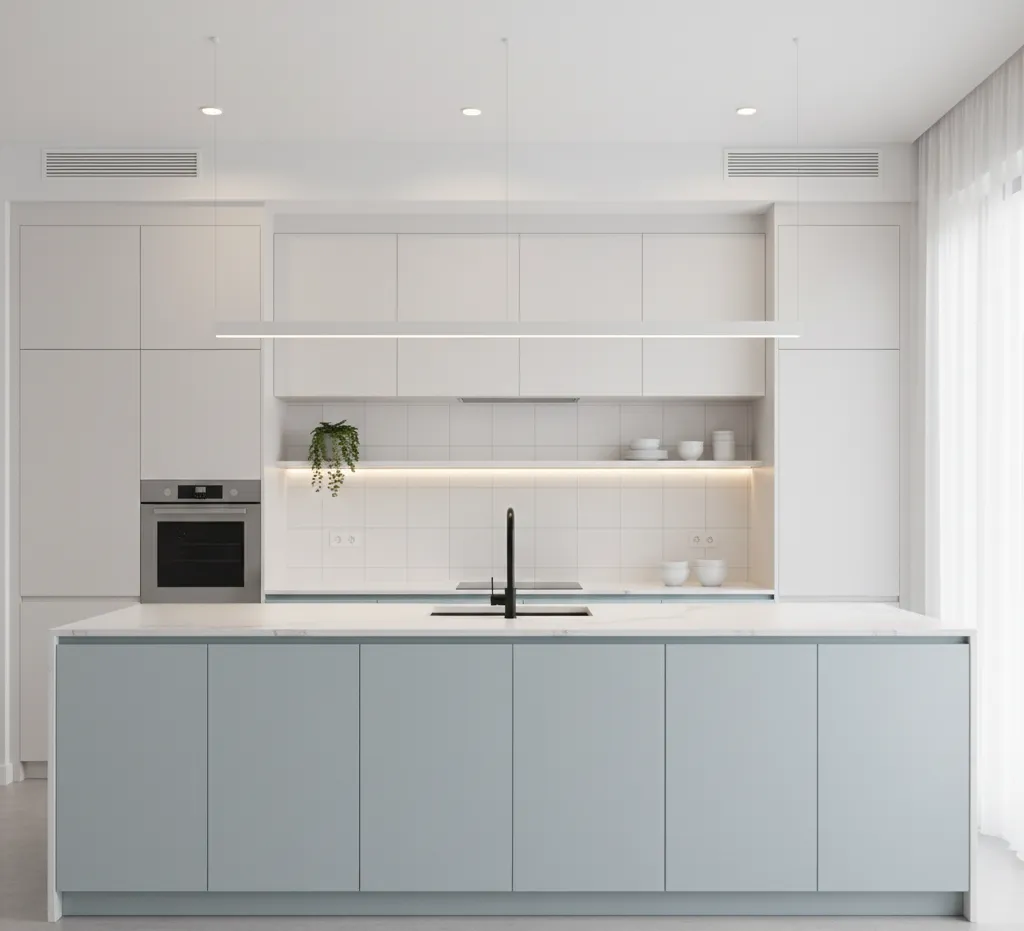
Bhabhi's designer did this instinctively last year and I've since seen the same approach recommended by three different kitchen companies.
BWR plywood for base cabinets. HDHMR for wall cabinets. MDF only for shutter faces if you want a routed design.
Marine-grade BWP plywood for the single base cabinet under the sink - the wettest spot in any kitchen, where plumbing joints can leak slowly and nobody notices until the panel is mush.
This split approach costs about 15-20% less than using BWR plywood everywhere while keeping the vulnerable zones protected with the strongest material. My bhabhi's entire kitchen was ₹2.8 lakh with this split. Full BWR everywhere would've pushed it to roughly ₹3.2 lakh. For the same layout. Same hardware. Same countertop. Just the board material making a ₹40,000 difference.
The upper cabinets in her kitchen are HDHMR. One year in. No issues. The base cabinets are BWR plywood. No issues. The under-sink section is marine plywood. No issues. But again - one year isn't twenty years. I have a phone reminder set for 2028 for a proper inspection. Bhabhi thinks this is excessive. I think Rohit's particle board disaster and my uncle's termite catastrophe justify any amount of vigilance.
The Price Picture (Because That's What Actually Decides Things)
I'm going to give you the numbers I collected from the Ajmer Road showroom and one other place on Tonk Road because these varied slightly and averages are more useful than single data points.
MDF runs about ₹30-45 per square foot for raw board. Cheapest of the three. Add laminate on top and it's still the most affordable finished shutter. For a complete kitchen's worth of shutter faces - maybe 18-20 doors - MDF shutters cost roughly ₹12,000-15,000.
HDHMR is about ₹65-90 per square foot depending on brand and thickness. Mid-range. For wall cabinet carcasses in a standard kitchen, HDHMR adds maybe ₹25,000-35,000 to the cabinet cost.
BWR plywood is ₹75-110 per square foot for branded IS:303 certified stuff. Ask for the certification - not all plywood labelled "BWR" actually meets the standard. Suresh ji told me he's seen boards stamped BWR that fail water tests because they're lower-grade plywood with fake markings. "Brand naam dekho, stamp dekho, aur smell karo - asli BWR mein phenol ki smell aati hai," he said. Look at the brand name, check the stamp, and smell it - real BWR has a distinct phenol chemical smell.
Marine-grade BWP plywood - ₹100-150+ per square foot. Use only for the under-sink cabinet and maybe the section right next to the dishwasher if you have one. Everywhere else is overkill.
The Edge Banding Thing That Decides Everything
Here's what kills me. You can pick the best material in the world - genuine BWR plywood, premium HDHMR - and still have your cabinets fail. Because the material isn't the only variable. The edge banding is equally important and almost nobody talks about it.
When boards are cut for cabinets, every cut edge is raw. Exposed fibres. Those exposed edges are where moisture gets in. In MDF, moisture through a raw edge causes catastrophic swelling. In HDHMR, it causes slow degradation. Even in BWR plywood, unsealed edges let water into the veneer layers over time.
Edge banding - a thin strip of PVC or ABS plastic glued onto every cut edge - seals those entry points. Costs almost nothing during manufacturing. Maybe ₹500-800 for an entire kitchen's edges. But I've seen kitchens where the visible edges are perfectly banded and the hidden edges - behind kick plates, behind wall-mounted cabinets, under the countertop - are left raw. Because nobody sees them. Because the carpenter or factory worker skipped them to save ten minutes.
My uncle's termite-destroyed kitchen? The termites entered through raw edges behind the kick plates. Suresh ji's swollen MDF cabinet? The swelling started from an unbanded edge at the bottom of a base cabinet. Every single cabinet failure I've personally witnessed started at an edge.
Tell your kitchen company - in writing, on the quotation - that ALL edges must be banded. Visible and hidden. Front and back. Top and bottom. If they push back, find someone who won't.
What I'd Tell You If You Were Sitting Across From Me at a Chai Stall
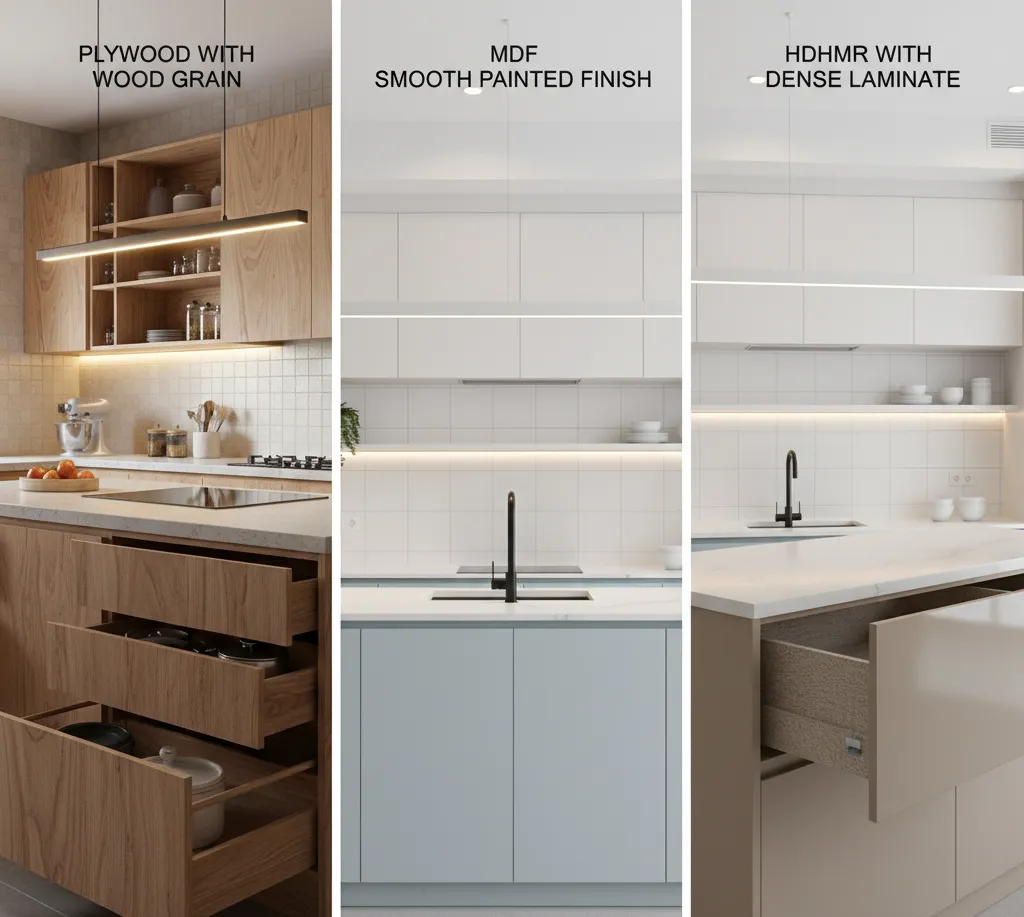
Skip MDF for cabinet boxes. Use it for shutter faces if you want decorative routing.
HDHMR for wall cabinets and dry zones. It's lighter, smoother, cheaper than plywood, and handles normal kitchen humidity without fuss.
BWR plywood for every base cabinet. The floor zone gets wet. Period. Splashes, drips, monsoon humidity rising from the floor - all of it hits the base first.
Marine plywood for the under-sink cabinet only. One cabinet. Spend the extra ₹1,500.
Edge band everything. Everything.
And smell your plywood before you approve it. If the BWR doesn't smell faintly of phenol chemicals, it probably isn't BWR. Suresh ji taught me that and I've been sniffing wood samples at showrooms ever since. The salespeople find it concerning. I find it necessary.
More material advice from someone who sniffs plywood at showrooms? KitchenKaki - we get weird about kitchens so you don't have to.
