
Best Kitchen Chimney for Indian Cooking: Auto Clean vs Baffle Filter
There's a specific argument that happens in Indian homes every three months — someone notices the chimney filter is visibly dirty, the other person insists it was just cleaned, nobody can remember for certain. I've had this argument twice. After the second time I went deep into how chimneys actually work, what auto clean really means versus what the brochure implies, and which fix
Best Kitchen Chimney for Indian Cooking: Auto Clean vs Baffle Filter
There's a specific kind of domestic argument that happens in Indian homes about once every three months.
It starts when someone - usually the person who does the most cooking - notices that the chimney filter is visibly, undeniably, embarrassingly dirty. Grease has built up. The suction feels weaker than it used to. The kitchen smells linger longer after cooking. There's a general sense that the chimney is working against you rather than for you.
The other person in this argument says the chimney was just cleaned. The first person says it was cleaned eight months ago. The second person says it was definitely more recent than that. Nobody can remember for certain. The chimney continues to underperform while this is established.
If you have a chimney in your kitchen, you have had this argument or a version of it.
I've had it twice. After the second time I spent more time than is probably reasonable researching how chimneys actually work, what the real differences between filter types are, and what "auto clean" actually means versus what the brochure implies it means.
What follows is what I wish I'd known before buying my first chimney - and before the second argument.
Why a Chimney Is Non-Negotiable in an Indian Kitchen
Let's get this out of the way first because there are still households treating the chimney as optional or as a luxury appliance.
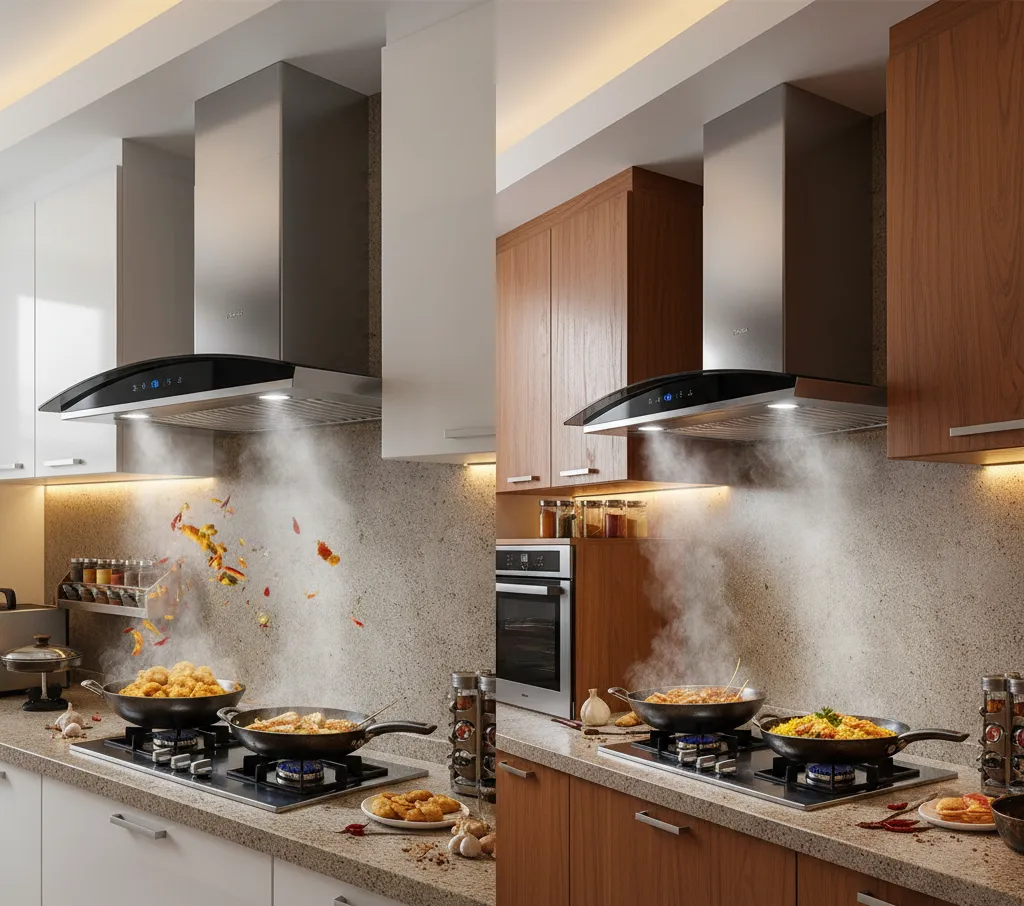
Indian cooking produces more airborne grease, oil mist, and combustion byproducts per meal than almost any other cuisine. A proper tadka - mustard seeds in hot oil - sends a fine oil mist across a significant radius. Deep frying fills the air with oil particles that settle on every surface in the kitchen and the rooms beyond. Daily pressure cooking produces steam that carries cooking odours and moisture into the walls and ceiling over time.
Without a chimney, all of this goes somewhere. Into the walls. Into the ceiling. Into the cabinets. Into the curtains of the adjacent room. Into the lungs of the people cooking. A kitchen that has operated without a chimney for years has a particular quality - a combination of cooking odours that have become permanent rather than temporary, a slight greasiness on surfaces that never fully cleans away, a ceiling above the cooking zone that tells the full history of every meal ever made there.
A chimney that works properly captures the oil mist, steam, and cooking odours at the source - above the hob - before they spread. That's its entire job. Everything else is about how well it does that job and how much maintenance it requires.
How Chimneys Actually Work - The Basics Worth Understanding
A chimney draws air upward using a motorised fan, passes it through a filter that captures grease particles, and either expels the cleaned air outside through a duct (ducted installation) or passes it through a carbon filter and recirculates it back into the kitchen (ductless or recirculating installation).
Ducted chimneys exhaust air outside. This is the better performing option. The grease and odours genuinely leave the kitchen rather than being partially recycled back into it. If the kitchen has access to an exterior wall - most do - ducted installation is the right choice.
Ductless chimneys recirculate air through a carbon filter that traps odours and a grease filter that traps oil. These work reasonably well for light cooking but for daily Indian cooking with heavy oil use and strong spices, the carbon filter saturates relatively quickly and needs replacement every few months. The overall performance is lower than a ducted installation. Use ductless only when ducting to an exterior wall is genuinely impossible.
The filter - what captures the grease before the air reaches the motor or exits the kitchen - is where the auto clean vs baffle filter question lives. This is the decision most people are actually making when they buy a chimney, even if they don't fully realise it.
Baffle Filters - The Honest Workhorse
A baffle filter is a set of curved aluminium panels arranged in a pattern that forces the rising air to change direction multiple times. As the greasy air hits these curved surfaces and changes direction, grease particles - which are heavier than air - can't make the turns. They separate out and collect in the filter panels and the oil collector tray below.
No mesh. No fabric. No material that oil soaks into. Just shaped aluminium that grease deposits on and slides down from.
Why baffle filters work well for Indian cooking:
The design handles heavy grease loads better than mesh filters. Because the grease separates by physics rather than by being trapped in a material, baffle filters don't clog the way mesh filters do. Air continues to flow through even as grease accumulates - the suction doesn't degrade as quickly.
Cleaning a baffle filter:
This is where people have the argument I described at the beginning. Baffle filters need to be cleaned. Not occasionally - regularly. For Indian cooking, once a month is realistic. Once every three months is the minimum before performance starts degrading noticeably.
The cleaning process: remove the filter panels, wash them in hot water with a degreasing liquid or dishwashing soap, scrub the oil collector tray, dry everything, reassemble. The whole process takes 20 to 30 minutes once you've done it a few times. It is not difficult. It is also not something anyone particularly enjoys, which is why it gets delayed until the chimney is visibly struggling.
The honest maintenance reality: A baffle filter chimney works excellently when cleaned regularly and underperforms noticeably when cleaning is delayed. Its performance is directly and proportionally related to how diligently it's maintained. This is the central truth about baffle filters that no amount of marketing can change.
Good baffle filter brands in India: Faber, Elica, Glen, Hindware, Bosch. All make reliable baffle filter chimneys in the ₹8,000 to ₹25,000 range that perform well for Indian cooking when maintained properly.
Auto Clean Chimneys - What the Marketing Says vs What Actually Happens
Auto clean chimneys have been sold aggressively in India for the last several years and the marketing around them contains enough ambiguity to confuse even careful buyers. Let's be precise about what auto clean actually means.
An auto clean chimney has a motor-driven oil collector - essentially a spinning disc or collector at the base of the suction path. When the auto clean function is activated, this collector spins at high speed and centrifugal force throws the accumulated oil outward into a small oil collection cup. The oil cup fills up and is manually emptied.
That's it. That's what auto clean does.
What it doesn't do - and this is important - is clean the filter or the internal surfaces of the chimney. The baffle panels or mesh inside an auto clean chimney still accumulate grease and still need cleaning. The auto clean function addresses the oil collector specifically, not the chimney comprehensively.
The marketing implication that an auto clean chimney requires no manual cleaning is misleading. What's true is that it requires less frequent manual deep cleaning because the oil collector is being cleared regularly. An auto clean chimney used properly - with the auto clean function run every few weeks - may only need a full manual clean every three to six months versus every month for a standard baffle filter chimney.
For households where the chimney cleaning is the source of regular conflict or regular delay, the auto clean function genuinely helps by reducing the frequency of the manual task rather than eliminating it.
The auto clean process in practice: Most auto clean chimneys have a button or setting for the function. You run it for a few minutes - typically 10 to 15 - while the motor spins and collects oil. You then empty the small oil cup. The cup empties are quick and clean - less than two minutes. This should be done every two to four weeks depending on cooking frequency.
If the auto clean function is never used - and many households buy auto clean chimneys and then never activate the function - the chimney performs no better than a standard baffle filter chimney and costs significantly more.
Auto Clean vs Baffle Filter - The Direct Comparison
Performance for Indian cooking: Both perform comparably when properly maintained. A well-maintained baffle filter chimney is not outperformed by an auto clean chimney. The suction motor, chimney size, and duct configuration matter more for raw performance than filter type.
Maintenance effort: Auto clean wins here, but only if the auto clean function is actually used regularly. If used properly, auto clean chimneys go longer between full manual cleans. If the auto clean function is ignored, the advantage disappears.
Cost: Baffle filter chimneys are significantly cheaper for equivalent suction capacity. A good baffle filter chimney with 1000 m³/hour suction costs ₹8,000 to ₹18,000. An equivalent auto clean chimney costs ₹15,000 to ₹35,000. The premium is real. Whether it's worth paying depends entirely on whether the reduced cleaning frequency is a genuine priority.
Longevity: Both last comparably when maintained. Auto clean motors have an additional moving component - the spinning collector - that can fail over time. Not a common failure, but an additional potential maintenance point that baffle filter chimneys don't have.
Noise: Auto clean chimneys tend to be slightly noisier on average because the motor is generally more powerful. Not dramatically - we're talking about a difference you'd notice if you compared them side by side, not one that makes the kitchen unusable. But worth knowing.
Verdict for Indian cooking specifically: If you are realistic about maintaining a baffle filter chimney every month, a good baffle filter chimney gives you equivalent performance for less money. If you know from experience that chimney cleaning gets delayed in your household - and for most households it does - the auto clean chimney's reduced maintenance frequency is worth the premium.
Suction Capacity - The Number That Matters Most
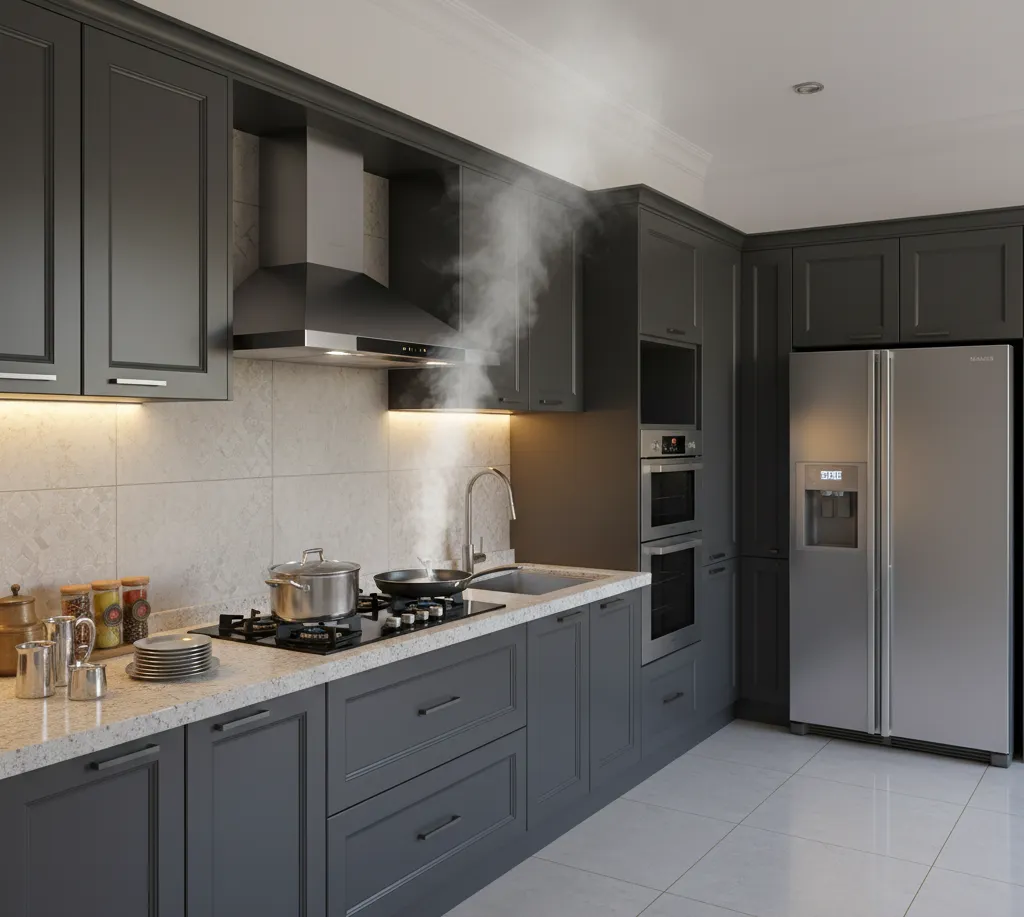
Both filter types come in different suction capacities measured in m³/hour (cubic metres of air moved per hour). This number matters more for performance than filter type, more than brand, more than almost any other specification.
For Indian cooking - daily tadkas, pressure cooking, regular frying - the suction capacity recommendations are:
Small kitchen, light cooking: 600 m³/hour minimum. This is genuinely the minimum. Don't go below this.
Standard Indian household, regular cooking: 900 to 1000 m³/hour. This is where most Indian homes should be. Not "maximum suction" overkill - just appropriate for what Indian cooking actually demands.
Large kitchen, heavy cooking, island hob: 1200 m³/hour and above.
The mistake most people make is buying on price rather than suction capacity and ending up with a 600 m³/hour chimney for a kitchen that does serious daily Indian cooking. The chimney runs constantly at full speed, struggles to keep up, the filters get dirty faster because more grease is getting past them, and the kitchen still smells after cooking.
Size up rather than down. A chimney running at medium speed with headroom to spare performs better and lasts longer than one constantly running at maximum to keep up.
The Duct - Where All Chimney Performance Goes to Die
A perfectly specified chimney with the right filter type and adequate suction capacity can still underperform dramatically because of a poorly planned duct.
The duct is the pipe that carries the exhausted air from the chimney to the outside. Every bend in the duct reduces effective suction. A straight duct to an exterior wall lets the chimney perform at or near its rated capacity. A duct with three 90-degree bends to reach a far exterior wall can reduce effective suction by 30 to 50 percent.
This is not something showrooms discuss when selling chimneys. It's not on the specification sheet. But it determines real-world performance more than almost anything else.
What to plan for:
The duct path should be decided before the kitchen cabinets are designed - not after. The chimney should be positioned on the wall closest to an exterior wall to minimise duct length and bends.
Standard duct size is 6 inches (150mm) round or equivalent rectangular. Using undersized ducting - 4 inch pipe where 6 inch is recommended - is a common installation shortcut that chokes performance.
The duct exit on the exterior wall needs a proper exhaust hood or louver that prevents outside air from pushing back in when the chimney is off. Without this, cold air or humid outside air enters through the duct when the chimney is not running, bringing moisture into the kitchen.
If the contractor says the duct will run along the ceiling for 8 feet before exiting, ask whether a shorter path is possible before accepting that plan.
Installation Height - The Small Detail With Big Consequences
The chimney should be installed at a specific height above the hob. Not approximately - specifically.
For a gas hob: 65 to 75 cm between the hob surface and the bottom of the chimney. This is the range where suction is most effective - close enough to capture rising oil mist and steam, far enough that the chimney doesn't interfere with large vessels on the burners.
Too high - above 75 to 80 cm - and the suction has to work harder to capture the rising fumes before they spread. The effective capture area decreases. The chimney underperforms not because of the filter or the motor but purely because of height.
Too low - below 60 cm - and tall vessels hit the chimney body. Practically inconvenient and potentially a fire risk if the chimney is in contact with flames or heat from very tall flames.
For an electric or induction hob: the recommended gap is slightly less - 55 to 65 cm - because there's no open flame and therefore slightly lower clearance is safe.
Check the specific recommendation for the chimney model you buy. Manufacturers print this in the manual and it's specific to each model. Don't assume the installer knows the correct height - measure and confirm before the installation bracket is fixed.
Brands Worth Considering - And What to Look for Beyond the Brand
In India the chimney market has a handful of reliable brands and a much larger number of brands that exist primarily to fill the lower price points with lower quality products.
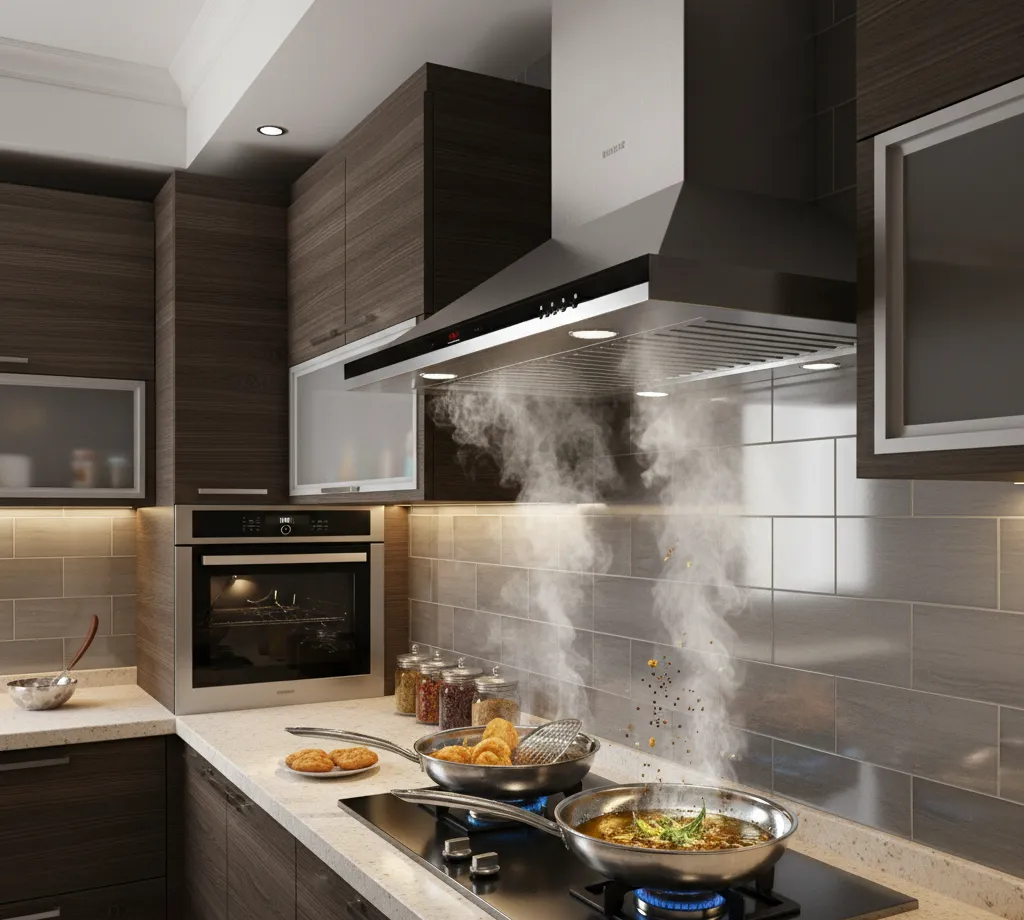
Faber: Probably the most consistently reliable chimney brand in India for Indian cooking. Good suction efficiency, available across price points, service network that actually exists in most cities. Both baffle filter and auto clean options are solid.
Elica: Strong performance, particularly in the mid to upper range. Some of the best-looking chimney designs available if aesthetics matter. Reliable motors.
Glen: Good value in the mid range. Performs well, reasonable service, not as premium-feeling as Faber or Elica but genuinely competent.
Hindware: Improving significantly in recent years. The mid-range models offer good suction capacity at competitive prices.
Bosch: Premium pricing, premium build quality, excellent motor longevity. For a kitchen where the chimney should last fifteen years without drama, Bosch is the answer. Not the most common recommendation in the ₹10,000 to ₹15,000 range because it's priced above that, but worth considering at the ₹20,000 and above level.
What to look for beyond brand: Noise level in decibels (listed in specs - below 58dB is quiet, above 65dB is noticeable during conversation), motor warranty (3 years minimum, 5 years for confidence), filter warranty, and whether the company has a service centre in your city. A chimney that needs service and the nearest authorised centre is 200 kilometres away is a problem waiting to happen.
The Decision Framework
Buy a baffle filter chimney if:
You are disciplined about monthly cleaning or genuinely enjoy maintaining appliances. Budget is a consideration. You want equivalent performance for lower cost. You're buying a kitchen chimney for the first time and want to understand the maintenance before committing to the auto clean premium.
Buy an auto clean chimney if:
Chimney cleaning has historically been delayed in your household. There are multiple cooks and nobody owns the cleaning task clearly. The kitchen sees very heavy daily Indian cooking and reducing maintenance frequency is genuinely valuable. Budget is not the primary constraint and you will actually use the auto clean function regularly.
In both cases:
Get at least 900 m³/hour for standard Indian cooking. Plan the duct before the cabinets. Install at the correct height. Buy from a brand with a service network in your city.
Postscript on the Argument
We have a Faber auto clean chimney now. 1000 m³/hour, ducted, installed at 70 cm above the hob, duct straight to the exterior wall with one bend.
The auto clean function gets run every three weeks. The oil cup gets emptied in about ninety seconds. A full manual clean happens every four months or so.
The argument has not recurred.
I'm aware this might be coincidence. But I'm choosing to credit the chimney.
More honest kitchen appliance and planning advice for Indian homes at Kitchen Kaki.
