
How to Choose the Right Kitchen Hob: Gas vs Induction
My uncle switched to induction three years ago and has not stopped talking about it since — the energy savings, the safety, the cleaning. My aunt, who does most of the actual cooking, tolerates it. She misses the gas flame in a way that's hard to put into words. Both of them are right. Here's the honest guide to the gas vs induction decision for Indian kitchens, including the hybrid option that most people don't know exists.
How to Choose the Right Kitchen Hob: Gas vs Induction
My uncle switched to induction three years ago and has not stopped talking about it since.
Every family gathering, every kitchen conversation, every time someone mentions cooking - he finds a way to bring it up. The energy savings. The safety. The ease of cleaning. The precise temperature control. He speaks about his induction hob the way some people speak about a religion they recently discovered and feel obligated to share.
My aunt, who does most of the actual cooking, has a different view. She tolerates the induction hob. She has learned to use it. But she misses the gas flame in a way that's difficult to articulate precisely - something about the visual feedback, the way you can tell the heat by looking at it, the fact that her tawa doesn't heat the same way, the particular way a roti puffs directly on a gas flame that an induction hob cannot replicate.
Both of them are right. That's the honest starting point for this conversation.
The gas vs induction debate in Indian kitchens is not a question with one correct answer. It's a question with one correct answer for your specific household - your cooking habits, your family's preferences, your kitchen's infrastructure, your tolerance for changing techniques that have worked for years. Getting to that answer requires understanding what each actually offers and what each actually costs you, beyond the marketing claims on both sides.
What We're Actually Comparing
Just to establish the field clearly before going further.
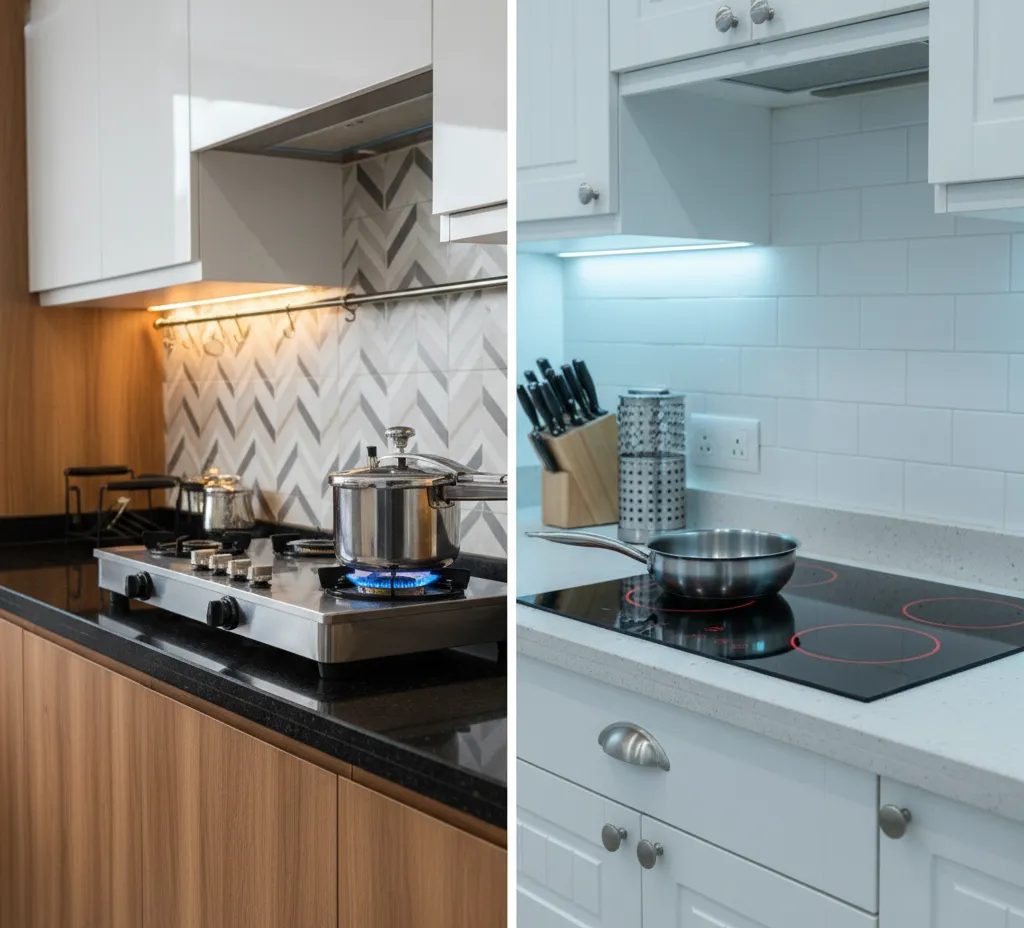
Gas hob - a cooktop with burners that produce an open flame using LPG (liquefied petroleum gas) from a cylinder or piped gas where available. The flame is direct, visible, and immediate. The heat is produced by combustion. In India, gas hobs range from simple 2-burner table-top models to built-in 4 or 5-burner glass-top hobs designed for modular kitchens.
Induction hob - a cooktop that uses electromagnetic induction to generate heat directly in the cookware rather than producing a flame or a heated surface. The hob surface itself doesn't get hot - only the vessel does, through the electromagnetic field. Requires cookware with a ferrous (iron or steel) base that can interact with the magnetic field. Regular aluminium vessels don't work on induction.
Glass top gas hob - a gas hob with a toughened glass surface instead of the traditional cast iron body. The burners sit in cutouts in the glass. Cleaner-looking, easier to wipe, but still a gas appliance. This is the format most modular kitchens use for gas because it integrates better with the kitchen aesthetic.
Most of this guide is about the fundamental choice between gas and induction, but the glass top vs traditional gas question comes up enough to address it where relevant.
The Case for Gas - Beyond Tradition
Gas gets dismissed in design-forward kitchen conversations as the old choice, the conservative choice, the choice made by people who haven't embraced modernity. This is unfair and slightly ridiculous.
Gas has specific, functional advantages that induction does not replicate - and in Indian cooking, some of these advantages are significant.
The open flame does things induction cannot.
Roasting on direct flame - the charred skin of a brinjal for baingan bharta, the blackened skin of a capsicum, a papad held over the flame - these are not possible on induction. You can approximate some of these results in other ways. You cannot replicate the direct flame char that gives baingan bharta its specific smoky quality.
Roti, phulka, chapati - most Indian households finish rotis directly on the flame after the tawa. The roti puffs, gets slight char marks, has a particular quality that doesn't come from a tawa alone. On induction, the roti can be finished on the tawa at high heat and it's perfectly edible. But it's different. Households where roti quality matters - which is most households - feel this difference.
Wok cooking and high-heat stir fry - the kind of high-heat, rapid tossing that happens in some dishes - works better over an open flame that heats the sides of the vessel as well as the base. Induction heats only the base of the vessel.
Cookware freedom. Every vessel you currently own - aluminium pressure cookers, traditional kadais, copper vessels, earthen pots - works on gas. Switching to induction requires auditing your cookware and replacing anything that isn't induction-compatible. This is a real cost and a real inconvenience that gets underplayed in pro-induction conversations.
Power cuts don't stop cooking. This is a practical reality in large parts of India. Gas continues to work through a power cut. Induction stops the moment electricity goes. In cities and areas where power reliability is not guaranteed, gas provides continuity that induction cannot.
Immediate high heat. Gas burners - particularly the larger burners on a quality hob - produce very high heat very quickly. The largest burner on a good gas hob produces more heat than most induction hobs available in the Indian market. For tasks that require genuinely high heat - deep frying, large batch cooking, reducing liquids quickly - gas has a real advantage.
The Case for Induction - The Genuine Advantages
The pro-induction arguments are not just marketing. Several of them are real and significant - they just need to be evaluated against the actual context of Indian cooking rather than the European cooking context most induction technology was designed for.
Safety - specifically with children or elderly family members.
The induction hob surface does not get hot itself. The heat is in the vessel. Put your hand on the induction surface next to a vessel that's been cooking - you'll feel warmth from the vessel's radiated heat, but the glass surface itself is safe to touch. A child who touches the induction surface while cooking is happening will not be burned the way they would be from touching a gas burner area or a hot cast iron surface.
For households with young children, elderly family members with reduced mobility, or anyone for whom an open flame is a specific safety concern - this advantage is real and significant. Not theoretical. Real.
Cleaning. The flat glass surface of an induction hob is the easiest cooking surface ever designed to clean. Spills sit on the flat glass. Wipe with a damp cloth. Done. There are no grates to remove, no burner caps to soak, no crevices where food accumulates. In a gas hob - even a glass top gas hob - the area around burners collects food and grease in ways that require effort to clean properly. In a well-used Indian kitchen where something overflows at least once a week, this difference accumulates meaningfully over time.
Energy efficiency. Induction transfers approximately 85 to 90 percent of energy directly to the cookware. Gas transfers approximately 40 to 55 percent, with the rest lost to the surrounding air. Induction is genuinely more efficient. Whether this translates to meaningful savings on your specific energy bill depends on the relative cost of electricity versus LPG in your city and your cooking patterns. In cities where electricity is expensive relative to gas, the savings are less dramatic than the efficiency numbers suggest. Worth calculating for your specific situation rather than accepting the general claim.
Precise temperature control. Induction hobs can hold very specific temperatures with remarkable consistency - simmering at a precise low heat for extended periods, maintaining a specific temperature for melting chocolate or making candy, holding a keep-warm temperature that doesn't continue cooking. Gas can be turned low but the actual temperature at low settings is less consistent than induction at the same setting. For specific cooking tasks that require precision - and there are more of these than most people realise - induction is genuinely superior.
No cylinder management. Piped gas eliminates the cylinder issue, but where piped gas isn't available - which is still most of India outside major cities - the LPG cylinder management is a real inconvenience. Booking refills, running out at inconvenient moments, the cylinder itself occupying space in or near the kitchen. Induction eliminates this entirely.
The Cookware Question - The Part Nobody Fully Addresses
This deserves its own section because it's the part of the induction decision that's most consistently underestimated.
Induction works on ferrous metals - cast iron, stainless steel with a magnetic base, carbon steel. It does not work on aluminium, copper, or ceramic unless these materials have a bonded steel base designed for induction.
In most Indian kitchens the following items will not work on induction without replacement:
The aluminium pressure cooker. The standard Indian pressure cooker - Hawkins, Prestige aluminium - is aluminium and will not work on induction. Stainless steel pressure cookers work. Induction-compatible aluminium pressure cookers exist but are less common and cost more.
Traditional aluminium kadai. The seasoned aluminium kadai that's been in the family for years - doesn't work.
Copper vessels. Don't work unless they have a bonded base.
Earthen and clay pots. Don't work.
Before switching to induction, go through every vessel in the kitchen and test it with a magnet. If a magnet sticks to the base - induction compatible. If it doesn't - not compatible.
The cost of replacing incompatible cookware is real and adds to the actual cost of switching. A good stainless steel pressure cooker costs ₹2,000 to ₹5,000. A good induction-compatible kadai costs ₹1,500 to ₹4,000. If four or five key vessels need replacing, that's ₹8,000 to ₹20,000 in cookware before cooking begins on the new hob.
Not a reason not to switch - but a cost that belongs in the honest calculation.
The Hybrid Answer - Gas and Induction Together
This is the option that most people don't know exists and that solves the debate more neatly than choosing one or the other.
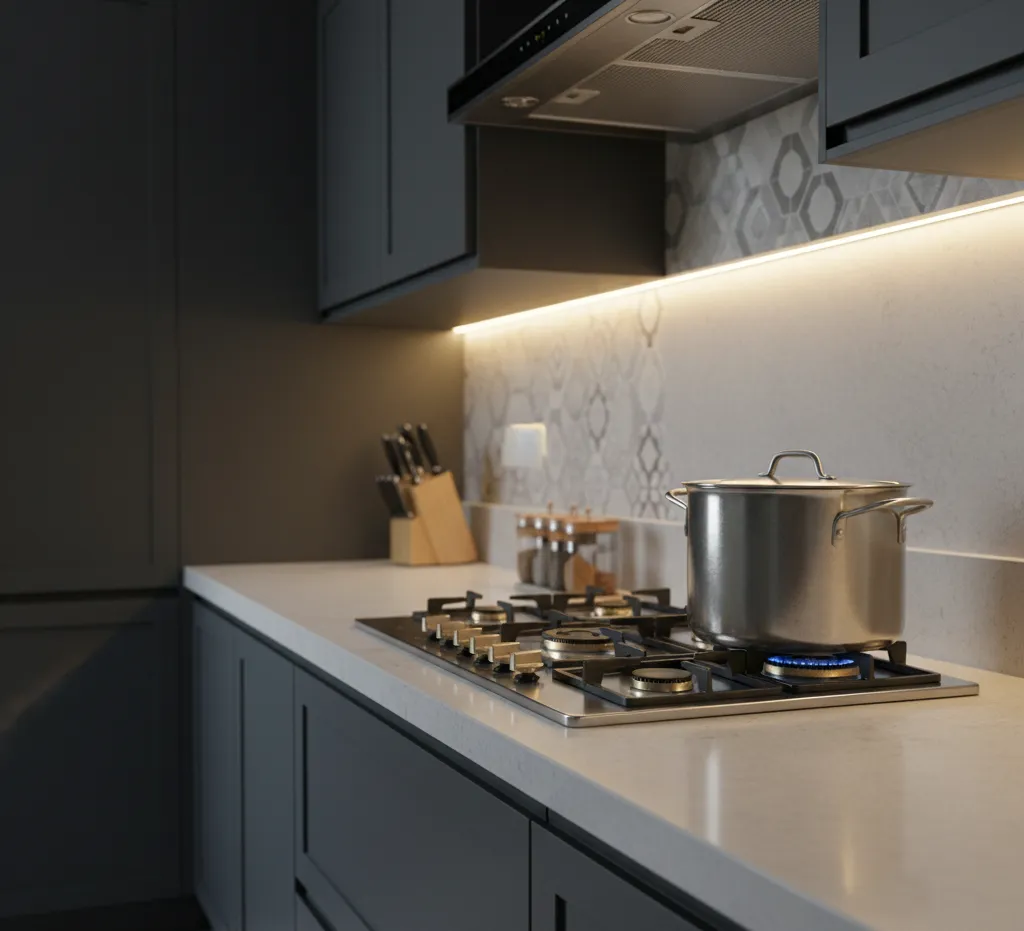
A 4-burner hob with 2 gas burners and 2 induction zones - or a 3-burner hob with 2 gas and 1 induction - gives you both. Gas for the roti, for the high-heat work, for the baingan bharta. Induction for the slow simmering dal, for the precise temperature tasks, for the boiling of water and milk that induction handles quickly and safely.
These combination hobs exist and are available in India from brands like Faber, Elica, and Glen. They require both a gas connection and an electrical point at the hob location - worth planning for during kitchen design ↗ rather than retrofitting.
For households where both the gas-committed cook and the induction-curious cook live - which sounds like my uncle's house and possibly many others - this is the actual solution rather than a compromise. You don't have to pick a side if the hob doesn't ask you to.
Built-In Hob vs Table-Top Hob - The Modular Kitchen Question
For modular kitchens specifically, the format question matters alongside the fuel question.
Built-in hob - designed to be installed into a cutout in the counter. Sits flush with or slightly above the counter surface. Looks integrated, looks intentional, looks like the kitchen was designed as a whole rather than assembled from parts. Gas built-in hobs have a glass top surface. Induction built-in hobs are all glass surface.
Table-top hob - a standalone appliance that sits on the counter. The traditional format for both gas and induction. Works perfectly well. Does not look like part of a designed kitchen.
For a modular kitchen, built-in is almost always the right format. The counter cutout is planned, the gas line or electrical point is built into the counter from the beginning, the hob sits flush and the kitchen reads as a complete design.
The practical note: built-in hobs are harder to replace mid-life. The cutout is sized for the specific hob dimensions. If the hob fails after five years and the exact model is discontinued, the replacement needs to match the cutout dimensions or the counter needs modification. Not a common problem but worth knowing - buy a brand with reliable longevity and service availability.
Burner Configuration - How Many and Which Type
For gas hobs:
A 4-burner configuration is the standard for Indian family cooking. Two burners in daily use, two for when cooking scale increases - family visits, festivals, the cooking marathons that Indian households do.
Burner types matter. A good quality 4-burner hob has at least one large "triple ring" or "brass burner" for high heat tasks, two medium burners for everyday cooking, and one small burner for simmering. A hob with four identical medium burners is less useful than one with differentiated burner sizes.
Brass burners vs aluminium burners - brass burners distribute heat more evenly, last longer, and are easier to clean. Most good glass top gas hobs use brass burners. It's worth checking.
For induction hobs:
Wattage matters more than zones in induction. A 2-zone induction hob where each zone is 2000W is more useful than one where zones are 1200W. For Indian cooking - high heat tasks, large vessels, pressure cooking - 2000W per zone minimum. Some hobs have a boost mode that takes one zone to 2200 or 2400W for specific high-heat tasks.
Touch controls vs knob controls - induction hobs with touch controls look cleaner and are easier to wipe. Knob controls are more intuitive for people who are new to induction and want to turn a physical dial rather than navigate a digital interface. Both work. Which you'll prefer is a personal question.
The Cost Comparison - Honest Numbers
Gas glass top hob (built-in, 4-burner): ₹8,000 to ₹35,000 depending on brand and features. A mid-range glass top gas hob from Faber, Elica, or Glen - the kind that performs reliably and looks good - costs ₹12,000 to ₹20,000.
Induction hob (built-in, 2-zone): ₹6,000 to ₹25,000. A good 2-zone induction hob from a reliable brand - ₹8,000 to ₹15,000.
Combination hob (gas + induction): ₹15,000 to ₹40,000. The premium for the hybrid format.
Additional costs for induction: Cookware replacement - ₹5,000 to ₹20,000 depending on what needs replacing. Dedicated electrical circuit - if the kitchen doesn't already have a 15-amp dedicated circuit for the hob location, adding one costs ₹1,500 to ₹4,000 in electrician and materials cost.
Ongoing costs: Gas hob running costs depend on LPG cylinder prices in your city. Induction running costs depend on electricity tariffs. In most Indian cities currently, cooking on gas is marginally cheaper per meal than cooking on induction - but the gap has been narrowing as electricity costs stabilise and LPG prices fluctuate. Running cost comparisons done today may look different in three years.
Brands Worth Considering
For gas hobs:
Faber - consistent quality across price ranges, good service network, reliable burners.
Elica - strong performer, particularly in the glass top segment, some of the best-looking designs in the Indian market.
Glen - good value, particularly in the ₹10,000 to ₹16,000 range, reliable.
Prestige and Sunflame - more traditional brands that make glass top models, better availability in smaller cities and towns, reasonable quality at accessible price points.
For induction hobs:
Bosch - premium pricing, excellent build quality, precise temperature control, long-lasting.
Faber - makes a good induction range that performs reliably for Indian cooking wattage requirements.
Pigeon and Bajaj - budget-friendly, good for table-top induction, less compelling in the built-in segment.
For combination hobs:
This is a smaller market and fewer brands do it well. Faber and Elica both make combination hobs worth considering. Check that the gas burner quality and the induction wattage both meet requirements - some combination hobs compromise one to fit both on a single surface.
The Actual Decision
After all of this, the decision comes down to four questions.
Does your cooking require an open flame? Baingan bharta. Roti on direct flame. High-heat wok work. If yes - gas, or a combination hob.
Is safety around the hob a specific concern? Young children, elderly family members, anyone for whom an open flame is a genuine risk. If yes - induction, or a combination hob with induction for the lower-risk tasks.
How reliable is power supply in your area? If power cuts are regular and unpredictable - gas provides continuity that induction cannot.
What is your cookware situation? If replacing four or five key vessels is a significant cost or if the family's cooking is attached to specific traditional vessels - gas is less disruptive.
If none of the four questions push you clearly toward one answer - get the combination hob. Pay the premium, keep both options, and let different tasks find their natural hob over time. Most households that do this end up with a clear sense of which they use more within six months and no regret about keeping the other.
Postscript on My Uncle
He read an early version of this guide and pointed out that I hadn't mentioned how much faster water boils on induction.
He's right. Water boils faster on induction. It's one of the clearest practical demonstrations of the efficiency advantage.
My aunt pointed out that she doesn't time how fast water boils. She puts the vessel on, goes to do something else, comes back when it's done.
They are both, as I said at the beginning, right.
More honest kitchen planning guides for Indian homes at Kitchen Kaki.
