
Kitchen Sink Types & Materials: A Complete Buying Guide
Nobody thinks about the kitchen sink until the kitchen sink becomes a problem. I replaced one mid-kitchen-life — not during a renovation, just because the original had failed. It's half a day's work, real mess, and an expense that was entirely avoidable with a better original decision. Here's everything worth knowing about sink types, materials, and configurations before you commit — written specifically for how Indian kitchens actually use a sink.
Kitchen Sink Types & Materials: A Complete Buying Guide
Nobody thinks about the kitchen sink until the kitchen sink becomes a problem.
This is the universal truth of sink ownership. The sink works, you wash things in it, life continues. Then one day the stainless steel develops a rust patch near the drain. Or the undermount seal starts lifting at one corner and water gets behind the counter. Or the single bowl turns out to be genuinely inadequate for the way you cook - you need to soak something large and also wash vegetables simultaneously and there simply isn't room for both.
At that point you think about the sink. Intensely, briefly, and usually while already committed to a choice that was made without enough information.
I replaced a sink once mid-kitchen-life - not during a renovation, just because the original one had become a problem. It is a more disruptive process than it sounds. The counter has to be cut or the old sink removed, the plumbing disconnected, a new sink fitted, the counter edge resealed. It's half a day's work and a fair amount of mess and an expense that could have been avoided by making a better original decision.
This guide exists so you make that better original decision. Sink types, materials, configurations, the questions worth asking before committing - all of it, specifically for Indian kitchens where the sink sees a different kind of use than what most buying guides assume.
What Indian Kitchen Sinks Actually Deal With
Before anything else - some context about what we're asking kitchen sinks in Indian homes to handle, because it's different from the use cases most international sink guides are written for.
Indian kitchen sinks deal with: large steel vessels - the patila, the big kadai, the pressure cooker that needs to soak. Turmeric - which stains. Daily washing of a volume of dishes that reflects how Indian families eat - multiple courses, multiple vessels, multiple times a day. Soaking of dal and rice and various things that need overnight sitting. The occasional scrubbing of the tawa that cannot go in the dishwasher. Rinsing of large quantities of vegetables. And in many households, the sink doubles as the place where the maid washes vessels in the morning, which means it's in use for extended periods with varying degrees of care.
This is not light use. The sink in an Indian kitchen is one of the most heavily used surfaces in the home. It needs to be large enough, deep enough, tough enough, and easy enough to maintain that it doesn't become a source of daily frustration.
Sink Configurations - Size and Layout First
Before material, before brand, the first question is how many bowls and what size.
Single bowl sink
One large basin. The advantage is that the full area is available for one task - soaking a large vessel, washing a big item, bathing a child in a pinch (this happens). The disadvantage is that when you need to do two things simultaneously - soak dal in one area and wash vegetables in another - you can't without one interrupting the other.
For Indian cooking specifically, single bowl sinks work best when they're genuinely large - 24 inches or more in width and at least 8 to 9 inches deep. A small single bowl is the worst of both worlds: not large enough to handle big vessels, not flexible enough to handle multiple tasks.
Double bowl sink
Two basins side by side. The most common configuration in Indian kitchens and for good reason - it allows simultaneous tasks. Soak on one side, wash on the other. Dishes in one bowl, vegetables in the other. One side clean, one side for raw items.
The size split matters. Equal bowls - 50/50 - are less useful than unequal bowls - 60/40 - because Indian cooking produces vessels of very different sizes. The larger bowl handles the big stuff, the smaller bowl handles lighter tasks. A 60/40 configuration is what most experienced kitchen planners recommend for Indian homes.
Depth matters as much as width. A double bowl sink where each basin is only 6 inches deep will struggle with tall pressure cookers and large kadais. 8 inches minimum, 9 to 10 inches preferred.
One-and-a-half bowl
One large bowl and one small auxiliary bowl - not deep enough for real washing, more of a prep bowl. Useful for draining, rinsing small items, or keeping clean utensils separate. Less common in Indian kitchens but worth knowing about.
Single large bowl with drainboard
A single deep bowl with an integrated drainboard on one side - a ridged or angled surface for drained items to rest on. Traditional in Indian kitchens and still practical. Takes up more counter length but keeps the draining area off the main counter surface.
Mounting Types - How the Sink Sits in the Counter
Top mount / drop-in sink
Drops into a cut hole in the counter from above. The rim of the sink sits on top of the counter surface. Easiest to install, easiest to replace. The rim creates a small lip where water and food particles collect - not a hygiene disaster but a cleaning detail that requires attention. In Indian kitchens where there's constant water around the sink area, the rim junction needs to be sealed properly and kept clean.
Most affordable installation type. Works with any counter material. If the seal between rim and counter ever lifts, water gets underneath - reseal promptly.
Undermount sink
Mounted from below the counter, with the counter surface extending to the edge of the bowl. No rim, no lip, no junction where food collects. The counter surface flows directly into the sink bowl - visually seamless and practically very easy to clean. Sweep water and crumbs directly from counter into sink without catching on a rim.
Requires a counter material that can handle the undermount installation - granite, quartz, and solid stone work. Laminate counters cannot be undermounted because the cut edge would be exposed to water and would swell and delaminate.
Costs more to install. If the sink or the seal ever needs attention, the process is more involved than with a top mount. But for a modular kitchen with a stone or quartz counter, undermount is the superior choice purely on function.
Flush mount
The sink surface sits exactly level with the counter surface - no rim above, no drop below. Rare in Indian homes, more common in very high-end or custom kitchens. Achieves a very seamless look. Expensive and complex to install correctly.
Farmhouse / apron sink
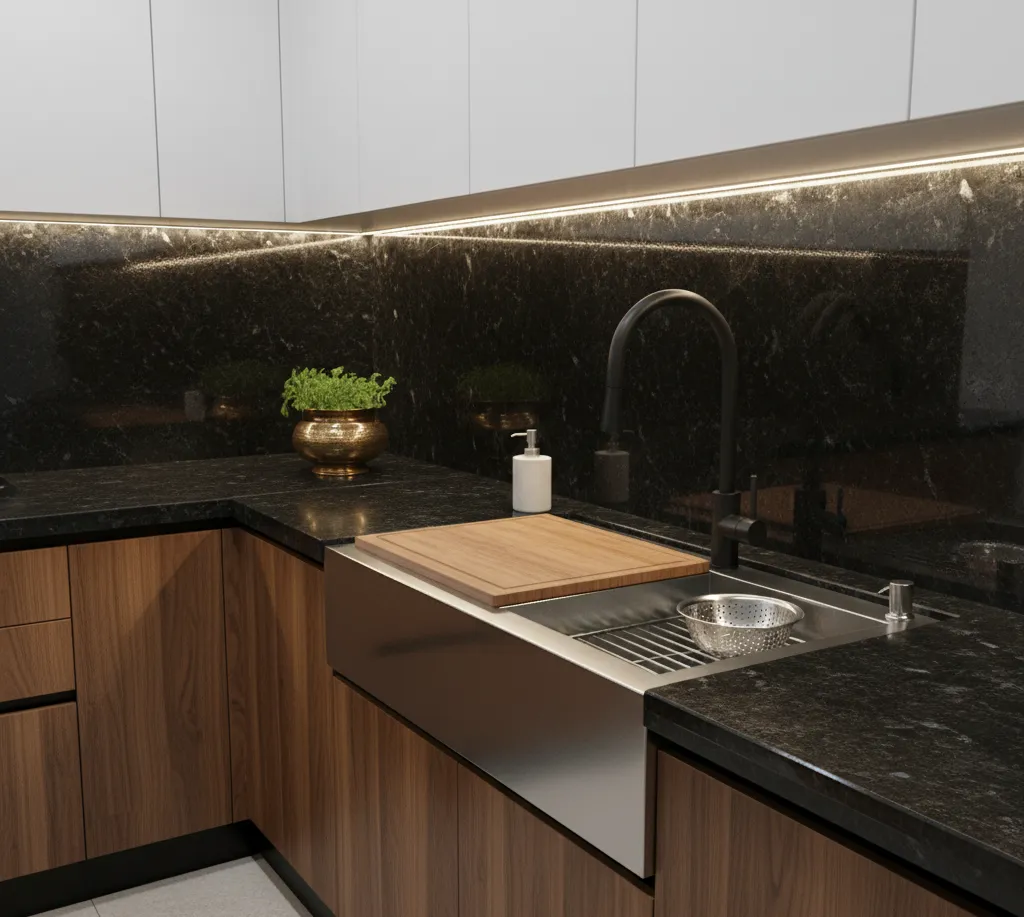
A deep, wide single bowl where the front of the sink extends beyond the counter and forms the front face of the cabinet below - the "apron." Large, dramatic-looking, very functional for volume washing. More common in larger kitchens and open kitchen designs. The depth handles large Indian cooking vessels well. Not suitable for small kitchens - takes up significant counter and cabinet space.
Sink Materials - What Actually Works in Indian Kitchens
This is where most buying decisions get made and where most mistakes happen.
Stainless Steel - The Default and Its Deserved Reputation
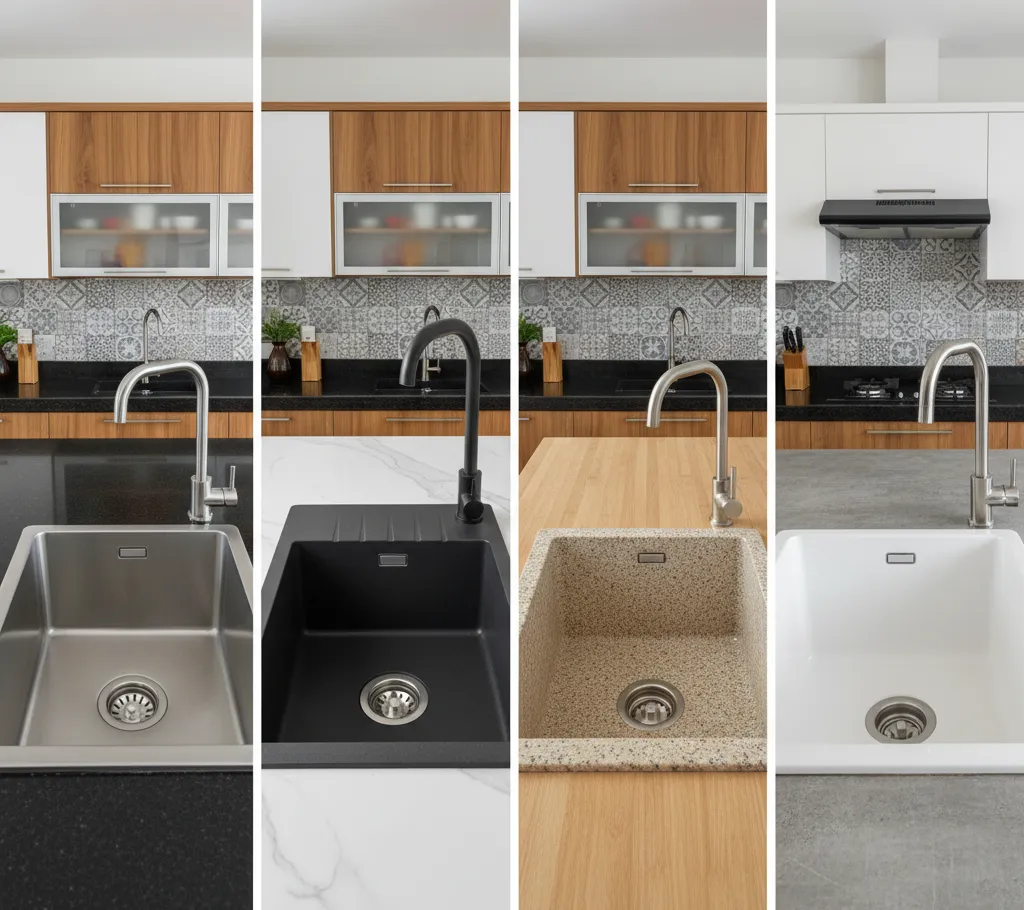
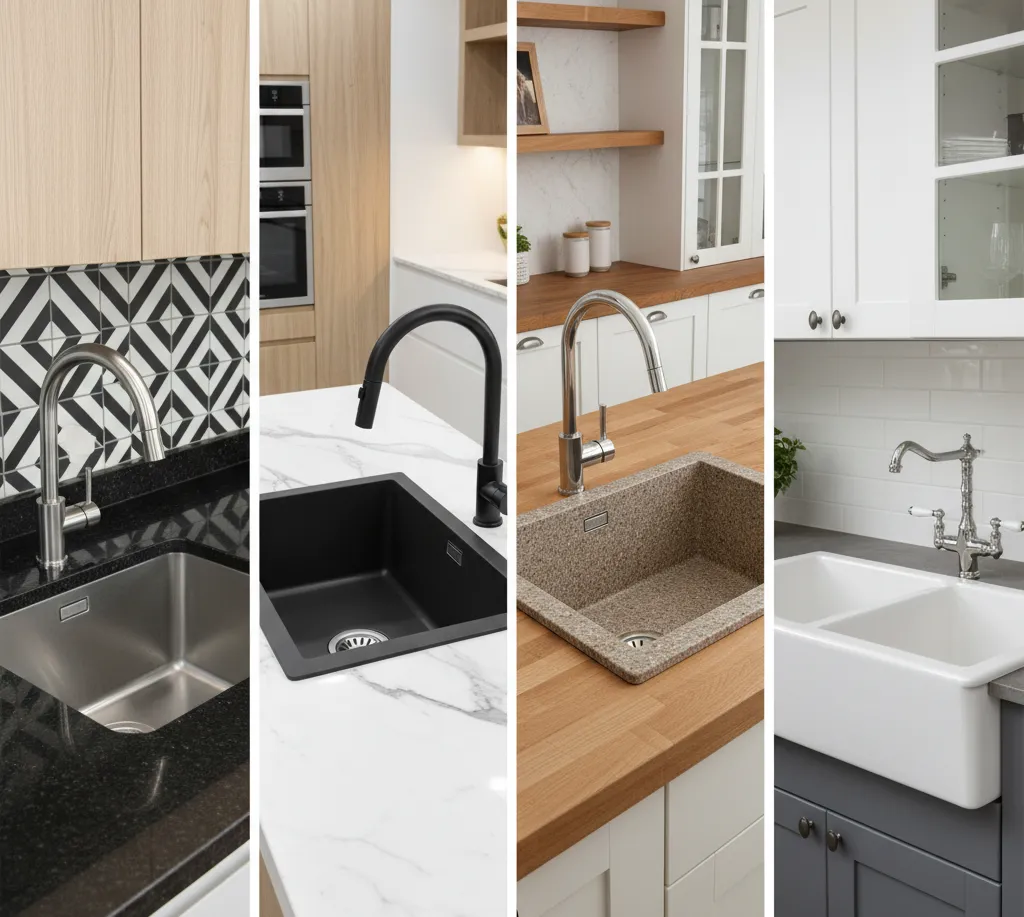
Stainless steel is what most Indian kitchen sinks are made of and the reason is not just price - it genuinely suits Indian kitchen use. Non-porous, hygienic, heat resistant, handles turmeric without permanent staining, and when it stains or scratches it can be cleaned back to a reasonable condition.
The grade of stainless steel is what separates good sinks from bad ones. The two grades relevant to kitchen sinks in India:
304 grade stainless steel - food grade, what good sinks are made from. Contains 18% chromium and 8% nickel (often called 18/8). Corrosion resistant, does not rust under normal kitchen conditions, handles water, food acids, and cleaning products without degrading. This is what you want.
202 grade stainless steel - cheaper, less corrosion resistant, more commonly used in budget sinks. Contains less nickel, more manganese. Will rust eventually, particularly around the drain area and at welds. Most of the "why is my sink rusting" stories involve 202 grade steel being sold without the grade being disclosed.
Ask specifically. When buying a stainless steel sink, ask the retailer or manufacturer which grade the steel is. If they can't tell you, that's an answer. If they say 304, get it in writing or on the invoice. The price difference between 202 and 304 grade sinks is real but not enormous - worth paying.
Gauge - the thickness of the steel - also matters. Lower gauge number means thicker steel. 16 gauge is thick and rigid - the best. 18 gauge is good. 20 gauge is adequate. 22 gauge and above is thin, resonates loudly when water hits it, dents more easily. Most budget sinks are 20 to 22 gauge. Most premium sinks are 16 to 18 gauge.
The noise problem with stainless steel: Water hitting a thin stainless steel sink makes a sound that some people find genuinely irritating - a resonant clanging that carries through the kitchen. Sound deadening pads applied to the underside of the bowl significantly reduce this. Most premium stainless steel sinks have these applied at the factory. Budget sinks often don't. If the sink you're considering doesn't have sound deadening, ask whether it can be added or budget for it separately.
Granite Composite - Worth Knowing About
Granite composite sinks are made from a mixture of granite stone dust and acrylic resin - typically 80% granite, 20% resin. The result is a sink that looks and feels like stone, is available in a range of colours (black, grey, cream, beige, white), is non-porous, and handles Indian cooking conditions well.
Why granite composite works for Indian kitchens:
Turmeric does not stain it permanently - the non-porous surface can be cleaned. Heat resistant to around 280 degrees Celsius - a hot vessel placed in it doesn't damage the surface the way it might damage some other materials. Scratch resistant - harder than stainless steel on the surface and doesn't show fine scratches the same way. Noise - water hitting a granite composite sink is dramatically quieter than water hitting a stainless steel sink. No clanging.
The trade-offs:
Costs more than stainless steel - 2 to 4 times the price for a comparable size and configuration. Heavier - installation requires adequate cabinet support. Light colours (cream, white) can show mineral deposits from hard water more noticeably than dark colours. In cities with hard water - which is most Indian cities - a dark granite composite sink (black or dark grey) is more practical than a light one. Mineral deposits on a black sink are visible but clean off easily. On a cream sink they require more effort.
Brands worth considering: Franke, Blanco, Carysil (Indian brand, good quality, significantly lower price than imported options). Carysil in particular offers granite composite sinks at price points that compete with good stainless steel sinks - worth investigating if the material interests you.
Ceramic and Fireclay - Beautiful, Specific Use
White ceramic or fireclay sinks - the traditional farmhouse sink material. They look beautiful, feel substantial, and have a particular quality that no other material replicates.
For Indian kitchen use, the limitations are real.
Ceramic chips. A heavy steel vessel dropped into a ceramic sink from any height can chip the surface - and once chipped, the chip is permanent and very visible against the white background. Indian cooking involves a lot of heavy steel vessels. This is not a theoretical risk.
Ceramic stains from turmeric - not permanently, but it requires prompt cleaning. A turmeric splash left on a white ceramic sink for a few hours can leave a yellow tinge that takes effort to remove. Daily Indian cooking with turmeric and an enthusiastic approach to cleaning - fine. Daily Indian cooking with a more casual approach to immediate cleanup - the sink will tell the story.
Hard water deposits show clearly on white ceramic. In cities with hard water, the sink needs regular descaling or it develops a dull white mineral film.
If the kitchen aesthetic genuinely calls for it and the household is willing to maintain it, a ceramic sink can work. It's not the practical workhorse choice for heavy Indian cooking. It's the beautiful choice that requires specific upkeep.
Quartz Composite - The Premium Option
Similar to granite composite but with quartz as the base material rather than granite. Even harder, even more scratch resistant, even more heat resistant. The most premium composite sink material available.
All the advantages of granite composite but more so - and all the disadvantages but less so. Costs more than granite composite. For a high-end modular kitchen where the sink needs to match the quality of everything else, quartz composite is worth looking at. Franke and Blanco both make quartz composite sinks available in India, though at pricing that's firmly in the premium bracket.
Drain Position - A Detail That Matters More Than Expected
Where the drain sits in the sink bowl affects both the usefulness of the sink and the plumbing below.
Centre drain: The traditional placement. Works. The bowl drains from the centre. Plumbing goes straight down.
Rear drain: The drain is positioned toward the back of the bowl rather than the centre. The advantage is that the bowl floor slopes gently toward the back, keeping the front of the bowl cleaner and drier. Under the sink, the drain pipe can run horizontally at the back rather than dropping straight down from the centre - this gives more cabinet storage space below the sink. In a modular kitchen where the under-sink cabinet is used for storage, rear drain sinks give you meaningfully more usable space.
Off-centre drain in double bowl: In a double bowl sink, the drain position in each bowl affects how the bowls drain and how the plumbing connects. Worth checking before buying - some configurations are simpler to plumb than others.
The Tap Hole Question
Most sinks come with pre-drilled tap holes - one, two, or three holes for the tap body and additional accessories like a soap dispenser or a separate spray head.
Before buying, decide what tap configuration you want. A single-lever mixer tap with integrated spray head needs one hole. A separate tap and spray head needs two. A tap plus spray head plus soap dispenser needs three.
Drilling additional holes in a stainless steel sink after purchase is possible but not simple. In a granite composite or ceramic sink it's more complicated. Getting the right number of holes from the start avoids this.
Also - tap hole position. Some sinks have the tap hole on the sink deck (the flat rim around the bowl). Others require a counter-top mounted tap with the hole drilled in the counter rather than the sink. Know which your plumber prefers before buying the sink and the tap separately.
The Hard Water Problem - Specific to Most Indian Cities
Hard water - water with high mineral content - is the reality in most Indian cities. Delhi, Jaipur, Ahmedabad, large parts of Bengaluru - hard water areas all. It leaves mineral deposits on every surface it sits on. And kitchen sinks, by definition, have water sitting in and on them constantly.
The effect on different sink materials:
Stainless steel: Mineral deposits appear as white or grey film, particularly around the drain and faucet area. Clean off with a mild acid - diluted white vinegar works well. Not a serious problem if cleaned regularly.
Granite composite (dark colours): Visible as white spots on dark surfaces. More noticeable than on stainless steel but still cleans off easily. A weekly wipe with diluted vinegar keeps it under control.
Granite composite (light colours) and ceramic: Most noticeable because the deposit colour and the sink colour are similar - a dull white film on a cream or white surface reads as general dinginess rather than clearly as mineral deposits. Requires more regular cleaning to stay looking clean.
Quartz composite: Most resistant to mineral deposits due to the surface density. Still requires occasional cleaning but less frequently than other materials.
If your city has hard water - which you can confirm by whether you get white deposits on taps and around drains currently - factor this into the colour choice for composite sinks. Dark is more forgiving. Light is more demanding.
Accessories Worth Thinking About Before Purchase
Colander inserts: A stainless steel colander that sits in the sink bowl, allowing vegetables to be washed with the colander in place and then lifted out draining as it goes. Very useful for Indian cooking where washing large quantities of vegetables and leafy greens is a daily task. Available for specific sink models - check compatibility before buying.
Cutting board inserts: A wooden or plastic cutting board sized to fit across the sink, creating an extra work surface above the bowl. Useful in small kitchens where every surface is spoken for. Niche, but some people find it transformative.
Bottom grids: A stainless steel grid that sits in the base of the sink bowl, protecting the surface from the direct impact of heavy vessels and keeping dishes slightly elevated for better drainage. Particularly useful in stainless steel sinks to prevent scratching and in ceramic sinks to prevent chipping. Should be on the shopping list alongside the sink itself.
Soap dispensers: A liquid soap dispenser mounted through a tap hole in the sink deck. More convenient than a separate soap bottle on the counter near the sink. Small thing, makes a difference.
What to Actually Ask Before Buying
In a showroom or while browsing online, most of what you see is the exterior. Here's what to ask specifically:
For stainless steel sinks: What grade is the steel - 304 or 202? What is the gauge? Is sound deadening applied to the underside?
For composite sinks: What is the percentage of stone content? (Higher is better - 80% minimum.) Is the surface heat resistant and to what temperature? What is the manufacturer's stain resistance claim and what does the warranty cover?
For all sinks: What is the warranty period and what does it cover - surface, construction, seal? Is the drain included or separate? What tap hole configuration comes standard?
For mounting: Is the sink designed for top mount, undermount, or both? If undermount, does it include the undermount clips and sealant, or is that a separate purchase?
The Practical Summary
For most Indian households doing daily heavy cooking - a 304 grade stainless steel double bowl sink, 60/40 configuration, 16 to 18 gauge, with sound deadening, in a size that genuinely accommodates large vessels - is the most practical, durable, and honest choice. It's not glamorous but it does the job reliably for a decade or more without drama.
For households where the kitchen aesthetic matters and the budget accommodates it - a dark granite composite double bowl sink from Carysil or Franke adds a quality that stainless steel doesn't have, handles Indian cooking conditions well, and ages more gracefully in appearance.
Ceramic for those who love the look and are willing to maintain it. Quartz composite for those who want the best available and aren't constrained by cost.
In every case - get the size right, get the depth right, and plan the mounting type before the counter is finalised. The sink is the one kitchen element that's genuinely difficult to change your mind about after installation. The decision deserves fifteen minutes of actual thought, not a showroom impulse.
More honest buying guides for Indian kitchen planning at Kitchen Kaki.
