
Magic Corner Kitchen Unit: How It Works & Why You Need One
For three years, my mummy's 5-litre pressure cooker lived in the deepest corner of her cabinet. Getting it out was a full-body exercise. Then I saw a magic corner in action and realised we'd been doing it wrong.
Magic Corner Kitchen Unit: How It Works & Why You Need One
For three years my mummy kept her biggest pressure cooker in the corner cabinet. The 5-litre Hawkins. The one she uses for rajma every Thursday and chole every other Sunday. It lived in the deepest, darkest corner of her L-shaped kitchen cabinet - the 90-degree dead zone where two counter runs meet.
Getting it out required a specific ritual. She'd open the cabinet door. Kneel on the kitchen floor. Lean her upper body inside the cabinet. Reach past the 3-litre cooker, past the steel idli stand nobody's used since 2019, past the big kadai that was blocking everything. Then she'd grab the 5-litre Hawkins by the handle, pull it sideways because it wouldn't come out straight, tilt it at an angle to clear the shelf above, and finally extract it - sweating slightly, knees aching, occasionally muttering something unflattering about whoever designed corner cabinets.
This happened twice a week. Every week. For three years.
When my parents renovated the kitchen in 2020, the designer asked about corner solutions. "Do you want a carousel or a magic corner?" My mummy had no idea what either of those words meant. Neither did I honestly. The designer explained. Mummy chose the carousel because it was cheaper - about ₹3,200 versus ₹9,500 for the magic corner.
The carousel helped. Spinning shelves are better than a dark void. But the big cooker still didn't fit easily because the circular tray had limited diameter and the cooker kept hitting the centre pole when you spun.
Fast forward to last year. My bhabhi's Jagatpura kitchen. Her designer installed a magic corner. I was there when bhabhi opened it for the first time with stuff inside. She pulled the cabinet door. The two front trays glided out smoothly toward her. Then - and this is the part that made my jaw actually drop - the two BACK trays followed, sliding forward and swinging outward from BEHIND the corner wall into full view.
Everything that was hidden in the blind corner three seconds ago was now sitting in front of her. Fully visible. Fully reachable. At waist height. No kneeling. No reaching into darkness. No tilting pressure cookers at weird angles.
I stood there staring at this mechanism for probably an embarrassing amount of time. Then I turned to my mummy, who was also visiting that day, and said, "We got the wrong thing."
She looked at the magic corner. Looked at me. Looked back at the magic corner. "How much was this?"
"About ₹9,500."
She went quiet for a few seconds. I could see her calculating the ₹6,300 difference between her carousel and this magic corner. Then she said: "My knees have been hurting for three years. ₹6,300 is what I spend on knee pain balm in one year."
Brutal. Accurate. And the reason I'm writing this blog.
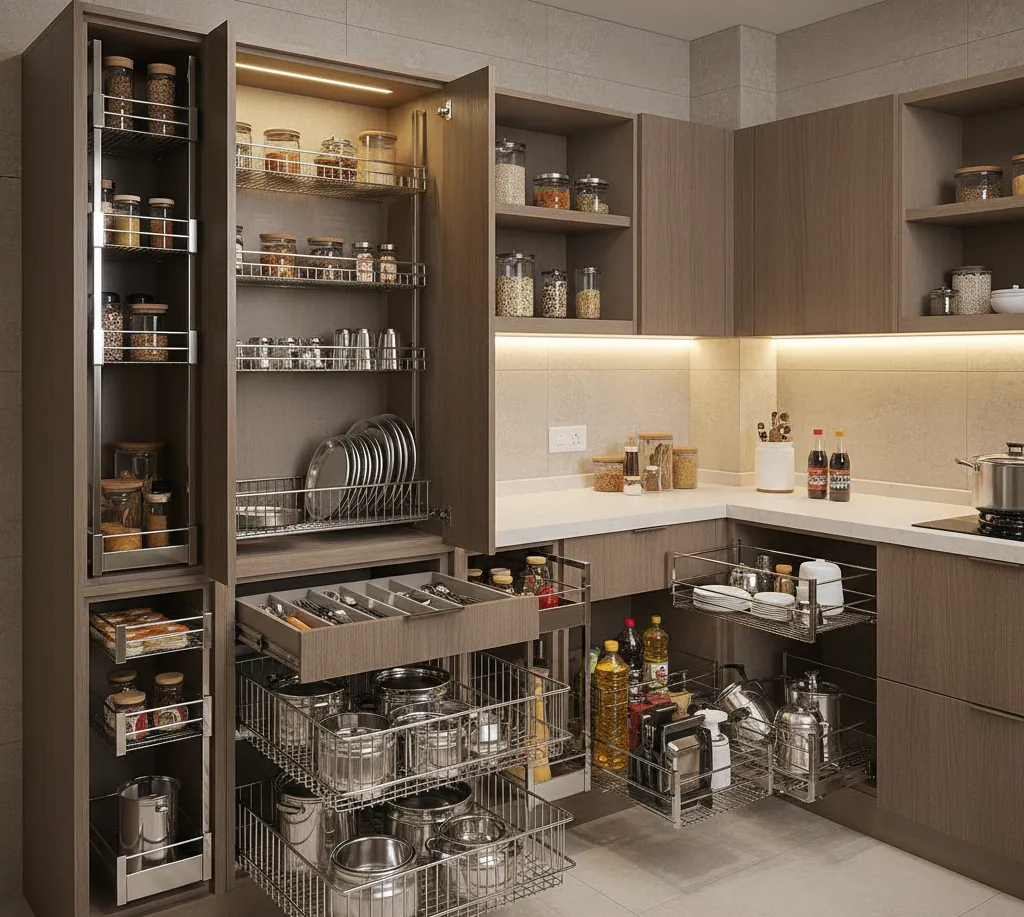
How the Mechanism Actually Works (Because Nobody Explains It Properly)
Every article I read about magic corners uses words like "innovative slide-out system" and "seamless accessibility" and tells you nothing about what's actually happening inside the cabinet. So let me try.
A magic corner has four trays arranged in two pairs. Two trays sit at the FRONT of the cabinet - the part you can see when you open the door. Two trays sit at the BACK - deep inside the blind corner, behind the wall of the adjacent cabinet run. The part you can't see and can't reach in a normal corner cabinet.
The front pair is attached to the cabinet door. When you pull the door open, the front trays come with it. They glide out on a sliding rail system - smooth, controlled, no jerking.
Here's where the magic happens. The back pair is connected to a separate sliding mechanism attached to the side wall of the cabinet. As the front trays pull out to a certain point, the back trays are triggered to follow. They slide forward AND swing outward - rotating slightly on a pivot - emerging from behind the blind corner wall and presenting themselves right next to the front trays.
Both pairs end up in front of you. Side by side. Everything visible. Everything at arm's reach. The blind corner that was previously a black hole is now completely emptied out in front of your eyes.
When you push the door back, everything reverses. Back trays swing inward first. Front trays follow. The door closes. Soft-close mechanism catches it 2 inches before shut and eases it closed without a bang.
The first time I saw this happen I genuinely said "oh" out loud. It's not complicated technology. It's levers and rails and pivots. But the result feels like someone solved a problem that's been annoying Indian kitchens since L-shaped layouts were invented.
The Carousel Comparison (From Someone Who Has One and Regrets It Slightly)
My mummy's carousel works. I want to be fair about that. It's circular trays on a central pole. You spin the tray and whatever's in the back rotates to the front. It costs about ₹2,800-3,500 depending on brand and size. Cheaper than a magic corner by a significant margin.
But there are problems she lives with daily that she's too stubborn to admit out loud - though she admits them to me when nobody else is listening.
The central pole wastes space. The tray is circular but the cabinet is square. The corners of the cabinet - the actual CORNERS of the corner cabinet, if that makes sense - remain dead space. Things that are too tall or too wide for the circular tray diameter just don't fit. Her 5-litre cooker TECHNICALLY fits but hits the pole when she spins. She has to lift it slightly, spin, then set it back down. Every time. It's a small inconvenience that compounds into genuine annoyance over thousands of repetitions.
The trays also aren't independently accessible. If she wants something from the back, she has to spin the whole tray 180 degrees. Whatever was in the front moves to the back. Whatever was in the back comes to the front. It's a rotation, not a retrieval. You can't just grab one thing - you have to reorganise the whole tray's contents mentally every time you spin.
The magic corner doesn't have any of these issues. No central pole wasting space. Rectangular trays that match the rectangular cabinet shape. Both pairs accessible independently - you can grab from the front trays without disturbing the back ones. The back trays come to YOU instead of you reaching into the corner.
Is that ₹6,000-7,000 difference worth it? After watching mummy's carousel for four years and bhabhi's magic corner for one year - yes. Not even a question. If your budget allows it, the magic corner is genuinely a different experience.
If your budget is tight - and I understand this, my brother's entire kitchen was ₹1.16 lakh - a carousel is still infinitely better than a standard corner cabinet. Don't skip corner solutions entirely just because you can't afford the magic corner. A ₹3,000 carousel versus a ₹0 standard cabinet is a bigger jump in quality of life than a ₹9,500 magic corner versus a ₹3,000 carousel.
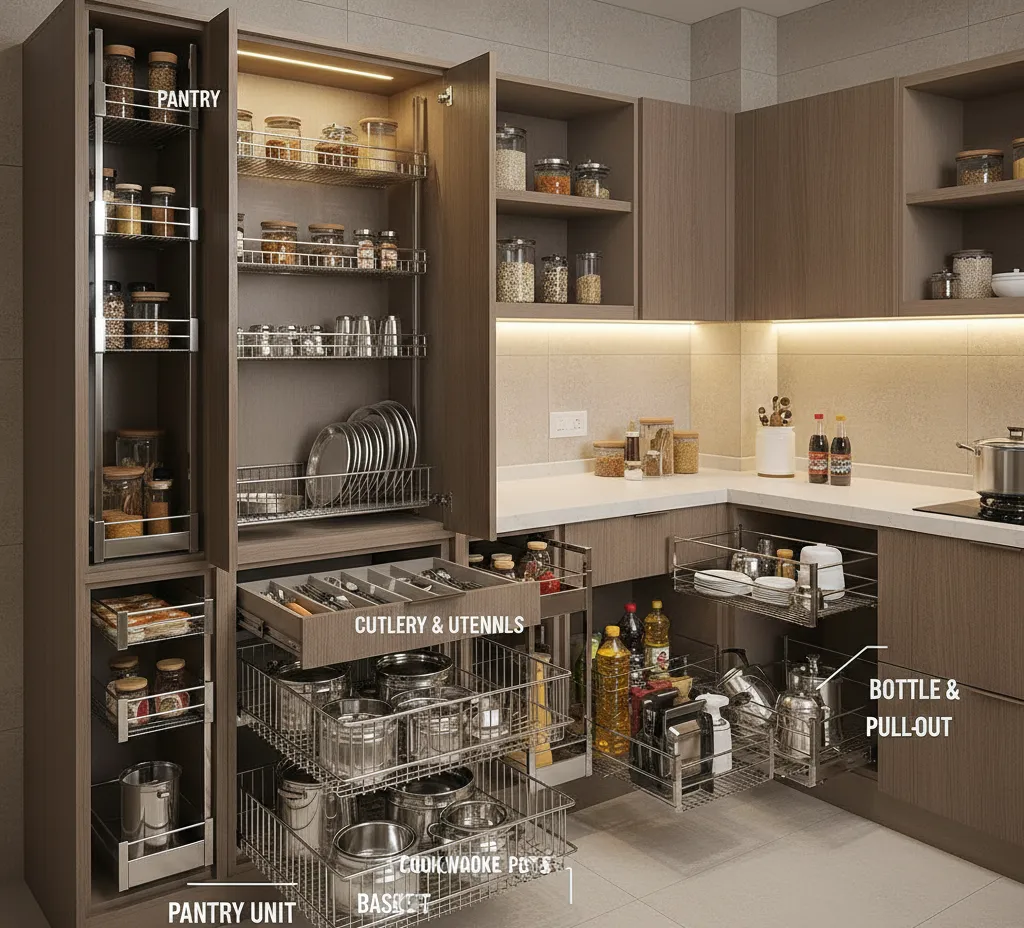
What Bhabhi Actually Stores in Hers
This matters because the magic corner's usefulness depends entirely on what you're putting in it. Some things work beautifully. Some don't.
The bottom pair of trays holds her heavy cooking vessels. The 5-litre pressure cooker. The big kadai she uses for biryani. The deep non-stick pan. These are heavy, bulky items that would be impossible to reach in a standard corner cabinet and annoying to manoeuvre on a carousel. On the magic corner trays, they sit flat, slide out smoothly, and she grabs them at waist height without bending.
The top pair holds medium items. Steel mixing bowls. The idli maker. A stack of serving plates. The casserole dish that comes out for guests. These are lighter but awkwardly shaped - they wouldn't stack well on a circular carousel tray but fit perfectly on the rectangular magic corner trays.
What she does NOT store in the magic corner: small loose items. Spice packets. Individual masala containers. Small lids. These tend to slide around on the metal trays when the mechanism moves, and a few times she's opened the magic corner to find a masala packet had migrated from the back tray to a position wedged between the tray edge and the cabinet wall. Minor issue but she solved it by putting small items in a rectangular plastic basket that sits ON the tray instead of loose on it. ₹150 basket from the local market. Problem solved.
The Installation Catch Nobody Mentions
This one's important and I learned it from bhabhi's carpenter, not from any blog.
A magic corner requires a minimum cabinet width. Most mechanisms need the cabinet to be at least 900mm wide on the opening side. Bhabhi's cabinet is 1,000mm. Standard L-shaped corner cabinets in Indian modular kitchens are usually 900mm or 1,000mm, so most will accommodate a magic corner.
BUT - and this is the catch - the magic corner mechanism needs to be specified BEFORE the cabinet is manufactured. The mounting holes, the internal frame dimensions, and the hinge positions all differ from a standard corner cabinet. You can't buy a magic corner from Amazon and retrofit it into an existing standard cabinet. The cabinet has to be built FOR the mechanism.
Bhabhi's designer planned this from the start. Her cabinet was manufactured with the magic corner dimensions in mind. Clean install. Smooth operation.
My mummy's friend tried to retrofit a magic corner into her existing L-shaped cabinet last year. The carpenter had to redrill hinge holes, modify the internal shelf heights, and shave down the frame in two places. It works - mostly - but one of the back trays catches slightly at a certain point during the slide, making a scraping sound that requires a firm push to get past. Not smooth. Not magical. Kind of annoying actually.
If you want a magic corner, tell the kitchen company during the DESIGN stage. Not after installation. Not as a "let's add this later" afterthought. During design. When the cabinet dimensions are being finalized. That's when.
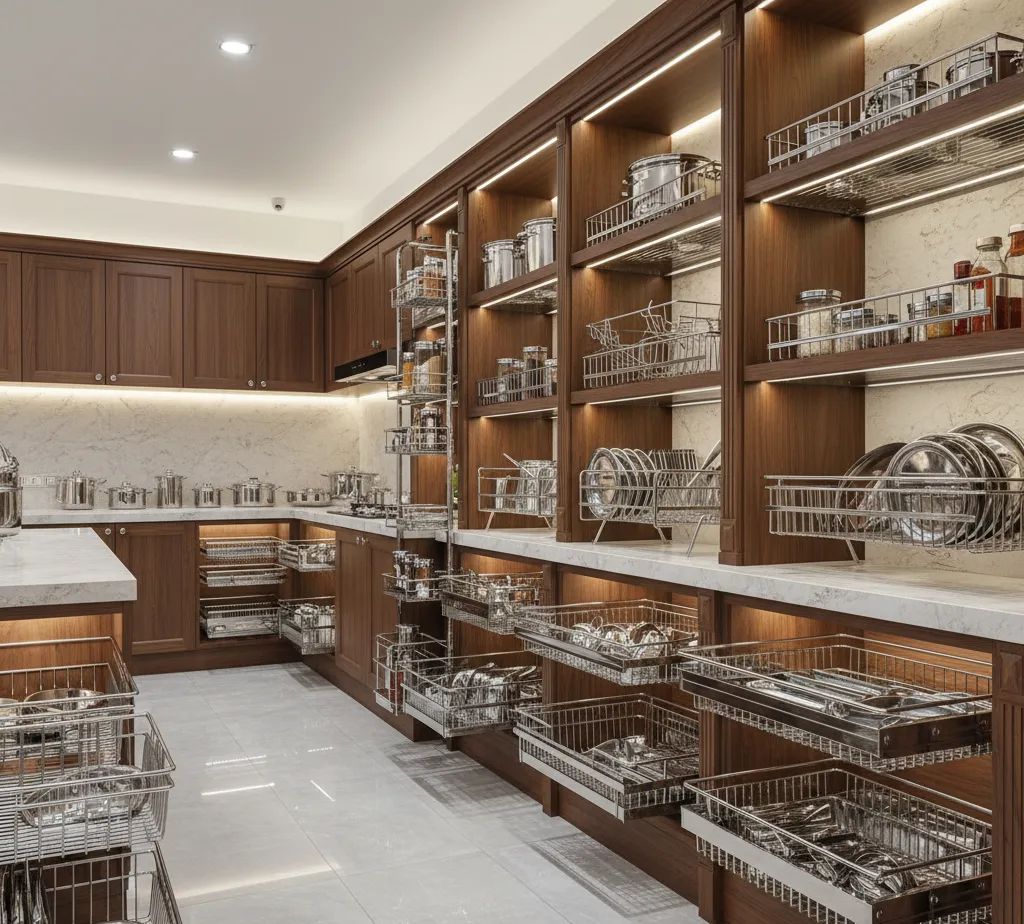
The Price Reality in 2026
Based on what bhabhi paid and what I've seen in Jaipur showrooms this year:
Basic magic corner mechanisms from Indian brands - ₹6,000-9,000. These have chrome-plated steel baskets, standard slide rails, and may or may not have soft-close. Functional. Get the job done. This is what bhabhi has.
Mid-range mechanisms from brands like Ebco or Kaff - ₹10,000-18,000. Better basket quality. Smoother slide. Reliable soft-close. More weight capacity - important if you're storing heavy kadais and cookers.
Premium mechanisms from Hettich ↗ or Hafele - ₹20,000-35,000. Everything is smoother, quieter, and rated for higher cycle counts. The Hettich one I tested at a showroom felt like it was sliding on butter. Is it four times better than the basic one? No. Is it noticeably smoother? Yes. Is "noticeably smoother" worth ₹15,000-25,000 more? Depends on how rich you are and how much you care about the sound a tray makes when it slides. My bhabhi does not care. My mummy would probably care. My dad would look at the price and leave the showroom.
Installation labour adds about ₹500-1,000 depending on your carpenter. Total cost including mechanism and installation: somewhere between ₹7,000 and ₹36,000. That's a wide range but the sweet spot for most Indian families - functional, reliable, not insanely priced - is the ₹8,000-15,000 range.
Do You Actually Need One?
If your kitchen is L-shaped or U-shaped, you have a corner cabinet. And if you have a corner cabinet, you have dead space. That's just geometry. The question is how much that dead space bothers you.
If you're the kind of person who stores rarely-used items in the corner and doesn't mind kneeling to fish them out occasionally - you might be fine with a standard cabinet. Save the money.
If you're my mummy - someone who keeps daily-use heavy vessels in the corner because there's no other space for them and who accesses that cabinet multiple times a week - a magic corner isn't a luxury. It's a functional necessity that her knees are currently paying the price for not having.
If your budget is extremely tight, get a carousel. It's the 80% solution at 30% of the cost.
If you can spend ₹8,000-15,000 and your cabinet is being built fresh - get the magic corner. Plan it from day one. You'll open it twice and wonder why anyone ever accepted blind corner cabinets as normal.
Bhabhi opens hers at least four times a day. Every time, the trays glide out and everything appears. Every time, she doesn't kneel. Every time, it takes three seconds instead of thirty.
She's never once mentioned it unprompted. Never bragged about it. Never told visitors to come look. It's just part of her kitchen. It works so naturally that it's become invisible.
That's the sign of a good kitchen accessory. You stop noticing it because it just does its job.
More kitchen accessory advice from actual daily use? KitchenKaki - we test things with rajma and pressure cookers, not showroom demos.
