
Termite-Proof Kitchen Solutions: Materials That Last Longer
My aunt discovered termites in her kitchen cabinet on a Tuesday afternoon while looking for her pressure cooker lid. The wood was intact on the surface and completely hollowed out two centimetres in — six to eight months of invisible damage. The repair bill was more than she had spent on the original kitchen in that section. Here's what to specify, treat, and inspect so this doesn't happen to yours.
Termite-Proof Kitchen Solutions: Materials That Last Longer
My aunt discovered termites in her kitchen on a Tuesday afternoon while looking for her pressure cooker lid.
She moved a stack of vessels that had been sitting in the base cabinet for a few months and found the back panel of the cabinet quietly, methodically being consumed from the inside. The wood was intact on the surface - she had no idea anything was happening - and completely hollowed out two centimetres in. The termites had been working in there, undisturbed, for what the pest control person later estimated was six to eight months.
The cabinet had to come out entirely. Two adjacent cabinets that shared the back wall had sub-surface damage as well. The repair bill was more than she had spent on the original kitchen in that section.
This is how termite damage in kitchens works. It is invisible until it is significant, and significant often means structural.
The particular cruelty of kitchen termites - compared to termites in other parts of the home - is the combination of conditions that makes kitchens ideal termite habitat. Moisture from the sink and cooking. Warmth from the hob and appliances. Wood and cellulose-based materials in the form of carcasses, backing panels, and in older kitchens, solid wood components. Limited visibility and access - the interiors of base cabinets and the gaps behind cabinets are rarely inspected. And often, proximity to the ground floor or to external walls where termite entry is easiest.
Understanding which materials resist termite damage, how to specify them correctly, and what to do if termites appear - this is information that belongs in every kitchen planning conversation and almost never comes up in showrooms.
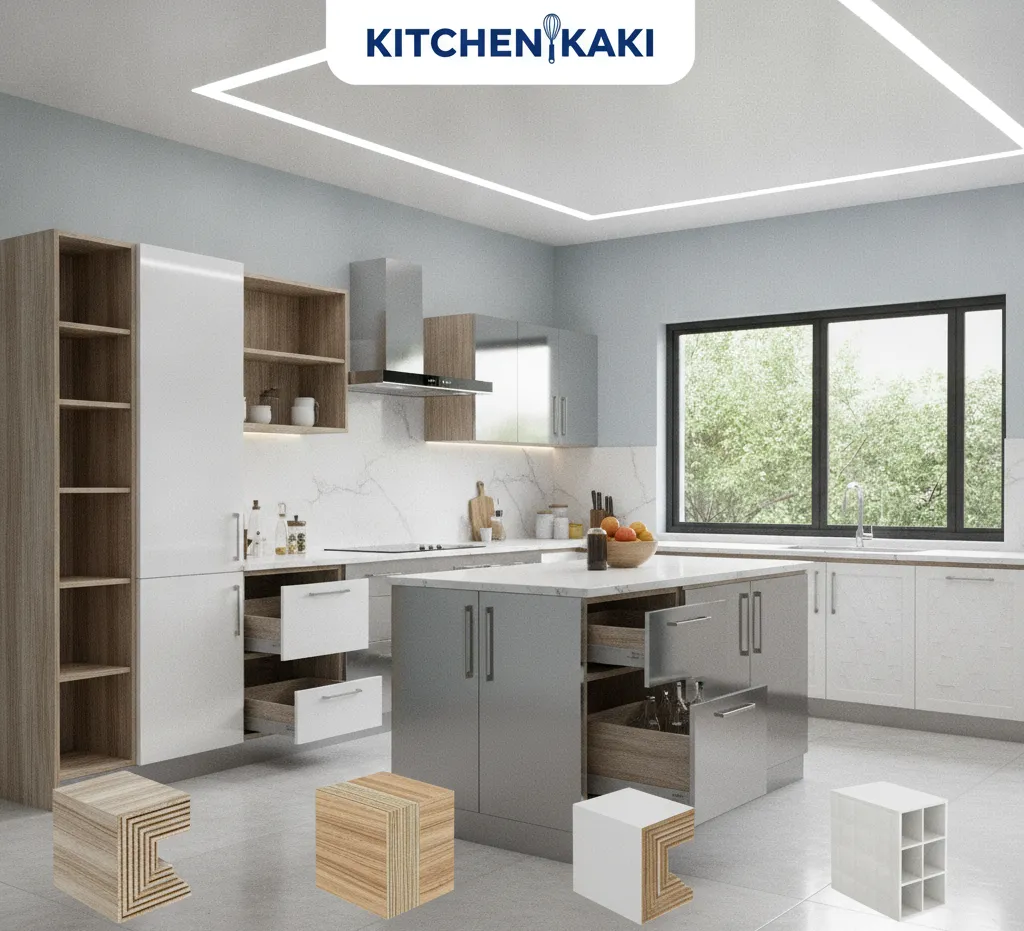
How Termites Actually Enter a Kitchen
Before the material choices - it helps to understand how termites reach kitchen cabinets in the first place. Termite prevention starts with entry point awareness.
From the floor. Subterranean termites - the most common variety causing structural damage in Indian homes - build mud tubes from the soil upward. In ground-floor and basement kitchens, they can enter through cracks in the floor screed, through the gap between the cabinet plinth and the floor, through openings around plumbing pipes where they enter the floor, or through the base of walls. The base cabinet - sitting closest to the floor - is the first kitchen component they reach.
From walls. Termites travel within walls through hollow spaces, through cracks in plaster, and through mortar joints between bricks. They can enter kitchen cabinets from behind if the back panel is in contact with an infested wall or if there are gaps between the cabinet and the wall.
From adjacent wooden structures. A kitchen that shares a wall with a room containing an infested wooden door frame, wooden furniture, or structural timber provides termites a continuous path. They do not need to emerge from the ground directly - they follow the available cellulose through whatever path exists.
Through new materials. Termites have been known to enter homes through infested timber or material brought in for renovation. Wood cut and used on-site for kitchen construction - shelves, filler panels, wooden components - sourced from infested timber stock is a documented entry point.
Understanding these entry points makes the prevention strategy clearer - it's not only about choosing termite-resistant materials for the cabinets themselves, but about addressing the surfaces and gaps around them.
The Material Choices - What Resists Termites and What Doesn't
Particle Board and MDF - The Most Vulnerable
Particle board is compressed wood chips and sawdust bonded with adhesive. MDF (medium density fibreboard) is similar - compressed wood fibres bonded under heat and pressure. Both are cellulose-rich, which makes them highly attractive to termites. Both also absorb moisture readily, which accelerates termite activity because termites require moisture to function.
A kitchen with particle board or MDF carcasses in a termite-active area is a kitchen with a significant vulnerability. The material is precisely what termites are designed by evolution to consume and it provides no resistance whatsoever.
This is the combination - cellulose-rich particle board, kitchen moisture, floor-level placement - that made my aunt's cabinet invisible externally while being hollowed internally.
Standard Plywood - Better but Not Immune
Regular plywood is more resistant to termites than particle board and MDF because the cross-laminated construction is denser and harder to penetrate. However, standard plywood is still a cellulose product and is not termite-proof. Termites that have established access will work through standard plywood - more slowly than through particle board, but they will.
BWR and BWP Plywood - Significantly More Resistant
BWR (Boiling Water Resistant) and BWP (Boiling Water Proof) plywoods use synthetic resin adhesives - phenol-formaldehyde or melamine-formaldehyde - between the layers rather than the organic adhesives used in standard plywood. These synthetic resins are toxic to termites and significantly reduce the palatability and penetrability of the material.
ISI-marked BWR and BWP plywood from established brands - Greenply, Centuryply, National Plywood, Kitply - is meaningfully more termite-resistant than standard plywood or board materials. It is also moisture-resistant, which addresses both the termite risk and the swelling risk in a kitchen environment.
This is the minimum carcass specification for any kitchen in a region with termite activity - which is most of India, particularly peninsular India, coastal areas, and anywhere with a combination of warmth and moisture.
Marine Plywood - The Best Wood-Based Option
Marine plywood is manufactured to the highest standard of moisture and adhesive resistance among plywood types. The adhesives used are fully waterproof and the manufacturing process is tighter. Marine plywood from a certified manufacturer is genuinely difficult for termites to establish in - not impossible if the infestation pressure is high enough and entry is provided, but significantly more resistant than any other wood-based board product.
For kitchens in areas with documented high termite activity - coastal Karnataka, Kerala, parts of Tamil Nadu, Goa, Andaman and Nicobar - marine plywood for all structural carcass components is the most resistant wood-based choice.
Pre-Laminated Boards with Anti-Termite Treatment
Some board manufacturers offer pre-treated options - particle board or MDF that has been treated with a termiticide during manufacture. The treatment is incorporated into the board itself and provides protection from the inside out.
Brands like Greenply and Centuryply offer termite-treated board variants. These are better than untreated particle board but still not equivalent to BWR plywood - the cellulose is still present and the treatment's effectiveness reduces over time, particularly in a moisture environment.
PVC-Based Cabinet Systems - Genuinely Termite-Proof
PVC (polyvinyl chloride) foam boards - used as carcass material in some modular kitchen systems - have zero cellulose content. They are made from plastic, not wood. Termites have no interest in them whatsoever and cannot digest or damage them regardless of how long the colony has been in contact.
PVC carcass kitchens are genuinely termite-proof in a way that no wood-based product can match. They are also completely moisture-proof - they don't swell, warp, or absorb water under any kitchen condition.
The limitations of PVC carcasses: they are less rigid than plywood under heavy loads - deep base cabinets with heavy contents need adequate support design. Screw holding strength is lower than in plywood - hinges and hardware need to be sized and installed correctly for PVC. They cost more than standard board products and are available from a smaller range of manufacturers.
For areas with high termite activity or for households that have experienced termite problems before, PVC carcass kitchens are worth the premium specifically because they remove the termite vulnerability entirely.
WPC (Wood Plastic Composite) - A Middle Ground
WPC boards are a composite of wood flour and plastic polymer. They have lower cellulose content than plywood or particle board and are significantly more moisture-resistant. Termite resistance is better than wood-based products - the plastic content reduces the material's attractiveness and the moisture resistance removes a key factor that promotes termite activity.
WPC is not as termite-resistant as pure PVC but is more structurally comparable to plywood in terms of rigidity and screw-holding. It's a reasonable middle ground for areas with moderate termite risk.
Stainless Steel Cabinets - The Commercial Kitchen Answer
Commercial kitchens - restaurants, hotel kitchens, industrial food processing - use stainless steel cabinetry almost exclusively, partly for hygiene and partly because steel has zero vulnerability to termites, moisture, or rot.
In residential Indian kitchens, stainless steel cabinetry exists and is used - particularly in coastal and humid areas where the combination of moisture and termites makes any wood-based product a long-term concern. It looks industrial rather than domestic by default, though design-forward stainless steel kitchen systems have improved significantly in recent years.
For a household in a high-humidity, high-termite-activity region that prioritises long-term durability over aesthetics - stainless steel cabinets are the most durable residential kitchen solution available.
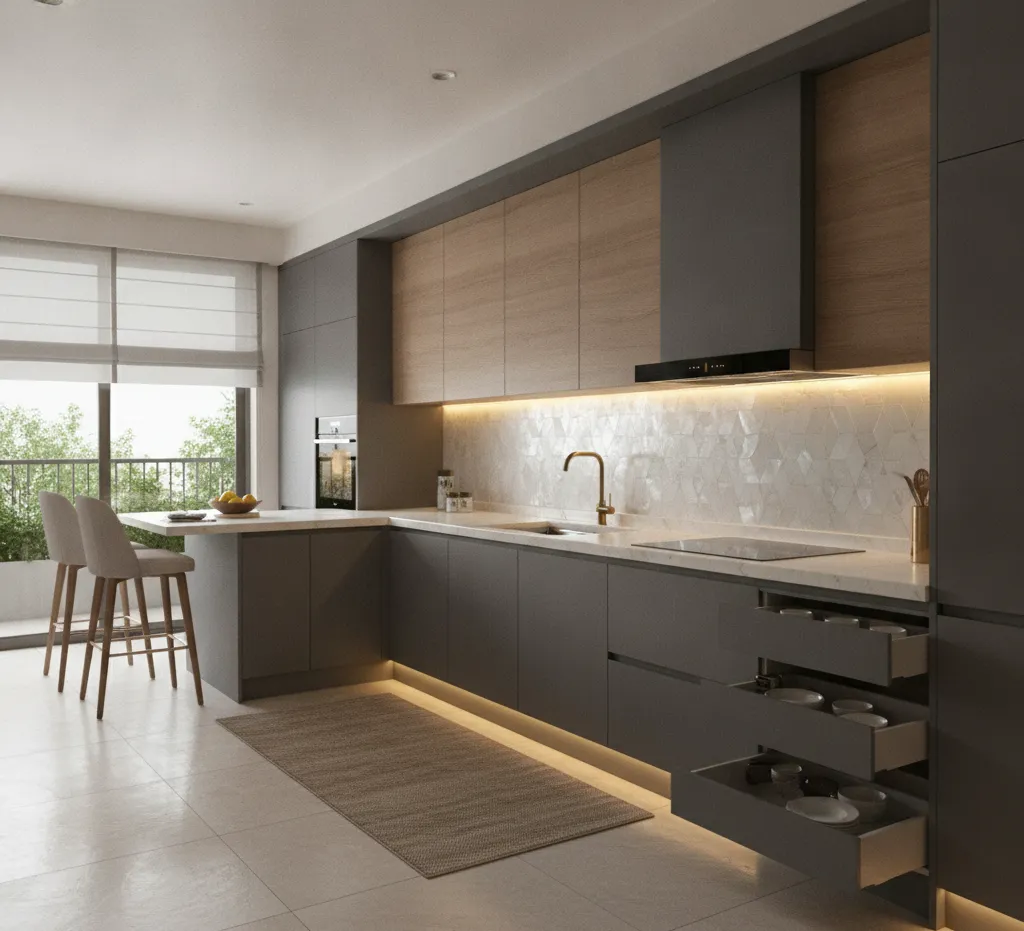
The Countertop - Less Vulnerable but Worth Knowing
Countertops are less termite-vulnerable than cabinets because most countertop materials are not cellulose-based. Stone, quartz, ceramic tile, and steel countertops offer no food source for termites.
The exception is a wooden countertop or a countertop with a wooden substrate - particle board or MDF with a laminate surface. The laminate is not cellulose but the substrate beneath is. If the laminate is intact and the countertop is sealed at all edges, the substrate is protected. If the laminate chips, cracks, or lifts at an edge - the exposed substrate is vulnerable.
For households in termite-active areas - a stone, quartz, or ceramic tile countertop with a stone or concrete substrate is the termite-immune choice. Avoid laminate countertops with board substrates in high-risk areas.
Anti-Termite Treatment - What It Is and When It's Done
Anti-termite treatment is a chemical process - typically involving termiticide applied to the soil around the building's foundation, to the floor screed, and to wall cavities - that creates a chemical barrier preventing subterranean termites from entering the structure.
For a new kitchen renovation, the appropriate time to do anti-termite treatment is before the cabinets are installed - when the floor and walls are accessible. Anti-termite treatment applied after the kitchen is fully installed has to work around the cabinets, is less thorough, and is more disruptive.
Pre-installation treatment:
The floor area of the kitchen - particularly the base of the walls and around plumbing penetrations - is drilled at intervals and treated with termiticide injected into the floor screed and wall base. The walls behind where cabinets will sit are also treated. The treatment creates a chemical barrier in the substrate.
This is typically done by a licensed pest control company - cost ranges from ₹3,000 to ₹8,000 for a kitchen-specific treatment depending on city and floor area. It should be part of the renovation budget in any area with known termite activity.
The borate treatment option:
Borates - sodium borate compounds - are available as wood treatment products that can be applied to plywood and wood-based boards before installation. Borate is absorbed into the wood and makes it toxic to termites. It is low-toxicity for humans and pets and does not affect the structural properties of the wood.
Applying a borate solution to all plywood components before installation - the carcass panels, the backing panels, filler pieces - is an additional layer of protection that is inexpensive and highly effective. The product (Tim-Bor or similar borate wood treatment) is available from pest control suppliers. Application is by brush or spray to all surfaces before assembly.
This treatment, combined with BWR plywood and a soil anti-termite treatment, provides the most comprehensive kitchen termite protection available without switching to PVC or steel cabinets.
Early Warning Signs - How to Know Before the Damage Is Significant
The reason my aunt's damage was as extensive as it was is the same reason most termite kitchen damage is discovered late - the signs are subtle until the problem is large.
Mud tubes. The most definitive sign of subterranean termite activity is the presence of mud tubes - pencil-width tunnels made from soil, termite saliva, and faecal matter that the colony builds to travel from the ground to their food source. Look for these on the back of base cabinets, along the plinth area, and on the floor surface inside base cabinets. They are visible once the cabinet is opened but not from outside. Inspect the inside of base cabinets quarterly - open them, look at the back and base panels, look at the floor inside.
Hollow sound. Tap the back panel or base panel of base cabinets with a knuckle. A solid panel sounds dense. A panel that has been hollowed by termites sounds hollow - an empty drumlike resonance rather than a solid knock. This is how significant internal damage can be detected before the external surface fails.
Fine powder or pellets. Drywood termites leave behind small piles of frass - tiny wood-coloured pellets - near their entry points. Finding these inside a cabinet near the base or back panel is a sign of drywood termite activity.
Paint or laminate bubbling. Termite activity below the surface creates slight moisture changes that sometimes cause the surface laminate or paint to bubble or blister. This is not always termite-related but in a base cabinet near the floor - it warrants investigation.
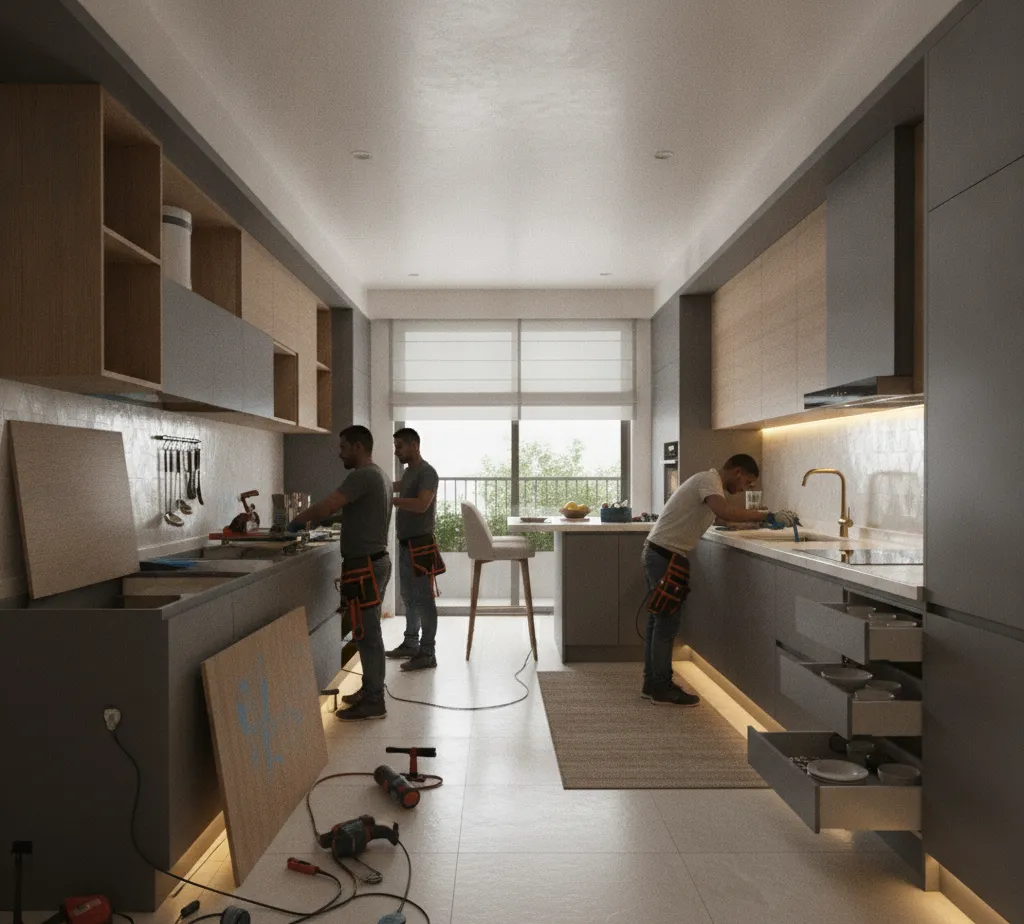
If Termites Are Found - What to Do
Do not disturb the mud tubes or the affected area unnecessarily. Disturbing the colony causes it to scatter - potentially spreading to new areas before treatment can be applied.
Call a licensed pest control company immediately. Not a general handyman - a company specifically licensed for termite treatment. The treatment options depend on the termite species and the extent of infestation. Options include liquid termiticide treatment, bait systems, and fumigation for drywood termites.
Assess the structural damage before repairing. Once treatment is complete and the colony is eliminated, the damaged material needs to be assessed. Particle board or MDF that has been significantly hollowed has no structural integrity and must be replaced. Plywood with surface damage may be salvageable if the damage is superficial.
Address the entry point, not just the colony. If termites entered through a crack in the floor screed around a plumbing pipe - that crack needs to be sealed after treatment. If they entered through the base of a wall - that area needs treatment and the entry point sealed. Eliminating the colony without addressing the entry means a new colony finds the same path.
The Practical Specification for a Termite-Resistant Kitchen
For households in areas with known termite activity - which includes most of peninsular India, coastal regions, and anywhere with warm, humid conditions:
Carcass material: BWR or BWP plywood minimum. PVC or WPC if budget allows or if the area has high termite pressure.
Borate pre-treatment: Applied to all plywood components before installation - inexpensive, highly effective additional protection.
Soil anti-termite treatment: Done before kitchen installation in the floor and wall base of the kitchen area.
Backing panels: Not particle board or MDF - use plywood or PVC sheet for the back panels of base cabinets. The back panel is the surface facing the wall - the first surface termites reach from the wall side.
Plinth sealing: The gap between the bottom of the cabinet plinth and the floor - seal with a flexible sealant to eliminate a common termite entry point.
Regular inspection: Open base cabinet doors quarterly and inspect the interior back and base panels. Five minutes per quarter. Catches any infestation before it becomes significant.
The Last Thought
My aunt's kitchen repair cost three times what the preventive measures would have cost - the BWR plywood upgrade, the borate treatment, the soil anti-termite treatment. The preventive investment would have been made once, at renovation, and never thought about again.
The reactive cost - the pest control treatment, the cabinet replacement, the disruption of a kitchen that had to come apart while the family was living in the house - was paid in money, time, and the particular stress of dealing with an infestation that had been growing invisibly for months.
The materials that resist termites cost more upfront. They cost less than the alternative.
More honest kitchen planning and materials guidance for Indian homes at Kitchen Kaki.
